




Abstract
Abstract
Background:
The origins of foreign matter are almost of medical materials, and no previous cases of ultrasound-guided breast foreign matter removal have been reported. The patient was a 30-year-old female with mammary foreign matter, a horse's bristle used in the treatment conducted by the galactagogue master.
Methods:
Removal of mammary foreign matter under the guidance of ultrasound.
Results:
A horse's bristle in the breast that was successfully removed with the guidance of ultrasound and the overall process of the operation went smoothly and took minutes.
Conclusions:
Ultrasonography is the first line of breast disease examination and the future will present many new treatment opportunities of interventional ultrasound.
Introduction
Although breast foreign matter has been reported, the origins of the foreign matter are almost of medical materials.1–3 This report describes a unique case of ultrasound-guided removal of mammary foreign matter, a horse's bristle, which was used in the nonmedical treatment of milk stasis. No previous cases of ultrasound-guided breast foreign matter removal have been reported.
Case Report
A 30-year-old female, who gave birth to a baby 3 months previously, was evaluated for a mass in the lower outer quadrant of the right breast. The day before she came to the hospital, she was treated by a folk doctor, who is called in China a “galactagogue master,” to cure presumed milk stasis. Treatment conducted by the galactagogue master consisted of the cannulation of the breast duct with a horse's bristle. Unfortunately, during treatment the bristle could not be retrieved and remained in the breast tissue.
On examination the lower outer quadrant of right breast was erythematous. Palpation noted a well-defined hard mass with poor mobility. Ultrasonography revealed well-defined multiple high-echoic oval masses that were attributed to areas of milk agglutination. In addition, a strong echo band, ∼5 cm long, could be seen clearly with a low echo background (Fig. 1A).
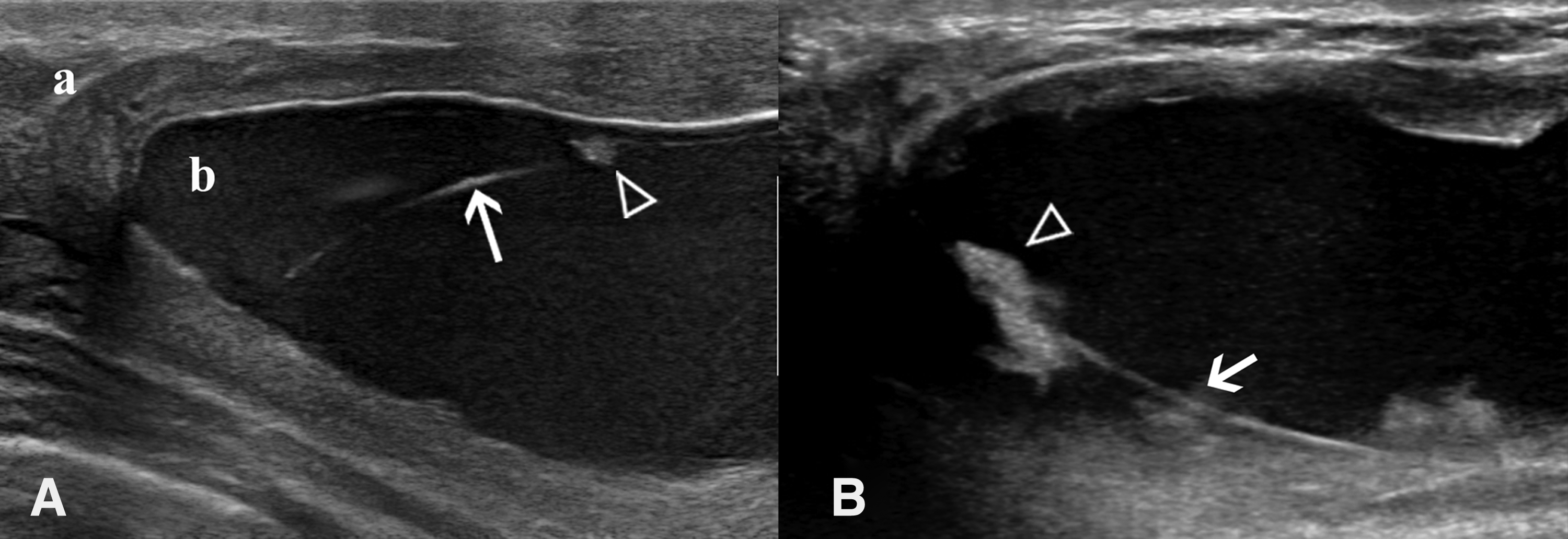
Image from a 30-year-old female with a horse's bristle in the lower outer quadrant of her right breast.
The patient decided to delay any treatment and after 1 week, the repeat ultrasonography noted that the location of the horse's bristle had changed (Fig. 1B). The patient agreed to proceed with an interventional procedure to remove the horse bristle. A disposable coaxial biopsy needle (17G × 17.8CM; Becton, Dickinson and Company) was inserted into the milk stasis area under the guidance of ultrasound, and aimed at the stiffer end of the horse's bristle. The needle core was pulled out and the 5 cm long bristle was sucked out by negative pressure. The overall process of the operation went smoothly and took minutes (Fig. 2). Postoperatively the patient recovered well and did not need any further treatment.

Photograph of the specimen shows that the horse's bristle is ∼5 cm long compared with the disposable coaxial biopsy needle. ↑, horse's bristle; ▴, disposable coaxial biopsy needle (17G × 17.8CM).
Discussion
Foreign matter in the breast is rare and the most common is silicone from breast augmentation procedures.1–3 Besides silicone, other rare foreign matters found in the breast are residual such as Lipiodol is an ultra fluid, 4 which is used for galactography and could mimic microcalcifications or induce inflammatory reactions or metallic particles5,6 from surgical instruments. There is also a report in the Chinese langue literature of a patient using folk prescription, cinnabar, to cure her mastitis.
As far as we know, no cases have ever been reported of a horse's bristle in the breast that was successfully removed with the guidance of ultrasound. In China, a group of folk doctors who are strictly regulated and called galactagogue masters are skilled at curing postpartum hypogalactia, breast engorgement, milk stasis, and the like. But, as documented in this case, these procedures are not without risk.
A search of the Chinese databases revealed that three similar cases had been reported in the medical news. All three patients came to the breast surgery department and the animal bristle was removed with the help of mammary fiberoptic ductoscopy. The mammary duct–lobular system is complex, thus, finding the horse's bristle is not easy in the tainted thick milk using this technique. Therefore, not surprisingly all three cases took about 2–4 hours.
Ultrasonography is the first line of breast diseases examination. As a new technology, interventional ultrasound was applied to more and more fields. In the aspect of diagnosis, ultrasound-guided breast lesions biopsy is a mature technology. In the aspect of treatment, cryoablation and thermal ablation have been reported and might be considered as a primary treatment option for patients who reject open surgical excision. 7 Ultrasound-guided breast abscess drainage and drug injection for treatment have been commonly used.
We report a case in which ultrasound facilitated the removal of breast foreign matter, that is, a horse's bristle, in a relatively benign manner, demonstrating the potential therapeutic of interventional ultrasound. This case suggests that the future will present many new treatment opportunities.
Footnotes
Disclosure Statement
No competing financial interests exist.