




Abstract

Human milk contains many bioactive factors that support organ development, contribute to the maturation of the immune system, and provide protection against neonatal infection and diseases, such as bronchopulmonary disease, retinopathy of prematurity, and necrotizing enterocolitis (NEC). 1 Lactoferrin is a glycoprotein found in human milk that is associated with a number of potentially important health benefits. 2 Concentrations of lactoferrin are highest in colostrum and abruptly decrease in more mature milk; this decrease occurs in all mammals (Fig. 1). Bovine and human lactoferrin share strong (77%) sequence homology 3 and the same antimicrobial peptide (n-lactoferricin). Lactoferrin demonstrates antimicrobial activity through several direct and indirect mechanisms, such as sequestering iron (a substrate for pathogens) and inhibiting the growth, adhesion, translocation, and virulence of pathogens.4–6 Lactoferrin has also been shown to stimulate cells involved in innate and acquired immunity. 7 Data from preclinical studies suggest lactoferrin is a key modulator of intestinal epithelium development. Lactoferrin supplementation was shown to improve intestinal mucosal structure and increase villus height and crypt proliferation in mice and piglets.8,9 A study of the in vitro effects of human and bovine lactoferrin in enteric Caco 2 cells showed lactoferrin had a concentration-dependent trophic effect on enterocytes; higher concentrations resulted in faster enterocyte proliferation, whereas lower concentrations resulted in faster enterocyte differentiation. 10 Lactoferrin may also play a role in establishing the neonatal gut microbiota. A study in 48 term and preterm infants found that the amount of fecal bifidobacteria and lactobacilli was significantly associated with fecal lactoferrin concentrations 3 days after delivery, suggesting lactoferrin may promote the growth of beneficial gut microbiota. 11
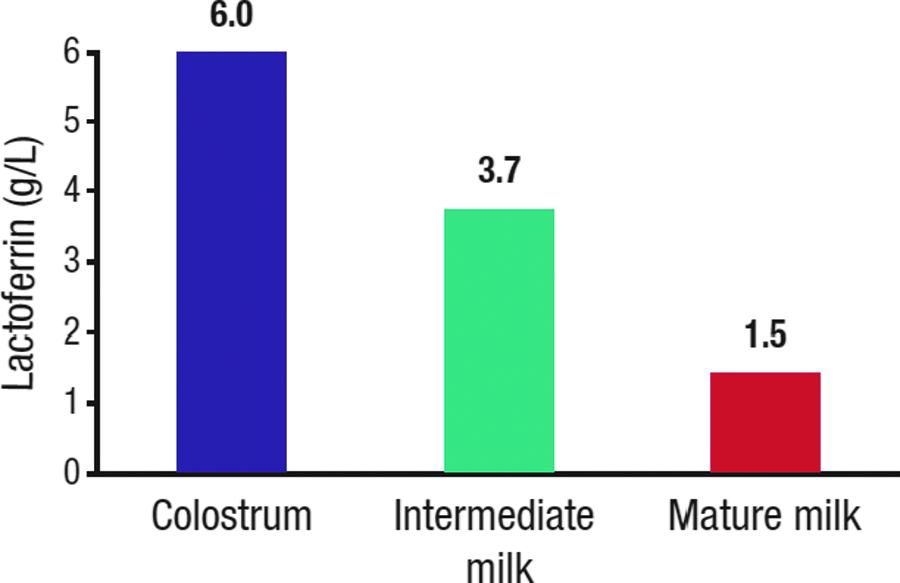
Lactoferrin concentrations decrease in mature human milk versus colostrum.
Multiple clinical studies have suggested a number of potentially favorable biologic effects associated with lactoferrin in infants and children.12–16 The first randomized controlled trial (RCT) to assess lactoferrin supplementation in neonates reported a significant reduction in the incidence of late-onset sepsis with bovine lactoferrin compared with placebo in very low birth weight preterm infants (Fig. 2). 3 A secondary analysis of the study data found that bovine lactoferrin supplementation reduced the incidence of fungal infection versus placebo (0.8% versus 5.4%; p = 0.009), yet there was no effect on fungal colonization in the gut. 17 Another RCT also reported a lower incidence of late-onset sepsis with bovine lactoferrin supplementation versus placebo in very low birth weight infants (20% versus 37.5%; p = 0.047). 18 Similar positive effects on sepsis were reported in other RCTs evaluating bovine lactoferrin supplementation in very low birth weight neonates; however, the studies were limited by small sample size and underpowered.19,20 A separate RCT in very low birth weight infants showed that bovine lactoferrin supplementation reduced the incidence of NEC and/or mortality compared with placebo (4.0% versus 10.1%; p = 0.008). 21 The only study evaluating human lactoferrin supplementation in very low birth weight infants reported lower rates of hospital-acquired infections with lactoferrin versus placebo (17% versus 33%; p < 0.04), but the study was underpowered to identify significant differences in outcomes between the two groups. 22

A recent Cochrane review that included six RCTs evaluating lactoferrin supplementation in preterm neonates concluded that lactoferrin supplementation, with or without probiotics, decreased late-onset sepsis (risk ratio [RR], 0.59; p = 0.008) and NEC (RR, 0.40; p = 0.02) with no adverse effects, but the available evidence was graded as “low” or “low to moderate” quality. 23 Further studies are needed to compare the different types of lactoferrin (human or bovine) to determine optimal dosing regimens and to assess long-term outcomes. Data from the recently completed ELFIN (enteral lactoferrin in neonates; N = 2,200) and LIFT (lactoferrin infant feeding trial; N = 1,500) studies will help clarify the potential benefits of lactoferrin supplementation in preterm infants.
Footnotes
Disclosure Statement
P.M. received speaker's fee from Prolacta.