




Abstract
Introduction:
Body image dissatisfaction (BID) has been inversely associated with breastfeeding initiation particularly among women with obesity. However, less is known on BID and the association with maintaining breastfeeding in Mexico, where breastfeeding rate is decreasing across ethnic subgroups. Therefore, we explore this gap of knowledge in diverse ethnic subgroups across levels of maternal weight status.
Methods:
Data were derived from the Mexican National Health and Nutrition Survey (Encuesta Nacional de Salud y Nutrición [ENSANUT] 2012), and 10,466 women aged 20–49 years were included. Breastfeeding (<6 months versus ≥6 months) of the last child, BID (Stunkard Figure Rating Scale), anthropometric (body mass index, BMI), sociodemographics, and biological variables were collected. Crude and adjusted target associations and effect modifiers were assessed using weighted-logistic regression models.
Results:
Overall, 72.4% of ever breastfeeding mothers breastfed a minimum of 6 months, 22% were indigenous, 74% were dissatisfied with their body image (BID >0), and 37% had obesity (BMI ≥30 kg/m2). In the multivariable analysis, for each one-unit increase in the BID score, the adjusted odds of breastfeeding (≥6 months) decreased by 6% (odds ratio [OR] = 0.94, 95% confidence interval [CI]: 0.89–0.99). After stratifications, only among women with obesity, a greater BID score was associated with lower odds of breastfeeding duration by 24% (OR = 0.76, 95% CI: 0.64–0.89) in indigenous and by 10% (OR = 0.90, 95% CI: 0.82–0.98) in non-indigenous women.
Conclusions:
Mexican women with a higher BID score reported lower odds of breastfeeding duration (≥6 months). Body image concerns should be integrated into a health promotion curriculum to mitigate their negative effect particularly in certain segments of the populations, such as women with obesity and among indigenous women.
Introduction
The World Health Organization (WHO) recommends “newborns be exclusively breastfed for at least six months with continued breastfeeding along with appropriate complementary foods up to two years of age or beyond.” 1 In Mexico, the rates of breastfeeding have substantially decreased. While more than 90% of the newborns receive human milk, only one in every seven infants is exclusively breastfed for 6 months.2–6 Breastfeeding rate varies across Mexico; in the northern and urban areas, a fifth of the children are exclusively breastfed at 6 months, compared to one-third of the children in the southern and rural areas.2–6
Globalization, urbanization, and growing exposure to Western culture (e.g., through media, immigration, and emigration) result in adopting different aspects of western behavior. 7 Specifically, Mexico has experienced a rapid nutritional shift in the past decade. Individuals are consuming high calorie-dense industrial foods 7 leading to increased rates of overweight and obesity of up to 75.0% of the Mexican women. 8
The nutritional shift also influenced infant feeding practices. Although Mexican women still preserve breastfeeding practices, they combine breastfeeding, without need, with baby formula. Data from the Encuesta Nacional de Salud y Nutrición (ENSANUT) indicated that within 6 years, the consumption of baby formula and other milk products had increased by 4%, while the rate of children exclusively breastfed as recommended by the WHO 1 declined by 8%.2–6 Among all Latin American countries, Mexico is among those with a lower prevalence of exclusive breastfeeding.2–6
Another implication of the transition to western culture is exposure to different idealized images of women's bodies. In western countries for many years, women were more likely to express a desire to be thin than women from nonwestern countries.9,10 Furthermore, unfulfillment of such desire can lead to body image dissatisfaction (BID), a narrower construct of body image, which is defined as an individual's negative thoughts about her body, including negative evaluations of body size, shape, and weight.11,12 Although BID is associated more with “a western culture,”10,13 in recent years, it has been spreading to nonwestern countries as well.14,15 For example, in Mexico, along with its cultural shifts, the rate of BID is escalating. 16 In urban settings, for example, 50% of female students reported BID and expressed a desire to be thinner. 16 Similar findings were observed in rural areas as well.14,15
Given its body-focused nature, unsurprisingly, breastfeeding has been found to be associated with body image concerns.17,18 It involves exposing a woman's body, sometimes publicly, causing some to avoid breastfeeding ever or for longer duration. 18 A previous study in Mexico showed an inverse relation; women with higher body dissatisfaction scores were less likely to initiate breastfeeding. 19 However, despite the growing literature, less is known about this association when women are trying breastfeeding for a longer duration of at least 6 months. Coincidently, as the infant matures, mothers spend more time outside with their infants. For some mothers breastfeeding then becomes more difficult to maintain, as options to breastfeeding discreetly in public places are limited.
Mexico is culturally diverse; indigenous people differentiated from the nonindigenous people, by living areas' (rural versus urban) languages, beliefs, and culture along with their breastfeeding behaviors.2–6 Whether body image is associated with breastfeeding duration and whether this relation runs across ethnicity and/or varies by maternal weight status remain unknown in Mexican women. Therefore, to satisfy this need, we examined the association between BID and breastfeeding duration of 6 months and the effect modifier of ethnicity and maternal weight status in Mexican women. The study hypothesis is that BID is reversely associated with breastfeeding duration; this relationship is stronger in indigenous women and in women with obesity.
Materials and Methods
Survey
Data were derived from the Mexican National Health and Nutrition Survey, ENSANUT 2012. ENSANUT is a nationally representative health survey conducted by the Mexican National Institute of Public Health between October 2011 and May 2012. It is a probabilistic multistage survey at the national, regional, and state levels with both urban and rural strata. The survey is representative of all of Mexico (both rural and urban). ENSANUT collected data from 50,528 households to obtain a sample of 89,000 individuals that represents the estimate of 29,429,252 households.20,21
Variables gathered included breastfeeding reports, body image, sociodemographics, and biological indicators. The anthropometric survey included direct measurements of the participants' weight in kilograms and their height in meters. The response rate in 2012 was 87%. The ENSANUT methodology has been published elsewhere.20,21 Written informed consent from all participants was collected. The database is available for the public online and includes no identifiers; therefore, this study was exempted from an institutional board review.
Sample
The initial population included 46,277 adults aged 20 and above who participated in the ENSANUT adult survey. The exclusion criteria and the number of excluded participants and reasons are presented in a flowchart (Fig. 1). Anthropometric measures were collected at a different time than was the household questionnaire but within 12 months. Based on the study's eligibility criteria, the final study sample size included 10,466 individuals, representing a population of 5,729,450 Mexican adult women, which was 4.7% of the total Mexican population in 2012.
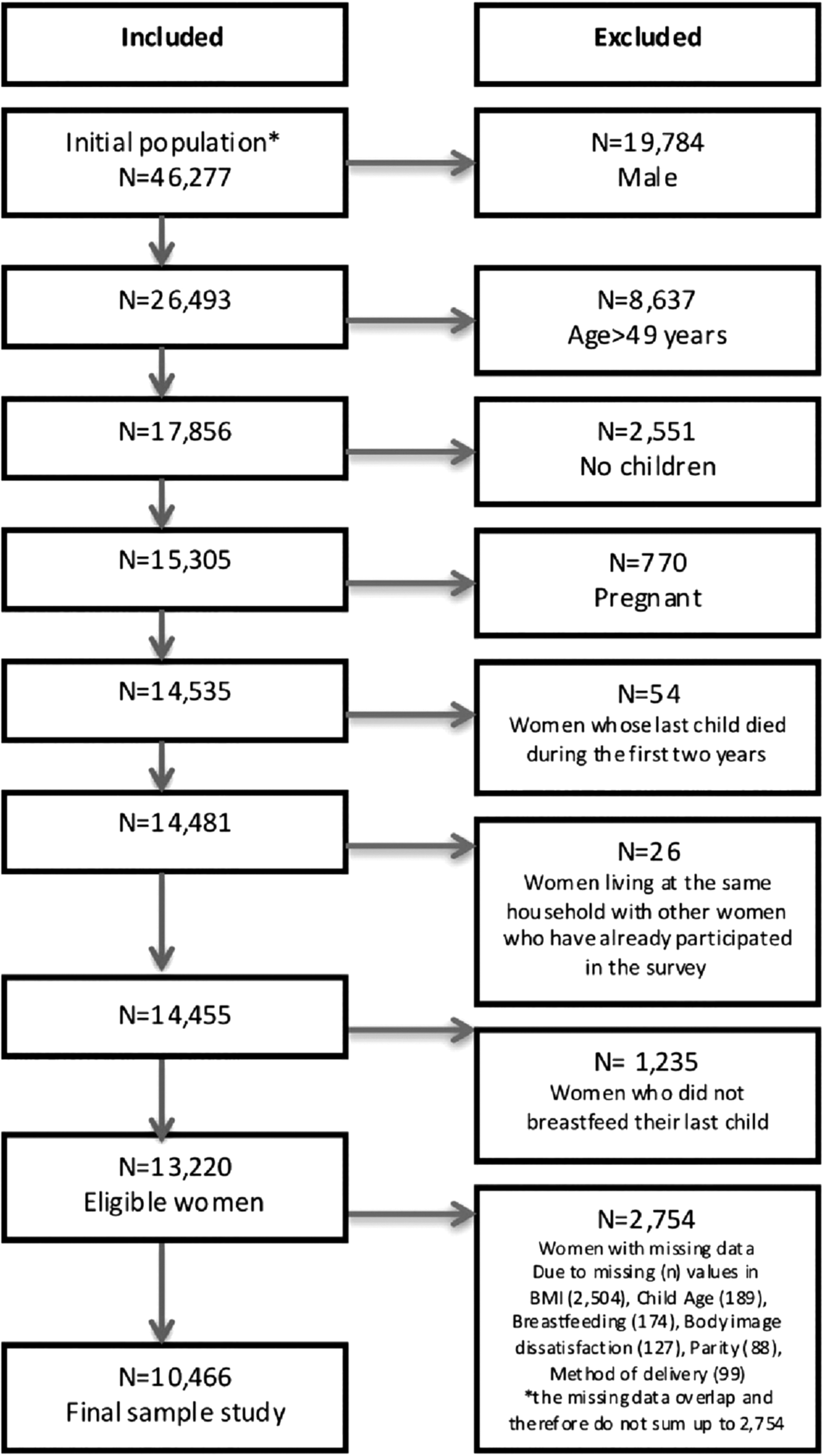
Flowchart of study eligibility criteria. *Participants who were recruited in the adult survey (age ≥20 years), ENSANUT 2012. ENSANUT, Encuesta Nacional de Salud y Nutrición.
Study variables
Main outcome
Breastfeeding duration
Women reported the period they had breastfed their last child based on the following question “How many months did you breastfeed your last child?” However, the survey did not include the additional question of whether they had breastfed their last child exclusively, predominantly, or partially. Therefore, duration includes any type of breastfeeding and it was dichotomized to breastfeeding <6 months (“<6 months”) and 6 months and more (“≥6 months”). Mothers who reported currently breastfeeding at the time of the survey were dichotomized as well based on the breastfeeding duration until the time of the interview. Women who did not breastfeed (∼10%) were excluded from this sample based on the eligibility criteria following the study's aims.
Main exposure
BID score
The figural rating scale 22 consists of a monotonic series of body figures ranging from extreme thinness to extreme obesity. Each figure is assigned a number from one through nine, respectively. Women indicated which of the body figures most closely resembles their actual body image and which one most closely resembles their ideal body image. The BID score was calculated as the absolute difference between the perceived and ideal body image. The final score was a continuous variable that ranged from 0 to 8 points. A score of zero indicated no BID, with a higher score reflecting higher levels of BID.
Modifier variables
Ethnicity
The definition of “indigenous” included all participants who self-identified as having an indigenous cultural background, regardless of whether they speak the language of the indigenous group they identified with. The “nonindigenous” group served as the reference category.
Maternal weight status
Body mass index (BMI, kg/m2) was measured using validated and standardized methods. The WHO adult cutoff points were as follows: underweight (<18.5 kg/m2), normal weight (18.5–24.9 kg/m2), overweight (25.0–29.99 kg/m2), or obesity (≥30.0 kg/m2). We collapsed underweight into the normal weight group (BMI <25.0 kg/m2) since it contained a sparse amount of data (1.5%). Normal weight served as the reference category.
Study covariates
The covariates included in the multivariable model were based on a literature review 23 and are described in Table 1. In addition, the child's age was included to partly control the time-lapse between breastfeeding occurrence, and BID was assessed. The household socioeconomic status (SES) index was created using a validated measure developed by the Center of Survey Research at the Mexican National Institute of Public Health by combining eight variables that assessed the household properties and the available services, such as water accessibility, vehicle ownership, household, and electrical goods.20,21
Description of Covariates Included in the Study
SES, socioeconomic status.
Statistical analyses
All statistical analyses and estimations were conducted by taking into account the complex survey design, including sampling weights, primary sampling units, and stratus variables provided by ENSANUT 2012 to accommodate stratification and clustering. Three strata, with a total of 62 participants, did not include indigenous participants and were collapsed with similar strata that shared the same region and municipality. A type I error (α) level of 0.05 was considered significant for testing the study's hypotheses. All data analyses were conducted using the STATA 13 software package (College Station, TX). 24
First, we conducted descriptive statistics as proportions (percentage), means, and standard deviations to describe participants' characteristics and classified them by ethnicity. Differences in the characteristics across ethnicity were tested through several weighted logistic regressions separately for each independent variable (Table 2). Then, we examined the crude association between each independent variable, including maternal weight status (Supplementary Table S1), BID score, and ethnicity (Table 3) with the main study outcome: breastfeeding duration (<6 months versus ≥6 months) using weighted logistic regression models for each independent variable.
Total Participants' Characteristics and by Ethnicity (ENSANUT)
Values are percent or means and are all weighted from the ENSANUT 2012.
BID, body image dissatisfaction; BMI, body mass index; ENSANUT, Encuesta Nacional de Salud y Nutrición; n, study population; N, population.
Multivariable Weighted Logistic Regression of Breastfeeding Duration and the Associations with Body Image Dissatisfaction, Ethnicity, and Maternal Weight Status Among Adult Women Living in Mexico, ENSANUT
Statistically significant values (p < 0.05) are presented in bold.
OR adjusted for: maternal age, household SES, maternal education, marital status, maternal employment, parity, methods of delivery, maternal BMI, ethnicity, and child age.
F adjusted test statistic = F(14, 1,421) = 1.287 (p = 0.239) for Goodness-of-fit test for weighted logistic regression.
Reference group: nonindigenous.
Reference group: maternal weight status normal weight: BMI: <25.
F adjusted test statistic = F(15, 1,420) = 1.402 (p = 0.182) for Goodness-of-fit test for weighted logistic regression.
Reference group BID × BMI: <25.
F adjusted test statistic = F(17, 1,418) = 1.313 (p = 0.224) for Goodness-of-fit test for weighted logistic regression.
CI, confidence interval; OR, odds ratio.
Source: ENSANUT 2012.
To explore the adjusted association between BID score and breastfeeding duration, we included the independent variables described in Table 1 and ethnicity. To test the significance of the primary coefficients (non-zero slope) for the BID and ethnicity, we used the Wald test statistic and the 95% confidence interval (95% CI) (Table 3). To examine the effect of the modifiers (ethnicity and maternal weight) on the target association, we created two interaction terms: BID score and ethnicity and BID score and maternal weight status and tested them using the adjusted Wald chi test to measure the overall significance of the effect modifiers (Table 3). The model goodness-of-fit was assessed using the goodness-of-fit test proposed by Fagerland and Hosmer. 25 Subsequently, we stratified the final multivariable-weighted logistic regression model by ethnicity and then by maternal weight status (Table 4).
Multivariable Weighted Logistic Regression of Breastfeeding Duration and the Associations with Body Image Dissatisfaction Stratified by Ethnicity and by Maternal Weight Status Among Adult Women Living in Mexico, ENSANUT
Statistically significant values (p < 0.05) are presented in bold.
OR adjusted for: maternal age, SES, maternal education, marital status, maternal employment, parity, methods of delivery, and child age.
Source: ENSANUT 2012.
Observations with “missing data” were removed from the analysis (Fig. 1). However, before the analysis, we compared participants who were included in the final sample to those that were excluded (due to missing values) to detect any potential biases using weighted-logistic regressions.
Results
Study sample
Overall, 10,466 women met the eligibility criteria (Fig. 1). Excluded women due to missing data (n = 2,754) did not vary on their age or BID score from women at the final sample. However, excluded women reported a higher household SES, a higher percentage completed high school, were nonindigenous, and were most likely to be single, employed, and more likely to breastfeed for <6 months compared to women who met the eligibility criteria (data not shown).
Sample characteristics
In total, 2,849 (22.2%) participants were self-identified as indigenous and 7,617 (77.8%) as nonindigenous (Table 1). BID score did not significantly differ between indigenous and nonindigenous women (Table 2). Only 26% of the women reported satisfaction with their body image (BID = 0). A third reported a BID score of one (BID = 1), and 40% pointed on their ideal body, which was two to three body images away from their perceived body (BID >1; data not shown). The prevalence of women with obesity was 36.8%, and it was slightly higher in nonindigenous than among indigenous women (37.3% versus 35.0%).
Breastfeeding duration
Among women who breastfed, 8% were still breastfeeding at the time of the interview (data unshown). Of those who breastfed, 72% reported breastfeeding for 6 months or more. Indigenous women reported significantly higher percentages of breastfeeding for 6 months or more than nonindigenous women (81.2% versus 69.9%) (Table 2). Based on the findings presented in Supplementary Table S1, women who breastfed for a longer duration were less educated, had lower household SES, and were more often multiparous compared to their peers who breastfed for <6 months.
Breastfeeding duration and BID
Table 3 results show that for each one-unit increase in the BID score, the odds of breastfeeding for 6 months or more decreased significantly by 6% (odds ratio [OR] = 0.94, 95% CI: 0.89–0.99). The interaction terms of BID score and ethnicity, as well as of BID score and maternal weight status, were significant (p < 0.05) indicating that ethnicity and maternal weight are effect modifiers of the target association. The Hosmer and Lemeshow goodness-of-fit test for the adjusted weighted logistic regression models were not significant, indicating a good model fit (Table 3).
Breastfeeding duration, BID, ethnicity, and maternal weight status
Among indigenous women, for each one-unit increase in the BID score, the odds of breastfeeding for 6 months or more decreased significantly by 15% (OR = 0.85, 95% CI: 0.77–0.94) adjusted for study covariates. Among nonindigenous women, this association was not significant (OR = 0.97, 95% CI: 0.91–1.03). However, when the model was further stratified by maternal weight status, only women with obesity, a greater BID score was associated with lower odds of breastfeeding duration by 24% (OR = 0.76, 95% CI: 0.64–0.89) in indigenous women and by 10% (OR = 0.90, 95% CI: 0.82–0.98) in nonindigenous women (Table 4).
Discussion
In this cross-sectional study, we found that a higher BID score is reversely associated with reduced odds of breastfeeding duration of 6 months or more in Mexican women. We further analyzed our sample and found that among indigenous women, each increase in one unit of BID score was associated with a 15% decrease in the odds of breastfeeding for 6 months or more, whereas among nonindigenous women this relation was hardly detected. Our study contributes to the growing literature in the field of maternal psychosocial factors and infant feeding practices by highlighting the link between body image concerns and breastfeeding behaviors, especially when breastfeeding becomes harder to maintain for a longer duration. We showed that such link also exists in societies that are not Western but undergoing a rapid Westernization as Mexico is.
A number of studies showed similar findings; women with positive body image with higher body satisfaction and who are less concerned with their shape and weight during postpartum are more likely to initiate breastfeeding and maintain it for a longer duration.17,18,26,27 For example, a study by Brown et al., 26 followed 128 pregnant women in the United Kingdom for 6 months, found that higher body image concerns during pregnancy and after delivery were associated both with an intention to use and actual use of baby formula starting at birth and with shorter breastfeeding duration.
According to seven out of nine peer-reviewed studies identified in a systematic review study, 18 women with body concerns for weight, shape, and the perception of feeling fat influenced on their decision on which infant feeding methods to choose during pregnancy (i.e., intention to breastfeed), after delivery (i.e., breastfeeding initiation), and during postpartum, (i.e., breastfeeding duration). Mothers who expressed a more positive perception of their body were more likely to breastfeed and continue with it for a longer duration. Some other reviews noted that this relation is also driven by the social and cultural norms in which the women live. 28
Mexico is culturally diverse; the indigenous people are the largest community and roughly consist of 22% of the total Mexican population. Their culture, language, and traditions are particularly relevant to our study since they shape their attitudes differently regarding their body image and breastfeeding behaviors.2–6,28 In our study, we showed for the first time that BID was inversely associated with breastfeeding duration among indigenous women compared to nonindigenous women. In addition, the two ethnic groups varied when we further stratified by maternal weight status; each increase in one unit of BID score decreased the odds that women breastfed for more than 6 months among women with obesity: by 24% among indigenous and 10% in nonindigenous women.
Although the mean BID scores were roughly the same in both ethnic groups, this psychosocial factor affected indigenous women disproportionately, as it inhibited them in a greater manner from achieving their full potential of breastfeeding. It seems that indigenous women are lagging behind nonindigenous women, yet following the overall trend with fewer women engaging in breastfeeding practices. However, it should be noted that despite the sharper decrease in breastfeeding rate across higher scores of BID, indigenous women are still in front in terms of breastfeeding rates.
To the best of our knowledge, this is the first study to examine BID and its relation with the duration of breastfeeding by maternal weight status among women residing in Mexico. The country is experiencing a significant reduction in the rates of breastfeeding that is spreading across the nation.2–6 Identifying risk factors that can be modified to prevent this phenomenon, such as body image, is timely and warranted.
A further strength is that we utilized a nationally representative health survey of the Mexican population conducted by the Mexican National Institute of Public Health. This survey has rich and unique data, 20 which comprise various measures like sociodemographic factors and biological variables to ensure accurate and valid estimation of the results. 23 Furthermore, the study sample was relatively large compared to other studies in the area, 18 allowing us to detect significant effects even after stratification.
Finally, the ENSANUT used the figure rating scale, which is a valid and standard instrument used in the research arena among various populations.19,22,27,29 The figural rating scale remains a quick and convenient tool for identifying women with body dissatisfaction and could be easily used in clinics or other health services at least as a screening tool to detect potential barriers to reach an optimal breastfeeding.
The first limitation although is inherent to the cross-sectional design, which cannot detect a causal or temporal relationship. Therefore, whether changes in body image concerns precede changes in breastfeeding behaviors or vice versa could not be determined. A bidirectional association may exist, but it has not been observed in previous studies. Moreover, preceding longitudinal studies showed that maternal body image concerns during and after pregnancy influence breastfeeding behaviors.26,30 Breastfeeding measures in this study did not differentiate between exclusive and any breastfeeding, which might differ in their relations with BID.
On average, 8 years had elapsed between breastfeeding the last child and participating in this study. We partly controlled for its variations by including the child and mother's age. Since we did not expect that women at different levels of BID score would significantly differ in their recall bias (over-reported or under-reported), undifferentiated misclassification of our outcome might be observed. The consequence is that the effect measure might be biased toward the null. Besides, there were no significant differences in the time frame between indigenous and nonindigenous subgroups, and therefore, this limitation was similar in both groups minimizing this effect on the study findings. Reducing the time frame would have meant reducing the sample size and the power to detect significant findings.
In addition, the time frame between the body image measures and maternal weight status was assessed and the time women had breastfed. However, and more relevant to our main conclusion, BID score has been found to be relatively stable during pregnancy31–33 and even tends to increase during postpartum. 34 Many other authors have argued that women's body dissatisfaction remains remarkably stable across their life span.11,35 Although body image and weight measures were not assessed before or during breastfeeding in this survey, they still reflect maternal body image concerns after pregnancy and childbirth occurred. Assuming that body image tends to increase during postpartum the consequence is that our effect measure might be biased toward the null.
Although the survey used the most standard instrument to measure BID10,13 the body image figures are mostly based on western body image ideals; it is unclear whether the measure can be generalized to Mexican women. In the Latino cultures, larger, voluptuous, and curvy body types are more appreciated than among mainstream American culture. They also value other regions of the body when appreciating beauty. Therefore, these cultural differences in body shape and size preferences may have misidentified the precise level of BID score in our sample and might vary by ethnicity. 36
Conclusion
We found a negative association between BID and breastfeeding duration for 6 months or more. The association was stronger and significant among women with obesity and among indigenous women. Establishing a relationship between BID and breastfeeding behaviors underscores the need to integrate body image concerns into a health promotion curriculum designed to promote breastfeeding particularly for specific segments of the Mexican populations such as women with obesity and/or indigenous women to eventually ensure that they can make and apply optimal infant feeding decisions.
Footnotes
Acknowledgments
The authors gratefully acknowledge the ENSANUT, which was designed and conducted by the Mexican National Institute of Public Health for providing the data.
Disclosure Statement
The authors declare that they have no conflicts of interest.
Funding Information
This research did not receive any specific grant from funding agencies in the public, commercial, or not-for-profit sectors.

References
Supplementary Material
Please find the following supplemental material available below.
For Open Access articles published under a Creative Commons License, all supplemental material carries the same license as the article it is associated with.
For non-Open Access articles published, all supplemental material carries a non-exclusive license, and permission requests for re-use of supplemental material or any part of supplemental material shall be sent directly to the copyright owner as specified in the copyright notice associated with the article.
