




Abstract
Aim:
Although reverse causation is well known in the breastfeeding–allergy arena, only a few studies have used a valid statistical method to test its occurrence. This study aimed to illustrate reverse causation between eczema and breastfeeding and to examine their effect estimate under this occurrence.
Methods:
Time-to-event data from the Infant Feeding Practices Study II were used. Model 1: early signs of eczema were modeled as a time-varying covariate to assess reverse causation using survival analysis approach. Model 2 examined the crude and adjusted relative risk between breastfeeding and early signs of eczema using generalized linear model.
Results:
Overall, 2,350 mother–infant pairs were included. On average, infants with early signs of eczema versus without, breastfed for 5.2 ± 0.2 months compared with 4.10 ± 0.1, respectively. Model 1, an early sign of eczema, was associated with approximately a 16% (95% confidence interval 2–28) reduction in the risk of ceasing breastfeeding indicating reverse causation. Model 2, each month of breastfeeding increased the risk for early signs of eczema by 3%.
Conclusion:
Modeling early signs of eczema as a time-varying covariate using survival analysis approach detects reverse causation and children with early signs of eczema were breastfed for longer duration. Failure to account for reverse causation may create biased result and a conclusion where breastfeeding increases the risk for early signs for eczema. Future studies should perceive reverse causation by using time-varying covariate in survival analysis approach.
Introduction
Although breastfeeding behavior is usually antecedent to allergy onsets, which may suggest causality, it is not always the case, even in longitudinal studies when temporal relation can be established.1,2 Generally, in many cases, even in breastfeeding studies, the antecedent is a consequence rather than a cause of the disease. This is known as a reverse causation.1,2 Specifically, infants with early signs of allergy may favorably be breastfed for longer duration due to the well-known health benefits of human milk with the mother's belief that it may reduce or cure their infant's early allergy signs.
Therefore, when using longitudinal data (i.e., time-to-event data), it is important to estimate the effect of those early signs and the relation with breastfeeding before and after it was first noted.1,2 In multivariable models, when this time frame is not considered, it leads to bias and imprecise parameter estimates.1–5 Although reverse causation is well known in the breastfeeding–allergy arena, only few studies have used a valid statistical method to test its occurrence. 3
This report will illustrate reverse causation using time-varying covariate approach for survival analysis in time-to-event data to test the hypothesis that an early sign of eczema influences breastfeeding duration. Then, under the reverse causation condition, the association between breastfeeding and eczema will be tested using common multivariable model with fix time exposure.
Methods
Study design
Time-to-event data were utilized from the Infant Feeding Practices Study II (IFPS II). IFPS II is a mail panel survey of American mothers and their newborn infants conducted from 2005 to 2007. Survey data were collected approximately monthly from their third trimester of pregnancy through their infant's first year. Infants born before 35 weeks, weighing <2.3 kg, who were a nonsingleton, or with medical conditions that would affect feeding were excluded. Previous publications have described the survey in more detail. 6 The survey was approved by the U.S. Food and Drug Administration's Research Involving Human Subjects Committee.
Breastfeeding duration was based on the mother reports in each cycle on whether she breastfed her infant or not. Also, in each cycle, the mother reported whether her infant had early signs of eczema in the past 2 weeks.
Statistical analysis
The analytical sample was restricted to 2,350 mother–child pairs by removing those with missing values for any variables used in the analysis.
Model 1: To examine reverse causality, Cox proportional hazard regression model was used. Indicator of early expression of early signs of eczema was modeled as a time-varying covariate to examine the study hypothesis that an early sign of eczema might influence the duration of breastfeeding from the time that eczema first occurred and if breastfeeding was occurring at the same time. Hazard ratios (HRs) of <1 indicate lower rates of cessation of breastfeeding. Kaplan–Meier method was used to estimate the distribution of time to cessation of breastfeeding by early signs of eczema status.1,2
Model 2: A generalized linear model (GLM) using the binomial family and the probit link function was employed to examine the crude and adjusted relative risk and associated confidence intervals (95% CIs) between breastfeeding duration and early signs of eczema at the first year.
In both multivariable models the associated variables were entered to the model (Table 1): child's gender and mother's education (≤high school, 1–3 years of college, or college graduate), race/ethnicity (non-Hispanic White or other) and poverty-income ratio (PIR; <185%, 185–349%, or ≥350%), number of siblings, family history of eczema included whether the mother or father or other close relatives had a history of eczema, child's birth weight and whether the child was delivered vaginally or by cesarean section. Variables were retained in the multivariable model if they had a p value of <0.05. STATA version 13 (StataCorp., College Station, TX) was used for all analyses to construct survival curves and to estimate HRs (with 95% CIs).
Characteristics of Study Cohort Baseline (N = 2,350)
Results
Figure 1 shows that infants without early signs of eczema had an early cessation of breastfeeding compared with infants with early signs of eczema during their first year of life. On average, infants with early signs of eczema breastfed for 5.2 ± 0.2 months compared with infants without who breastfed for 4.10 ± 0.1 months.
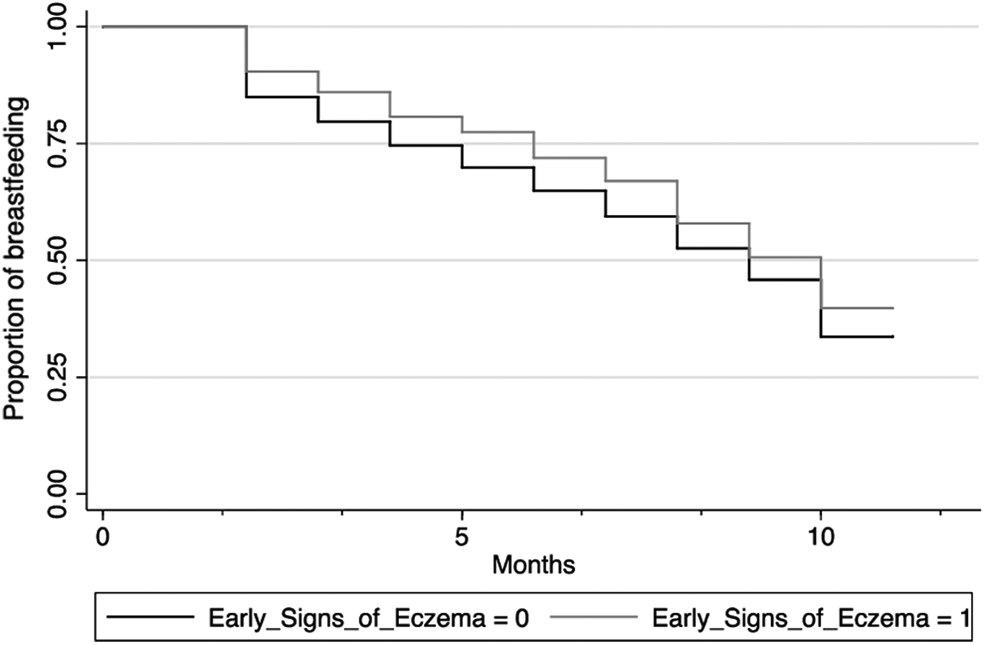
Duration of breastfeeding during the first year by early signs of eczema.
Based on the findings from Model 1, an early sign of eczema was associated with approximately a 16% (95% CI 2–28) reduction in the risk of cessation of breastfeeding after adjusting for potential confounders, indicating reverse causation in this sample (Table 2), whereas in model 2, each month of breastfeeding increased the risk for early signs of eczema by 3% after adjusting for potential confounding factors.
Associations Between Any Breastfeeding and Early Signs of Eczema by Two Multivariable Models in Time-to-Event Data
Model 1: Cox proportional hazards regression model—association between early signs of eczema at the first year and risk of ceasing breastfeeding.
Model 2: General linearized model—associations between total breastfeeding and early signs of eczema.
Adjusted for maternal age, infant gender, poverty-income ratio, education, race ethnicity, number of siblings, delivery mode, family history of eczema, and smoking status of the mother during pregnancy.
CI, confidence interval; HR, hazard ratio; RR, relative risk.
Discussion
This brief study examined the relation between breastfeeding and early signs of eczema using two models in time-to-event data. The models mainly differed in the way the time-dependent variable was tackled. The time-varying modeling approach generally yields unbiased estimates where an early sign of eczema was independently associated with a 16% reduction in the risk of ceasing breastfeeding after adjusting for potentially confounding factors. In other words, children who had signs of eczema were likely to be breastfed for a longer period than infants who did not while being breastfed, indicating a reverse causation.
However, breastfeeding–eczema relation when it was examined by utilizing GLM, the model created a spurious relation with an increased risk of eczema. This model did not include the time of onset of early symptoms of eczema during breastfeeding. Therefore, in this sample, failure to account for reverse causation created biased results.
In the literature, very few studies assessed reverse causation, 3 and some have found evidence that it may influence the relationship between breastfeeding and allergic disease. However, some studies trying to rule out reverse causation used fix-time methods such as logistic regression 4 or by performing separate analyses in which they split the sample between children with and without early signs of eczema at baseline. 5 Although it might seem more intuitive analyses, they did not measure breastfeeding duration before and after the early signs of eczema to validate a reverse causation.1,2 Therefore, modeling early signs of eczema as a time-varying covariate using survival analysis approach allows estimating the effect of eczema from the time it was first noted.
Conclusion
Reverse causation occurs when mothers of children with early signs of eczema breastfeed for a longer duration than mothers of children without early signs of eczema. This can affect results if failed to be considered. Therefore, future studies should detect reverse causation by using a time-varying covariate approach for survival analysis in time-to-event data.
Footnotes
Disclosure Statement
No competing financial interests exist.
Funding Information
This research did not receive any specific grant from funding agencies in the public, commercial, or not-for-profit sectors.