




Abstract
Introduction:
Depictions of infant feeding practices in the media influence public attitudes toward breastfeeding and breastfeeding behaviors. Understanding how breastfeeding is represented in the media can provide insights into breastfeeding experiences and outcomes. This study describes trends in breastfeeding portrayals in the United States newsprint media between 2007 and 2016.
Methods:
We conducted a retrospective content analysis of 452 newspaper articles identified from the Nexis Uni database. Articles were coded for tone toward breastfeeding (supporting, neutral, or opposing), message frame, and region (Midwest, South, West, Northeast). We frequency weighted articles by publication circulation to account for differences in readership volume.
Results:
Findings indicate that breastfeeding has been positively portrayed and increasingly discussed. Among the four regions, the South had the most supportive tones, while the Midwest had the most opposing tones. The topics of Health Benefits and Breastfeeding Support and Resources received the most coverage. Positive portrayals surrounding Workplace/University Issues are increasing, while negative portrayals surrounding Indecent Exposure are decreasing.
Conclusion:
Positive portrayals of breastfeeding in newspapers may signify increased support for breastfeeding as a normal practice. Future research is needed to better understand the direct and indirect impact of newsprint messages on breastfeeding in the United States.
Introduction
Breastfeeding rates in the United States have increased in the past decade from 74.1% in 2005 to 83.8% in 2016. 1 However, less than a quarter of U.S. mothers continue to breastfeed exclusively at six months 2 as recommended by the American Academy of Pediatrics. 3 Disparities in breastfeeding persist, with rates of initiation and duration lowest among low-income and African American women. 4
Cultural norms shape familial and societal attitudes toward breastfeeding, which in turn produce consequences for maternal breastfeeding experiences and outcomes. Mothers who perceive strong support and positive breastfeeding attitudes from their romantic partners are more likely to initiate breastfeeding, to breastfeed exclusively, and to breastfeed for longer durations than those that do not feel as though they have support.5–9 Similarly, managerial and coworker perceptions of breastfeeding or milk expression in workplace environments are associated with breastfeeding decisions and outcomes among working women.10–13 In public settings, the opinions of employees and business owners can dictate whether mothers can comfortably breastfeed in restaurants, shopping malls, and similar venues.14–16 Discomfort and embarrassment with breastfeeding in public contributes to decisions to bottle feed or prematurely quit breastfeeding.5,17 Encountering negative attitudes toward breastfeeding tends to instill feelings of discouragement and reinforce beliefs that breastfeeding should not occur outside of the home. 15 The manner in which societal norms and attitudes toward breastfeeding develop and evolve is an important target for normalizing breastfeeding and achieving public health goals.
Media can play a vital role in shaping public opinion. 18 According to framing theory, framing emphasizes some aspects of a perceived reality, while excluding other elements, to render a particular set of experiences or views more salient. 19 Frames help make sense of experiences and can guide assessments of behavior, including what is morally acceptable and how problems are best defined and resolved.19,20 Complementarily, media priming theory proposes that media messages can reinforce or alter existing attitudes and behaviors via priming.21–23 When individuals encounter media messages, these messages can shape decision-making processes and behavior. Further, exposure to a message about a belief can increase the association of the belief with personal attitudes and intentions. 21 Media priming theory is particularly useful for explaining the reinforcement of beliefs and how they become susceptible to change: thoughts and behaviors can subconsciously be modified by media exposure. 24 Together, framing and media priming theory explain how media messages can influence not only breastfeeding mothers but also public opinion of breastfeeding.
A number of studies provide evidence of an association between media portrayals of breastfeeding and breastfeeding attitudes and behaviors. Positive framing of breastfeeding on television favorably altered perceptions of breastfeeding among an experimental group, indicating that audiences are inclined to conform to the attitudes that media normalizes. 25 A survey of 123 mothers found that over 90% indicated that prevalence of breastfeeding media content would encourage them to breastfeed. 26 In a historic study, Foss and Southwell reported that frequency of formula advertisements in Parents' Magazine was associated with a decrease in breastfeeding rates in the subsequent year. 27
Researchers examining media coverage of breastfeeding in the United States have found reporting to be generally heteronormative and positive.28–34 Simultaneously, these studies have illuminated persisting biases against—and discomforts associated with—breastfeeding, particularly in public settings.27–29,32 For instance, a textual analysis of 53 television representations of breastfeeding found that breastfeeding in public was conveyed as socially unacceptable and an act that produced discomfort among bystanders. Positive portrayals of breastfeeding in television were limited to Caucasian women portrayed as older and educated in this sample, 29 although findings do indicate that women of color are being portrayed in some recent examples. 25 News reports of breastfeeding have largely focused on associated health benefits, barriers to breastfeeding, or controversies about breastfeeding in public, 28 but additional research on how the news portrays breastfeeding is needed to recognize the variations in how this issue is being framed.
Although newspapers are considered an up-to-date and credible media source, 34 only a few studies have examined longitudinal trends in breastfeeding in the United States newspaper media in the past decade. With a particular focus on exclusive breastfeeding, Hamilton and Lewis 30 examined breastfeeding content in newspaper articles between 2010 and 2013. They found that the majority of articles had a positive valence. Most articles were published in the West, and breastfeeding support was the most popular frame across most regions. DeMarchis et al. 35 conducted an analysis of media coverage of breastfeeding policy in Washington State, using article attitude and message frames to describe newsprint media coverage of breastfeeding policies between 2000 and 2014. They found that breastfeeding coverage has been increasing and largely neutral. Hitt et al. examined 10 national newspapers for media trends over a 5-year period (2008–2013), coding newspaper content according to the Theory of Planned Behavior. 31 Broadly, the researchers found that while most newspaper articles supported breastfeeding as healthy and normative, articles also widely discussed breastfeeding barriers rather than facilitators. Together, these existing studies have valuably illuminated trends in public discourse about breastfeeding; however, studies that included newspapers from across the United States examined only up to five years of data,30,31 and studies that examined trends over a longer period of time focused exclusively on a particular region of the United States. 35
The aim of the current study is to examine trends in the portrayal of breastfeeding in newsprint media in the United States. We expand upon prior research by examining publications from across the nation over a 10-year period. We analyze newspaper articles by tone and key themes to describe the ways in which breastfeeding is presented. Findings from this study can highlight challenges and opportunities for advancing public opinion of breastfeeding.
Methods
Design
We used retrospective content analysis to code newspaper articles. This qualitative research technique involves the systematic classification of archival text data into categories that represent similar meanings. 36 The process focuses on the characteristics of the language and the contextual meaning of the text to formulate codes and identify themes. 37 We used an inductive approach, which began with a broad set of breastfeeding-relevant categories (e.g., benefits, barriers, policy) that were refined through an iterative process of constant comparison among articles. All of the articles analyzed were newspaper articles published in the United States between January 1, 2007 and December 31, 2016. This study was considered exempt from Institutional Review Board review as it did not involve human subjects.
Sample
Articles were obtained through the Nexis Uni database. Nexis Uni is a database of both online and print news, legal, and business sources with three primary collections of data (full news articles, full-text legal documents, and economic data on business). Articles were limited to English language news articles identified using the following search terms: “nursing mom” or “human milk” or “breastfeed” or “breastfed” or “breast feeding” or “breastfeeding” or “lactate” or “lactation” or “lactating.” The initial search yielded 576 articles, 124 of which were omitted. Exclusions included duplicate articles (n = 11), articles unrelated to human breastfeeding (n = 41), and articles categorized as event announcements (e.g., location of a lactation event) or classifieds (n = 72). A total of 452 articles were retained for the final sample.
Measurement and data collection
We developed a codebook to analyze each newspaper article for descriptive characteristics and content, consistent with prior studies.30,31,35 Each newspaper article was coded based on the following descriptive variables: author type (e.g., staff, wire service, associated press), article type (e.g., news story, op-ed/editorial/commentary), section type (e.g., general news, lifestyle, business), publication year, geographic region (as defined by the Centers for Disease Control: South, West, Northeast, Midwest), and publication circulation. National newspapers were categorized into regions based on the publication's headquarters location (e.g., U.S.A. Today was placed in the geographic region of South based on the publication headquarters of McLean, VA). The content of each article was coded for article tone and key message frame (Table 1). Article tone captured the author's expressed attitudinal valence toward breastfeeding and was classified as supporting, opposing, or neutral. Key message frame refers to the central idea in the article and was coded into one of nine exclusive categories (Table 1). Article tone was coded according to implicitly stated content, while message frames were coded according to explicitly stated content. For instance, consider the following passage:
Description of Coding Structure
“Breastfeeding is a completely normal, healthy part of motherhood and should not be decided by the public where it is permitted.”
This article would be coded for tone as supportive and for message frame as Advocacy for Feeding in Public due to indicators such as, “…completely normal, healthy part of motherhood,” and “…not decided by the public,” respectively.
Data analysis
Each article was coded by two members of the research team, with discrepant codes reconciled at the dyad level. Article codes that could not confidently be reconciled at a dyad level were reviewed by the full research team for consensus coding. Intercoder agreement had a Krippendorff38,39 alpha coefficient of 0.84. We used basic descriptive statistics to summarize sample characteristics (e.g., article type, section type, publication year). For article tone and message frame, data were weighted by newspaper circulation to account for the differential impact of articles produced in media outlets with varying readership size. Circulation figures were retrieved from circulation databases or directly from the publication website.40,41 All statistical analyses were performed using IBM SPSS Statistics 26.
Results
Sample characteristics
The study included articles from national newspapers (4.6%, n = 21), local municipalities (84.1%, n = 380), and university-based publications (11.3%, n = 51). The majority of newspaper articles in our sample were news stories (as opposed to op-ed/editorial/commentary, letters to the editor, or other; 94.5%, n = 427), written by staff or employees of the publication source (75.2%, n = 340), and appeared in the general news (73.5%, n = 332) section of the newspaper.
While the number of articles published each year varied over the 10-year period, there was an increasing trend from a low of 27 articles in 2008 to a high of 66 in 2015. More than two-thirds of articles (70.1%, n = 317) were published during 2011–2016 (Fig. 1). The U.S. region with the most articles was the South with 32.5% (n = 147), followed by the Midwest 26.3% (n = 119), the West 26.1% (n = 118), and the Northeast 15.0% (n = 68).
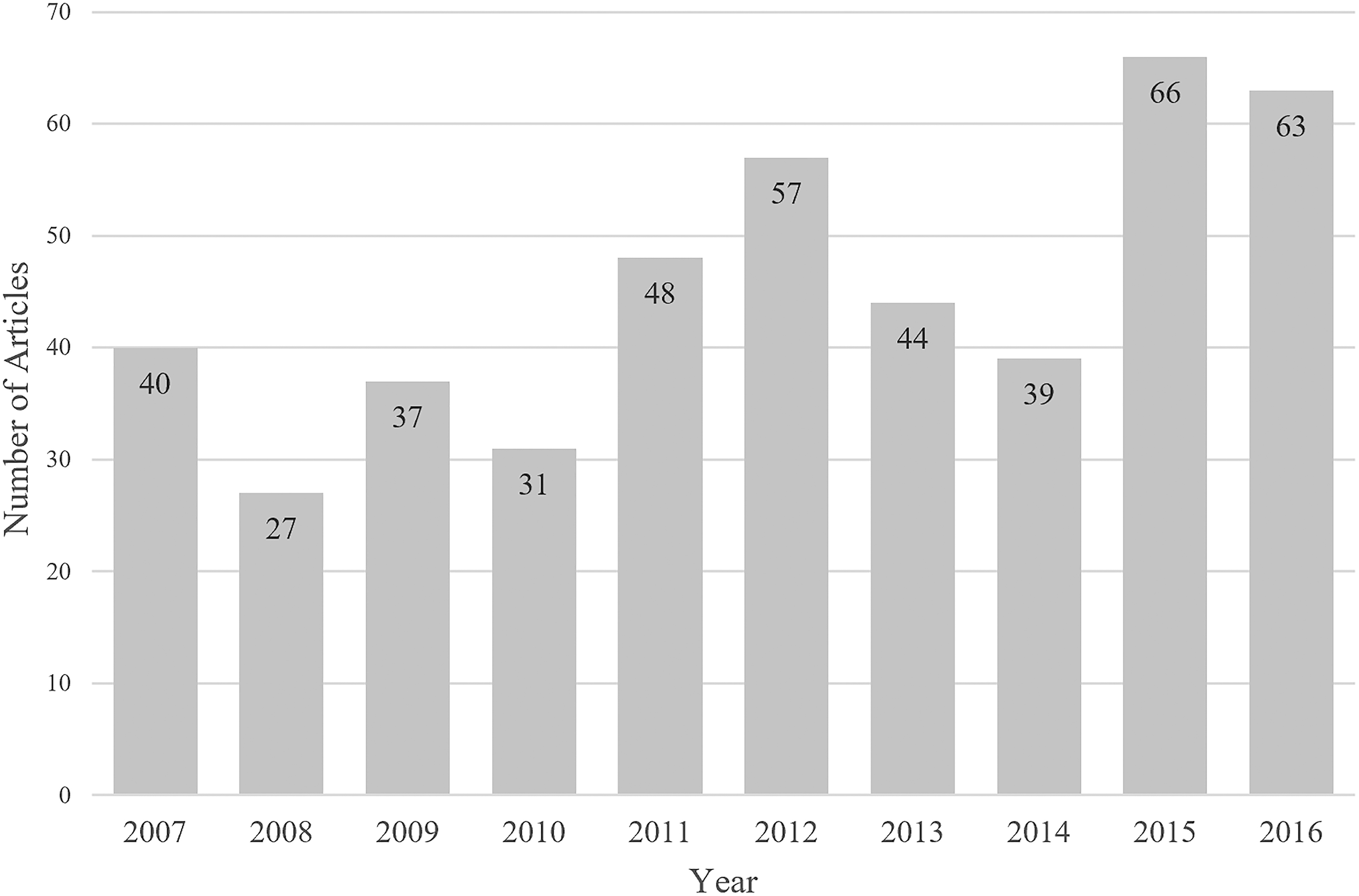
Number of U.S. newspaper articles on breastfeeding during 2007–2016 (n = 452).
Attitude toward breastfeeding over time and by region
Figure 2 displays the distribution of article tone by year. Across the decade, the percent of articles with opposing tones decreased while neutral tones increased. The percent of articles with supporting tones was greatest in 2008. The percent of articles with opposing tones was greatest in 2010.
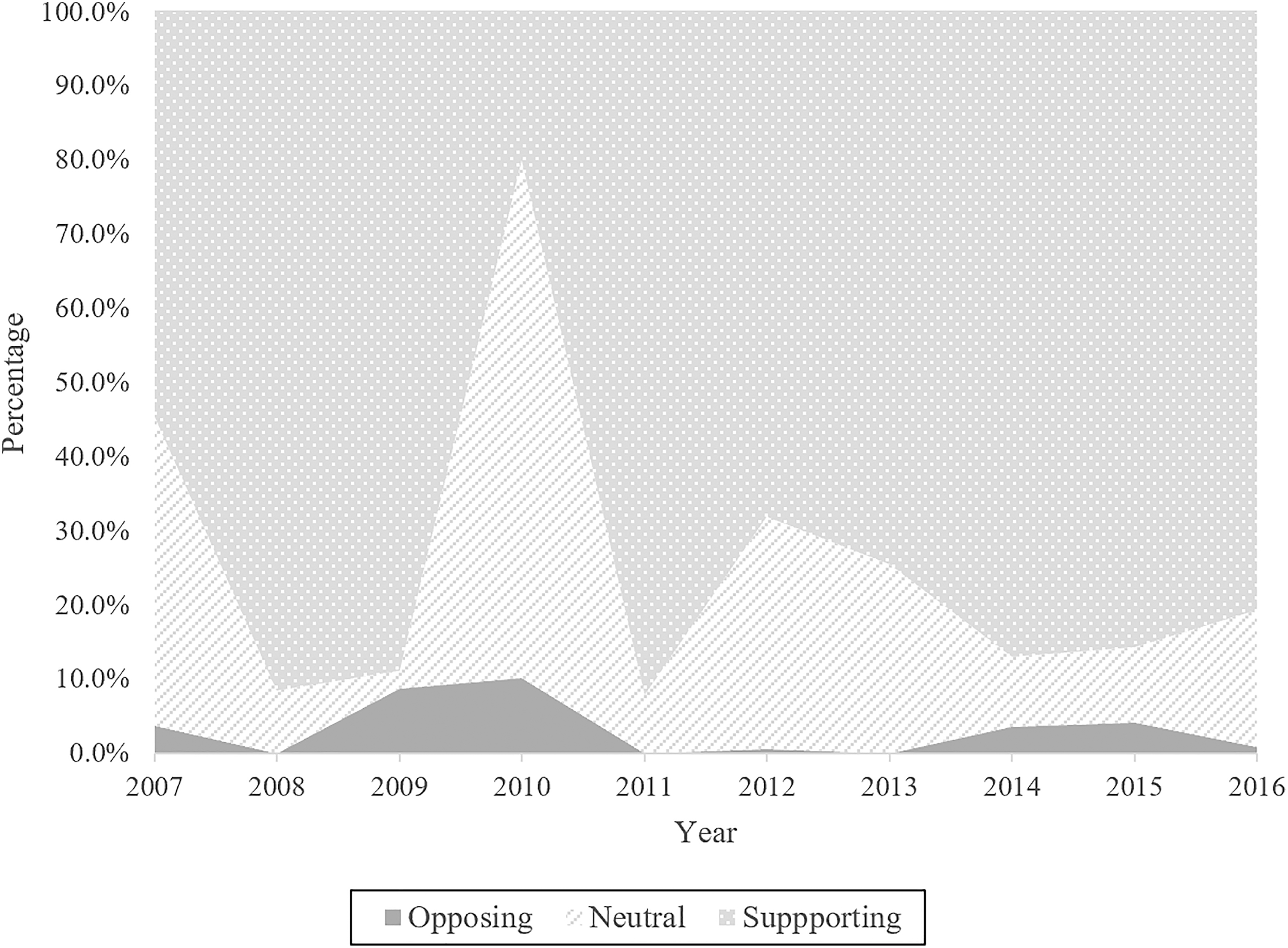
Weighted percentage of breastfeeding-related U.S. newspaper articles with opposing, neutral, and supporting tones, 2007–2016 (n = 452).
Figure 3 depicts article tone for each region for the 10-year study period. Articles published in the South (93.7%), Midwest (81.4%), and West (69.8%) were predominantly supportive in tone. Articles published in the Northeast (53.8%) were predominantly neutral in tone. The Midwest (7.2%) and West (6.8%) had the greatest percentage of opposing article tones.
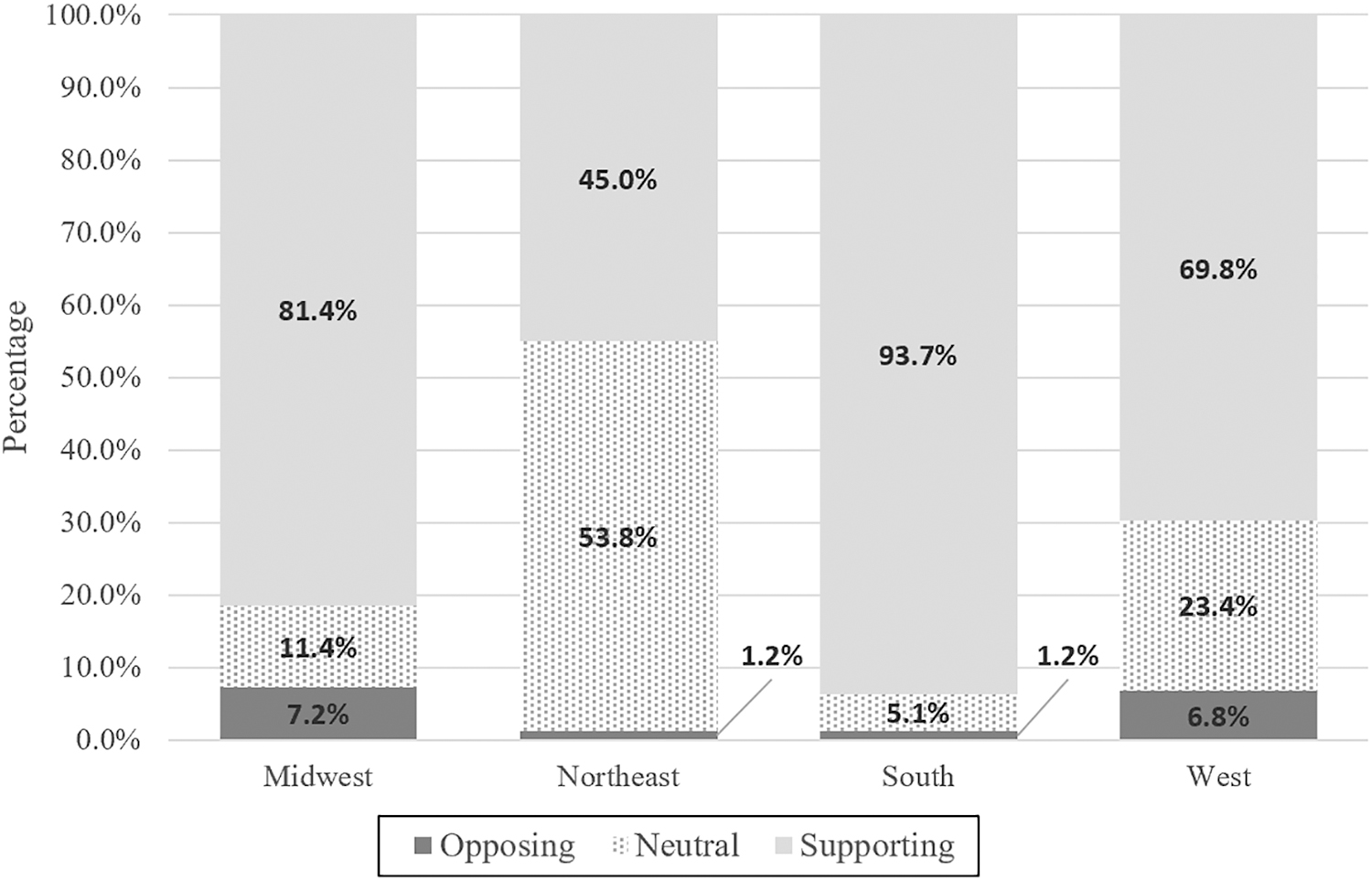
Weighted representation of opposing, neutral, and supporting article tone for each region (n = 452).
Trends in breastfeeding messages over time and by region
Newsprint media portrayals of breastfeeding spanned several content areas from which nine message frames emerged: Health Benefits, Breastfeeding Support and Resources, Breastfeeding Promotion, Advocacy for Feeding in Public, Workplace/University Issues, Hospital-based Initiatives, Breastfeeding Policy, Breastfeeding Education, and Indecent Exposure. Table 2 displays sample quotes from articles representing each of the nine message frames and the percent of articles, including each theme. Health Benefits (24.9%) and Breastfeeding Support and Resources (20.7%) received the most coverage across the decade. Articles focused on Health Benefits discussed issues relating to physical health (e.g., prevention of illness, immune health, and prevention of cancer for mothers) and emotional health (e.g., mother/infant bonding, closeness with child). Articles on Breastfeeding Support and Resources largely focused on instrumental and social resources that mothers could utilize, including new lactation spaces and breastfeeding seminars. Breastfeeding Education (3.8%) and Indecent Exposure (1.2%) had the least representation.
Weighted Percentages of Message Frames with Example Quotes
Notable trends include an increase in articles concerning Workplace/University Issues in the years 2012 through 2016 from 2.1% to 29.8%. Message frames concerning Breastfeeding Support and Resources rose from 23.6% in 2010 to 33.6% in 2015 despite comprising <10% of articles in the years 2007–2009.
The distribution of message frames varied widely across regions. The majority of articles in the South focused on Health Benefits (37.3%) and Breastfeeding Promotion (24.4%). In the Northeast, the majority of articles focused on Breastfeeding Support and Resources (38.3%) and Health Benefits (33.7%). The West and Midwest had a more even distribution of message frames, with predominant frames being Hospital-based Initiatives (28.1%) in the West and Breastfeeding Support and Resources (28.3%) in the Midwest.
Discussion
Media can shape breastfeeding attitudes and, consequently, breastfeeding experiences and outcomes, making it important to examine how breastfeeding is being represented. 32 This descriptive study captured trends in the portrayal of breastfeeding in United States newspaper media between 2007 and 2016. Findings showed that newspapers covered breastfeeding stories more frequently as the decade progressed, with the majority of articles holding supporting attitudes toward breastfeeding. Articles that opposed breastfeeding were uncommon and decreased over time. Unique to this study, we weighted articles based on circulation to account for the varying reach of each newsprint source.
The increase in the number of articles over the decade suggests a growing public interest in discussing breastfeeding. 42 The topics of Health Benefits and Breastfeeding Support and Resources received the greatest coverage, jointly comprising nearly half of the sample. Authors are increasingly highlighting the physical, social, and emotional benefits of breastfeeding, which is consistent with previous research.30,31 Attention to the topic of access and availability of breastfeeding supports and resources is also becoming more common. Articles in this message frame described an array of ways that women are accessing forms of support, including La Leche League and lactation consultants. They also described the importance of familial support, further emphasizing the effect of other's attitudes on mother's breastfeeding experiences.
Articles featuring the Indecent Exposure message frame included topics about finding breastfeeding sexually unappealing, inappropriate, or distasteful. This frame showed a substantial decline from 2014 to 2016. As other research has noted, there are increasing media depictions of breastfeeding in public settings, although breastfeeding in public is still frequently portrayed negatively. 29 Laws that protect breastfeeding (e.g., H.R. 1848 Right to Breastfeed Act, Section 7(r) of the Fair Labors Standards Act: Break Time for Nursing Mothers Provision), 43 nurse-in rallies,44,45 and increasing media coverage35,46,47 may be contributing to the declines of explicitly negative attitudes toward public breastfeeding observed in this study.
There was a rise in publications of Workplace/University Issues across the decade, which may have been catalyzed by amendments to Section 7 of the Fair Labors Standards Act within the Patient Protection and Affordable Care Act (ACA). 43 This legislative amendment required businesses with >50 employees to provide adequate break time and a private lactation space during work. 43 The ACA may also explain the increase in the number of neutral articles in 2010, as newspapers may have been reporting more objective facts relating to breastfeeding rather than focusing on more subjective issues. In the past four decades, the percent of working mothers with children under three years of age has nearly doubled, from 34% in 1975 to 62% in 2018. 48 These trends point to the increasing importance of the workplace environment for breastfeeding mothers. In light of the ways in which framing can influence perceptions, newsprint articles on Workplace/University Issues can be a mechanism of media advocacy through content that seeks to educate lactating women about how to balance occupational responsibilities with lactation needs and articles that normalize the expression of milk in workplace settings.
Consistent with past breastfeeding newsprint research,30,31 tones toward breastfeeding were mostly positive. Reports on public breastfeeding tended to be sympathetic to the mother, but often described barriers and difficulties rather than success stories of breastfeeding in public. While these articles support breastfeeding, they do highlight challenges that mothers face, which may discourage them from public breastfeeding. Because mothers can feel uncomfortable when breastfeeding in public due to concerns about the perceptions of others,5,17 reading about instances in which mothers were sanctioned for breastfeeding may serve as a deterrent for public breastfeeding.
Across the four U.S. regions, the South had the greatest representation of supportive tones. The predominantly positive valence of articles from the South was also reported by Hamilton and Lewis, 30 with 92% of exclusive breastfeeding articles in the South being positive. However, Hamilton and Lewis 30 found the most positive articles in the West. This variation may be attributed to differences in sampling time frame (2010–2013 compared to 2007–2016) and analytic approach (frequency count compared to weighted frequency).
Research about media strategies for improving breastfeeding offers valuable practical insight for normalizing breastfeeding. Bock et al. 28 argue that word choice is one of the most powerful vehicles through which reality is framed in the news. Thus, one strategy involves a more frequent use of the word “nipple” in main sections of newspapers to diminish the social taboo associated with the female breast. 28 Media producers are uniquely positioned to serve as advocates for breastfeeding and can improve public perceptions of breastfeeding through the selection of the frames they choose to apply. News media can be particularly valuable for promoting public policies that help working mothers achieve their breastfeeding goals (e.g., maternity leave, baby-friendly workplaces, and affordable childcare). 49
Another strategy is to increase images of public breastfeeding in newsprint. 32 It is recommended that newspaper images are accompanied by the depicted mother's full identity to convey maternal comfort with breastfeeding in public while remaining sensitive to varying religious and cultural groups. In addition, Mohamad underscored the importance of article placement, noting that the presence of articles in the general news section of a publication can help normalize breastfeeding as a general human affair rather than strictly a health issue. In the current study, we found that nearly three-quarters of the articles were published in the general news section of the newspaper.
Limitations & recommendations for future research
While this study provides a national glimpse of newsprint portrayal of breastfeeding over the course of a decade, it bears some limitations. First, the study sample was extracted from a single media database (Nexis Uni). It is possible that news outlets with a certain target demographic are overrepresented. While our use of a single media database is consistent with other descriptive newsprint studies,31,35 future studies could benefit from utilizing multiple newsprint databases. Second, this study examined archival data and did not involve data collection from human subjects. As such, we are unable to draw inferences on any associations between the portrayal of breastfeeding and actual breastfeeding experiences and outcomes. Foss and Southwell 27 examined the association between magazine content and breastfeeding and reported a significant association between some types of media content and breastfeeding in new mothers, 27 providing valuable groundwork for how researchers might study the relationship between media content and breastfeeding outcomes.
Although there is evidence that media consumption influences breastfeeding attitudes, 25 exposure to supportive newspaper media tones alone may not outweigh the effects of exposure to other media messages, regional cultural norms, and hand-feeding advertisements. Media priming theory posits that priming is ineffective in influencing behavior if the reader has prior experience that contradicts the priming message. 23 Therefore, media messages may primarily influence first-time mothers' behaviors or those who do not have breastfeeding experience. Future studies involving active data collection from a representative sample presented with breastfeeding articles would offer greater insight into the way that newsprint media shapes views and breastfeeding decisions. It could also shed light on the role of sociocultural factors in breastfeeding newsprint consumption, an existing gap in the literature. Understanding the role of sociocultural factors in media consumption may be a valuable strategy for reducing disparities in breastfeeding rates, particularly among low-income and racial and ethnic minorities.50,51
Conclusion
This national, longitudinal examination of media portrayals of breastfeeding illuminated trends in the U.S. public discourse, which can be used to inform strategies for improving breastfeeding experiences and outcomes. Our findings indicate that while articles describe challenges with breastfeeding, attitudes toward breastfeeding are supportive overall, with an increasing focus on Breastfeeding Support and Resources, Health Benefits, and Workplace/University Issues in recent years. Indecent exposure articles were published less frequently over time, and most articles regarding public breastfeeding were in support of the mother. These results offer useful implications for future research, including examining the association between newsprint media consumption and breastfeeding perceptions and outcomes.
Footnotes
Acknowledgments
We gratefully acknowledge Jordan Widenhouse for her assistance in data collection, as well as two anonymous reviewers for their helpful suggestions.
Disclosure Statement
No competing financial interests exist.
Funding Information
The authors received no specific funding for this research.