




Abstract
Objective:
The impact of maternal anxiety on the macronutrients content of human milk (HM) is unknown. We hypothesized that maternal stress generated by her infant‘s hospitalization will affect the mother's breast milk's macronutrients content.
Materials and Methods:
HM samples (2–3 mL) were collected from 21 mothers whose infants were hospitalized for 2–3 days between August 2016 and November 2017 due to neonatal fever. Samples were provided at three time points: first day of admission, second day of admission, and 1 week after discharge. The maternal anxiety level was measured by the State-Trait Anxiety Inventory (STAI). Milk analyses for macronutrients were performed by infrared transmission spectroscopy.
Results:
Fat and energy contents of HM on day 7 were significantly higher compared with the day of admission (p = 0.019 and p = 0.022, respectively), whereas they were similar to values on day 2. The maternal anxiety level (STAI) at the time of infant admission was significantly higher than at 1 week after discharge (p < 0.001). There was no significant correlation between the changes in fat content and changes in the STAI score between admission and 1 week after discharge.
Conclusion:
Short infant hospitalization is associated with a significant rise in maternal stress; however, macronutrients content of HM remained unaffected.
Introduction
Research on parental stress related to a child's critical illness has led to an increasing recognition of its impact on health and well-being of both the parents and the child. 1 Several studies have observed an effect of stress and anxiety on breastfeeding, such as inadequate milk volume. 2 Maternal anxiety trait scores were inversely correlated with infant breast intake, suggesting that mothers who are prone to be more anxious have more difficulty in maintaining lactation. 3 It is still unknown whether a stressful experience, such as infant hospitalization, has any effect upon the macronutrient content of human milk (HM). We, therefore, designed this prospective study to analyze the HM macronutrient content of healthy mothers of hospitalized term infants. We hypothesized that maternal anxiety over the hospitalization will affect the macronutrients content of her breast milk.
Materials and Methods
This prospective study was approved by our local institutional review board (Helsinki), and written informed consent was obtained from all participating mothers.
Participants
Twenty-one mothers whose infants were hospitalized due to neonatal fever for a duration of 2–3 days were recruited at the Department of Pediatrics at Dana-Dwek Children's Hospital, Tel Aviv Medical Center, between August 2016 and November 2017. The study group comprised compliant mothers of full-term infants who were 2 weeks to 3 months of age, who had a normal medical background and no previous hospitalizations/chronic diagnoses, who were exclusively breastfed, and who were hospitalized for neonatal fever during the study period. Excluded were mothers with acute mastitis, a febrile illness, or a chronic illness, those who had undergone medical or surgical treatment of the breast, as well as those whose infant had a respiratory illness or bacterial meningitis. Demographic and medical data were collected by means of a standard questionnaire, and they included mother's age, gestational age, mode of delivery, parity, ethnic origin, mother's weight and height, infant's gender, infant birth weight and current weight, and maternal medication. Maternal body mass index (BMI) was also calculated.
Samples
HM samples (2–3 mL) were collected at three time points: on the first and second day of infant hospital admission and 1 week after discharge. The samples were collected with a breast milk pump or by manual mid-expression. Short-term storage (a maximum of 24 hours) was at 4°C, and long-term storage was at −20°C.
Laboratory methods
Just before analysis, each frozen sample was thawed at 40°C in a thermostatic bath. The samples were then homogenized by ultrasonic technique with the MIRIS milk sonicator (Miris, Uppsala, Sweden), as recommended by the manufacturer. Milk samples were analyzed for macronutrients content by the Human Milk Analyzer from MIRIS, an instrument based on mid-infrared transmission spectroscopy,4–7 which provides results with repeatability values of <0.05%. 8
Maternal anxiety assessment
Maternal anxiety was measured with the State-Trait Anxiety Inventory (STAI). 9 This self-evaluation questionnaire includes the “state” anxiety scale (STAI-S) that evaluates the current state of anxiety in a particular situation, and the “trait” anxiety scale (STAI-T) that evaluates relatively stable aspects of “anxiety proneness” in an individual. A Hebrew version of the questionnaire was used in this study. 10 Each questionnaire contains 20 items on how the mother felt at that moment (STAI-S) and how she usually feels (STAI-T), with respondents rating anxiety from 1 (“not at all”) to 4 (“very much so”). Scores for each subscale range between 20 and 80, with the higher score indicative of a higher anxiety level and a cut point of 39–40 has been suggested to detect clinically significant symptoms for S-Anxiety scale. 9 Both the STAI-T and STAI-S questionnaires were completed at the time of first HM sample collection, whereas only the STAI-S questionnaire was completed at the time of the third collection.
Statistical analyses
Statistical analyses were carried out by Minitab® Statistical Software. Descriptive statistics (mean and standard deviations) were calculated for demographic data. A paired t-test was used to compare macronutrients content at different time points: the first day of admission versus the second day, and the first day of admission versus 1 week after discharge. A paired t-test was also used to compare the anxiety level at the time of infant admission and 1 week after discharge. Regression analysis was applied to judge the effect of stress upon macronutrients content.
Results
Twenty-one mothers who fulfilled the inclusion criteria were recruited into this study. Their demographic characteristics and those of their infants are presented in Table 1. The total protein, carbohydrate, fat, and caloric contents of the HM samples per study day are listed in Table 2. The fat and energy content of the HM on day 7 were significantly higher compared with the day of infant admission (paired t-test, p = 0.019 and p = 0.022, respectively, Table 2), but they were not significantly different on day 2 from the values measured on days 1 and 7.
Maternal and Neonatal Characteristics (n = 21)
Data are presented as mean ± standard deviation (range) or n (%).
Macronutrients Content of Human Milk
Data are expressed as mean ± standard deviation (range).
p-Value between days 1 and 7.
NS, nonsignificant.
Recruited mothers had a STAI-T <40 (median 31 [Q1–Q3; 27–37]), suggesting that they are less susceptible to stress. The maternal anxiety level (STAI-S), at the time of infant admission was significantly higher than the level of anxiety 1 week after discharge (42 [Q1–Q3; 35–50] versus 29 [Q1–Q3; 24–33] p < 0.001) (Fig. 1). There was no significant correlation between the changes in fat content and the changes in STAI scores between the time of admission and 1 week after discharge.
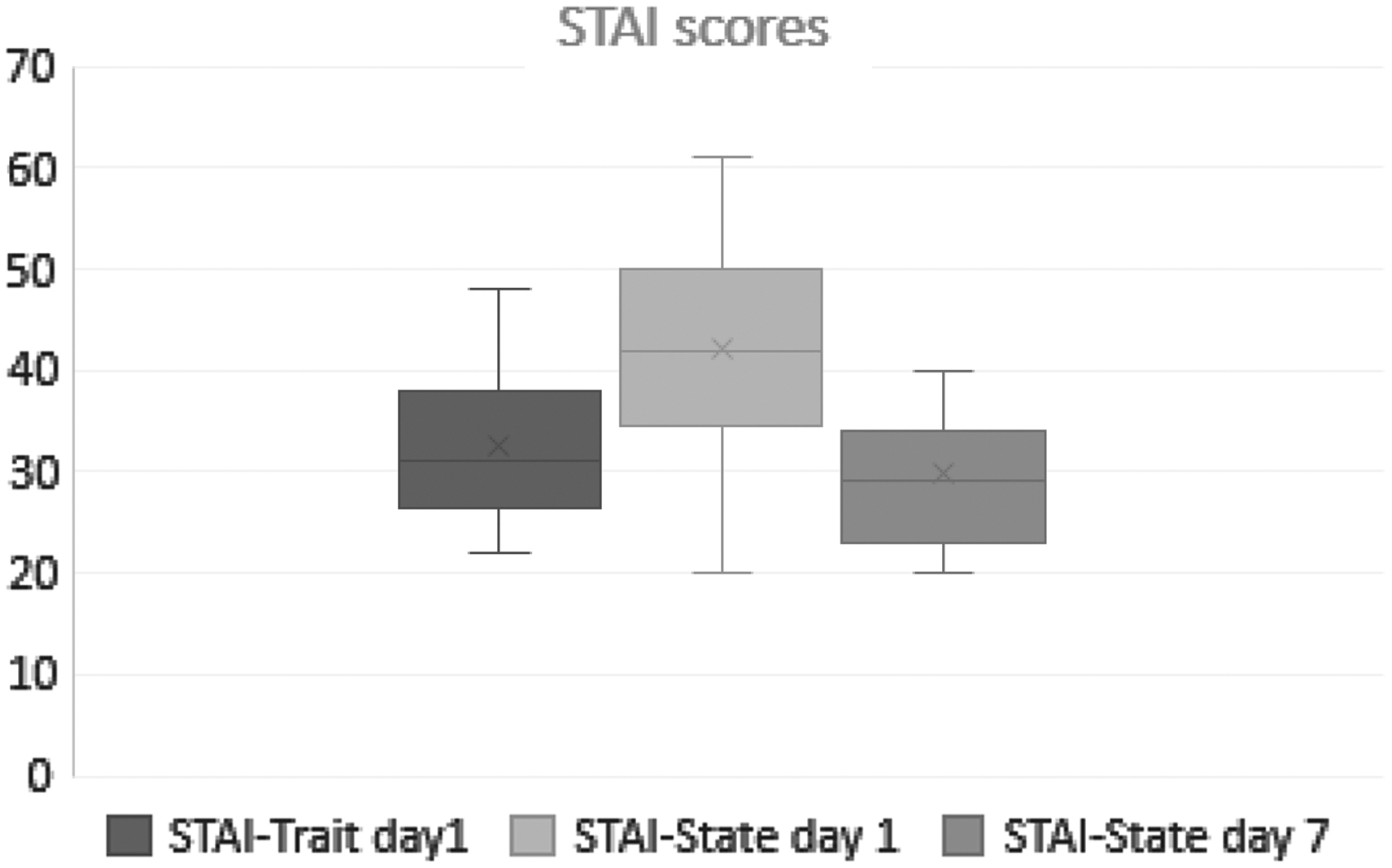
STAI scores at days 1 and 7. STAI, State-Trait Anxiety Inventory.
Discussion
To the best of our knowledge, there are no publications on the impact of maternal anxiety on the macronutrients content of HM. As expected, infant hospitalization was proven anxiogenic as shown by an increased STAI-S score >40 in a population of mothers not generally prone to anxiety. The results of this study demonstrated that HM fat and energy content were lower at the time of admission compared with 1 week after hospitalization. Although the most stressful events for both mother and infant occur during the first 24 hours of hospitalization (such as emergency department visit, blood tests, lumbar puncture procedures), there were no significant differences in fat and energy content between day 2 compared with day 1, or between day 7 compared with day 2. The same held true for carbohydrate and protein content between those time points. Maternal stress was significantly higher at the time of admission compared with 1 week after discharge. Although these macronutrient variations happened concomitant to infant hospitalization that generated anxiety, we could not show a direct correlation between the changes in fat content and the changes in maternal anxiety level.
These findings are contrary to our initial hypothesis. Parents have reported a variety of reactions when dealing with a sick baby, including sadness, fear, anxiety, grief, and helplessness. 1 Several studies have described the effect of depressive symptomatology on breastfeeding outcomes.11,12 HM composition is extremely complex, and it is affected by maternal factors (age, diet, ethnicity, weight gain during pregnancy, gestational diabetes mellitus, and BMI).13–17 It also varies with infant birth weight, length of lactation, time since last feed, stage of the nursing process, and time of day.13,18,19 Inadequate milk volume or milk insufficiency has been attributed to stress. 2 Ueda et al. reported that psychological stress reduces the pulsatile oxytocin release, thus inhibiting lactation. 20 Dimitraki et al. demonstrated that primiparity, long labor, stress to the mother and fetus during labor and delivery, and the negative effects and high scores of post-traumatic stress are risk factors for delayed lactogenesis. 21 In addition, maternal anxiety trait scores were inversely correlated with infant breast intake, suggesting that mothers who are prone to be more anxious have more difficulties maintaining lactation. 3
HM lipids provide the infant with energy, essential vitamins, polyunsaturated fatty acids, and bioactive components. 22 Lipids are most variable in terms of concentration. 13 Several studies have listed various factors that affect the fat content and fatty acid composition of HM, such as maternal ethnicity, maternal diet, genetics, 23 daytime and nighttime, 18 and maternal age. 24
The results of our study showed that during a short period of anxiety, the HM macronutrient content remained unaffected and the observed increase in fat and energy contents reflected the normal variation in fat content during different stages of lactation.18,25 Indeed mothers were in average at 5.2 ± 2.8 weeks of lactation and fat and energy content continued to evolve. Later determination of HM macronutrients would have been necessary to judge the course of fat content variation.
Limitations
The study has a few limitations that bear mention. One is its small sample size and it is uncertain if the lack of association between maternal anxiety and HM macronutrient content would also be observed in studies with larger cohorts. Another is the impossibility of having a baseline of macronutrients concentration of HM before admission, which would have allowed us to interpret the observed change in fat and energy content of HM as a reduction at admission or as an increase at day 7, other than the natural course of fat and energy content. Finally, we only measured macronutrients and it would be valuable to determine whether micronutrients and other biologically active components of HM are affected by maternal stress and anxiety.
Conclusions
We conclude that short infant hospitalization is associated with a significant rise in maternal stress; however, macronutrients content of HM remained unaffected.
Footnotes
Disclosure Statement
There is no potential, perceived, or real conflict of interest.
Funding Information
No funding was received.