




Abstract
Background:
The impact of milk banking processes on macronutrient variability in donor human milk (DHM) is largely unknown.
Objective:
To gain a better understanding of fat and protein composition in DHM and assess potential relationships with modifiable milk bank processes.
Methods:
Samples of raw, pooled DHM were collected from 20 milk banks (n = 300) along with the following processing attributes: if macronutrient analysis was used to select donors for pooling (target pooling; yes/no), number of donors per pool, pooling container material (glass/plastic/other), and method for mixing during bottling (manual/mechanical). Fat and protein were assessed. Homoscedasticity was assessed and magnitude of the spread was quantified.
Results
: Fat ranged from 1.9 to 6.1 g/dL (n = 298) and protein ranged from 0.7 to 1.4 g/dL (n = 300). Variability in fat was significantly lower in samples that had been target pooled (p = 0.04), contained more donors per pool (p < 0.001), and had been mixed mechanically (p < 0.001). Variability in protein was significantly lower in samples that contained more donors per pool (p = 0.001). In a stratified analysis, increasing the number of donors per pool only reduced nutrient variability in samples that were not target pooled.
Conclusion:
For milk banks that do not target pool, using a greater number of donors in a pool may reduce fat and protein variability.
Introduction
Donor human milk (DHM) is the recommended feeding for preterm infants when mother's own milk is unavailable,1–3 and the use in neonatal intensive care units (NICU) is increasing. 4 Research suggests that the macronutrient content of DHM is highly variable, although many studies are limited by a small number of samples,5–7 obtained from a single milk bank.8–10 A systematic review of DHM found a collective range of 1.1–7.4 g/dL for fat, 5.5–8.6 g/dL for lactose, 0.7–2.2 g/dL for protein, and 43–86 kcal/dL for energy. 11 For preterm infants, intakes of energy and protein are positively associated with growth,12–16 suggesting that efforts to obtain a more consistent macronutrient profile in DHM are warranted.
The American Society for Parenteral and Enteral Nutrition recommends that DHM be obtained from a milk bank following evidenced-based guidelines, such as those published by the Human Milk Banking Association of North America (HMBANA). 17 The HMBANA guidelines provide standards for milk bank operations. 18 At a high level, DHM processing entails thawing milk, combining milk from multiple donors into a pool, bottling, pasteurizing, and testing. Some milk banks choose to assess a donor's milk for macronutrients using infrared analysis and strategically combine donors to reach macronutrient targets (targeted pooling). Emerging evidence suggests that target pooling may help reduce macronutrient variability in DHM. 19 Increasing the number of donors per pool is another strategy to reduce nutrient variability. 10 Current milk banking guidelines do not require target pooling or specify a range of donors to include in each pool. 18 To date, there is limited research into how processes within milk banking may impact the distribution of nutrients in DHM.
The primary objective of this study was to describe the variability in protein and fat in DHM and assess potential relationships with two modifiable processing factors–targeted pooling and the number of donors per pool. The secondary objective was an exploratory analysis that included two additional modifiable processing variables–pooling container material and method of mixing during bottling.20–25 Fat and protein were selected because of their role in supporting preterm infant growth.2,26 We hypothesized that variances in fat and protein would be significantly reduced in DHM produced with targeted pooling and with increased number of donor per pool.
Methods
This study was categorized as nonhuman subject research by the University of North Carolina at Greensboro (UNCG) Institutional Review Board. After approval by the HMBANA Research Committee, all milk banks were invited to participate in this study. Participating milk banks were assigned an ID and mailed a package containing instructions, a data collection log, and 15 labeled, sterile sample cups.
Sample collection
Instructions were to collect two ounces from the first pour of 15 unpasteurized pools of DHM intended for a NICU. Once collection began, samples were to be obtained from consecutive, unique pool and frozen until all samples were ready to be shipped on dry ice to the laboratory at UNCG. The following processing variables were collected for each sample: if macronutrient analysis was used to select donors for the pool (target pooling; yes/no); number of donors per pool, material of the container that held the pool during bottling (glass/plastic/other), and method used to pour milk into bottles (hand/pump). The latter variable was used to assess the method of mixing during bottling (manual/mechanical). Based on observations in the field, including separate variables for pouring and mixing, it was redundant because pouring method was analogous with mixing method–milk banks that poured by hand also mixed by hand (via intervals of swirling the container) and milk banks that poured via dispensing pump also used a device to continuously mix the DHM (e.g., magnets, stand mixer, and/or oscillating plate).
Sample handling
Upon arrival to our laboratory, samples were stored at −20°C until processing. Thawing occurred in a Precision Shaking Water Bath 15 (SWB; TSSWB15; Thermo Fisher Scientific, Newington, NH) at 55 RPM and 35°C for at least 30 minutes, until no ice crystals remained and temperature was between 20°C and 24°C. A preliminary investigation determined that magnetic mixing on a stir plate (11-498-7SH; Fisher Scientific, Bohemia, NY) for 5 minutes at a moderate speed was necessary to obtain representative aliquots, which were drawn from samples and stored at −20°C until analysis. For all analyses, samples from the same milk bank were tested as a set after thawing for 10 minutes at 30°C using a Digital Heating Cooling Drybath (88880029; Thermo Fisher Scientific, Waltham, MA).
Sample analysis
Fat was measured using the creamatocrit method described by Lucas et al. 27 Although this technique is more operator-dependent than others,28,29 a preliminary investigation illustrated that the researcher was able to consistently achieve coefficients of variation (CVs) <3% by vortexing aliquots and using a flatbed centrifuge. In brief, samples were vortexed for 10 seconds before filling capillary tubes. Capillary tubes were centrifuged 10 minutes at 11920 g on a Zip-IQ PCV Centrifuge (ZiC-24HD-75T3; LW Scientific, Lawrenceville, GA), then measured using a Creamatocrit Plus (100–146; EKF Diagnostics, Boerne, TX). Creamatocrit values were converted to fat (g/dL) with the equation determined by Meier et al: (3.968 + 5.917*creamatocrit)/10. 30
Protein was measured via Pierce bicinchoninic acid assay (BCA; 23225; ThermoFisher Scientific, Rockford, IL), which has been validated for HM, 31 although it likely overestimates by as much as 30%. 28 Protein (g/dL) was quantified with a bovine serum albumin standard curve and values were adjusted using the formula reported by Keller and Neville for comparison to Kjeldahl methods, which accounted for the nonprotein nitrogen fraction in human milk. 31
Statistical analysis
Independent variables included milk bank ID; target pooling (yes/no); number of donors per pool (number); container material (plastic/nonplastic); and mixing method during bottling (manual/mechanical). Dependent variables were fat (g/dL) and protein (g/dL).
Statistical analysis was conducted using R software (version 3.5.2; R Foundation for Statistical Computing, Vienna, Austria). Case influence statistics were used to determine outliers. Descriptive statistics were calculated for the full dataset and by processing variable. Chi-square analysis was performed for all pairwise combinations of processing variables to compare distributions. Differences by processing variables were assessed using ANOVA. Since the primary objective of this study was to assess whether processing attributes influence nutrient variability, we performed statistical tests to assess for unequal variances. Homoscedasticity was assessed using the Fligner–Killeen test, and magnitude of the spread was quantified by sample variance (s 2 ). Linear mixed models were used to investigate the combined impact of all processing variables on mean fat and protein content, with milk bank ID as the random intercept to control for clustering.
Results
Twenty milk banks provided 15 samples for a total of 300 unique samples of DHM. Distribution of processing variables were as follows: Target Pooling [55% (165/300) Yes, 45% (145/300) No]; Donors Per Pool [17% (51/299) 1-Donor, 28% (83/299) 2-Donor, 40% (121/299) 3-Donor, 11% (33/299) 4-Donor, 4% (11/299) 5-Donor]; Pooling Container [25% (75/300) Plastic, 75% (225/300) Non-Plastic]; and Mixing Method [59% (176/300) Manual, 41% (124/300) Mechanical].
Fat was measured in duplicate and protein was measured in triplicate, with average CVs of 2.2% and 3.0%, respectively. Fat content for the dataset (n = 300) ranged from 1.9 to 14.6 g/dL, and protein content ranged from 0.7 to 1.4 g/dL (Fig. 1). Two observations for fat (9.0 g/dL, 14.6 g/dL) were identified statistically as influential outliers. These samples were retested and yielded similar results, thus they were omitted from additional analyses. All protein values were within physiological ranges, and no observations were omitted. Chi-square distributions were significantly different for all pairwise comparisons of processing variables (p < 0.001 for all). Descriptive statistics for the entire sample set are presented in Table 1. There was a significant difference in fat (mean ± standard deviation) by pooling container material (plastic 3.7 ± 0.6 g/dL; nonplastic 3.5 ± 0.6 g/dL; p = 0.007). No other differences in mean fat or protein values were observed.
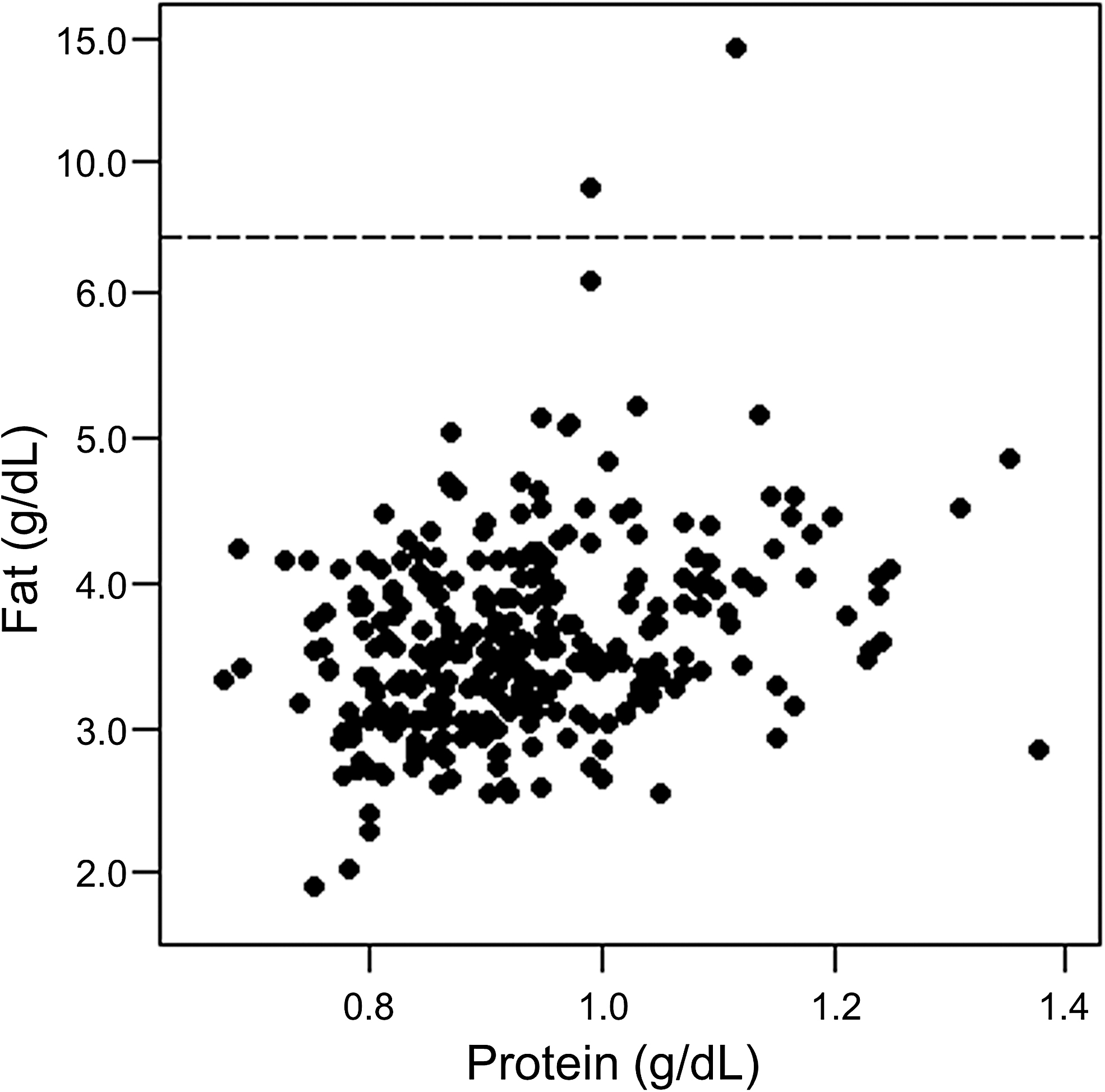
Fat and protein content of donor human milk (n = 300). Statistical outliers are plotted above the dashed line.
Descriptive Statistics for Fat and Protein (g/dL) by Processing Variables
Data represent mean ± standard deviation (minimum, maximum). Differences between groups were evaluated by ANOVA.
p < 0.05.
Impact of target pooling and donors per pool
For Target Pooling (Fig. 2), variance was significantly different for fat (s 2 = 0.43 for No and 0.26 for Yes, p = 0.04), but not protein (p = 0.78). For Donors per Pool (Fig. 2), variance was significantly different for fat (s 2 = 0.55 for 1-Donor, 0.34 for 2-Donors, 0.32 for 3-Donors, 0.29 for 4-Donors, and 0.09 for 5-Donors; p < 0.001) and for protein (s 2 = 0.026 for 1-Donor, 0.016 for 2-Donors, 0.011 for 3-Donors, 0.008 for 4-Donors, and 0.005 for 5-Donors; p = 0.001). Since there were significant differences in the chi-square distribution for number of donors per pool by target pooling (percent of samples not target pooled: 59% for 1-Donor, 53% for 2-Donors, 45% for 3-Donors, 73% for 4-Donors, and 100% for 5-Donors; p = 0.002), we performed a stratified analysis by target pooling. When target pooling was not performed, variance between the number of donors per pool was significant for both fat (n = 163; s2 = 0.65 for 1-Donor, 0.41 for 2-Donors, 0.47 for 3-Donors, 0.25 for 4-Donors, and 0.09 for 5-Donors; p = 0.01) and protein (s 2 = 0.035 for 1-Donor, 0.011 for 2-Donors, 0.012 for 3-Donors, 0.007 for 4-Donors, and 0.005 for 5-Donors; p < 0.001). When target pooling was performed, variance by donors per pool was not significantly different for fat (p = 0.27) or protein (p = 0.30).
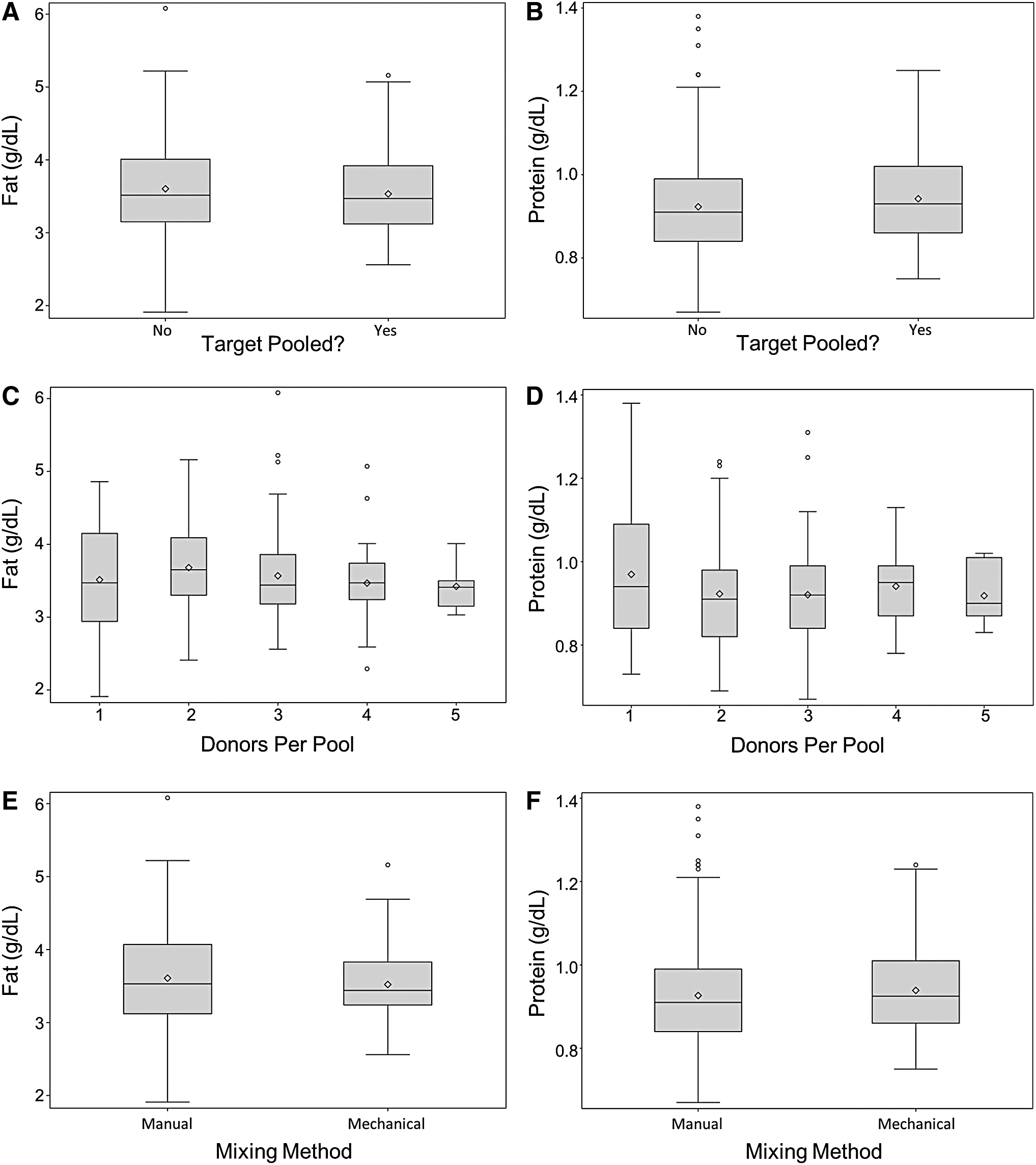
Distribution of fat (n = 298) and protein (n = 300) for study samples by processing factor. Diamonds (◊) represent mean values; gray rectangles represent Quartile 1 to Quartile 3; solid lines represent median. Homogeneity was assessed with a Fligner–Killeen test.
Impact of container material and mixing during bottling
For pooling container material, variance was not significantly different for fat (p = 0.43) or protein (p = 0.36). There were significant differences in the chi-square distribution for container material by target pooling (percent of samples not target pooled: 40% of plastic and 60% of nonplastic; p = 0.004). When target pooling was not performed, variance between container materials was significant for protein (s 2 = 0.005 for plastic and 0.017 for nonplastic; p = 0.03) but not for fat (p = 0.42). When target pooling was performed, variances were not significantly different by pooling container material for fat (p = 0.85) or protein (p = 0.63).
For mixing method (Fig. 2), variance was significantly different for fat (s 2 = 0.45 for manual and 0.22 for mechanical, p < 0.001), but not for protein (p = 0.44). There were significant differences in the chi-square distribution for mixing method by target pooling (percent of samples not target pooled: 68% of manual and 36% of mechanical; p < 0.001). When target pooling was not performed, variance between mixing methods was significant for both fat (s 2 = 0.50 for manual and 0.17 for mechanical; p < 0.001) and protein (s 2 = 0.018 for manual and 0.007 for mechanical; p = 0.008). When target pooling was performed, variances were not significantly different based on mixing method for fat (p = 0.34) or protein (p = 0.06).
Predicting fat and protein content
In linear mixed models for fat and protein, none of the predictor variables was significant except for container material in the fat model. The model for predicting fat had a total explanatory power of 9.0%, in which the fixed effects explained 4.6% of the variance and the random effect of milk bank explained 4.5% of the variance. The fat model's intercept was at 3.98 (SE = 0.15, 95% CI [3.67–4.29]), and the effect of container material was significant (B = −0.28 ± 0.10, 95% CI [−0.49 to −0.06], p = 0.02). The model for predicting protein had a total explanatory power of 11.7%, in which the fixed effects explained 3.1% of the variance and the random effect of milk bank explained 8.6% of the variance. The protein model's intercept was at 0.97 (SE = 0.05, 95% CI [0.88–1.06]).
Discussion
In independent analyses of milk bank processing factors, we observed that fat variability was significantly lower when a macronutrient analyzer was used to create targeted pools; there was a greater number of donors per pool; and DHM was mechanically mixed during bottling. We observed that protein variability was significantly lower when there was higher number of donors in a pool. However, there were significant differences in the distribution of processing variables (as illustrated by bivariate chi-square distributions with p ≤ 0.004), and stratified analyses revealed different findings.
Impact of target pooling
Use of a macronutrient analyzer to target pool DHM was associated with a decrease in fat and protein variability compared to nontarget pooled samples. Target pooling is not required by HMBANA, but 45% of our samples came from targeted pools, suggesting that this practice is common. Recent research has shown that a variety of infrared analyzers are reliable and accurate for measuring fat and protein in a milk bank setting. 32
Fu et al. 8 examined the macronutrients in target pooled DHM from one milk bank and reported fat values from 1.5 to 4.5 g/dL, and protein values from 0.3 to 1.4 g/dL. In our study, we observed higher minimum values in target pooled milk (2.6 g/dL for fat and 0.8 g/dL for protein) than those reported by Fu et al. These differences may be related to sample collection protocol. To obtain their samples, NICU technicians were instructed to save at least 1 mL of “remaining milk” 8 that was left after DHM had been used to create feedings, which may not have been a representative sample.
Impact of donors per pool
When samples were not target pooled, we found that increasing the number of donors per pool decreased the variability for both fat and protein. This was expected per the Central Limit Theorem, 33 which states that an increased number of observations results in a decreased standard deviation, thus the pooling of multiple donors would help reduce nutrient variation. In target pooled samples that used an analyzer to nonrandomly select donors based on the macronutrient composition of their milk, the number of donors per pool did not influence the variability of fat or protein.
HMBANA defines a pool as “more than one donor”, 18 yet, 17% of the samples in this study were single-donor pools. Similarly, a recent study by Young et al. 9 reported that 41% of DHM samples were from single-donor pools. Our findings regarding the impact of donors per pool aligns with a study by John et al., 10 which simulated random pooling of up to five donors using a large dataset of HM composition from over 500 lactating women and concluded that increasing the number of donors decreased variability. These results are slightly different than a study from de Halleux and Rigo, 34 which found significantly higher variability for protein (p < 0.05) but not fat in single-donor versus multidonor DHM pools. However, the number of donors in multidonor pools was not provided, and it is unknown if macronutrient analysis was used to create targeted pools. Young et al. 9 found that as the number of donors per pool increased, variability of protein decreased (p = 0.014), but variability of fat did not. However, there were only 11 pools with three to four donors, so the analysis may not have been adequately powered to detect differences in pools with high numbers of donors. 9 Our novel finding suggests that nutrient variability in DHM can be reduced without necessarily adding more donors to the pool if target pooling is used.
Impact of container material
We observed that mean fat content of DHM prepared in nonplastic pooling containers was significantly lower than that prepared in plastic containers. Other studies about the impact of container material on human milk nutrients found minimal influence of container material, although these studies were not within the lens of milk banking where large containers are used to hold pools of DHM. A study by Chang et al. 20 investigated the effect of nine containers (eight plastic and one glass) on macronutrient loss in 30 mL HM after frozen storage and reported no significant difference by container. Goldblum et al. 21 compared the impact of glass and plastic containers on the loss of bioactive compounds during short-term refrigerated storage and concluded that no container was superior regarding the loss of these nutrients. Williamson and Murti 23 assessed glass and stainless steel containers and reported that certain compounds in HM (e.g., immunoglobulins and lysozyme) may more readily adhere to the walls of steel containers. As our study was an observational study, the impact of pooling container warrants further investigation. When analyzing the entire dataset, we did not observe significant differences in the variance of fat or protein by pooling container material.
Impact of mixing during bottling
We observed higher nutrient variability in samples that had been mixed manually during bottling than those mixed mechanically. The occurrence of two large outliers in this study beyond the physiological levels for fat underscores the importance of adequate mixing. From the dairy industry's research on gravity separation, it is known that time and temperature impact the kinetics of fat separation. 25 Studies investigating the mixing of human milk have been done primarily in a clinical setting with small milk volumes (e.g., one bottle <120 mL), not in milk banks where pools typically range in volumes of 6–20 L.35,36 Evaluation of mechanical and manual methods for mixing large pools of donor milk is an important area for future research.
Predicting macronutrients
While statistical tests of unequal variance found that several milk bank processing factors were associated with reduced nutrient variability in DHM, a linear mixed model that included all study variables explained less than 12% of the nutrient content in our sample set. Milk banks are a combination of multiple processing variables, only four of which were represented in this study. Those four variables created 40 unique combinations, and the results of the chi-square distributions illustrated the wide variation in practices across milk banks. Lack of significance in the models may be partially attributed to the sample size of 300, which was not large enough to have a sufficient number of observations in all subgroup combinations.
Strengths and limitations
A major strength of this study was the high participation rate (75% of banks in the HMBANA network), compared to previous studies, which collected a small number of samples from 1 to 3 milk banks.5–10 In addition, we collected information on multiple processing factors which have not been systematically included in previous studies. Fat and protein assessment were done by one researcher, with good CVs, and using established methods.
Limitations include the fact that this was an observational study designed to establish relationships, not determine causation. There were significant differences in the distribution of the processing factors, thus it was difficult to attribute results to a single factor. We attempted to account for this with stratified analyses, which then led to more nuanced conclusions, suggesting the need for more controlled research. Information was not available on donors, including lactation and gestation stage, and how milk was stored before donation, which may have also influenced nutrient composition. Additional information about the pooling process (e.g., type of maternal storage container, how milk was mixed before removal from original storage container, and collection of milk residuals from surface of container) was not collected.
Conclusion
In this large, multisite study of 300 samples of DHM collected systematically from 20 milk banks, we report twofold and threefold differences in the protein and fat composition of DHM. For milk banks that do not use macronutrient analyzers to target pool, fat and protein variability may be reduced by creating pools with a greater number of individual donors. For milk banks that use macronutrient analyzers to strategically combine donors, fat and protein variability was not influenced by the number of donors per pool, suggesting that the use of macronutrient analyzers to create targeted pools is a useful tool for controlling nutrient variability in DHM. The findings of our study were based on fat and protein, and more research is needed to elucidate the impact of processing factors on the micronutrients and bioactive compounds in DHM.
Footnotes
Authors' Contributions
M.T.P. conceived of the study; L.L.F. and M.T.P. designed the study; L.L.F. collected all study data; L.L.F. and M.T.P. analyzed data; L.L.F. was the primary author; both authors contributed to revisions and agreed on the final article.
Acknowledgments
Thank you to the milk banks who participated in this study. Also, thank you to Zari Johnson and Bruna Gutierrez dos Santo for their assistance with this project.
Disclosure Statement
M.T.P. serves on the Board of Directors for the Human Milk Banking Association of North America in an unpaid capacity.
Funding Information
This research was funded by a grant to M.T.P. from The Allen Foundation.