




Abstract
Presence of blood in colostrum may change the color of breast milk and it is known as “rusty pipe syndrome.” It may resolve within days, but it may be a barrier for exclusive breastfeeding. Knowledge of “rusty pipe syndrome” among health professionals is very helpful in the management of breastfeeding initiation.
Introduction
Breast milk is the most basic nourishment for the child with the amount and variety of the nutrients it contains. World Health Organization recommends exclusive breastfeeding for the first 6 months of life and continuing to breastfeed along with complementary feeding until 2 years of age. 1 According to UNICEF 2017 Report, less than half of the children can receive breast milk worldwide. This is because many women face difficulties from the beginning and maintenance of breastfeeding. 2 Considering the dose-dependent increased benefit of breastfeeding, initiation and maintenance of breastfeeding is important. The beginning of milk production may course with bloody nipple discharge or brown milk, which is a self-resolving physiological syndrome called rusty pipe syndrome (RPS). 3 It usually results from old blood clots in ducts, a residual of rapid growth and vascularization during pregnancy. 4 This condition is generally seen in primiparous women in the first days of lactation and it is painless, bilateral, and generally resolved within a few days. 3 There are different managements of RPS in the literature. Differences were observed at the timing of breastfeeding initiation, in formula use after birth until the resolution of RPS, and in further investigations.
In this study, we present a case report and review the literature about the management of RPS.
Case Report
A male infant was born vaginally to a 28-year old primiparous mother at 38 weeks of gestation. In the antenatal period, mother was followed by a maternity clinic regularly and no health problems was identified. After delivery, baby was diagnosed with transient tachypnea of newborn and transferred to the neonatal intensive care unit. For the initiation of breastfeeding, staff nurse visited the mother in the first hour and showed her hand expressing of the milk. The nurse realized brownish milk from both breasts (Fig. 1).
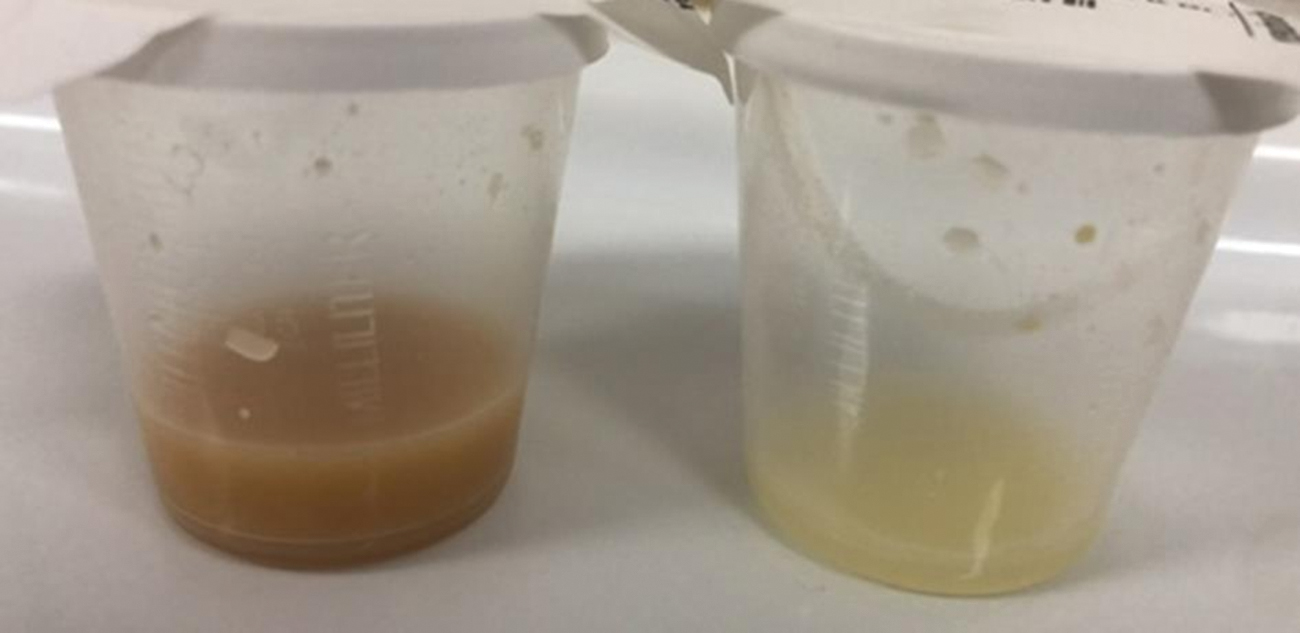
Breast milk colors on the third left and the seventh days. Photo by Dr. Serap Sapmaz. Color images are available online.
Examination of the breasts revealed no engorgement, tenderness, or erythema. The nipples and areola had no erosions, ulcers, or cracks. There was no history of breast trauma. Examination of the newborn's mouth ruled out the presence of natal teeth. A breast ultrasound was performed. No solid nodular images were found, only sparse multiple bilateral mammary cysts measuring up to 5 mm diameter on the right and 3.3 mm diameter on the left.
The mother was supported by breastfeeding counseling and she was reassured. The mother expressed breast milk regularly and the baby was exclusively breastfed by a cup. The breast milk decolorized within 40 hours (Fig. 1). By the third day, respiratory stability was achieved and the baby latched on the breast. The child is still being followed, he is now 5½ months old and on exclusive breastfeeding.
Discussion and Review of Literature
RPS is a benign painless condition that occurs as spontaneous bloody or brown nipple discharge in pregnant women at third trimester or within the first days of breastfeeding.5,6 Owing to different management it may have a potential of hampering exclusive breastfeeding. It may come to notice when the mother expresses the milk or the infant vomits out blood, which tests positive for adult hemoglobin (Apt test). Cracked nipples and trauma may be a cause, but pathological conditions such as intraductal papilloma or fibrocystic disease should be excluded. 3 Mastitis, cracked nipples, and trauma are associated with pain. Ductal papilloma is usually unilateral. 7 In the literature, RPS was mostly recognized with milk expression soon after birth as in our case. The condition remains unnoticed unless the mother is expressing the milk.3,8–10 In two cases, mothers realized bloody discharge at the third trimester of pregnancy.5,6
Diagnosis of RPS is first made by anamnesis and normal physical examination, followed by complementary examinations if necessary, such as cytological analysis of the mammary secretion and ultrasound, which may help rule out pathological conditions. 11 In the literature, the most common investigations were cytological analysis of milk and imaging of breasts by ultrasound (Table 1). In our case, we also did ultrasonography to rule out breast mass.
Summary of Cases in the Literature
C/S, cesarean section; F, female; M, male; N/A, not applicable; NICU, neonatal intensive care unit; RPS, rusty pipe syndrome.
In the literature, management of RPS varies from the perspectives of timing of breastfeeding initiation and formula use. Three out of nine cases, initiated exclusive breastfeeding after birth, whereas others initiated formula feeding.3,5,11 Mothers might be intimidated by the color, so they opt for not to breastfeed their children. Breastfeeding should be encouraged and the resolution of the bleeding is usually achieved within 10 days postpartum.3,5 Faridi et al. presented two cases; in the first case, mother experienced RPS in her previous lactation initiation, so she did not prefer breastfeeding after birth. In their second case, mother chose to breastfeed her baby by the help of lactation consultation. 5 Those mothers who had a previous history of RPS should be informed that it may happen again at their future pregnancies.
There is no known contraindication to breastfeeding during RPS. Barco et al. stated that blood contents may result in gastrointestinal irritation symptoms such as vomiting or regurgitation; in our case, we did not come across any of these symptoms. 8
RPS is a rare physiological self-limiting condition. Knowledge of RPS among health professionals would be very helpful to avoid unnecessary investigations and preclude anxiety in mothers. Prevention of unnecessary formula use, initiation, and continuity of exclusive breastfeeding must be the goal in the management of RPS.
Consent
Informed consent was obtained for the figures.
Footnotes
Disclosure Statement
No competing financial interests exist.
Funding Information
No funding was received for this article.