




Abstract
Background:
Breast milk (BM) is considered the ideal and natural way of feeding for all infants. Although previous studies evaluated the factors influencing the content of BM, data concerning the effect of being a refugee on macronutrient contents of BM are rather inadequate. Therefore, we aimed to compare the macronutrient content of colostrum samples of Turkish and Syrian mothers.
Materials and Methods:
BM from lactating mothers who delivered term newborns was collected within the first 48 hours of lactation. Milk protein, fat, carbohydrate, and energy levels were measured by using a mid-infrared human milk analyzer. Demographic characteristics of the mothers and the infants were recorded.
Results:
Colostrum samples of 180 lactating mothers (Turkish: 96, Syrian: 84) were obtained. There were no significant differences between the groups in terms of body mass index of the mothers, mode of delivery, and infant gender. However, Syrian mothers gained less weight during pregnancy compared with Turkish mothers (p = 0.029). The median protein, fat, and energy levels of colostrum samples were found to be significantly higher in Turkish mothers than in Syrian mothers (p = 0.001, p = 0.017, p < 0.001, respectively). Cesarean delivery and being a Syrian refugee were independently associated with lower protein content of colostrum in logistic regression analysis.
Conclusion:
Lactating mothers who delivered their babies through vaginal route were found to be advantageous in terms of colostral protein content. Also, an association between being a refugee and lower protein content of colostrum was remarkable.
Introduction
Breast milk (BM) is the perfect way of infant feeding, as well as nutritional benefits, infection protection, strengthening immunity, and bonding of the mother and the newborn are provided. 1
BM contents vary individually; maternal nutrition, maternal body mass index (BMI), parity, and mode of delivery are found to be associated with the content of BM.2–4 BM was evaluated in various aspects. However, there has been restricted data about the comparison of nutrient content of BM in different ethnic groups and populations.
Golfetto et al. examined BM of urban Korean and refugee Karen mothers and compared the fatty acid composition with that of European mothers. They found out differences in docosahexaenoic acid levels and associated this difference with dietary habits of Western mothers. 5 Likewise, increasing the number of studies determining the effect of living conditions on BM content would be necessarily useful.
According to United Nations data, since 2011, >5 million Syrians have left their country and 3.6 million of them took refuge in Turkey. 6 Especially for the past few years, the number of Syrian refugees has increased in Turkey and the birth rate has raised additionally. According to Turkey Demographic Health Survey 2018, 7 the current total fertility rate among locals is 2.3 births per woman and the current total fertility rate of Syrian migrants in Turkey is 5.3 births per woman.
A large study examining obstetric outcomes of Syrian refugees in Turkey showed that rates of antenatal follow-up were lower and complicated pregnancies were higher. 8 Since BM could reduce the vulnerability of high-risk babies of Syrian mothers, it is the cornerstone of feeding for Syrian babies.
This study was conducted to compare the macronutrient content of colostrum among Syrian refugees and locals in Turkey.
Materials and Methods
This study was conducted at a tertiary care Maternity Hospital in Turkey between October and December 2018. Nursing mothers with healthy single full-term newborns were recruited to the study. Mothers who had pregnancy-related or chronic illness, delivery complications, or who did not provide adequate milk sample within the planned time period were excluded. Demographic characteristics of mothers and infants were recorded.
Two milliliters of colostrum samples were collected from each mother, within the first 48 hours of lactation. BM was expressed from one breast by hand, into Eppendorf tubes, before feeding the infants, between 09:00 a.m. and 12:00 a.m. During the milk collection process, assistance was provided to all participating mothers. We have preferred to analyze colostral milk samples because Syrian mothers and newborns are frequently lost to follow-up during the postnatal period.
Analysis
After milk collection was completed, fresh colostrum samples were immediately analyzed with MIRIS (mid-infrared human milk analyzer), which uses spectroscopic method for measurement of the macronutrient components. Protein, carbohydrate (CHO), fat, and energy levels of the samples were evaluated.
Approval of the ethic committee of the hospital and informed consent form of participants were obtained.
Statistical analysis
Statistical analysis was conducted with SPSS software version 18.0 (SPSS, Inc., Chicago, IL). The distribution of continuous variables was confirmed through the Kolmogorov–Smirnov or Shapiro–Wilk tests. Mann–Whitney test was performed to compare continuous variables since they were not normally distributed. Categorical variables were compared using χ 2 or Fischer's exact test. In multivariate logistic regression model, all variables with p-values <0.2 in univariate analysis were included. Backward stepwise method was used in logistic regression. Odds ratios (ORs) and 95% confidence intervals (CIs) for each variable were determined. A p-value <0.05 was considered statistically significant.
Results
The study included 180 nursing mothers, of whom 84 were Syrians and 96 were Turkish. The main characteristics of mothers and newborns are given in Table 1. No differences between maternal age, weight or BMI, delivery mode, infants' gestational age, birth weight, or gender were observed. Weight gain during pregnancy was higher in Turkish mothers and it was statistically significant (p = 0.03) (Table 1).
Main Characteristics of the Study Groups
Bold is significant.
Data are median (interquartile range).
BMI, body mass index; NS, not significant.
As shown in Table 2, protein, fat, and energy levels of Syrian mothers' colostrums were significantly lower. CHO levels were similar between Syrian and Turkish mothers (Fig. 1). Furthermore, logistic regression analysis revealed that cesarean delivery (OR: 4.14, 95% CI: 1.69–10.14) and being a refugee (OR: 4.88, 95% CI: 1.89–12.55) were independently associated with lower protein content of colostrum.
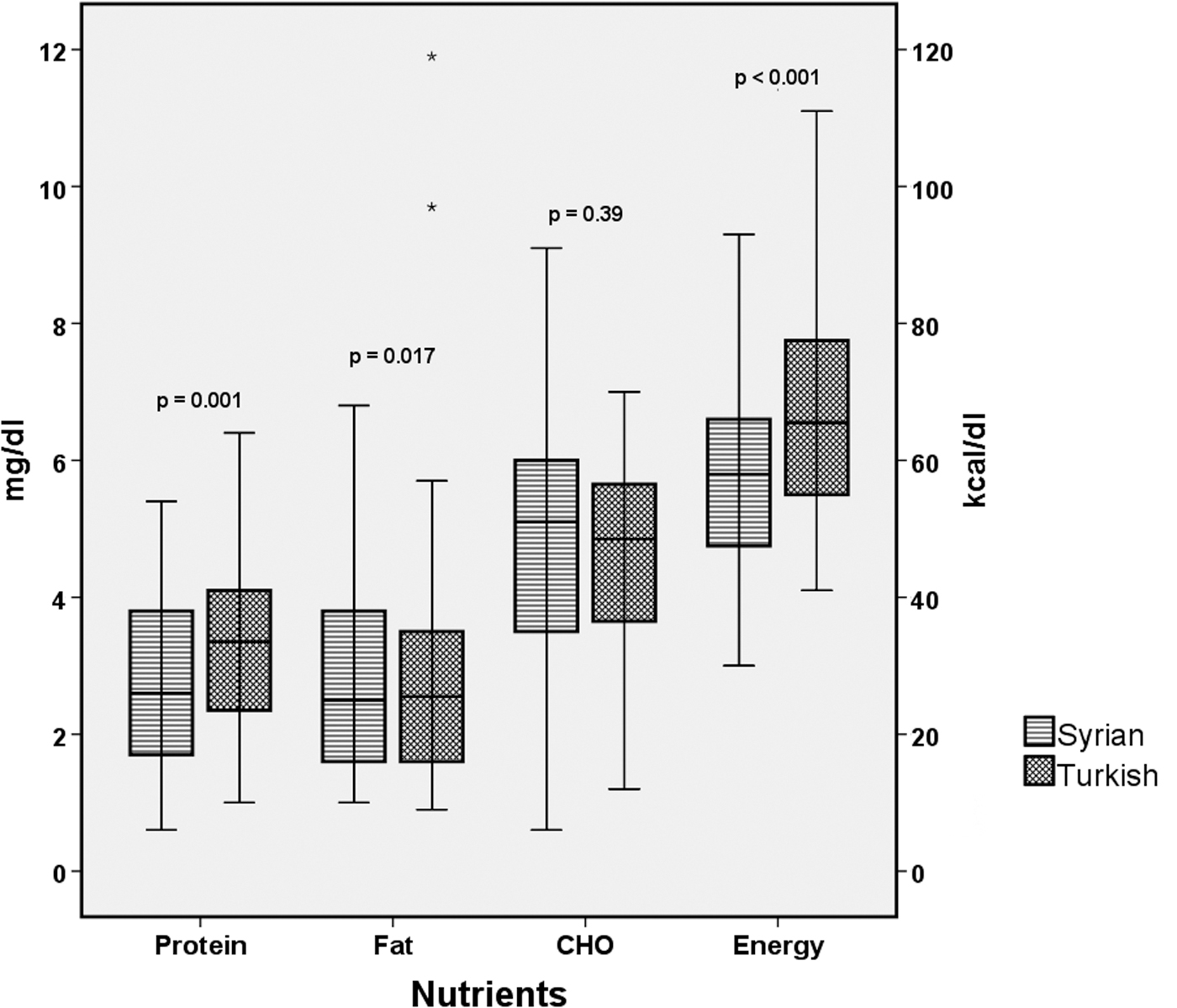
Macronutrient content and energy values in colostrum of Syrian and Turkish mothers. *Extreme values.
Breast Milk Protein, Fat, Carbohydrate, and Energy Levels in Syrian and Turkish Mothers
Data in bold are significant.
All data are median (interquartile range).
CHO, carbohydrate.
Although Turkish mothers gained more weight during pregnancy, this was not correlated with the macronutrient content in colostrums. Neither BMI, gestational age, nor birth weight were correlated with the macronutrient content of colostrums of both groups.
Turkish and Syrian mothers were able to provide milk samples mostly on the second day after delivery (83% versus 81%; p = 0.34). We observed no differences between macronutrient content of the first and the second day colostrums of Turkish and Syrian mothers (Table 3).
Macronutrient Content in Colostrum According to Days
Data are median (interquartile range).
CHO, carbohydrate; NS, not significant.
Discussion
In this study, we showed that colostral milk of Syrian mothers differ from Turkish mothers' milk in terms of protein and fat contents and energy values. And lower protein content in colostrum was associated with cesarean delivery and being a refugee.
The macronutrient content is considered not to be affected by mother's diet.9,10 However, a number of studies showed an association.11–14 In poor socioeconomic countries such as India, 11 Guatemala, 12 Pakistan, 13 and Colombia, 14 mothers' insufficient protein intake resulted in a reduction of protein in BM. This study showed a significant difference of protein levels among the groups in favor of Turkish mothers' colostrum, which may be a sign of insufficient protein intake of Syrian mothers.
Dizdar et al. compared delivery route in terms of macronutrient content of BM and found out cesarean delivery was associated with lower protein content. 4 Similar to this study, protein content was lower in BM of mothers undergoing cesarean deliveries in our study. However, it is remarkable that protein content of BM both in Turkish and Syrian groups is higher compared with previous studies.15–18 This can be explained by the fact that we collected milk samples within the first 48 hours after birth. Protein content of BM dramatically decreases as it changes from colostrum to mature milk. 17 In the meta-analysis that assessed results of 41 studies of BM content, Gidrewicz and Fenton showed that mean protein level of colostrum is 2 g/dL and it decreases to 1.0 g/dL in 10–12 weeks. 17
In large studies from Korea and Japan, BM lipid content was found to be similar to that of Turkish mothers' in our study.16,19 However, Syrian mothers had lower lipid content of milk than Turkish mothers. In a Polish study, the correlation between macronutrient content and BMI was investigated, in which median lipid content was 3.5 g/dL (measured by MIRIS) and higher lipid concentration was related to higher BMI. 2 On the contrary, Mangel et al. observed 109 mothers' colostrums by grouping the mothers according to BMIs and found no relationship between BMI and fat content. 20 Likewise, this study showed no correlation between BMI and macronutrient content in either study groups.
It is known that lipids are the most varied component of BM, depending on maternal diet, stage of lactation, hind/foremilk, and time of the day, and storage conditions. 19 To minimize variability in this study, samples were collected at the same time period of the day, from one breast before feeding, during the first 48 hours after birth and analyzed immediately. As Mandel et al. showed that energy contents were significantly correlated with lipid content, 21 we suggest that Turkish mothers' higher energy content of colostrums is related with their higher lipid concentrations.
We supposed that significant differences in protein and lipid content of milk samples between Syrian and Turkish mothers might be related to poor living conditions, it was assumed that Syrian mothers could not meet their daily nutritional needs. However, we could not address the mothers' daily dietary intake in either groups. Moreover, it should be considered that only colostral milk samples were examined in our study. In a recent study from Turkey, macronutrient content of BM is examined during the first month of lactation and it is shown that protein levels decrease weekly, and fat, CHO, and energy levels increase. 22 In this respect, it would be appropriate to compare macronutrient content of BM during all stages of lactation among refugees and locals.
Syrian refugees face physical and psychological stress besides insufficient access to nutritional intake. Various studies showed that psychosocial strain of refugees results in higher risk of psychiatric disorders such as depression, anxiety, and post-traumatic stress disorder.23–27 Although we did not perform stress scaling in our study, the stress Syrian refugees are exposed to raises the question of whether it can affect macronutrient of BM. However, the literature has no evidence of the effects of stress on BM content.
In conclusion, we suggest that mode of delivery and being a refugee might result in variabilities of BM content. We believe that further investigations to evaluate BM content considering all factors related to mother and consecutive measurements at different lactation stages would shed light on the literature.
Footnotes
Disclosure Statement
No competing financial interests exist.
Funding Information
No funding was received for this article.