




Abstract
Background:
It has been observed that breastfeeding mobilizes the deposits of fat that accumulate during pregnancy and promotes weight loss through energy expenditure. The purpose of this study was to demonstrate that full breastfeeding (FBF) reduces anthropometric and body composition indicators in women between the 8th and the 16th week postpartum.
Methods:
In a nonrandom cohort study, 170 mothers at the Hospital Civil de Guadalajara, Guadalajara, México, were enrolled: FBF 74, partial breastfeeding (PBF) 57, and human milk substitutes (HMS) 39. Anthropometric indicators and body composition were measured at the 8th and 16th week postpartum. We performed analysis of variance to compare body composition according to the type of feeding and paired Student's t-test to compare the changes from the 8th to 16th week postpartum.
Results:
We found that FBF mothers had a trend to lower arm fat area and triceps skinfold than PBF and HMS mothers at 8 and 16 weeks postpartum. We observed a decrease in weight (p = 0.004), weight/age index (p = 0.003), body mass index (p = 0.003), hip circumference (p = 0.037), and lean mass (p = 0.003) from 8 to 16 weeks postpartum in mothers who offered FBF. The mid-upper arm circumference, the arm total area, and their z-score increased in the three feeding groups.
Conclusions:
Our results show that FBF mothers had some lower adiposity from 8 to 16 weeks postpartum compared with the result observed among PBF mothers and those who utilized HMS.
Introduction
According to the World Health Organization (WHO), human milk should be the universal food for the infant until 6 months of age and should be accompanied by other foods up to 2 years. 1 Breastfeeding offers multiple benefits for the infant, such as protecting against infectious diseases such as diarrhea and respiratory illness, favoring their biological and mental development. 2 Women who breastfeed have a lower risk of postpartum hemorrhage and depression, can return to their pregestational weight in less time and have reduced risks of diseases such as type II diabetes, osteoporosis, cancer, hypertension, and heart problems. 3
The postpartum period is also associated with an increase in food intake and a decrease in the level of physical activity, 4 which can lead to the development of overweight and obesity. The weight retention associated with pregnancy is estimated to be between 0.5 and 3.8 kg at 2.5 years after delivery; in addition, the weight retention contributes to the increase in abdominal fat and an atherogenic lipid profile. 5 It has been observed that breastfeeding mobilizes the deposits of accumulated fat during pregnancy and promotes weight loss through energy expenditure (500 kcal/day) 6 ; however, this protective effect may vary among the population. 7
The promotion of a healthy weight and the prevention of obesity, with its associated multiple health risks, are public health challenges. In Mexico, 75.6% of women older than 20 years are overweight or obese, and 87.7% have abdominal obesity. 8 Obesity has become one of the main causes of chronic diseases, mainly hypertension, atherosclerosis, cerebrovascular accidents, type 2 diabetes mellitus, and cancer.9,10 Therefore, the purpose of this study was to demonstrate that fully breastfeeding mothers have significantly reduced anthropometric and body composition indicators between the 8th and 16th week postpartum compared with the indicators among partial-breastfeeding mothers or those who utilized human milk substitutes (HMS).
Methods
Design
This was a nonrandom cohort study of a sample of 170 mothers who were assessed according to the type of infant feeding: 74 full breastfeeding (FBF), 57 partial breastfeeding (PBF), and 39 utilizing HMS. Women returned to the hospital for measurements at 8 and 16 weeks postpartum.
Sampling
We identified 815 mothers who were admitted to the physiological puerperium ward in a shared room at the Nuevo Hospital Civil de Guadalajara from June 2015 to June 2017. Mothers were invited to participate after receiving education on the importance of FBF for at least 6 months. We clarified that we were interested in including all the mothers who wanted to participate regardless of the mode of feeding that they chose for their infants. They were included and followed for 16 weeks if they met the inclusion criteria: healthy postpartum women living in the metropolitan area of Guadalajara, who gave the authorization by signing the informed consent sheet and had a full-term healthy single infant of either sex with an adequate weight for gestational age. Mothers were excluded if they had a history of chronic, genetic, or congenital diseases; addiction to alcohol, tobacco, or drugs; or if their newborn had congenital malformations and/or genetic diseases. Mothers were also excluded due to loss of follow-up, presence of subacute or chronic disease, occurrence of illness or serious accident, or incomplete data of the mother or infant. Four hundred eight eligible mothers were contacted by telephone 4 weeks after delivery; 219 mothers accepted the invitation and attended the first visit at the 8th week, with 170 mothers ultimately returning for a second visit in the 16th week postpartum (Fig. 1). We compared the general characteristics (sociodemographic, educational, economic, etc.) at the beginning of the study (815), at 4 weeks (408), 8 weeks (219), and 16 weeks (170) and we did not find significant differences between the participants and nonparticipants. Therefore, we considered that the sample was homogeneous. The sample size and the sampling system are described elsewhere. 11
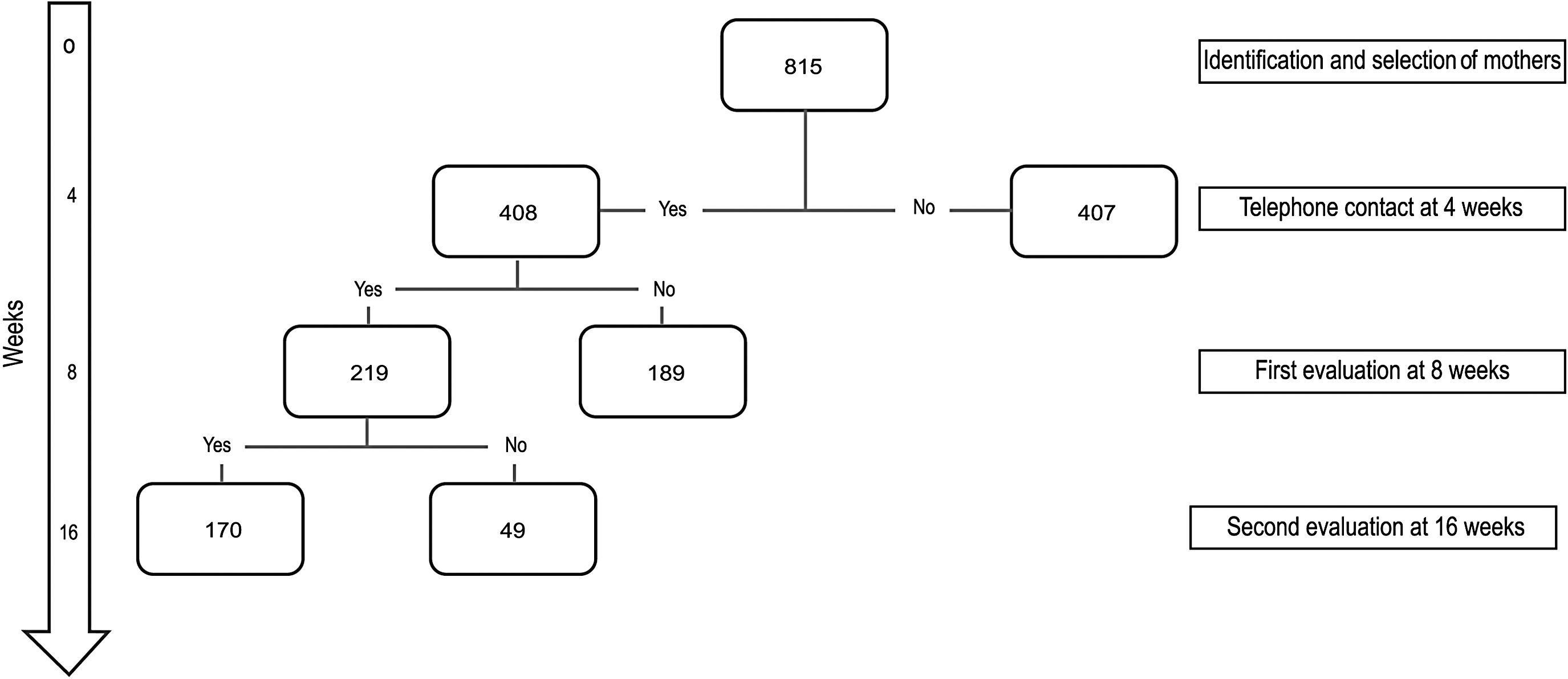
The flowchart describes the sequence of identification, contact, and inclusion of mothers from birth to 16 weeks postpartum.
Dependent variables
Anthropometric measurements and indicators were weight (kg), weight/age index (z), body mass index (BMI) (kg/m2), BMI (z), waist circumference (cm), hip circumference (cm), and waist/hip ratio. Arm anthropometric indicators: mid-upper arm circumference (MUAC, cm), MUAC (z), triceps skinfold (TSF, mm), TSF (z), subscapular skinfold (SSF, mm), and SSF (z). For the MUAC and TSF, the arm muscular area (AMA, mm) and arm fat area (AFA, mm) and z score were calculated. The following body composition indicators were assessed with bioelectric impedance analysis (BIA): lean mass (kg), fat mass (FM, kg), and body fat (%).
Independent variable
The type of feeding offered to the infant:
FBF: the mother offered the infant only breast milk, but could include supplements of oral hydration, drops, or syrups (vitamins, inorganic nutrients, and medicines). PBF: infant received breast milk and at least one bottle with HMS. HMS: no breastfeeding.
Measurement instruments and techniques
After the standardization of two observers (E.G.-M. and N.C.M.-E.), the following anthropometric measurements were performed at the 8th and 16th week postpartum:
Weight and body composition
Weight and body composition (total body water, lean mass, FM, and body fat) measurements were carried out by bioelectrical impedance analysis with a Tanita Body Composition Analyzer (model TBF-410GS; Tokyo, Japan). After having fasted for a minimum of 8 hours and with minimal clothing, the participant stood in contact with the electrodes of the analyzer platform and distributed their weight equally in both legs with their arms placed on both sides of their body.
Height
A stadiometer, model 213 (Seca, Hamburg, Germany), was used. The height measurements were performed with the participants standing without shoes or anything on their head. The participants were placed with their backs straight and their heels together and touching the vertical surface of the instrument; their buttocks, shoulders, and head were also in contact with the vertical surface of the instrument. Care was taken to distribute the weight on both feet and keep both arms at the sides relaxed and keep the axis of the eye and the external auditory canal aligned horizontally. The participant was asked to inhale deeply and then the mobile part of the stadiometer was lowered, and the measurement was taken to the closest 0.1 cm.
Waist circumference
A fiberglass metric tape measuring 6 mm in width was used to measure the part of the abdomen between the 12th rib and the iliac crest in the theoretically narrowest part of the torso and trunk (in women, the waist is 2 or 3 cm above the navel).
Hip circumference
A fiberglass measuring tape with a 6 mm width was used to perform the measurement, while the subjects were standing with their feet together and their arms on either side of their body with the palms of the hands facing inward; the tape was placed on the buttocks in the widest place horizontally around the body. The hip circumference was measured, and the measurement was taken to the closest 0.1 cm.
Triceps skin fold
The measurement was performed in the middle part of left arm that was previously marked on the posterior part. The layer of skin and subcutaneous tissue of the underlying muscle were separated, and the reading was taken at 5 mm, 3 seconds after the placement of the caliper (Lange Skinfold, MI).
Subscapular skin fold
The lower edge of the scapula was located. The examiner located 1 cm below the mark and horizontally folded the skinfold at a 45° angle; then, the measurement was performed (Lange Skinfold).
Statistical analysis
Once the information was obtained, the database was elaborated and captured, and the statistical analysis was performed with SPSS version 24 software. The Kolmogorov-Smirnov test showed that the anthropometric measurements and indicators had a normal distribution. They were described as mean and standard deviation and compared with parametric statistical tests. The comparison between the feeding types was performed with the analysis of variance test and the bivariate comparisons with Student's t-test. The comparisons within groups from 8 to 16 weeks for the three feeding types were carried out with the paired t-test. The error level assigned to consider a significant result was <0.05.
Ethical considerations
The recommendations of the Declaration of Helsinki were followed based on its last amendment during the 64th Annual Assembly organized by the World Medical Association, 2013. The protocol was applied to each of the participants who met the inclusion criteria after the mother provided her authorization by signing the informed consent. The protocol was approved by the Committees of Bioethics and Research of the Hospital Civil de Guadalajara (CI-01314).
Results
A total of 170 mothers were included at 16 weeks postpartum; of the total sample, 74 (43%) were in the FBF group, 57 (34%) were in the PBF group, and 39 (23%) were in the HMS group. The sociodemographic characteristics of the study participants are shown in Table 1.
Sociodemographic Characteristics of the Mothers According to the Type of Feeding Offered to the Infant
Chi-square test = n (%); ANOVA = mean ± SD.
Without having been married.
FBF, full breastfeeding; PBF, partial breastfeeding; HMS, human milk substitutes; ANOVA, analysis of variance; SD, standard deviation.
At 8 and 16 weeks postpartum, FBF mothers had anthropometric indicators and z-scores (weight, weight/age index [z], BMI [kg/m2], BMI [z], waist circumference, and hip circumference) lower than those of the PBF mothers and those who used HMS, although the differences were not significant. However, FBF mothers had a decrease in anthropometric indicators and z-scores from the 8th to 16th week postpartum (weight [p = 0.004], weight/age index [p = 0.003], BMI [p = 0.003], BMI z-score [p = 0.002], and hip circumference [p = 0.037]). No significant change was observed in the PBF or HMS groups (Table 2).
Changes of Anthropometric Indicators and z-Scores from the Eighth to the Sixteenth Week Postpartum According to the Type of Feeding Offered to the Infant
ANOVA test to compare intergroups at 8 and 16 weeks postpartum: NS.
Bivariate comparisons (Student's t-test) at 8 and 16 weeks postpartum: NS.
Paired Student's t-test to compare intragroups from 8 to 16 weeks postpartum. Some values of outliers were eliminated.
BMI, body mass index; FBF, full breastfeeding; PBF, partial breastfeeding; HMS, human milk substitutes; ANOVA, analysis of variance; SD, standard deviation; NS, non significant.
Regarding the anthropometric arm indicators and z-score, at 8 weeks postpartum, FBF mothers had a trend to lower AFA (z) p = 0.058 and TSF (z) p = 0.069 than those of HMS mothers, and MUAC (z) p = 0.061 and AFA (z) p = 0.057, at 16 weeks postpartum. Nevertheless, we observed an increase in MUAC (cm), MUAC (z), AMA (mm), and the AMA (z) in the three groups of mothers from 8 to 16 weeks postpartum (Table 3).
Changes of Anthropometric Arm Indicators and z-Scores from the Eighth to the Sixteenth Week Postpartum According to the Type of Feeding Offered to the Infant
ANOVA test to compare intergroups at 8 and 16 weeks postpartum: NS.
Bivariate comparisons (Student's t-test). At 8 weeks postpartum: AFA (z): FBF versus PBF p = 0.088; FBF versus HMS p = 0.058; TSF (z): FBF versus HMS p = 0.069; SSF (z): FBF versus PBF = 0.057. Bivariate comparisons (Student's t-test) at 16 weeks postpartum. MUAC (z): FBF versus HMS p = 0.061; AFA (z): FBF versus HMS p = 0.057.
Paired Student's t-test to compare intragroups from 8 to 16 weeks postpartum. Some values of outliers were eliminated.
FBF, full breastfeeding; PBF, partial breastfeeding; HMS, human milk substitutes; ANOVA, analysis of variance; SD, standard deviation; MUAC, mid-upper arm circumference; AMA, arm muscular area; AFA, arm fat area; TSF, triceps skinfold; SSF, subscapular skinfold.
In the body composition indicators (lean mass, FM, and percentage of body fat), no significant difference was observed between the three feeding groups at 8 and 16 weeks postpartum, although mothers with FBF had lower indicators than the PBF and HMS groups. We observed that FBF mothers exhibited a trend to lower FM (p = 0.093) and percentage of body fat (p = 0.075) from 8 to 16 weeks postpartum. Nonsignificant difference was observed in the PBF and HMS groups (Table 4).
Changes of Body Composition from the Eighth to the Sixteenth Week Postpartum According to the Type of Feeding Offered to the Infant
ANOVA test to compare intergroups at 8 and 16 weeks postpartum: NS.
Bivariate comparisons (Student's t-test) at 8 and 16 weeks postpartum: NS.
Paired Student's t-test to compare intragroups from 8 to 16 weeks postpartum. Some values of outliers were eliminated.
FBF, full breastfeeding; PBF, partial breastfeeding; HMS, human milk substitutes; ANOVA, analysis of variance; SD, standard deviation.
Discussion
Breastfeeding is associated with health benefits for both the mother and infant,2,12 and its role in weight control after delivery is still controversial. In theory, breastfeeding should decrease postpartum weight retention due to the fat mobilization associated with the energy expenditure associated with breastfeeding.13,14 However, the change in weight during this stage in lactating women is variable and may be influenced by different factors. 7 In this study, we analyzed the changes and differences that occurred in the anthropometric and body composition indicators at 8 and 16 weeks postpartum among FBF and PBF mothers and those who used HMS.
Anthropometric and body composition at 8 weeks
At 8 weeks postpartum, there were no significant differences between the three groups; however, in FBF mothers, we observed lower adiposity measured with the anthropometric indicators than those of the PBF mothers and those who used HMS. The mean weight of the mothers in the FBF group was 2.3 and 3.1 kg lower compared with the PBF mothers and those who used HMS, respectively. BMI was also lower in FBF mothers, while an average BMI above 25.0 kg/m2 was observed in the PBF and HMS groups, which is considered overweight according to the WHO criteria. 15 Our results differ from the data reported by Okechukwu et al., 16 who observed a higher weight and BMI in FBF mothers 8 weeks postpartum. We found that mothers with PBF and HMS had waist circumference higher than 80 cm. Waist circumference is the indicator that has been related to cardiovascular and metabolic risk in adults when the value is >80 cm. 15
Regarding the anthropometric arm indicators, it was observed that important fat reserve indicators, such as the z-score of TSF and AFA, were trending lower in the FBF group than in the PBF and HMS groups. In contrast, Okechukwu et al. 16 did not observe differences in TSF at 2 months postpartum.
Regarding body composition evaluated by BIA, we did not observe significant differences between the three groups; however, lean mass, FM, and fat percentage were lower in the FBF group than in the PBF and HMS groups. Our results were similar to those reported by Hatsu et al., 17 who found lower FM in FBF mothers than in PBF mothers at 8 weeks postpartum and observed lower lean mass in PBF mothers at 4 and 8 weeks postpartum.
Anthropometric and body composition at 16 weeks
The values were lower in FBF mothers than in PBF mothers and those who used HMS, with nonsignificant differences between the three groups. We observed that the mean weight in the FBF mothers was 2.8 and 3.8 kg lower than the PBF mothers and those who used HMS, respectively. The mean BMI was lower in the FBF group than in the PBF and HMS groups, which had average BMIs >25 kg/m2. Our results are consistent with those observed by Mullaney et al., 4 who compared anthropometric indicators of mothers between the three feeding groups at 4 months postpartum. We also observed that waist circumference and hip circumference were lower in the FBF group than in the other two groups. The waist circumference remained higher than 80 cm among PBF mothers and those who used HMS.
Regarding the anthropometric arm indicators, we found lower MUAC (z) in the FBF group than in the HMS group. The MUAC is an indicator of nutritional status that reflects muscle mass and FM status according to Schaap et al., 18 and is an indicator of protein-energy malnutrition or a state of starvation, according to Das et al. 19 In addition, we observed lower values of indicators of fat accumulation, such as AFA (z), in FBF mothers than in mothers who provided HMS. Our results were similar to those reported in the study by Okechukwu et al., 16 who observed lower fat reserve indicators in FBF mothers at 4 months postpartum. Regarding body composition data, we observed a trend toward lower lean mass in the FBF group than in the PBF and HMS groups. Our findings are similar to those reported by Mullaney et al. 4 and Hatsu et al., 17 who compared FBF mothers with PBF mothers. We found that FM and fat percentage were also lower in FBF mothers than in PBF mothers and those who provided HMS; however, Mullaney et al. 4 and Hatsu et al. 17 observed higher FM in FBF mothers.
Differences in anthropometric and body composition from the 8th to 16th week postpartum
When we analyzed the decrease in anthropometric indicators and body composition in each group from 8 to 16 weeks postpartum, we observed a significant decrease in adiposity indicators in the FBF group: weight, weight/age index, BMI, BMI (z), and hip. In PBF mothers and those who provided HMS, we observed an increase in waist circumference; the hip circumference only increased in the HMS group, without a significant difference. Our findings are consistent with the results of other studies that observed a decrease in body weight and BMI in FBF mothers in the first 3 or 4 months postpartum.4,16,17 However, in the anthropometric arm indicators, we observed a significant increase in MUAC (mm) and AMA (mm) and their z-score, among the three groups from the 8 to 16 weeks. This increase could be associated with the need to recover lean mass that has been recognized as a determining factor in the increase in energy needs promoted through appetite regulator signals that directly influence daily dietary intake. 20 Given that fat-free mass (FFM) is the main determinant of resting metabolic rate, and the two parameters co-vary strongly, it is important to establish whether it is FFM (or more specifically, a molecular signal arising from FFM) or energy expenditure per se that drives food intake. 21 In a mediation model using path analysis, Hopkins et al. 22 indicated that FFM had no “direct” effect on food intake, but rather “indirectly” influenced food intake by its effect on resting energy metabolism. Stubbs et al. 23 in a review article showed that pregnancy is associated with a marked increase in weight, FM, FFM, and importantly, appetite. Also, in an animal study there was a 100% increase in energy intake (EI) during pregnancy and up to 450% in lactation; while in humans, the increase in EI is more modest: 10–15% during pregnancy and 20–25% during lactation. With most attention directed to the role of adipose tissue (or FM), FFM has become the “forgotten variable,” even though it is clearly important under some conditions. It is interesting that a detailed analysis of body composition and appetite variables using the multilevel platform has demonstrated that FFM, but not FM or BMI, is strongly correlated with meal size and daily EI. 24
Regarding adiposity indicators (FM and percentage of body fat) measured by BIA, we found a lowering trend from 8 to 16 weeks postpartum in the FBF mothers, while the PBF and HMS mothers had an increase of adiposity without significant differences from 8 to 16 weeks. Our findings were in contrast to those reported by Hatsu et al., 17 who observed greater loss of FM and fat percentage in the PBF group than in the FBF group.
The main strength of the study was the follow-up of a cohort from birth and the measurement of anthropometric indicators and body composition of mothers at 8 and 16 weeks postpartum according to the type of feeding practice. We did not identify selection bias because the formation of the groups happened naturally and the researchers did not influence the decision of what type of feeding the mothers offered to the infants. In addition, since the documentary measurement instruments were the same in the three study groups, information bias was not considered to occur. The main limitation was that the number of mothers who used HMS was lower than the number of mothers who adopted FBF and PBF methods. We speculated that the reason was because exclusive breastfeeding was promoted since delivery.
Conclusion
Our results show that FBF mothers had lower anthropometric arm indicators of adiposity at 8 and 16 weeks postpartum than mothers in the PBF or HMS groups. In addition, the mothers in the FBF group showed a decrease in adiposity as measured with anthropometric and body composition indicators from 8 to 16 weeks postpartum, unlike the results of PBF mothers and those who provided HMS. Therefore, FBF could have a protective effect against overweight or obesity in the postpartum period and in the long term against cardiovascular disease and other chronic conditions related to nutrition. These findings reaffirm the importance of encouraging and supporting mothers to offer FBF as recommended by the WHO, not only for the benefits it offers to the infant but also for the health of the mother.
Footnotes
Acknowledgments
We gratefully thank all the mothers who participated in this study, and we would also like to thank all the personnel at the Hospital Civil de Guadalajara “Dr. Juan I. Menchaca” involved in this project.
Disclosure Statement
No competing financial interests exist.
Funding Information
This work was supported financially by the National Council of Science and Technology of Mexico (234158). The protocol was approved by the Committees of Bioethics and Research of the Hospital Civil de Guadalajara “Dr. Juan I. Menchaca” (CI-01314).