




Abstract
Background:
The Human Milk Banking Association of North America (HMBANA) is a nonprofit association that standardizes and facilitates the establishment and operation of nonprofit donor human milk banks in North America. Few studies have examined milk donor characteristics and geographic distribution, and little is known about how donor characteristics change with time.
Materials and Methods:
We performed a retrospective cohort study of mothers who donated to Mothers' Milk Bank Northeast (MMBNE) between January 1, 2011 and September 1, 2019. Data collected from MMBNE donor surveys and collection procedures were analyzed using descriptive and comparative statistics. Donor characteristics were examined for secular trends.
Results:
Donors (n = 3,764) were of mean age 32.5 years (median 32; IQR 30–35) and most donated more than once (median 2; IQR 1–3; range 1–41). The majority of donors gave birth to term infants and resided in New England; however, MMBNE donors were located in 39 states at the time of donation. Median total volume donated per donor was median 11,396 mL (380 Oz); IQR 6,020–24,242 mL. Mothers of preterm compared with term infants were more likely to be bereaved (p < 0.01) and donated larger volumes (p < 0.01). Over time, number of first-time donors increased, although donors became less likely to have preterm infants or to reside in Massachusetts or New England.
Conclusions:
Donors to MMBNE varied greatly in age and were broadly distributed geographically. Donor characteristics changed substantially over time. Enhanced understanding of the characteristics of donors may improve the efficiency of efforts to promote milk donation.
Introduction
Approximately 10
The majority of DHM used in United States NICUs comes from milk banks in the Human Milk Banking Association of North America (HMBANA) network. 16 Existing studies suggest that HMBANA donors are older, educated, and married,17,18; however, such studies are few and little is known about how the characteristics of a milk bank's donors change over time. The purpose of this study was to characterize mothers donating milk to a northeastern milk bank with respect to age, geography, and other factors, and to explore secular trends in donor characteristics.
Materials and Methods
This retrospective cohort study examined donors to Mothers' Milk Bank Northeast (MMBNE), a nonprofit HMBANA milk bank located in Newton Upper Falls, Massachusetts. We used data from donor intake interviews and human milk collection procedures collected by MMBNE from January 1, 2011 to September 1, 2019. The MMBNE screening process mirrors that of American Red Cross blood donation. 19 Donors were eligible for inclusion if they were screened and interviewed by MMBNE, donated any quantity of milk to MMBNE, and provided a gestational age for their infant. Donors were excluded if they did not pass the original screen, donate any milk, have a documented date of first donation, did not reside in the United States, or if their infant did not have a documented gestational age. MMBNE donor data used for this study included date of mother's approval as MMBNE donor, the state from which donations were sent, age at first donation, total donated milk volume to date, dates of donation, number of donations, and infant gender and gestational age. Donors were considered bereaved if their infant was deceased. The IRB at Connecticut Children's approved this study.
Statistical methods
Descriptive summary statistics were used to characterize cohort data. Univariate comparison of donor characteristics applied Mann–Whitney U tests for continuous data and chi-square tests for categorical data. Secular trends in donor characteristics were examined for the period 2012–2018, excluding the years 2011 and 2019 for which data were not available for the complete calendar year. Trends were identified by comparing aggregated annual data with its 2012 baseline using chi-square tests for categorical data and one-sample tests of proportions for counts. Trends in age at first donation were identified with logistic regression modeling in which donor age at first donation was the dependent variable and year of first donation was the independent variable, again, using 2012 as reference. All statistical analyses were conducted using SPSS 26 (IBM, Armonk, NY). A two-tailed p-value <0.05 was considered significant.
Results
Data from 3,764 MMBNE milk donors were included in the study, with a total of 10,525 donations. The majority of donors were ≥30 years of age (Table 1). Most mothers donated their milk more than once, with the largest number of donations 41. There was a wide range in total volume of milk donated per donor (median 11,396 mL; IQR 6,020–24,242 mL). The largest total volume donated was 529,349 mL. Most donors gave birth to term infants and were not bereaved (Table 1). There was a roughly equal distribution of male and female infants born to donors. Relative to term mothers, total volume of milk donation was higher among mothers of preterm infants (Table 2). The majority of bereaved mothers gave birth to preterm infants (p < 0.01; Table 2).
Characteristics of Mothers Donating to Mothers' Milk Bank Northeast
N < 3,764.
IQR, interquartile range; SD, standard deviation.
Study Cohort Characteristics Stratified by Gestational Age
Chi-square test.
N < 3,764.
Mann–Whitney U test.
SD, standard deviation.
Massachusetts, the state where the milk bank is located, had the highest percentage of donors; however, more than half of donations came from outside of Massachusetts (Table 3). The majority of donors were located in New England (n = 2,786; 74%). Donors were broadly dispersed within the United States, with donated milk originating in 39 states and the District of Columbia.
Donor Location at the Time of Donation
Compared with 2012, donors became significantly less likely with time to have preterm infants, although the proportion bereaved did not change (Fig. 1). Donors also became less likely to reside in Massachusetts or New England early in the study period, and although this rebounded, subsequently the proportion of donors from Massachusetts or New England remained significantly below the 2012 initial value. The full year with the fewest first-time donors was 2012 (n = 116) (Fig. 2) and, relative to this baseline, the number of first-time donors increased each year to a maximum in 2018 (n = 689). No significant secular trend was evident regarding maternal age.

Secular trends in donor population, Mothers' Milk Bank Northeast, 2012–2018.
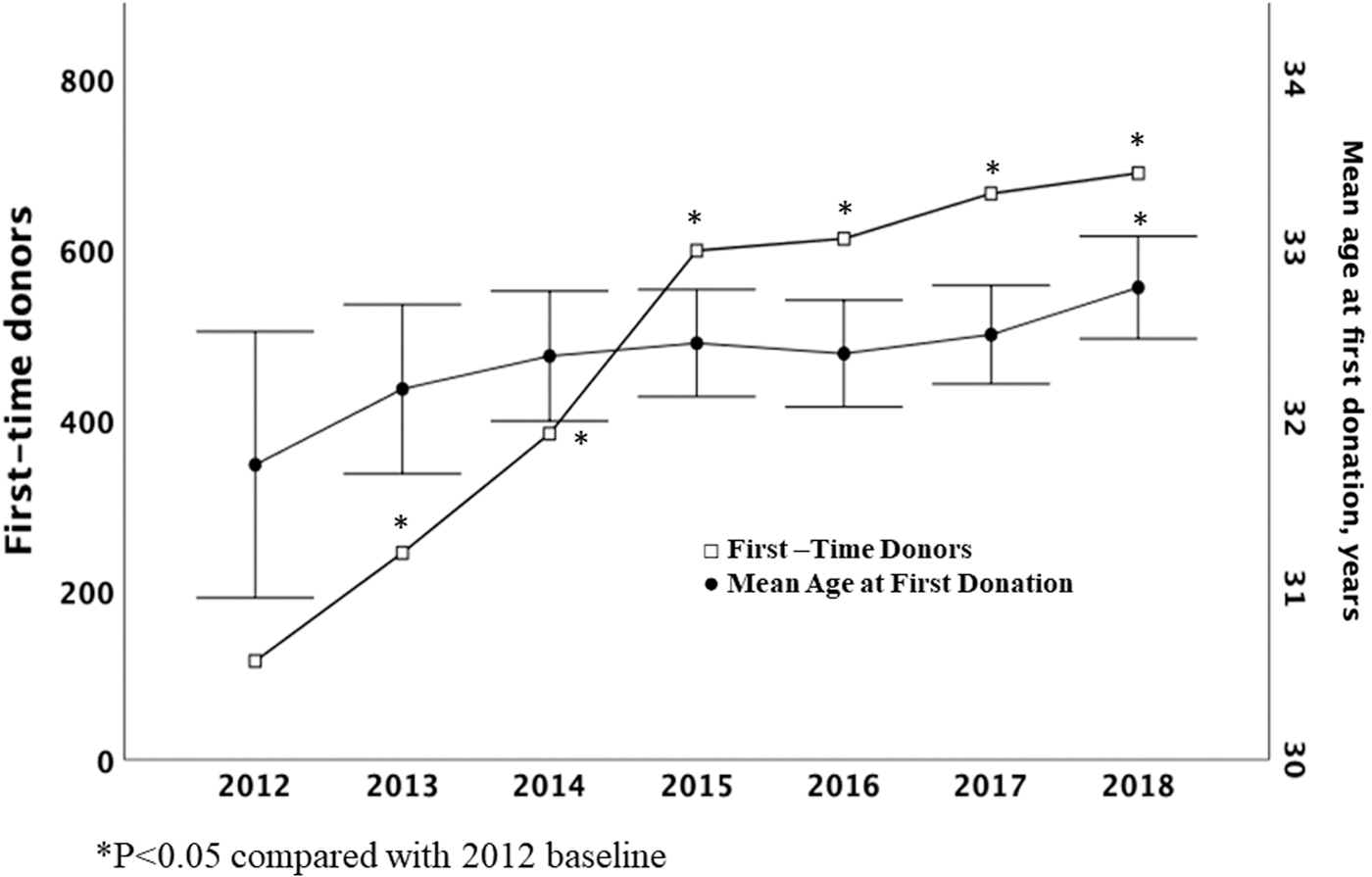
Secular trends of donor age at first donation and number of donors, Mothers' Milk Bank Northeast, 2012–2018.
Discussion
Using data from a nonprofit human milk bank in New England, these observed findings identified factors associated with human milk donation in the northeastern United States, which included being >30 years of age, residing in New England, and giving birth to term infants. Furthermore, this study highlighted secular trends regarding milk donor characteristics.
There is limited literature on this topic as this is the first study to quantify and describe such data regarding donors in the Northeast. Although minimal previous research evaluated quantitative and qualitative factors associated with milk donation,20–22 few studies evaluated the demographics and characteristics of a large subset of human milk donors in the United States.17,18,23
With respect to existing research evaluating U.S. human milk donation to HMBANA-affiliated milk banks, donors were generally older, which was consistent with our findings.17,18 A study of donors to a HMBANA-affiliated milk bank in Austin, Texas (N = 87), reported that donors were generally ≥30 years of age, white, married, and educated with a mean volume of donation of 29,650 mL, SD 31,130 mL. 17 The mean volume of donation was greater than this study's observed mean volume donation of donation. Furthermore, a descriptive study of donors (N = 50) from a HMBANA-affiliated milk bank in the Midwest reported that donors were more likely to be white, college-educated, and married; the mean age of donors was 30.8 years and the majority (n = 43) were single donors. 18 In addition, the majority of their donations ranged from 5,915 to 8,872 mL. 18 Although consistent with mean age, this study's observed findings from MMBNE identified that donors donated on average more than once with an increased mean volume of donation per donor.
Previous global human milk donation studies reported inconsistent findings.20–23 This study population was similar in age to many global studies, but we reported dissimilar gestational ages of donor infants and volumes of donation, as these results observed a smaller proportion of preterm infants and a larger mean volume of donation.20–23 Given that these global studies examine milk banks that do not exist within the HMBANA milk banking umbrella, the demographics and characteristics of their donors differ as expected.
Disparities associated with accessing DHM remain a broad and important issue. One study observed that hospitals in postal zip codes with percentage of non-Hispanic black residents being above the national average at the time of study (12.3%) were more likely to report not using DHM than hospitals in postal zip codes with percentage of non-Hispanic black residents being below the national average at the time of study. 24 Another study examining predictors of nonconsent to receive donor milk in the NICU found that nonwhite race predicted nonconsent status. 25
Although several studies evaluated characteristics and general motivators of human milk donors globally and other studies investigated a small subset of HMBANA milk donors, no previous research evaluated a sample size this large or the unique quantitative factors associated with this specific U.S. milk bank.17,18,20–23 This study's large sample size of >3,500 human milk donors strengthens our analysis.
Our findings are subject to several limitations. First, the data collected are only representative of MMBNE donors. Screening procedures and donor inclusion criteria are not standard among milk banks, so that other banks may have donors with different characteristics and demographics. Information regarding race, income, number of children, and type of delivery were not available to analyze. The goals of the MMBNE donor screening processes are to ensure that donors and their infants are healthy and that the donated milk is safe for the fragile infants who receive it. MMBNE determined that the collection of race and ethnicity demographics were not relevant to the goals of their screening process. Without a common definition for race and ethnicity, they believe each donors identification on a checklist would be of limited use. In addition, no data were available regarding mothers who did not meet MMBNE inclusion criteria for donation; therefore, we were unable to identify factors associated with nondonor status. Also, some data were obtained from donors through telephone and are, therefore, vulnerable to response bias. Finally, because MMBNE milk donors are given a new donor ID number for each pregnancy in which they donate milk, we were not able to track mothers who donated across more than one pregnancy.
Conclusions
In summary, we report that donors to a nonprofit milk bank in New England varied greatly in age and in number and volume of donations, and were broadly distributed geographically. Donor geographical distribution and other characteristics changed substantially with time. These data will be useful for MMBNE and other nonprofit HMBANA milk banks to prioritize donor recruitment efforts. Further research may choose to investigate predictors of repeated donation, how milk donors are introduced to milk banks, and characteristics of mothers not meeting criteria for donation. These results suggest future donor milk bank collections and studies evaluate current practices and ensure DHM is accessible to all vulnerable infants across the United States.
Footnotes
Acknowledgment
We thank Ms. Morgan Kennedy Henderson for her assistance in data collection and expertise in Mothers' Milk Bank Northeast data collection processes.
Disclosure Statement
No disclosures to report.
Funding Information
No funding was received.