




Abstract
The article is devoted to Leo Tolstoy's ideas about breastfeeding that he expressed eloquently in his novels, educational articles, and philosophical essays. Tolstoy's perspective on breastfeeding is discussed in his novella The Kreutzer Sonata and in his nonfiction of the late 1880s. His basic ideas had been shaped through his own experience and family life. Also important was his correspondence with the American physician, Alice Bunker Stockham, MD, an author of Tokology: A Book for Every Woman, and Tolstoy's editorial work on the medical brochure written by the head of Moscow Children's Hospital, E.A. Pokrovsky. Tolstoy's literary and historical accounts of breastfeeding promotion can help to understand the current day practices and ways in which cultural traditions are incorporated into infant care in contemporary Russia.
Leo Tolstoy (1828–1910), the great Russian novelist and philosopher, developed strong ideas about family and breastfeeding that he expressed eloquently in his novels, educational articles, and philosophical essays. These theories about new approaches to parenthood and nursing were adopted by his numerous followers and enthusiastic readers, as well as by mothers who attested to them in their diaries in the early 20th century. 1 Agricultural colonies and communal farms devoted to living a Tolstoyan life were part of an international movement that proliferated in the 1890s. Tolstoyan life assumed nonresistance, simple living, vegetarian diet, pacifism, and chastity. Centers of Tolstoyan activity emerged in many places in Russia, Britain, the United States of America, the Netherlands, Finland, Hungary, Japan, South Africa, and Chile. 2
Tolstoy's literary and historical accounts of breastfeeding promotion can help to understand the current-day practices and ways in which cultural traditions are incorporated into infant care in contemporary Russia. The organization of breastfeeding promotion campaigns and advocacy of increased nursing duration could “result in healthier children and reduced health care costs.” 3 One can find telling examples of this approach in Tolstoy's literary heritage. Tolstoy's treatment of the issue can be illuminating for present-day health care specialists, as well as for artists and writers involved in breastfeeding promotion campaigns.
Tolstoy's perspective on breastfeeding and its well-documented health benefits, including its long-term effects, are discussed in his novella The Kreutzer Sonata, published in 1889. In this novella, Tolstoy is telling the story of Pozdnyshev marriage and murder of his wife through the agency of hero's narrative and conversation between passengers in the train, and his nonfiction of the late 1880s.
His basic ideas had been shaped through his own experience and family life. Also important was his correspondence with the American physician, Alice Bunker Stockham, MD, an author of Tokology: A Book for Every Woman, and Tolstoy's editorial work on the medical brochure written by the head of Moscow Children's Hospital, E.A. Pokrovsky. Tolstoy considered breastfeeding a significant element not only of childcare but also of the family relationships that reinforce spouses' duties and the intimacy of marriage as an institution.
The daily life of married noblewomen in Russia after Peter the Great's reforms (1700–1721) consisted of “coquetry, balls, dancing, and singing,” whereas “family, household, and education of children” were moved into the background. 4 Although breastfeeding was seen as a “natural and expected continuation of the conception-pregnancy cycle as well as expected social maternal behavior,” it was expected that mothers would resume their social life after giving birth and would reassign their offspring to a wet nurse. 5
In contrast, peasant and working-class women were supposed to resume their domestic chores and work, along with mothering their newborns. Therefore, they had to supplement breastfeeding through using a kind of “suckling device,” which was a dummy made of a piece of chewed bread wrapped in cloth, and bottles made of cow horns filled with the whole or diluted cow's milk. As a result, infant feeding was highly irregular, infectious diseases were frequent, and the infant mortality rate was extremely high.
At the turn of the century, the child mortality rate was alarming all over the world. However, in the European part of Russia, the mortality level was one of the highest compared with other European countries and North America. The infant mortality rate was 277 out of 1000, and the probability of dying before age 5 years was 422 out of 1000. 6 Earlier statistical data are not available but the data quoted indicate the major trends revealed by the first all-nation census in Russia (1896–1897). Furthermore, it should be noted that childbirth itself was gravely dangerous for women; for women of childbearing age, death caused by the childbed fever (postpartum sepsis) was common due to poor sanitary practices in obstetrics and misunderstanding of the causes that led to it. Thus, a vicious circle was formed.
Women were not breastfeeding exclusively, ovulation was not suppressed by lactation, and mothers shortly became fertile again, and conceived a new baby. Successive births were deadly dangerous either for women, or for babies that tend to become orphaned. Orphanhood increased all kind of risks for babies and led to a further increase in child mortality (Fig. 1).

Figures represent the ratio of deaths per 100 births within the first year of life in the following states [translated from Russian] (Norway, Sweden, Switzerland, France, England, Italy, Germany, Austria, USSR). Exhibition “Maternity and Infancy Protection,” Table 3. Published by the “Maternity and Infancy Protection,” People's Commissariat of Health of the USSR. Moscow, 1923. Image from the collections of the Russian Medical Museum in Moscow, Russia.
A global campaign devoted to reducing the under-five mortality rate was officially declared at the Moscow Twelfth International Congress of Medicine in 1897. However, this problem had been widely discussed both among medical professionals and on the community level. Tolstoy was deeply involved in this discussion. Along with doctors and public health professionals, writers and artists addressed the issue in their public appeals. Indeed, literature in the Russian Empire had more than “merely decorative” value 7 ; it was perceived as a teacher of life and had multiple practical applications.
Tolstoy's ideas about community needs were formed while he participated in the 1882 Moscow census as a census taker, and he created the first schools for children of Russian peasants. He emphasized the significance of education and defended ideals of chastity and sexual abstinence. His active promotion of nonviolent resistance became known worldwide. His public life was the focus of intense interest, and his private life was the object of severe scrutiny. One of Tolstoy's major topics was the family. He claimed that the role of the family in a person's life and in the society was indispensable; neither the state nor the church was the significant human institution, but rather the family.
Tolstoy was married to Sophia Andreevna Behrs. They lived for 48 turbulent years together and had 13 children, 8 of whom survived childhood. Parents' grieving about the loss of their little ones was common in both wealthy and well-educated families as well as poor and uneducated families. Count Tolstoy's family was no exception.
In addition to political and social causes, infectious diseases, and epidemics, Tolstoy mentioned improper infant feeding and sex between husband and pregnant or nursing wife as significant factors contributing to child mortality. Even though Tolstoy believed that the family was of predominant value and that the main purpose of marriage was to produce children, he insisted on sexual continence as a “means of alleviating the plight of many women who suffered as a result of excessive childbearing” 8 and nursing as a recipe for indirectly reducing birth rates.
It is essential to highlight that Tolstoy developed these ideas during the period of his “spiritual upheaval” that changed his writings, his way of life, and the reality of all his large family.“He, who idealized family life, and described with love the noblemen's life in three novels, and created his own, similar environment, suddenly began to severely condemn and stigmatize it,” 9 wrote Tolstoy's 14-year-old son Ilya in the middle of 1880s.
The literary critic and scholar Pavel Basinsky, the author of the book Leo Tolstoy: Flight from Paradise, published in 2010, analyzes Tolstoy's and his family members' narratives, describing the family drama that led to Tolstoy's departure from his estate Yasnaya Polyana in 1910. There is another telling note of Ilya: “Of the thirteen children she gave birth to, she nursed eleven with her own breast. Out of the first thirty years of her married life, she was pregnant for one hundred and seventeen months, that is, ten years, and nursed for more than thirteen years.…” 9 In his book, Basinski suggests that one of the first “incisions” in the tissue of the family peace and harmony were related to the challenging experience of nursing Tolstoy's firstborn Seryozha. Sophia had not enough milk, suffered in pain, and was terribly discouraged by her husband, who was very angry that a “doctor (a stranger!) had the right to examine his wife's breasts.” 9
Tolstaya reflects on her exhausting experience in the novella Whose Fault? Apropos of “The Kreutzer Sonata,” which stayed unpublished and unknown until mid-1990s. This was her answer on her husband's The Kreutzer Sonata and a feminine perspective on the similar main plot, describing the main hero as “an egotist” obsessed with writing, who fancies himself a great “philosopher, and having a voracious sexual appetite, not only with his wife as the object.” 10 This novella was her way to speak out about her feelings and living through the breakdown in a family.
At the time of the composition of The Kreutzer Sonata the book Tokology: A Book for Every Woman by an American female doctor, a general practitioner from Illinois, Alice Bunker Stockham, was another source from which Tolstoy received his inspiration. 11 In his novella, Tolstoy refers to Stockham's ideas about chastity in marital relations. For example, Stockham encourages mothers to breastfeed, stating that “the true mother will not deny herself the privilege and pleasure of nursing her own offspring.” Tolstoy echoes her in The Kreutzer Sonata: “women become superior by the gravity of the acts of conception, birth, and nursing.” Both authors were modeling parents' behavior and believed that sex should be avoided during breastfeeding: “The milk is deprived of its vitalizing and nutritious elements,” 12 which would negatively affect breastfed babies—wrote Dr. Stockham in the chapter devoted to the chastity in marriage.
Similarly, Tolstoy believed that a woman is too weak to be a mistress and nurse at the same time and might develop hysteria and neurosis. 13 Based on examples taken from “nature,” Tolstoy proposed solutions to the social problem of women constrained by family relationships. That surprisingly coincided with the early suffragists' campaigns and emerging advocacy of “celibacy and abstinence as birth control.” 14
Contemporary medical evidence shows that sex during uncomplicated pregnancy and breastfeeding is perfectly safe, but in the late 19th century Tolstoy claimed the opposite. Even though Tolstoy's views on the significance of breastfeeding are eccentric and grotesque both for his contemporaries and for readers, they constructed an artificial model of family relationships and regulations that provided a pretext that women would use to avoid undesirable marital duties and direct sexual abuse inside the family. Upper class women, as well as the under class women, were obliged to follow the customary law and Code of Russian Laws, published in 1836, whereby “The woman must obey her husband, reside with him in love, respect, and unlimited obedience, and offer him every pleasantness and affection as the ruler of the household.”
Tolstoy's misconceptions about sex and its role in a woman's martyrdom echo his childhood. When he was only 18 months old, his mother died from a childbed fever after giving birth to his younger sister. David Holbrook in his book Tolstoy, Woman, and Death: A Study of War and Peace and Anna Karenina 15 () relates this fact to the infantile fantasies that haunted Tolstoy throughout his life.
These fantasies “of the mother being killed by sex—the sex that led to the pregnancy that took her away psychically, from her baby, and then killed her” 16 affected Tolstoy's feelings about motherhood. The dread of loss and the historically high level of maternal deaths informed Tolstoy's ideas about the possible ways to achieve the ideal of family happiness. Tolstoy's heroines embody his preoccupation with the family and endorse only one role for females—the role that implies marriage and motherhood.
Dr. Stockham supported Tolstoy's ideas of continence both inside and outside of marriage as a mean to overcome “injustice now done to women and children under the cover of the marriage law16,” in Tolstoy's words a way “restraining appetites both sexual and gastronomical.” 13 Tolstoy was pleased that his theories were substantiated scientifically and even requested the author's permission to have the “Tokology” translated into Russian.
In the foreword for Tokology he wrote that unlike others: “this book is about what no one is talking about and what is needed and welcome for everyone.” 17 He advocated the women's enlightenment in this sphere and sought for medical knowledge of pregnancy and labor, childcare and breastfeeding as a part of progressive motherhood. Tolstoy believed that higher education in medicine for women violated the 19th century norms of female behavior and qualified it as a kind coquetry. However, he claimed that certain awareness of the human body would not hurt women, their modesty, delicacy, and refinement that are intrinsic in their “primary charms,” 18 as moralists of that time stated (Fig. 2).
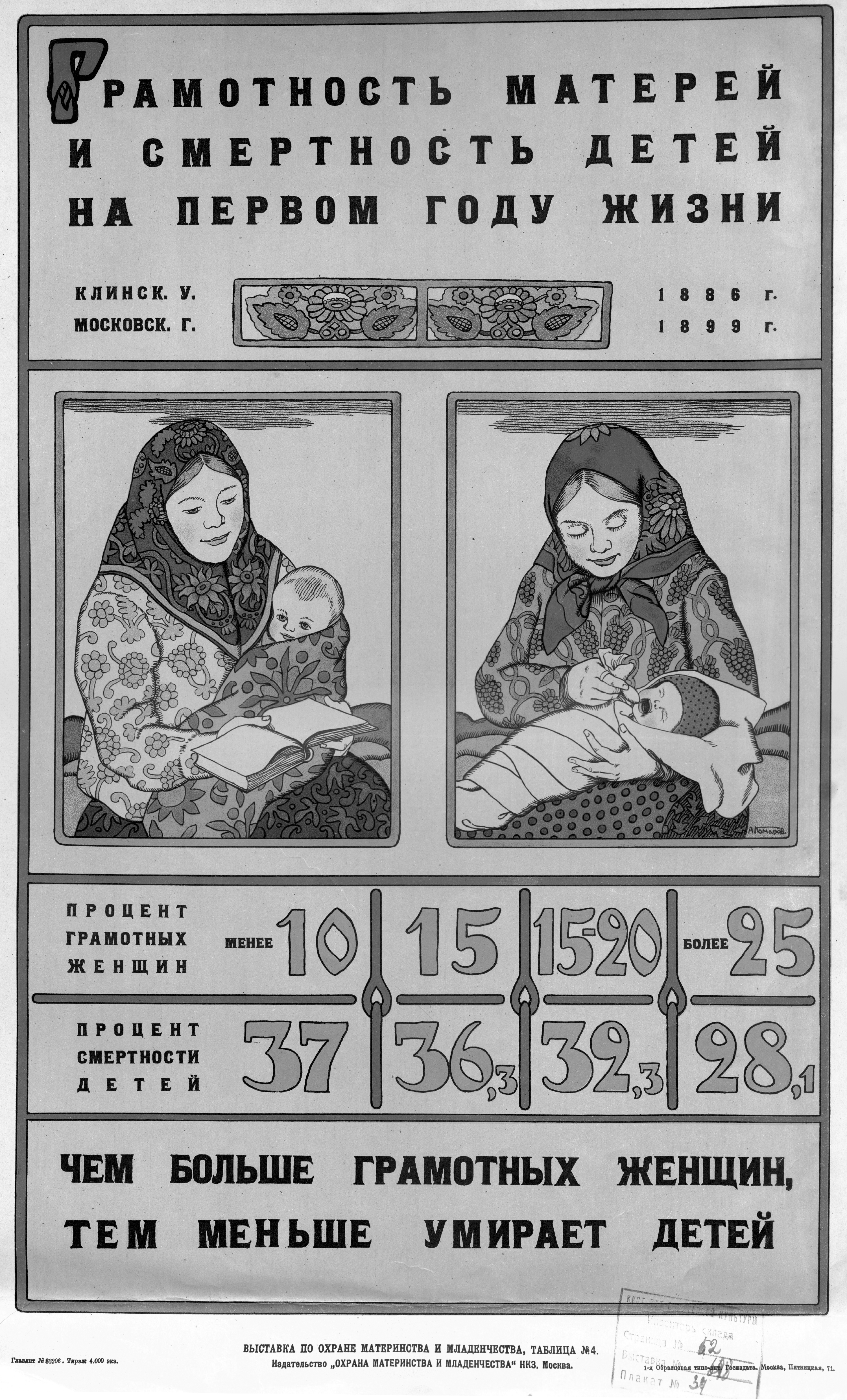
Maternal literacy and mortality in the first year of life—female literacy rate—infant mortality rate. The more literate the women, the less infant mortality [translated from Russian]. Exhibition “Maternity and Infancy Protection,” Table 4. Published by the “Maternity and Infancy Protection,” People's Commissariat of Health of the USSR. Moscow, 1923. Image from the collections of the Russian Medical Museum in Moscow, Russia.
About the same time (1887–1890), Tolstoy revised and simplified chapters from the head of the Moscow Children's Hospital, Dr. Pokrovsky's brochure intended for peasants. Tolstoy was writing a special piece for this popular book about the negative side of using suckling devices as dummies. His target audience was poorly educated women. The article was offered to “Posrednik” (mediator), a publishing house established in 1884 with Tolstoy's active support. He wrote: “A breastfed infant develops properly, basically healthy, and is not doomed to die. It is proven that most infants who died were fed with cow milk, fewer infants died when they were breastfed by wet nurses, and least infants died when they were breastfed by their mothers.” 17
Tolstoy and Pokrovsky defended breast milk as the only appropriate nutrition for infants until they are 6 months old. But they also emphasized that it should be their own mother's milk, condemning wet nurses services, pointing that it is not good both for the hiring wealthy family and the hired nurse. After all, in most cases, it was a poor woman who had to leave her child at home to care for another infant. The main character of The Kreutzer Sonata, Vasiliy Pozdnyshev, lamented that they had to hire a nurse to breastfeed their firstborn, a rather feeble child and that their family “in fact profited from the poverty and ignorance of this woman… after all, they stole her from her little one for the sake of their child.” Although Pozdnyshev noted that he paid the price, he was tormented with jealousy of his wife who started to lead a hectic social life shortly after the nanny got to work.
Likewise, in his brochure on infant care intended for underclass women, Tolstoy protested against mothers becoming breastfeeding nurses: “Let these mothers realize that that is they who are to be blamed for the death of their children and that leaving children and being employed as nurses, is the greatest sin women can commit, since they violate the law given to mothers by God Himself.” 17
Dr. Pokrovsky's ideas and his collaboration with Tolstoy on the education of mothers were reflected in social advertising. A special poster was created as part of the program to protect motherhood and childhood, initiated by the Soviet Government in the early 1920s. In 1887, Dr. Pokrovsky claimed that the “handmade suckling dummy killed more people than the plague, cholera, and all other illnesses combined”; in 1925, the Soviet Government restated that “chewed bread fed to infants killed more peasant's babies than soldiers' bullets did” (Fig. 3).
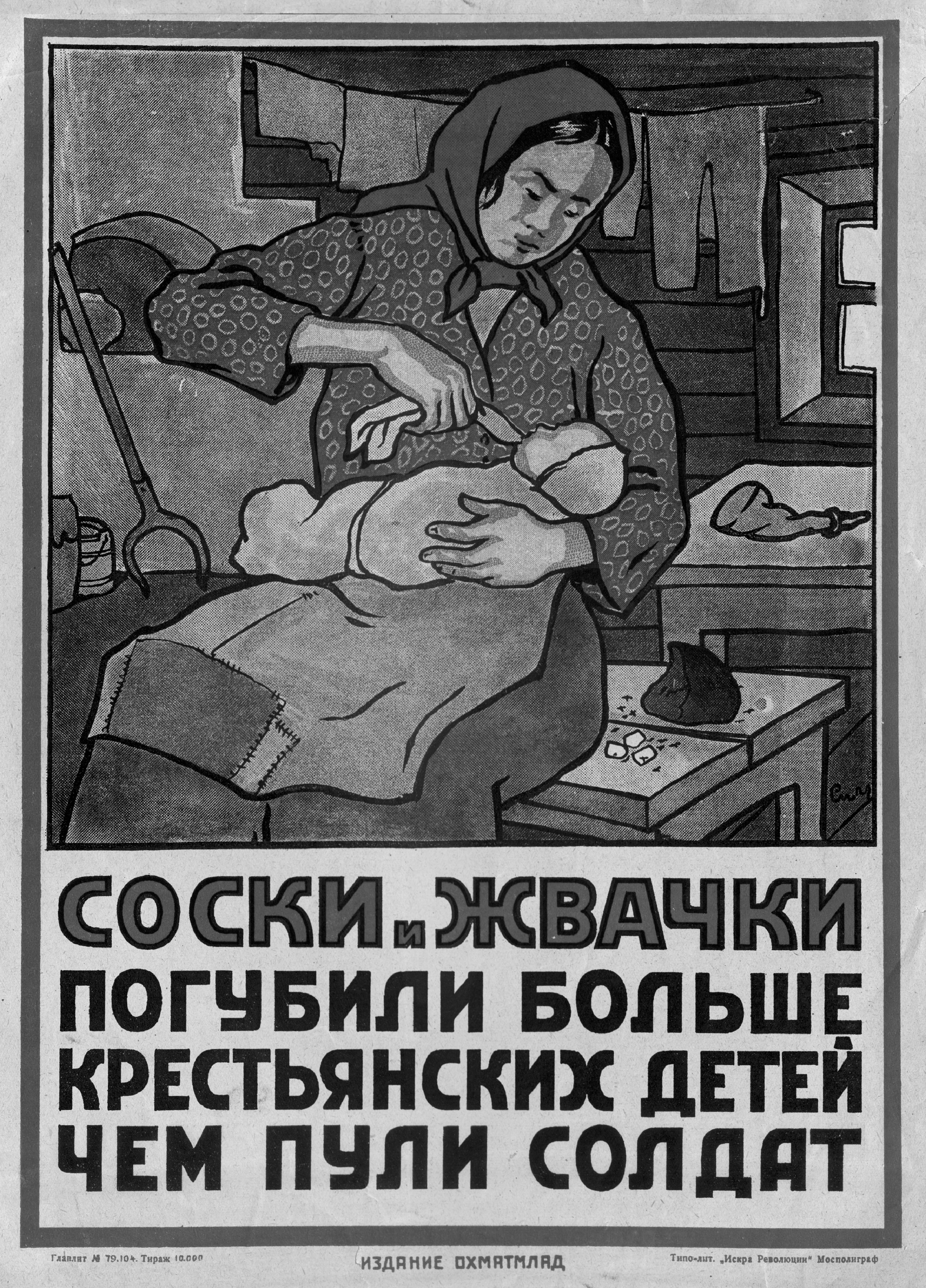
Chewed bread fed to infants killed more peasants' babies than soldiers' bullets did [translated from Russian]. Published by the “Maternity and Infancy Protection” edition. “Iskra revoliutsii [Spark of revolution, translated from Russian],” Mospoligraf, Moscow, 1925. Image from the collections of the Russian Medical Museum in Moscow, Russia.
In conclusion, it is worth mentioning that Tolstoy's considerations about breastfeeding practices should be understood within the broader context of family relationships and the general cultural attitude to women as subordinated to men in late 19th century Russia. His reasoning about family life in The Kreutzer Sonata reflected the trends of his time in social and medical discourse and his moral philosophy. Considerations about health issues and proper infant feeding along with intimacy in marriage, and advocating of “female true nature” contributed to Tolstoy's cause of breastfeeding promotion.
It is documented that the reduction of infant and child mortality is correlated with a fall in the birth rate. 19 Tolstoy proposed to reduce birth rates by putting limitations on sexual life during breastfeeding. A longer breastfeeding time when sex is avoided facilitated longer periods between conceptions. In other words, childbirth spacing could be considerably improved. Tolstoy's ideas were welcomed by readers and followers.
The combined efforts of influential writers such as Tolstoy, country doctors, and women's activists led to the increased popularity of breastfeeding in all segments of society including the upper classes and elite, the intelligentsia, the peasantry, and workers. That led to an increase in the number of breastfed infants and served as an “effective means of reducing infant illness at the community level.” 20
Tolstoy and his novels are still present in today's popular culture. There are a number of historical drama films, TV series, and modern adaptations based on The Kreutzer Sonata, Anna Karenina, and War and Peace that led to a new reading of Tolstoy's texts and his ideas about marriage, family, and childcare. Breastfeeding viewed in the context of family relationships, social norms, and health care is winning recognition more and more decisively among all segments of the population and medical professionals.
Footnotes
Disclosure Statement
No competing financial interests exist.
Funding Information
The author received no specific funding for this work.