




Abstract
Objective:
The objective of this research was to study the role of music listening by mothers during a cesarean section and the postpartum period to achieve exclusive breastfeeding in the first 6 months.
Methods and Study Design:
This was a prospective, observational, randomized controlled trial study. A total of 185 singleton pregnant women, in at least 37 weeks of gestation, who were appointed for elective cesarean sections, were recruited. They were randomized into three groups, including pregnant women who did not listen to music (Group 1), listened to music during cesarean section (Group 2), and listened to music during cesarean section and the postpartum room for the first 2 days (Group 3). The breastfeeding results of all three groups were followed up at 7 days, 14 days, and then at months 1, 2, 3, and 6.
Results:
Success in exclusive breastfeeding among Groups 1, 2, and 3 and Groups 1 and 2 + 3 was not different in every lactating period (7 days–6 months). From subgroup analysis, mothers who listened to music in a private ward had more success in exclusive breastfeeding than those in a common ward. Mothers who listened to music and had an income of <20,000 baht, an educational level lower than university, planned the pregnancy, had their first pregnancy, and stayed in a private ward had more successful exclusive breastfeeding in a 6-month period than those mothers who did not listen to music, and the difference was statistically significant.
Conclusions:
Music listening by mothers during a cesarean section and in the postpartum ward did not enhance exclusive breastfeeding during the first 6 months of the postpartum period. However, from subgroup analysis, mothers who listened to music in a private ward had more success in exclusive breastfeeding than those in a common ward. Thai Clinical Trials Registry number was TCTR20180712001.
Introduction
It is well known that breastfeeding has many benefits. Breastfeeding immediately after delivery will prevent postpartum hemorrhages and can reduce the mother's weight, helping her to get back to her previous form as a result of the metabolic activity and energy consumption during breastfeeding.1–4 Moreover, breastfeeding for up to 1 year will especially reduce the risk of coronary heart disease, dyslipidemia, and hypertension. 4 Exclusive breastfeeding means that the infant receives only breast milk, no other liquids or solids are given, not even water, with the exception of oral rehydration solution, or drops/syrups of vitamins, minerals, or medicines. 3
In addition, mothers who do exclusive breastfeeding during the first 6 months typically do not get pregnant during that time; they do not need to use contraception. This is called “lactational amenorrhea,” which is a kind of natural family planning. 5 However, if a mother menstruates during the first 6 months after delivery, contraception should be used because of the risk of becoming pregnant soon. 5
The baby gets various benefits from breast milk, including the best immunity. Breast milk helps to increase local microbes in the skin, in the intestines, and in the epithelium of the respiratory system. The death rate of breastfed newborns due to respiratory and gastrointestinal infections is reduced.6–8 Also, the baby gets warm while breastfeeding, and the regular process can enhance their stability and emotional intelligence 8
Successful exclusive breastfeeding must consist of three main elements: it must occur quickly, frequently, and correctly. 9 Quickly sucking is classified as the baby getting breastfed immediately or within 30 minutes after birth, to stimulate the milk to be released quickly. Frequently sucking means that the newborn must receive breastfeeding soon after delivery, especially on the 1st day of life. The mothers must do breastfeeding every 2–3 hours or 8–12 times a day. Correct sucking will prevent cracked nipples and breast engorgement. In this regard, close family members, especially the primary partner, must be encouraged to support the new mother to achieve successful exclusive breastfeeding. 9
Mothers who undergo a cesarean section have considerably more pain than those who have a spontaneous delivery, and this is linked to unsuccessful exclusive breastfeeding10–12 Pain results in a limitation of ambulation, increased stress, and an inhibition of milk production. Pain and stress can reduce oxytocin secretion, which affects the hormonal system in the stimulation of milk production.13–15 Moreover, if the mother is unable to breastfeed, especially during the first 6 hours after delivery, exclusive breastfeeding during the first 6 months of neonates may be unsuccessful. 16
Pain from cesarean section is related to unsuccessful exclusive breastfeeding. 17 Encouraging the mother after delivery to understand the importance of breastfeeding is crucial on the 1st day and at least during the first 3 days of the postpartum period because it is vital to stimulate milk production and lactation. Successful exclusive breastfeeding during these 3 days of the postpartum period is related to exclusive breastfeeding in at least the first 6 months of the postpartum period. 18 Music is well understood to be major influence on human emotions and wellbeing. It is classified as the universal nonverbal language that can enable mutual understanding. 19 Many studies have proposed that mothers who had premature deliveries and listened to music during the postpartum period were successful in exclusive breastfeeding.20,21 Music listening during breastfeeding by mothers who delivered by cesarean section also helps to reduce pain and achieve a higher rate of exclusive breastfeeding. 22
Since there is no such research in Thailand, we aimed to compare the effects of music listening to successful exclusive breastfeeding involving three groups of mothers—those who listened to no music, those who listened to music during the cesarean section, and those who listened during the cesarean section and the first 2 days of the postpartum period.
Methods and Study Design
This was a prospective, observational, randomized controlled trial study, which was approved by the Ethics Committee of the Siriraj Institutional Review Board (Si 462/2017). The study followed the Helsinki Declaration on Medical Research and was conducted during cesarean section and postpartum ward of the Department of Obstetrics and Gynaecology, Faculty of Medicine, Siriraj Hospital, Mahidol University, from October 1, 2018, to September 30, 2019.
The sample size and power calculations by Pan et al. were used to calculate the proper sample size. 23 To achieve 80% power and 5% statistical significance for the trial of two intervention groups, we had six repeated and measured periods (7 days, 14 days, and then 1, 2, 3, and 6 months) of exclusive breastfeeding. We expect 70% exclusive breastfeeding in general-term mothers (the control group) and a range of 70–90% exclusive breastfeeding in mothers who listened to music as prescribed. We also expected the estimated correlation of repeated exclusive breastfeeding for 0.5 for each mother; 185 cases per group; and a 10% loss of participants due to a failure to follow up as prescribed. The final number of recruited cases in each group was 210, or a total of 630 cases, since there were three groups.
The included patients from both private and common wards were the singleton pregnant women in at least 37 weeks of gestation, who were appointed for an elective cesarean section and confirmed for recontacting during the next 6 months. The anesthetic method for all the recruited women was a regional spinal block. All participants gave written informed consent before the study began.
The excluded patients were those who had an emergency cesarean section, or their neonates had to be separated from them due to respiratory problems, metabolic problems, and soon, during the first 2 days after delivery. Also excluded were pregnant women who did not understand the Thai language, had hearing problems, were prohibited from breastfeeding, and/or could not be followed up on during the first 6 months after delivery.
All recruited pregnant women were informed verbally and in writing of the purpose of the study. They gave their written informed consent before it began. They were randomized into three groups by using block randomization. 24 The first group (Group 1) was pregnant women who did not listen to music. The second group (Group 2) was pregnant women who listened to music during cesarean section. The third group (Group 3) was pregnant women who listened to music during cesarean section and the postpartum room for the first 2 days.
For the second group (Group 2), pregnant women during cesarean section listened to music (which was repeated twice) after the skin incision began. For the third group (Group 3), the first time, pregnant women during cesarean section also listened to music (repeated twice) after the skin incision began. However, the second phase of music listening for this group was applied on the 1st and 2nd day after delivery when the mothers did breastfeeding in the postpartum room. The breastfeeding results of all three groups were followed up on at 7 days, 14 days, and then 1, 2, 3, and 6 months.
The reason for applying music listening to mothers on the 1st and 2nd day after delivery was because most women without complication can be discharged from the hospital at the 3rd day after delivery.
During the period of October 1, 2018, to September 30, 2019, 630 cases of mothers with term pregnancy with an indication for elective cesarean section were assessed for eligibility in the study. Ten cases were excluded due to maternal heart disease, postpartum hemorrhage, non-reassuring fetal heart rate pattern, and/or a refusal to participate in the study. A total of 620 cases were randomly allocated into three groups: Group 1 had 207 cases: Group 2 had the same number; and Group 3 had 206 cases (Fig. 1). As part of the research protocol, we must do follow-up calls with the patients to check on the success of their exclusive breastfeeding. In some cases, the patients did not respond to our calls or online inquiries, we classified as a failure to follow up.
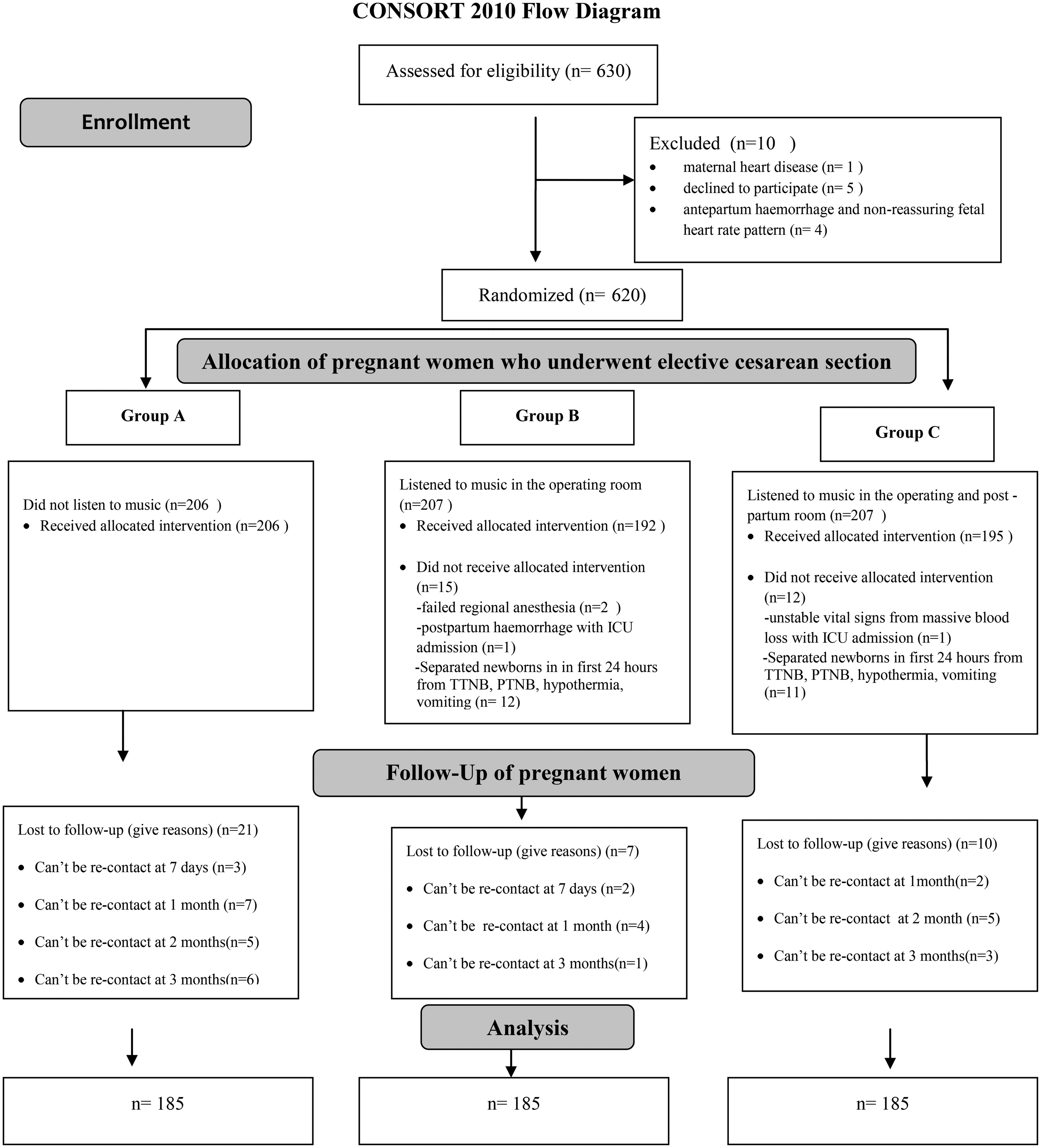
CONSORT 2010 Flow Diagram regarding how to recruit patients for the study. ICU, intensive care unit; PTNB, persistent tachypnea of the newborn; TTNB, transient tachypnea of the newborn.
Regarding the controlled group of mothers who did not listen to music (Group 1), 21/206 cases were excluded from the study because of a failure to follow up from 7 days to 3 months after giving birth. So a total of 185 cases were enrolled in the study.
Of the group of mothers who listened to music during cesarean section (Group 2), 22/207 cases were excluded from the study due to failed regional anesthesia (2/22), postpartum admission to intensive care unit (ICU) (1/22), separated newborns from mothers (12/22), and failure to follow-up (7/22). A total of 185 cases were enrolled in the study.
Of the group of mothers who listened to music during cesarean section and postpartum ward (Group 3), 22/207 cases were excluded from the study due to postpartum admission to the ICU (1/22), separated newborns from their mothers (11/22), and a failure to follow up from 1 to 3 months after giving birth (10/22). A total of 185 cases were enrolled in the study.
Postpartum ward was divided into two types; private ward and common ward. Private ward is the ward with separated room and special care. Common ward is the ward with common room providing with 20–30 beds for postpartum women.
The song used in the study
The song, titled in Thai “Im-Oun,” was composed by the famous songwriter, Mister Su Boonlieng. We asked for his permission to use the song in this study. The lyrics are about how no food for a baby is as good as breast milk because this food is distilled from the mother's heart. The mother teaches her children to be good, strong, and hopeful. The baby does not only feel full from a breastfeeding but also warm and loved. The melody is beautiful and gentle. We assumed that mothers who listen to this song will be even more moved to embrace the baby immediately after birth, which may result in successful, exclusive breastfeeding.
The music was played through earphones. Mothers can adjusted the volume as they wanted and achieve clear listening. The volume did not exceed 85 decibel. The type of music was Thai popular song, soft, timbre with slow rhythm. The duration of music was about 3 minutes and 50 seconds and played twice. The music was replayed in the 1st and 2nd day during breastfeeding time, which depended on the infants demand or their crying. Family members could stay in the room, but stayed outside the partition when mothers and her children were breastfeeding.
Results
The demographic and baseline characteristic data regarding the three groups are shown in Table 1. Maternal age, occupation, salary, educational level, pregnancy desire, and parity were different in each group at a statistically significant level. The differences in all the baseline characteristics among the three groups, except for salary, were not clinically significant.
Demographic and Baseline Characteristic Data of Patients Divided into Three Groups of Mothers—Those Who Did Not Listen to Music, Those Who Listened to Music During Cesarean Section, and Those Who Listened to Music During Cesarean Section and in Postpartum Ward
Data are presented mean ± SD and n (%).
* One-way ANOVA test for continuous data and Chi-square test for categorical data.
Statistical significance p < 0.05.
ANOVA, analysis of variance; BMI, body mass index; C/S, cesarean section; PP, postpartum; SD, standard deviation.
The sex of newborns, the neonatal body weight, and the appearance, pulse, grimace, activity, and respiration scores were not different. The gestational age at delivery of newborns in the three groups, and the postpartum wards of mothers were different, statistically, but not to a clinically significant degree (Table 2).
Newborn Data Divided into Three Groups of Mothers—Those Who Did Not Listen to Music, Those Who Listened to Music During Cesarean Section, and Those Who Listened to Music During Cesarean Section and in Postpartum Ward
Data are presented mean ± SD and n (%).
One-way ANOVA test for continuous data and Chi-square test for categorical data.
Statistical significance p < 0.05.
Success in exclusive breastfeeding among the three groups of mothers was not different in every lactating period (7 days–6 months) (Table 3).
Successful Exclusive Breastfeeding, Divided into Three Groups of Mothers—Those Who Did Not Listen to Music, Those Who Listened to Music During Cesarean Section, and Those Who Listened to Music During Cesarean Section and in Postpartum Ward
Chi-square test.
EBF, exclusive breastfeeding.
As for comparing two interventions, listening to music and not listening to music, the results are presented in Tables 4–6. For demographic and baseline characteristic data, the statistically significant differences between mothers in those two groups involved occupation, income, educational level, pregnancy desire, and the number of previous children who lived (Table 4).
Demographic and Baseline Characteristic Data Involving Two Groups of Mothers—Those Who Did not Listen to Music and Those Who Listened to Music
Data are presented mean ± SD and n (%).
One-way ANOVA test for continuous data and Chi-square test for categorical data.
Statistical significance p < 0.05.
Mothers who listened to music in a private ward had more success in exclusive breastfeeding than those in a common ward [no music 116/185 (62.7%); music 285/370 (77%); p < 0.001] (Table 5).
Newborn Data Involving Two Groups of Mothers—Those Who Did not Listen to Music and Those Who Listened to Music
Data are presented mean ± SD and n (%).
One-way ANOVA test for continuous data and Chi-square test for categorical data.
Statistical significance p < 0.05.
GA, gestational age.
Successful Exclusive Breastfeeding Involving Two Groups of Mothers—Those Who Did Not Listen to Music and Those Who Listened to Music
Chi-square test.
Also, mothers who did not listen to music seemed to have more success in exclusive breastfeeding. However, there was no statistically significant difference between the mothers who listened and did not listen to music in every period of breastfeeding (Table 6).
When exploring the statistically significant data, we found that mothers with an income of <20,000 baht and who listened to music had more successful exclusive breastfeeding in the 6-month period [36/109 (33%)] than those mothers who did not listen to music [19/95 (20%)], and that this was statistically significant (Table 7). Mothers with an educational level lower than university and who listened to music had more successful exclusive breastfeeding in the 6-month period [29/93 (31.2%)] than those mothers who did not listen to music [9/68 (13.2%)], and this also was statistically significant (Table 7). Mothers who had planned to have a baby and did not listen to music had more successful exclusive breastfeeding in the 1-month period [47/66 (71.2%)] than those mothers who listened to music [48/88 (54.5%)], and this was statistically significant (Table 7). Mothers experiencing their first pregnancy and who did not listen to music had more successful exclusive breastfeeding in the 1-month period [74/115 (64.3%)] than those mothers who listened to music [75/152 (49.3%)] and that was statistically significant (Table 7). Mothers who stayed in a private ward and did not listen to music had more successful exclusive breastfeeding in the 1- to 6-month period [83/116 (71.6%)–67/116 (57.8%)] than those mothers who listened to music [162/285 (56.8%)–118/285 (41.4%)], and, again, this was statistically significant (Table 7). Mothers who stayed in a common ward and did not listen to music had less successful breastfeeding in the 2- to 6-month period [22/69 (31.9%)–0/69 (0%)] than those mothers who listened to music [46/85 (54.1%)–29/85 (34.1%)], and this was statistically significant (Table 7).
Successful Exclusive Breastfeeding Exploring Some Statistically Significant Baseline Characteristic Data Involving Two Groups of Mothers—Those Who Did Not Listen to Music and Those Who Listened to Music
Chi-square test.
Statistical significance p < 0.05.
To analyze the frequency of listening to music, a subgroup analysis of the group of mothers who listened to music during cesarean section and who did so both during cesarean section and the postpartum ward was done. We found that the baseline demographic and characteristic data of mothers in those groups were not different (Table 8).
Demographic and Baseline Characteristic Data Involving Mothers Who Listened to Music During Cesarean Section and Those Who Listened to Music During Cesarean Section and in Postpartum Ward
Data are presented mean ± SD and n (%).
Independent t-test for continuous data and Chi-square test for categorical data.
Statistical significance p < 0.05.
The number of newborns delivered by a mother who listened to music during cesarean section [156/185 (84.3%)] was higher than those by mothers who listened to music during cesarean section and postpartum ward [129/185 (69.7%)], at a statistically significant level (Table 9).
Newborns Data Involving Mothers Who Listened to Music During Cesarean Section and Those Who Listened to Music During Cesarean Section and in Postpartum Ward
Data are presented mean ± SD and n (%).
Independent t-test for continuous data and Chi-square test for categorical data.
Statistical significance p < 0.05.
Success in exclusive breastfeeding involving two groups of mothers who listened to music during cesarean section, and both during cesarean section and the postpartum ward, was not different (Table 10).
Successful Exclusive Breastfeeding Involving Two Groups of Mothers—Those Who Listened to Music During Cesarean Section and Those Who Did During Cesarean Section and in Postpartum Ward
Chi-square test.
Subgroup analysis for the environment and frequency of music-listening during breastfeeding is presented in Table 11. We found that the frequency of music listening during cesarean section and ward did not affect the success of exclusive breastfeeding, except that mothers who listened to music both during cesarean section and the postpartum common ward had more successful exclusive breastfeeding during the 3-month period than another group, at a statistically significant level (Table 11).
Successful Exclusive Breastfeeding Involving Two Groups of Mothers—Those Who Listened to Music During Cesarean Section and Those Who Did During Cesarean Section, in the Postpartum Private Ward, and in the Ordinary Ward
Chi-square test.
Statistical significance p < 0.05.
Subgroup analysis of significant factors, including income, educational level, and pregnancy desire, in the group of mothers who did not listen to music is presented in Table 12. We found that income affected exclusive breastfeeding during the 7–14 days postpartum period.
Factors Influencing Exclusive Breastfeeding in Mothers Who Did Not Listen to Music
Chi-square test.
Multiple logistic regression.
Statistical significance p < 0.05.
N/A, not applicable; PBF, partial breastfeeding.
Subgroup analysis of significant factors, including income, educational level, and pregnancy desire, in the group of mothers who listened to music are presented in Table 13. We found that no factor affected exclusive breastfeeding in every postpartum period.
Factors Influencing Exclusive Breastfeeding in Mothers Who Listened to Music
Chi-square test.
Discussion
Breastfeeding plays an important role for mothers during the postpartum period. However, cesarean section pain may cause immobilization of the mothers, resulting in failure of early breastfeeding. Delay in early breastfeeding may result in failure of later exclusive breastfeeding. 9 Music has powerful effects on people, and may be a nonpharmacological method of relieving chronic pain. 25
Many studies have argued that music is an effective pain reliever and can promote relaxation by inhibiting the release of stress hormones and weakening the arousal of the pituitary-adrenal stress axis.26–28 Music also affects the brain's opioid system, which can control physical and mental pain.26–28
Akca's study 29 aimed to link cesarean pain and delayed breastfeeding with music therapy. This study suggests that music influences a newborn's sucking behavior during the 1st hour of life, which may relate to later exclusive breastfeeding. The idea is that the mother's anxiety can be reduced, and the baby can be relaxed and suck well. Anxiety and depression can inhibit oxytocin secretion. 30 Music therapy can reduce stress in mothers with a premature baby in a neonatal ICU, and this can relatively increase breast milk production, which affects the development of premature babies. 31
Moreover, Keith's study 21 concluded that mothers who listened to music can produce a greater volume of milk and with a significantly higher fat content in the first 6 days of the study. Feher's study 32 also concluded that using a relaxation technique with music therapy for mothers with premature babies can help to increase the volume of milk production.
Hobbs et al. 11 reported that planned cesarean sections were related to unsuccessful exclusive breastfeeding during the 4-month postpartum period, when compared with a vaginal birth. Cesarean sections are associated with more pain and immobilization than in vaginal births. 33 It is suggested that maternal pain and fetal stress may be related to early cessation of early breastfeeding. 33 Zanardo et al. 34 also reported that cesarean sections are related to a lower rate of exclusive breastfeeding than with vaginal deliveries.
Although much research has suggested that music has an influence on lactation, our research does not support that conclusion. The crucial issue is whether pain after a cesarean section affects lactation. Although a mother listened to music, the pain played the primary role, causing immobilization in mothers, which can result in unsuccessful exclusive breastfeeding. 35 The best research shows that breast milk can be well secreted if early sucking is done as soon as possible after birth. 36 The mothers who underwent a cesarean section are affected by many relevant factors, including insomnia from the anesthetic agent, monitoring equipment in the recovery room, and a Foley's catheter being used, along with an intravenous fluid hydration line.
Maternal discomfort from the intravenous line and Foley's catheter may result in difficult movement and, thus, problems with breastfeeding. Postoperative sedation and an excessive volume of blood loss from the cesarean section will also affect maternal alertness and cause a delay in breastfeeding. Although music listening can relieve pain, it cannot overcome all those factors.
Our study showed that the rate of exclusive breastfeeding in the three groups of mothers was not different, although baseline characteristics, including age, occupation, income, and education, were different to a statistically significant degree. However, those characteristics had no clinical significance.
Moreover, those mothers who did not listen to music seemed to have more success in breastfeeding than the group of mothers who listened to music and the other two groups, but at no statistically significant level (Table 3). This can be explained by concluding simply that music did not overcome the pain from a cesarean section.
It is interesting that the mothers who were laborers and had a low income had more successful exclusive breastfeeding, although they did not listen to music. This shows that occupation and income play an important role in exclusive breastfeeding in Thailand, which is generally an upper–middle-income country. One's room environment was also a relevant factor in successful exclusive breastfeeding. Mothers in a private ward (a separate room) had more successful exclusive breastfeeding than those in a common ward. The mothers may need much privacy and comfort to feed their child. However, both groups of mothers who listened and did not listen to music were not different in their amount of breastfeeding in every period (7 days–6 months).
Mothers who did not listen to music seemed to have more successful exclusive breastfeeding than those who listened to music, but this was not statistically significant. Music does not overcome pain from a cesarean section, but the economic status of patients is a very significant factor here.
Music listening was related to a higher rate of successful exclusive breastfeeding in the group of mothers with a lower income, lower educational level, and who stayed in a common ward. Mothers who listened to music, stayed in a common ward, and had more time to listen to music also had more success in exclusive breastfeeding during the 3-month period, at a statistically significant level. Listening to music repeatedly also plays an important role in achieving a successful rate of exclusive breastfeeding.
The most important factor influencing exclusive breastfeeding during the 14-day postpartum period in mothers who did not listen to music was income. The educational level and pregnancy desire did not affect successful exclusive breastfeeding.
The rate of breastfeeding in all three groups of mothers has been reduced significantly in recent times. Most mothers have to get back to work as soon as possible, as there is no national policy providing paid leave for later exclusive breastfeeding. Economic factors should be considered crucial, and must be evaluated at the practical level when a mother wishes to do exclusive breastfeeding during the first 6 months.
A national policy for promoting breastfeeding is vital. New mothers who return to work have to stop breastfeeding. Alternative methods provided by the Ministry of Health for continuing breast milk pumping should be provided during the postpartum period.
Conclusions
We have often heard that pain can be alleviated by listening to music. Music is believed by many to be a nonpharmacological method of pain relief. It has been suggested that music listening during a cesarean section can reduce the mother's pain and result in successful exclusive breastfeeding. Our study found that even among mothers who listened to music during a cesarean section and in the early postpartum period, exclusive breastfeeding during the first 6 months was not successful.
We statistically analyzed baseline characteristic data (subgroup analysis) and found that mothers who stayed in a common ward and did not listen to music had less successful exclusive breastfeeding in the 2- to 6-month period than those who listened to music, and the difference was statistically significant. This may have resulted from the fact that mothers had to get back to work. It was interesting that even mothers (subgroup patients) who did not listen to music and stayed in a private ward, who were experiencing their first pregnancy, and who were not planning for pregnancy also had success in exclusive breastfeeding. This may indicate that being in a private environment such as a separate room can positively affect breastfeeding.
In summary, mothers who did not listen to music had more success in exclusive breastfeeding than those who listened to music. Mothers with a lower income had a higher rate of successful, exclusive breastfeeding than those in higher income and educational brackets. Thailand needs a national policy to promote exclusive breastfeeding at least in the first 6 months of the postpartum period. And spaces in the workplace for breastfeeding can be so helpful to mothers and their babies.
Footnotes
Authors' Contributions
S.C. contributed to the conception and design, acquisition, analysis, and interpretation of data, as well as with the drafting and critical revising of this article, and then approving the final version submitted for publication. V.T. contributed to the interpretation of data, the drafting and revising of this article, and then approving the final version submitted for publication. J.P. contributed to the analysis and interpretation of data, along with revising the article and approving the final version submitted for publication.
Acknowledgments
We would like to thank Mr. Su Boonliang and the KatiKala Company for their permission to use his breastfeeding song, and Nattacha Palawat for her administrative support.
Disclosure Statement
The authors declare no conflicts of interest.
Funding Information
No funding was received for this article.