




Abstract
Background:
The benefits of breastfeeding are well established in the literature. Barriers related to breastfeeding, such as maternal obesity, are also cited in the literature. Worldwide obesity rates in women of reproductive age are rising at an alarming pace. Previous research has attempted to study the relationship between maternal body mass index (BMI) and its effect on breastfeeding outcomes, but it is not clear what the role of maternal BMI category has on breastfeeding outcomes.
Objectives:
The objective of this review is to examine whether and how maternal BMI affects maternal breastfeeding outcomes such as intention, initiation, duration, and exclusivity.
Methods:
A systemic literature search through PubMed and Cumulative Index to Nursing and Allied Health Literature was conducted between January and May 2020, by using Preferred Reporting Items for Systematic Reviews and Meta-Analyses guidelines. A total of 23 relevant articles were retrieved.
Results:
Of the 23 studies that assessed the relationship between maternal BMI and breastfeeding intention and other outcomes, only 4 found no differences in breastfeeding outcomes across BMI categories. Higher than normal maternal prepregnancy BMI has been found to be associated with poorer breastfeeding outcomes. Overweight and obese women are less likely to intend to breastfeed and initiate breastfeeding. They also have shorter breastfeeding durations and are less likely to exclusively breastfeed for any period compared with normal weight women.
Conclusions:
Breastfeeding rates across all BMI categories do not meet the recommended guidelines established by the World Health Organization and other public health agencies, and overweight and obese women have poorer breastfeeding outcomes. Overweight and obese women need additional support to initiate breastfeeding, and to breastfeed longer and exclusively. Targeted and well-designed interventions should be implemented early in the perinatal period to support this vulnerable population.
Introduction
The World Health Organization (WHO) and the American Academy of Pediatrics (AAP) recommend that infants are exclusively breastfed for at least the first 6 months, with continued breastfeeding along with introducing appropriate complementary foods for 1 year or longer.1,2 The benefits of exclusive breastfeeding (EBF), defined as breast milk only, are well established in the literature for mother, child, and the health care system. Breastfed infants have lower risks for sudden infant death syndrome; ear, respiratory, and gastrointestinal infections; and are less likely to develop asthma, obesity, and diabetes later in life. 3 Mothers who breastfeed have a lower risk for developing type 2 diabetes mellitus, high blood pressure, and certain cancers. 4 Recognizing the importance of breastfeeding, the U.S. Department of Health and Human Services sets forth national breastfeeding objectives for women every decade as part of the Healthy People Initiative. 5
Breastfeeding rates in the United States have been increasing over the past decade and the most recent data from the 2018 Breastfeeding Report Card suggest that ∼83% of mothers initiate breastfeeding immediately after birth. The high initiation rate suggests that most mothers in the United States have a desire to breastfeed and begin doing so. However, despite the recommendation to breastfeed exclusively for the first 6 months, only 46.9% of infants were exclusively breastfed through 3 months and 24.9% were exclusively breastfed through 6 months. 6 The rates are even lower if we break down these rates by socioeconomic status or by race. Low-income and ethnic-minority women tend to breastfeed on average of 4 months shorter and not exclusively. Controlling for educational level, African American women, who are more likely to be overweight or obese, are less likely to breastfeed for any amount of time compared with white, Asian, and Hispanic women. 7 If 90% of U.S. families complied with the Healthy People recommendations to breastfeed exclusively for 6 months, the United States would save ∼$13 billion annually and prevent an excess 900 deaths, nearly all of which would be in infants. 8 The low breastfeeding rates suggest, and previous research has posited, that there are numerous multifaceted barriers at play that prevent mothers from breastfeeding for the recommended duration.
Research has shown that one barrier to breastfeeding is maternal obesity. Obesity rates are rising worldwide. Obesity rates in women of reproductive age are alarming, especially in the United States. This presents a health concern not only for the mother but also for the child. Pregnancy complications due to obesity put both the lives of the mother and child in danger as it can lead to serious adverse health outcomes. Since breastfeeding has been shown to reduce the risk for certain chronic diseases, in both the mother and child, it is imperative to examine breastfeeding in women who fall into the higher body mass index (BMI) categories. Therefore, the focus of this systematic review is to understand the role of maternal BMI in breastfeeding intention, initiation, duration, and exclusivity.
Methods
Literature search
A systematic review of studies that reported maternal BMI and breastfeeding outcomes was conducted following the Preferred Reporting Items for Systematic Reviews and Meta-Analyses guidelines. 9 Outcomes studied were any breastfeeding outcomes (intention, initiation, duration, and exclusivity). Breastfeeding intention is defined as a prebirth plan or commitment to breastfeed. Breastfeeding initiation is defined by the WHO as breastfeeding occurring shortly after birth, ideally in the first hour. For the purposes of this analysis, any breastfeeding that was reported at any time was included. Breastfeeding duration is the length of time for any breastfeeding. Breastfeeding exclusivity is defined as providing the infant with breast milk only, without additional foods or drinks, for any period. Type of exposure included maternal or prepregnancy BMI. In accordance with international standards, BMI scores of >24.9 kg/m2 are considered overweight, whereas BMI scores ≥30 kg/m2 are considered obese. For reference, a normal BMI score ranges from 18.5 to 24.9 kg/m2. PubMed and Cumulative Index to Nursing and Allied Health Literature were used to search for peer-reviewed studies published after 2010, in accordance with the latest Healthy People Initiatives. Studies were selected for inclusion by reading the abstract or full article. Retrospective or prospective cohort or cross-sectional studies were included if they reported any breastfeeding outcomes among maternal prepregnancy BMI categories. The search terms and strategy are included in Figure 1.
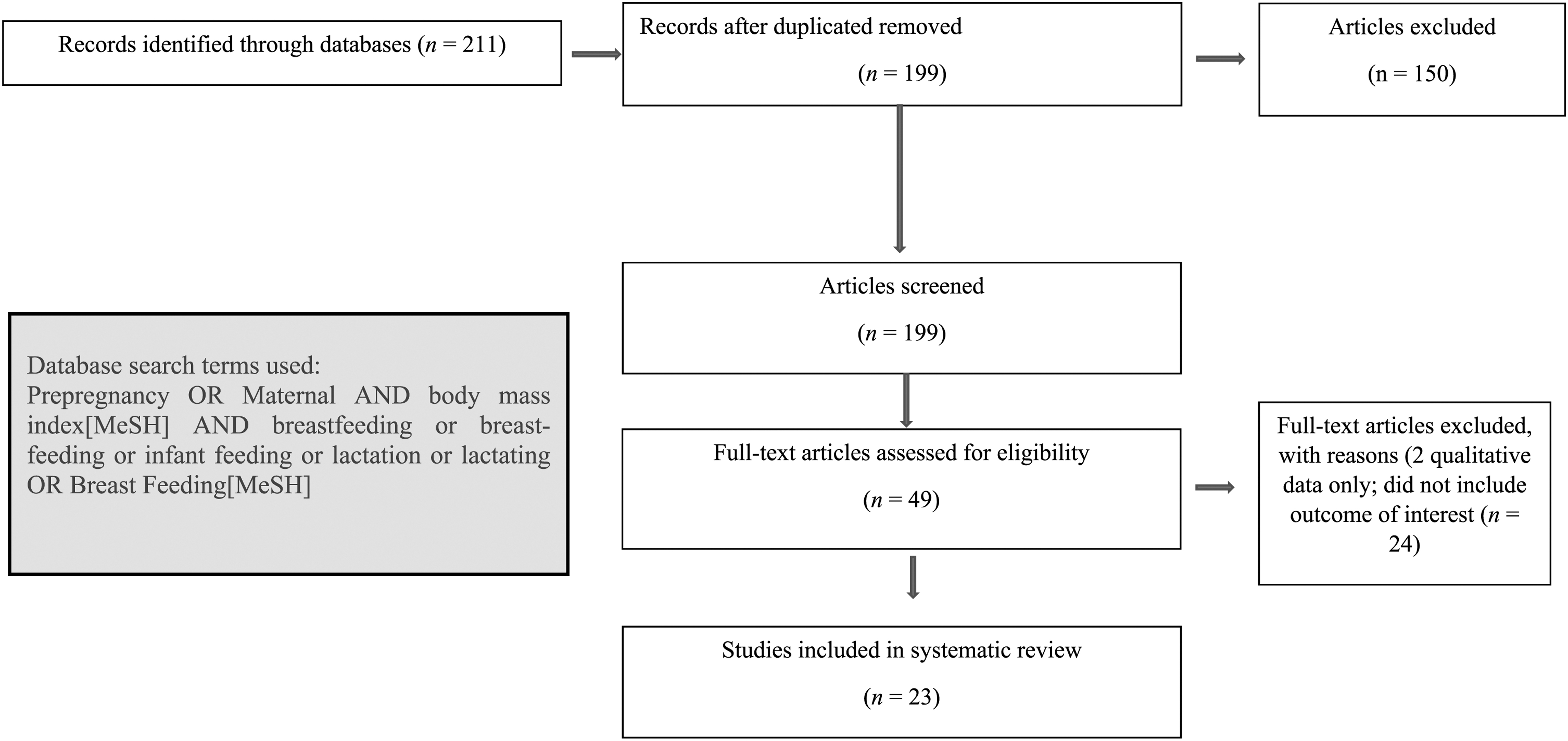
Literature search strategy.
The literature search strategy (Fig. 1) identified 211 publications, many of which were reviews or did not report outcome measures of interest. After screening, 49 were reviewed in full text. Of the remaining studies, articles were excluded if they only reported qualitative data (n = 2) and if they did not include outcomes of interest (i.e., breastfeeding problems and introduction of complimentary foods) (n = 25). Table 1 details the studies included in this systematic review examining the association of maternal prepregnancy BMI and breastfeeding outcomes. IRB approval was not necessary for this systematic review as it does not involve human subjects.
Studies Included in Review
ABF, any Breastfeeding; BMI, body mass index; CI, confidence interval; EBF, exclusive breastfeeding; GA, gestational age; GWG, gestational weight gain; HR, hazard ratio; IRR, incidence rate ratio; OB, obese; OR, odds ratio; OW, overweight; PP, postpartum; RR, risk ratio; SES, socioeconomic status.
Results
Of the 23 studies that met the inclusion criteria, 10 studies evaluated breastfeeding duration only,10–19 3 evaluated breastfeeding intention only,20–22 4 evaluated only breastfeeding initiation,23–26 4 evaluated initiation and duration,26–29 1 evaluated intention, initiation, and duration, 30 and 1 study evaluated all four breastfeeding outcomes 31 (Table 1). The 16 studies that found an association between maternal BMI category and breastfeeding outcomes did so in the same direction: overweight and/or obese women had increased risk for poorer breastfeeding outcomes (lower breastfeeding intention, less likely to initiate breastfeeding, decreased duration, and decreased exclusivity). Six studies did not find a significant association between maternal prepregnancy BMI and breastfeeding outcomes.11,12,14,18,20,21 These studies were conducted in the United States (n = 10), Canada (n = 1), Australia (n = 1), Greece (n = 1), Mexico (n = 1), United Kingdom (n = 2), Belgium (n = 2), Denmark (n = 1), Israel (n = 1), Norway (n = 1), Brazil (n = 1), and France (n = 1). Sample sizes varied across studies. Median sample size was 1,261 (mean = 58,885). Seventeen studies utilized a prospective cohort study design.
Breastfeeding intention
Breastfeeding intention is defined as a pregnant woman's plans to provide her infant breast milk either directly from the breast or from a bottle. Breastfeeding intention has been shown in previous research to be a strong predictor of breastfeeding initiation. Of the studies that evaluated breastfeeding intention and BMI categories, only two found no significant differences in intention among the different BMI categories.20,21 All other studies measuring intention found significant differences in breastfeeding intention among overweight and obese women in comparison with women in the normal weight BMI category. For example, in the largest study in this review, Thompson et al. found that obese women were significantly less likely to initiate breastfeeding compared with normal weight women (odds ratio [OR] 0.84, 95% confidence interval [CI] 0.83–0.85). 22 Similarly, in a smaller study, Guelinckx et al. reported that fewer obese women intended to breastfeed (p = 0.002). 32
Breastfeeding initiation
The first breastfeeding session usually takes place shortly after birth and lactation experts recommend that newborns be put to the breast within the first hour to increase exclusivity and duration of breastfeeding. Certain pregnancy and delivery complications can prevent this from happening. Women who are overweight or obese are at a greater risk of experiencing pregnancy and delivery complications than normal weight women. Of the eight studies that assessed breastfeeding initiation, all but one reported significant findings that overweight and obese women are less likely to initiate breastfeeding. Mehta et al., a prospective longitudinal cohort study, including 688 participants, reported that overweight and obese women were four times less likely to initiate breastfeeding than normal weight women, controlling for poverty level, education, race/ethnicity, and marital status (risk ratio [RR] 3.94, 95% CI 2.17–7.18) compared with normal weight women. 23
In a secondary analysis of 450 postpartum mothers, Krause et al. 26 found that high BMI was negatively associated with initiation of breastfeeding. 12 In a prospective cohort study, Hauff et al. found that obese women had lower odds of initiating breastfeeding (p = 0.04). 31 Although Campbell and Shackleton, in a retrospective cohort study of 17,113 participants, found negligible differences in tendency to initiate breastfeeding based on prepregnancy BMI (OR 0.88, 95% CI 0.78–1.00), they did report that overweight and obese women had higher odds of ceasing breastfeeding within the first week. 28 Guelinckx et al., a retrospective study of 200 participants, found that fewer obese women initiated breastfeeding (p = 0.002). 32
Breastfeeding duration
The recommended duration of breastfeeding varies across institutions. The WHO and United Nations International Children's Emergency Fund recommend breastfeeding for at least 2 years, whereas the AAP recommend at least 1 year. For the purposes of this review, all studies were included that reported any breastfeeding duration. Eighty-two percent of studies found significant differences in breastfeeding duration among the different BMI categories. Overall, a higher maternal BMI was associated with shorter breastfeeding duration in overweight and obese women.
Researchers found that overweight and obese mothers were more likely to stop breastfeeding during the first week and less likely to continue past 4 months. 28 Similarly, Hauff et al. reported that obese women were more likely to have shorter median EBF duration (shorter by 6 weeks) and any breastfeeding duration (shorter by 9 weeks) compared with other breastfeeding women. 31 In a prospective observational study of 109 breastfeeding mothers, researchers found that as the BMI category increased, the likelihood of breastfeeding at 6 months of age decreased (OR 0.88, 95% CI, 0.79–0.99). 16 Boudet-Berquier et al., 13 a prospective birth cohort of 3,368 women, also found breastfeeding duration differences between overweight and obese women. Interestingly, among first time mothers, being overweight, but not obese, was significantly associated with shorter breastfeeding duration, after controlling for several maternal factors. 13 Similarly, Oddy et al. 19 found that overweight and obese women were more likely to discontinue breastfeeding before 6 months (OR 1.48 95% CI 1.20–1.83, p < 0.01). Of the 16 studies that reported the outcome, 4 studies found no statistical differences in breastfeeding duration between BMI categories.11,12,14,18
Breastfeeding exclusivity
EBF, or breast milk only, is recommended for the infant during the first 6 months. Of the eight studies that assessed EBF, all but one found an association between maternal prepregnancy BMI categories. 12 For example, Marshall et al. 17 reported that women with BMI >25 kg/m2 were less likely to exclusively breastfeed at 6 weeks and 6 months compared with women of normal BMI (67% and 37% versus 91% and 79%, p-value 0.005 and 0.001, respectively). Davie et al. 20 also reported that obese women are at a significantly greater risk of early cessation of EBF compared with normal weight women (hazard ratio [HR] 1.32; 95% CI: 1.14–1.52). 10 In terms of exclusive direct breastfeeding, one longitudinal descriptive study of 116 mother–baby pairs found that obese mothers were less likely to exclusively directly breastfeed (p < 0.002). For first time mothers, being overweight was significantly associated with short EBF (incidence rate ratio [IRR] = 0.74, 95% CI 0.58–0.95). Among multiparas, obese women also had shorter duration of EBF after controlling for sociodemographic variables.
Racial and socioeconomic factors
Previous research has shown that African American women, regardless of socioeconomic status (SES), are less likely to initiate breastfeeding. 7 Women of lower SES are less likely to initiate and sustain breastfeeding compared with all other socioeconomic groups. In this review, only one study specifically measured the relationship between race, maternal prepregnancy BMI, and breastfeeding outcomes. Kitsantas et al., 27 in a prospective birth cohort in the United States, found that a lower proportion of overweight and obese African American women of lower SES (34%) initiated breastfeeding compared with white (49.5%) and Hispanic women (75.2%) (p < 0.001). In the same study, African American women of middle SES were less likely (OR = 0.64, 95% CI 0.45–0.92) to initiate breastfeeding compared with white women of the same SES. Overweight and obese Hispanic women of middle SES were significantly less likely to continue breastfeeding up to 4 months (OR: 0.65, 95% CI: 0.41–0.98) compared with their white counterparts. Finally, among women who initiated breastfeeding, overweight and obese white women of low SES had the highest rate of stopping within 2 months postpartum (66.7%). 27
Discussion
Overall, this review found an association between maternal overweight and obese BMI categories and breastfeeding outcomes. Breastfeeding rates across all BMI categories fall short of the recommended breastfeeding practices established by the WHO and other public health agencies. As overweight and obesity rates continue to rise among women of reproductive age, overweight and obese women need additional support to breastfeed, breastfeed exclusively, and breastfeed for a longer duration. The promising breastfeeding intention rates across all BMI categories suggest that most mothers want to breastfeed. The results of this review support what other investigators have found in previous research. 33 Overweight and obese women face unique challenges across all breastfeeding outcomes. Although most studies found that intention to breastfeed, breastfeeding initiation, duration, and exclusivity differed by BMI categories, few did not. Conflicting research findings may be due to differences in sample sizes, self-report of maternal BMI, study design, weight bias and stigma, and other unique characteristics of the study populations.
Conclusions
More research is needed to fully understand why overweight and obese women seem to be less likely to achieve breastfeeding outcomes recommended by leading public health organizations. Also, examining the effect of BMI and breastfeeding outcomes among different racial categories in the United States could be revealing as African American women are more likely to be overweight and obese 34 and less likely to breastfeed compared with all other racial groups. Given these existing racial disparities, and other maternal outcome inequalities, this is a topic of great concern for public health professionals. It provides ample opportunities for researchers and public health practitioners to develop innovative ways to support these vulnerable groups. Targeted and well-designed interventions should be implemented early in the perinatal period. In addition, future studies should further investigate the role of race and SES, specifically among overweight and obese African American women, in breastfeeding outcomes.
Footnotes
Disclosure Statement
No competing financial interests exist.
Funding Information
No funding was received.