




Abstract
Background:
In the neonatal intensive care unit (NICU) expressed mothers' milk usually is stored frozen until used. We found that when human milk was stored at −20°C for up to 9 months there were reduced bacterial counts and pH, increased free fatty acids, but unchanged immune proteins. Antioxidant protection is an important benefit of human milk. Few studies have evaluated long-term effects of cold storage on the antioxidant capacity of human milk. We hypothesized that the antioxidant capacity of human milk is affected adversely by long-term storage at −20°C.
Objective:
To study the impact of long-term cold storage on the oxidative capacity of human milk and the biological impact of these changes on macromolecular constituents of human milk.
Methods:
Freshly expressed milk was obtained from mothers in the NICU, stored at −20°C for 6 months, and compared with the baseline. Paired samples were analyzed for glutathione, hydrogen peroxide (H2O2), 8-isoprostane, catalase, and superoxide dismutase.
Results:
There was no change in H2O2 concentration between baseline and 6 months. Significant reductions from baseline in both catalase and superoxide dismutase concentrations and activities, total glutathione, oxidized glutathione, reduced glutathione, and the ratio of reduced to oxidized glutathione were observed (p < 0.05). There was a significant increase in 8-isoprostane concentrations (p < 0.001).
Conclusion:
These data indicate significant changes in antioxidant capacity of human milk, including oxidation of macromolecules, after storage at −20°C for 6 months. The clinical implication of these findings may explain the nonuniform protection against oxidant disease in preterm infants fed human milk.
Introduction
The use of human milk, the optimal nutrition for preterm infants, is increasing in neonatal intensive care units (NICUs) and after discharge home. 1 Refrigeration and freezer storage of expressed human milk commonly are practiced before milk is utilized.
Previously, we evaluated host defense and nutritional properties of milk stored at refrigerator and/or freezer temperatures.2,3 Those studies found that cold storage was associated with decreases in bacterial colony counts, white blood cell counts, and pH, and increases in nonesterified fatty acids, but no major changes in osmolality or concentrations of secretory IgA, lactoferrin, total protein, and total fat.2,3
Human milk possesses important antioxidant properties. The antioxidant barrier functions in the deactivation and scavenging of reactive oxygen species. Reactive oxygen species are implicated in the pathogenesis of critical diseases in preterm infants, such as bronchopulmonary dysplasia, retinopathy of prematurity, and necrotizing enterocolitis.4,5 Fresh human milk feeding lowers oxidative stress in neonates, not only in healthy full-term newborns but also in preterm newborns who are particularly susceptible to the consequences of oxidative stress.6,7
Few studies have examined the oxidative status of the human milk diet and how it is affected by storage in cold temperatures. It has been suggested that freezer storage or refrigeration for <48 hours preserved antioxidant activity.8,9
The aim of this study was to examine antioxidant properties (superoxide dismutase, catalase, glutathione peroxidase, and isoprostane) of human milk stored for 6 months at −20°C. We hypothesized that antioxidant capacity of human milk is affected adversely by long-term storage at −20°C.
Methods
The study was approved by the Institutional Review Board of Northwell Health. Consent was obtained from mothers who had a milk supply in excess of their infants' needs. Mothers with signs and/or symptoms of breast infection or those treated with antibiotics within 1 week before sample collection were excluded from study participation. Milk samples were collected from one to two combined complete consecutive milk expressions using a hospital-grade electric breast pump following the standard double pumping procedure used in the NICU. After 100 mL was removed for the study, the remainder was fed or stored frozen for future feeding. Aliquots of the samples were prepared within 4 hours of milk expression. One aliquot was stored at −20°C for 6 months and then analyzed along with the baseline, paired sample, which was maintained at −80°C. The refrigerator-freezer unit used in the study to store samples at −20°C is similar to units used in the NICU including daily monitoring and recording of temperatures.
Milk samples were analyzed for catalase concentration (Abcam Catalase Human ELISA Kit; Abcam, Cambridge, MA, USA), catalase activity (Catalase Assay Kit; Cayman Chemical Company, Ann Arbor, MI, USA), superoxide dismutase concentration (Abcam SOD ELISA Kit), superoxide dismutase activity (SOD Kit; Cayman Chemical Company), total and reduced glutathione (Glutathione Assay Kit; Cayman Chemical Company), hydrogen peroxide (H2O2) concentration (Hydrogen Peroxide Colorimetric Detection Kit; Enzo Life Sciences, Plymouth Meeting, PA, USA) and 8-isoprostane (8-isoprostane ELISA kit; Detroit R&D Systems, MI, USA). All assays were conducted after discussions with the manufacturers, and trial runs were carried out with discarded milk to determine dilutions before using actual samples.
A sample size of 36 mothers was chosen to detect a difference of one standard deviation from the mean for each analysis and allow for a dropout rate of 10%, assuming α error = 0.05 and β error = 0.10. Significant differences were defined as p < 0.05. Data were expressed as the mean ± standard error of the mean. Paired t test was used to detect the differences. Statistical analysis was performed using SigmaStat (Jandel Scientific Software, San Rafael, CA, USA).
Results
Thirty-six mothers participated in the milk collections. The mean maternal age was 32 years (range: 19–46 years), gestation at delivery was 30 weeks (range: 23–41 weeks), and postpartum age at the time of milk sampling was 61 days (range: 5–270 days). The average time between milk expression and initiation of freezer storage was 2.2 ± 0.2 hours.
There were no significant changes in H2O2 concentrations between baseline and 6 months. Catalase activity and concentration (Fig. 1) and superoxide activity and concentration (Fig. 2) decreased significantly by 6 months storage (p < 0.001). Total glutathione (p < 0.001), reduced glutathione (p < 0.001), and oxidized glutathione (p < 0.001) decreased significantly (Fig. 3). By 6 months there was a decrease in the ratio of reduced:oxidized glutathione (p < 0.001). Isoprostane concentrations increased significantly from baseline to 6 months (47 ± 2.7 pg/mL versus 55 ± 2.6 pg/mL, p < 0.001). Table 1 depicts the percentage change in components when comparing cold storage for 6 months with baseline.
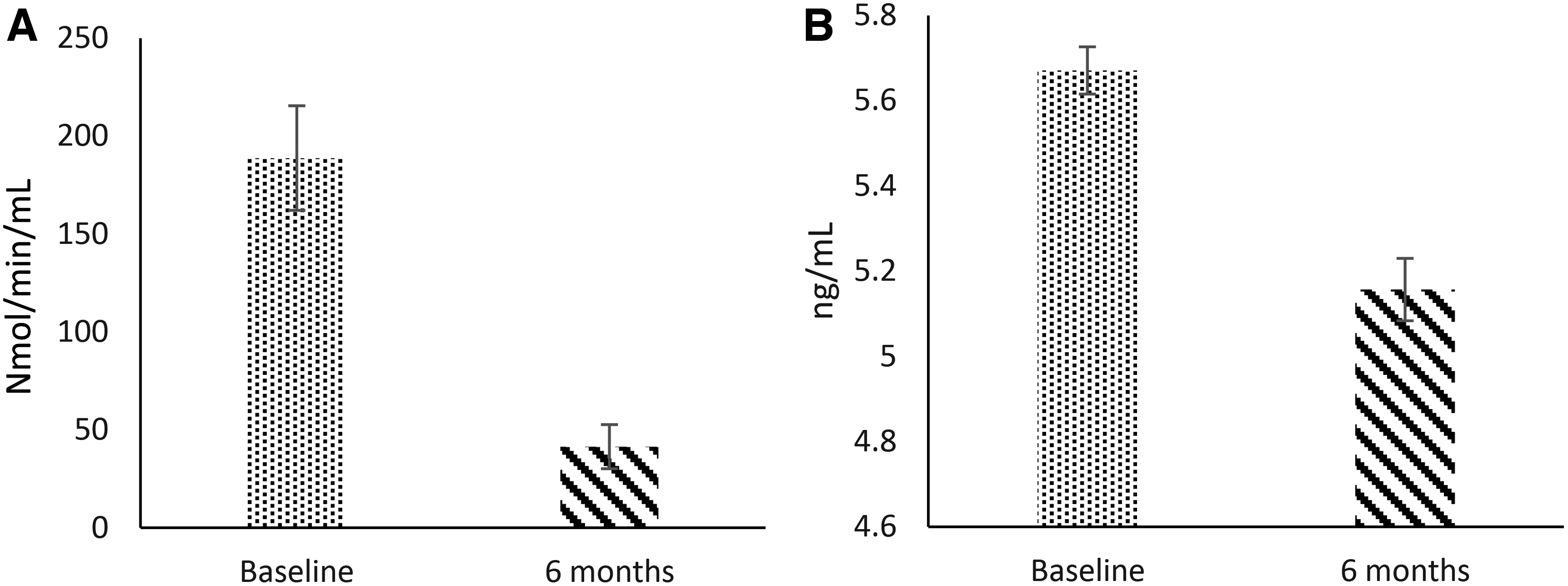
Catalase activity

Superoxide dismutase activity
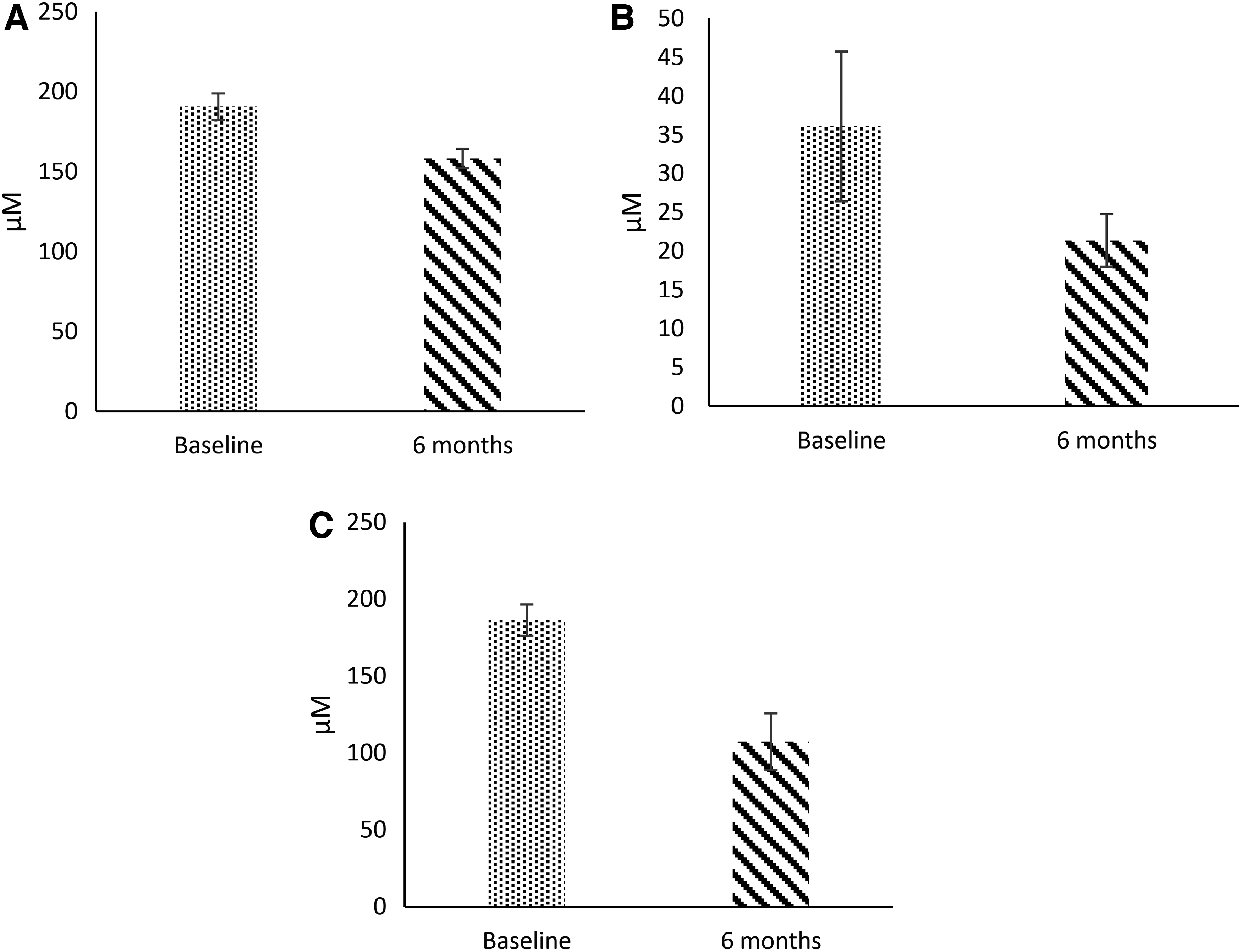
Total glutathione
Percentage Change from Baseline After 6 Months Storage at −20°C
H2O2, hydrogen peroxide; SOD, superoxide dismutase.
Discussion
Human milk possesses significant antioxidant properties. Infants in the NICU, especially those born preterm, are subjected to oxidative stresses, and have morbidities related to oxidant-mediated diseases such as bronchopulmonary dysplasia, retinopathy of prematurity, and necrotizing enterocolitis. 10 The use of refrigerated and/or frozen human milk is common in the NICU. Therefore, it is important to understand whether this antioxidant protection is disrupted by the cold storage conditions practiced in the NICU. 8
We found that prolonged storage of human milk at −20°C significantly affects its antioxidant capacity, as manifest by the significant decreases in catalase and superoxide dismutase concentrations and activities. Our data agree with other reports indicating a loss of glutathione and its related components after short-term cold storage, which now can be extended to 6 months.9,11–13
The lack of change in H2O2 production after cold storage may be explained by the decreases in catalase concentration and activity. Moreover, we reported previously that cold storage of human milk was associated with decreases in bacterial colony counts. 3 Thus, the lack of catalase and the lesser counts of bacteria together may account for the unchanged H2O2 concentrations.
In addition, based on isoprostane concentrations, we observed that there is a reduction in antioxidant protection after cold storage. As a marker of fatty acid oxidation, we found that isoprostane increased significantly after 6 months of cold storage. These increased concentrations suggest the breakdown of triglycerides into fatty acids, which we reported previously as increased free fatty acid concentrations after cold storage. 3 The significant change in isoprostane concentrations in frozen milk is a strong indicator of an alteration in redox status of human milk, which was altered by storage for 6 months.
Bioactive proteins in human milk, such as leptin, lysozyme, and lactoferrin, may potentiate antioxidant activity in the milk. These proteins are considered as independent factors that predict the total antioxidant activity of the milk.5,14 Previously, we found that lactoferrin concentrations were preserved after cold storage.2,3
In summary, we find that components of the antioxidant system in human milk are affected by prolonged freezer storage at −20°C for 6 months. Although other bioactive components are preserved during cold storage, the effect of those components on restoring antioxidant capacity is not well studied. The clinical impact of these differences may explain the nonuniform protection from oxidant diseases in preterm infants fed stored human milk.
Footnotes
Disclosure Statement
No competing financial interests exist.
Funding Information
Funding for the study was received from the Department of Pediatrics, Northwell Health.