




Abstract
Purpose:
To report the clinical course and vascular endothelial growth factor (VEGF) levels in breast milk among three nursing women diagnosed with idiopathic choroidal neovascularization (CNV) before and after intravitreal injection of conbercept.
Methods:
This was an observational case series. The main outcomes and measures included best-corrected visual acuity (BCVA), anatomical features using optical coherence tomography, and breast milk concentrations of VEGF before and after the intravitreal injection of conbercept.
Results:
BCVA was increased, and no ocular or systemic safety problems were observed in any of the three patients during the follow-up period. An enzyme-linked immunosorbent assay was used to measure VEGF concentrations in the breast milk samples. Samples were collected 1 day before and 1, 7, and 30 days after the first intravitreal injection of conbercept. After conbercept injection, VEGF levels in breast milk were slightly decreased and did not change significantly in the following week; levels recovered fully by 30 days post-treatment.
Conclusions:
Intravitreal injection of conbercept shows favorable effectiveness and safety in the treatment of idiopathic CNV in nursing women and does not result in a significant reduction in VEGF in human breast milk.
Introduction
In patients with retinal disorders, choroidal neovascularization (CNV) in the macula is a major cause of most vision-impairing complications. Although a variety of clinical symptoms suggest that most of these patients are older than 50 years, CNV affects a growing number of young patients, including younger women of childbearing age. 1 Antivascular endothelial growth factor (VEGF) medications are widely used for CNV treatment and have become the treatment of choice.2,3 And these drugs are recommended to be used repeatedly at 4–6-week intervals to achieve an optimal outcome. However, the evidence of the primary anti-VEGF agents regarding their effect on maternal and fetal health remains very limited. 4
Some studies have made efforts to determine the influence of anti-VEGF agents on nursing women. Previous studies have reported that intravitreal anti-VEGF agents can be transferred into breast milk and influence VEGF levels in breast milk. The VEGF in human breast milk contributes to the maturity and development of the infant's digestive system. If these drugs enter breast milk and inhibit local VEGF levels, it is not yet known whether they may cause adverse events in the developing baby. Bevacizumab, aflibercept, and ranibizumab are representative anti-VEGF agents used in the clinic. Because of the potential harmful effects of bevacizumab on the developing fetus or infant, patients are warned to avoid this medication during pregnancy or breastfeeding. 5
Previous studies have reported that after intravitreal treatment with bevacizumab, despite no detectable levels of bevacizumab in breast milk, the breast milk VEGF-A level decreased considerably after 2 weeks and recovered slowly over the following weeks. However, after ranibizumab injection, the level of VEGF-A in the breast milk remained stable without significant alterations.6,7 Therefore, clinical and pharmacologic data suggest that when compared with bevacizumab and aflibercept, ranibizumab has a lower absorption into systemic circulation and reduced effect on maternal serum and breast milk VEGF levels. 8
Conbercept (or KH902, Lumitin; Chengdu Kang Hong Biotech Co, Ltd., Sichuan, People's Republic of China) is an anti-VEGF multitarget drug that was developed in China for intraocular injection. It can bind to all isoforms of VEGF-A, VEGF-B, and placental growth factor. Conbercept is larger than aflibercept and contains the fourth binding domain of VEGFR-2. It has some advantages, such as a lower VEGF dissociation rate, higher binding affinity, lower isoelectric point, and a longer clearance time. Since conbercept was approved by the China State Food and Drug Administration (FDA) in 2013 for the treatment of neovascular age-related macular degeneration, diabetic macular edema, and CNV in pathological myopia, it has become one of the most commonly used anti-VEGF drugs in China.9–11
However, the efficacy and safety of conbercept in nursing women have not been confirmed, and it is not known whether conbercept has an effect on the concentration of VEGF in human breast milk. In this study, we aim to more accurately quantitate the efficacy of conbercept on CNV in nursing women and the change in VEGF levels over a lengthy time course and with multiple sampling time points in three patients who received frequent intravitreal injections of conbercept. This information will aid clinicians in their counseling of nursing mothers who wish to minimize exposure and risk to their breastfeeding infants while they are receiving intravitreal treatment with conbercept for CNV.
Patients
Patient 1 was a 32-year-old mother nursing a 3-month-old child. She had 20/33 blurred vision in her left eye. She received an intravitreal injection of conbercept 0.05 mg in her left eye to treat idiopathic CNV, and her vision improved to 20/20 after 1 month. And she discontinued breastfeeding after starting conbercept treatment. However, 2 months later, she developed recurred CNV, and conbercept 0.05 mg was injected in her left eye again. Her best-corrected visual acuity (BCVA) was restored to 20/25 1 year after presentation.
Patient 2 was a 28-year-old woman nursing a 5-month-old baby. She also decided to stop breastfeeding after treatment and used milk powder as a substitute. She was treated for the first time and diagnosed with idiopathic CNV. Conbercept was injected twice within 1 month, and no detected CNV had recurred until now. Each dose of each injection was 0.05 mg in her left eye. Her BCVA was maintained at ∼20/50 after 10 months of conbercept treatment.
Patient 3 was a 27-year-old mother who was feeding a 2-month-old baby. The patient had 20/100 blurred vision in the left eye. She received an intravitreal injection of conbercept for idiopathic CNV. She received three more injections of conbercept in the next 1, 2, and 5 months. Each dose was 0.05 mg in her left eye. We detected no signs of active CNV, and her BCVA was 20/80 6 months after presentation. She continued breastfeeding during conbercept treatment, but as the baby grew, she increased the supplementary feeding of one meal a day.
Methods
This study was approved by the ethical review committee of Qilu Hospital of Shandong University, and all procedures were performed in accordance with the provisions of the Declaration of Helsinki for research involving human subjects. Written informed consent was obtained from all patients in this study before enrollment. Breast milk was collected at baseline (1 day before first injection) and at the same time point every day after first injection. For patient 1 and patient 2, we stopped collecting breast milk after 7 days, because they stopped breastfeeding so that their breast milk became scarce. The breast milk of patient 3 was collected at baseline (1 day before first injection) and on days 1 through 30 after first injection until she accepted the second injection 1 month later.
Enzyme-linked immunosorbent assay
To separate the fatty content of the milk, we centrifuged breast milk samples at 11,325 g for 5 minutes and stored them at −80°C. We measured VEGF levels using Quantikine Human VGEF immunoassay (R&D Systems, Inc.). The enzyme-linked immunosorbent assay (ELISA) employs the quantitative sandwich enzyme immunoassay technique. Any VEGF present is bound by the immobilized antibody. The Quantikine Human VEGF Immunoassay is a 4.5-hour solid-phase ELISA designed to measure VEGF165 levels in cell culture supernatants, serum, plasma, and body fluids. And studies demonstrated that the level of VEGF in breast milk by an ELISA-based system was also sensitive. 6 All VEGF assays were measured by the same skillful technician, and samples were run in duplicate for analysis. Approval was obtained from IRB.
Results
In all the three patients, BCVA increased and no ocular or systemic safety problems were observed during the follow-up period. Before treatment, optical coherence tomography indicated neovascularization on the retinal pigment epithelium and an increase in retinal thickening of the fovea. After treatment with conbercept, the eyes of all the three patients showed a significant decrease in the central retinal thickness as compared with the first visit and a real resolution of the subrinal fluid. And in the follow-up of the third patient who chose to continue breastfeeding, there was no abnormality in the growth and development of her child compared with children of the same age.
Using an ELISA, we detected VEGF concentrations in breast milk before and after the first intravitreal injection of conbercept. As shown in Figure 1, VEGF levels in cases 1 and 2 were without statistically significant changes in the first week after injection. In case 1, the VEGF level was slightly reduced from 1.87 ng/mL at baseline to 1.84 ng/mL on day 1 after injection and further decreased to 1.82 ng/mL on day 7 after injection. In case 2, the VEGF concentration decreased from 1.91 ng/mL at baseline to 1.84 ng/mL on day 1 and remained almost stable over the next 7 days. However, at day 7 after conbercept injection, we observed a reduction in VEGF concentration in case 3, from 1.72 ng/mL to 1.42 ng/mL, which was a marked decrease of 15%. Over the following 3 weeks, the VEGF levels in all three cases recovered fully.
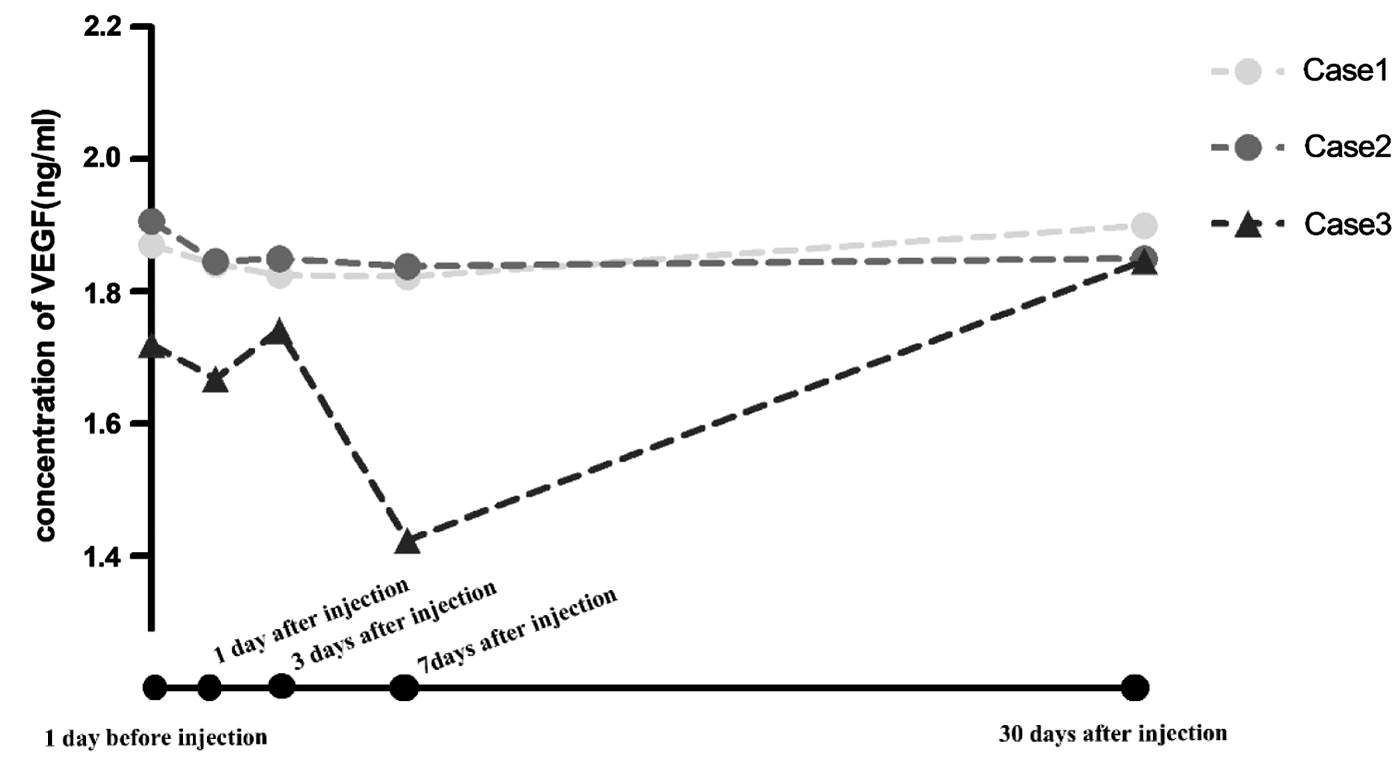
Graph displaying the concentration of VEGF in breast milk from baseline to day 30 after an intravitreal injection of conbercept in three patients. Case 1 ceased breastfeeding after starting conbercept treatment. Case 2 was treatment naive and ceased breastfeeding after starting conbercept treatment. Case 3 was treatment naive and continued breastfeeding during conbercept treatment. VEGF, vascular endothelial growth factor.
Discussion
Conbercept has become the first line of anti-VEGF drugs in China. Different groups have separately reported the efficacies of conbercept for CNV. Conbercept has been shown to remarkably improve visual acuity in CNV patients secondary to pathological myopia, 12 neovascular age-related macular degeneration, 9 polypoidal CNV, 13 idiopathic CNV, 14 and inflammation. 15 The results of our current study provide further information regarding the ocular efficacy of conbercept in a special population, namely, nursing women with CNV, and confirmed its favorable effectiveness and safety in the treatment of CNV again.
Because of the widespread use of conbercept in China, the systemic effects of conbercept during CNV treatment require great attention. Studies have shown that in both adults and infants, conbercept can cross the retinal–blood barrier and substantially decrease serum VEGF levels 1 day and 1 week after injection.16,17 The levels of VEGF in human breast milk have also been estimated in anti-VEGF drugs, such as bevacizumab and ranibizumab. To the best of our knowledge, this study is the first to assess the breast milk concentration of VEGF in patients treated with conbercept. Our results showed that in two patients, the levels of VEGF in breast milk were without statistically significant changes at 1 week after injection. Meanwhile, we detected a marked decrease of VEGF concentration in the third patient. Over the following 3 weeks, VEGF levels in all the three cases recovered fully.
This phenomenon could be explained by conbercept's molecular structure. Conbercept is a recombinant fusion protein composed of extracellular domain 2 of VEGFR-1 and extracellular domains 3 and 4 of VEGFR-2 (KDR-d4), combined with the Fc portion of human IgG1. Prior studies reported that Fc-containing antibodies could be transferred across the blood–retina barrier and the placenta through the Fc receptor of the neonate.6,18 However, conbercept did not result in a significant reduction in VEGF in human breast milk.
Based on our data, the intravitreal injection of conbercept shows favorable effectiveness and safety in the treatment of CNV in nursing women. However, we cannot completely exclude the possibility of adverse events in nursing mothers by the reduction of VEGF-A levels in the breast milk after intravitreal injection of conbercept, and a multicenter clinical study with larger cohorts would be warranted in the future.
Footnotes
Authors' Contributions
Z.S. and S.L. collected data and drafted the article. X.Y. collected sample and was involved in the preparation of the study. J.W. revised the study. H.L., Y.Z., and C.H. conducted experiments and performed the statistical analysis. F.Z. and J.L. conceived and designed the study and interpreted data. All authors have read, critically revised, and approved the current version of the article.
Ethical Approval and Consent to Participate
Approval was obtained from medical ethics committee of Qilu Hospital of Shandong University (No. KYLL-2020(KS)-833). The procedures used in this study adhere to the tenets of the Declaration of Helsinki.
Consent for Publication
Informed written consent for the publication of this case series and any additional related information was taken from the patients involved in the study.
Availability of Data and Materials
The data sets used and/or analyzed during this study are available from the corresponding author on reasonable request.
Disclosure Statement
No competing financial interests exist.
Funding Information
This study was funded by Key Research and Development Project of Shandong Province Grant No. 2017GSF218033.