




Abstract
Objective:
Intergenerational transmission of breastfeeding attitudes and behaviors from mother to daughter are well known, but there is limited research on intragenerational transmission of breastfeeding attitudes or behaviors within families. This study aimed to understand how initiation and duration of breastfeeding are influenced by past breastfeeding experiences of sisters among women in a longitudinal population-based cohort.
Methods:
Data were obtained on women enrolled in the 1979 National Longitudinal Survey of Youth (NLSY) who had at least one child enrolled in a substudy of cohort members' children. For each mother in the study, we determined whether any of her sisters also enrolled in the main NLSY study had previously breastfed one of their children.
Results:
Mothers whose sister(s) had prior breastfeeding experience were more likely to breastfeed their first-born child on unadjusted analysis (70% versus 45%, chi-square p < 0.001) and had a longer median of breastfeeding duration (median 14.5 versus 12 weeks, rank-sum p = 0.039). However, on a multivariable analysis accounting for potential confounding by maternal characteristics, infant characteristics, and differences among households, sisters' breastfeeding experience was no longer independently associated with the likelihood of breastfeeding initiation (odds ratio: 1.16; confidence interval [95% CI]: 0.73–1.85; p = 0.520) or the hazard of breastfeeding discontinuation (hazard ratio: 0.96; 95% CI: 0.82–1.12; p = 0.598).
Conclusion:
After adjusting for socioeconomic characteristics, intragenerational transmission of breastfeeding behavior was negligible among mothers raised in the same household. Other forms of intragenerational transmission (e.g., influence of extended family members) may be more salient influences on women's decision to breastfeed.
Introduction
Breastfeeding is recommended to support infant health and development, with the World Health Organization encouraging mothers to exclusively breastfeed infants through the first 6 months of life. 1 In the United States, ∼83% of infants are initially breastfed, but only 36% are still breastfed at 6 months of age. 2 Intergenerational transmission, or the influence of past generations on the breastfeeding behaviors of later generations, is a key social determinant of breastfeeding because support and advice from family members are highly influential for both initiating and continuing breastfeeding.3–8 Although past studies have specifically focused on transmission of breastfeeding attitudes and behaviors from mother to daughter,5,9 the experiences of other family members may also directly influence a mother's choice to breastfeed. For example, one study found that grandmothers' experience of breastfeeding was positively correlated with granddaughters' breastfeeding initiation, showing the far reach of intergenerational transmission. 5
Despite the wealth of literature on intergenerational transmission of breastfeeding, little evidence exists regarding how breastfeeding is influenced by intragenerational transmission, or the experience of sisters, cousins, or other family members of the same birth cohort as the mother. Experiences of family members belonging to the same generation could be especially relevant to mothers' decisions about breastfeeding initiation and continuation, because these family members would be able to share contemporary experiences with both barriers and facilitators of breastfeeding. In this study, we use data from a longitudinal birth cohort study to determine how sisters' past experience with breastfeeding is associated with first-time mothers' breastfeeding initiation and duration. We hypothesize that mothers whose sister(s) had experience with breastfeeding would be more likely to initiate breastfeeding and continue breastfeeding for a longer duration.
Methods
We used de-identified publicly available data from the National Longitudinal Surveys of Youth, including the 1979 cohort (NLSY79), as well as the NLSY79 Children and Young Adults cohort (NLSY79CYA). The local Institutional Review Board determined that analyses of these data did not constitute human subjects research. The NLSY79 was a nationally representative longitudinal cohort study launched in 1979 with participants ages 14–22 years. 10 All eligible participants in each household were enrolled, including multiple participants living in the same household. 11 Although the relation among multiple participants in the same households could not be ascertained from the public use data file, we assumed these participants were siblings based on kinship links accounting for the NLSY79 respondents' yearly living status in relation to their biological mother and father. 11
Participants were initially interviewed annually, and, starting in 1996, were interviewed biennially. Starting in 1986, children born to women in the NLSY79 cohort were enrolled in a follow-up study, NLSY79CYA. 12 The most recent rounds of data collection were conducted in 2016 for both studies. Interviews were done primarily in person, or, if necessary, by phone. To study intragenerational transmission of breastfeeding behavior, we limited our study to NLSY79 households where two or more women were enrolled in the original study (NLSY79) 13 and had children enrolled in the NLSY79CYA. For each mother (NLSY79 participant), we evaluated breastfeeding outcomes for the first-born child (NLSY79CYA participant), as shown in Figure 1. Cases with missing data on outcomes and covariates were excluded from the analysis.
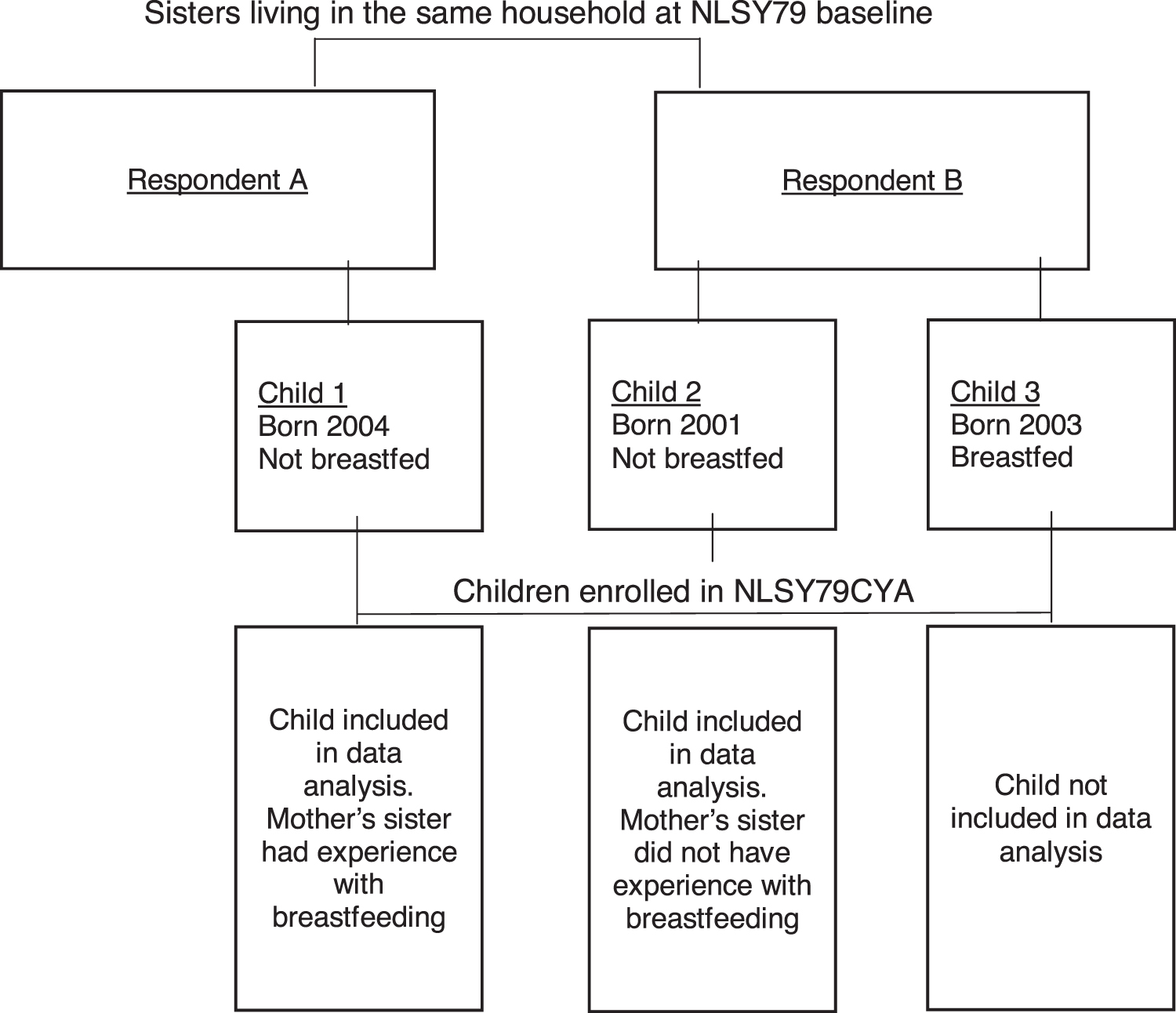
Diagram of respondent linkage between the NLSY79 and NLSY79CYA substudy. NLSY79, National Longitudinal Survey of Youth, 1979 Cohort; NLSY79CYA, NLSY79: Children and Young Adults.
Study outcomes included breastfeeding initiation and duration (in weeks) for the first-born child of each mother. Breastfeeding initiation was based on the NLSY79CYA survey and was defined as having breastfed the child at any point in the year of birth. Breastfeeding duration was based on the child's reported age in weeks when the mother had stopped breastfeeding (top-coded at 52 weeks). Infant-specific control variables were also obtained from the NLSY79CYA, and included sex of the infant, birth weight (kg), and gestational age in weeks, recoded as preterm (<37 weeks) versus term birth 14 ; as well as how many days the mother spent in the hospital after giving birth (0–2 days, 3 days, and 4+ days). Additional data from the NLSY79 were used to determine the mother's marital status, employment status, educational attainment, total household income, and race and ethnicity. 15 For children born before 1979, maternal characteristics were obtained from the earliest survey year available.
For each mother in the study, we determined whether any of her sisters (who were also enrolled in the NLSY79) had previously breastfed one or more of their children (who were also enrolled in the NLSY79CYA) before the birth of her own oldest child. This variable was coded as 1 if the mother's sister(s) had any reported breastfeeding experience at the time of her own child's birth, and 0 otherwise. Breastfeeding outcomes and other study data were compared according to sisters' experience with breastfeeding using chi-square tests for categorical variables, and rank-sum tests for continuous variables. We adjusted for confounding using multivariable logistic regression for breastfeeding initiation, and multivariable Cox proportional hazards regression for breastfeeding duration. To account for the clustering of mothers within households (from the NLSY79 survey), multivariable logistic regression analysis included a household-level random intercept. Data analysis was conducted in Stata 16.0 (StataCorp, LP, College Station, TX), and p < 0.05 was considered statistically significant.
Results
A total of 3,587 mothers were included in this study, of whom 272 (8%) had a sister who had breastfed her children before the mother's first child. In this sample, 47% of mothers initiated breastfeeding, and median breastfeeding duration was 12 weeks (interquartile range: 3, 4). As shown in Table 1, breastfeeding initiation was more common (70% versus 45%, p < 0.001) and breastfeeding duration was longer (median 14.5 versus 12 weeks, p = 0.039) among mothers whose sisters had previous breastfeeding experience. However, mothers in this group were also distinguished by shorter hospital length of stay (LOS), higher employment rate, higher educational attainment, and higher household income.
Respondent Characteristics According to Whether Respondents' Sister(s) Had Breastfed Their Children Before the Respondent's Own First Birth (N = 3,587)
Among 1,686 mothers who breastfed their first-born child.
IQR, interquartile range; LOS, length of stay.
To account for potential confounding, we fit a multivariable logistic regression model of breastfeeding initiation as shown in Table 2. This model included a statistically significant household-level random intercept (p < 0.001), indicating significant variation in breastfeeding initiation across NLSY79 households after controlling for observed characteristics. In the adjusted model, sister experience with breastfeeding was no longer associated with the likelihood of breastfeeding initiation (odds ratio [OR]: 1.16; confidence interval [95% CI]: 0.73–1.85; p = 0.520). Breastfeeding initiation was more likely with increasing birth weight; shorter hospital LOS; and greater maternal educational attainment. Married mothers were also more likely to initiate breastfeeding, compared with never-married mothers, and mothers who were unemployed were less likely to initiate breastfeeding than mothers who were not in the labor force, respectively. Black mothers were less likely to initiate breastfeeding compared with white mothers.
Logistic Regression Model of Breastfeeding Initiation (N = 3,587)
CI, confidence interval; OR, odds ratio.
Among 1,686 mothers who had initiated breastfeeding, Table 3 explored factors associated with breastfeeding discontinuation using a Cox proportional hazards regression model. Similar to the adjusted model of breastfeeding initiation, sisters' experience with breastfeeding was not independently associated with the hazard of breastfeeding discontinuation (hazard ratio: 0.96; 95% CI: 0.82–1.12; p = 0.598). The hazard of breastfeeding discontinuation was lower (implying longer breastfeeding duration) for mothers with greater educational attainment; and was higher (implying shorter breastfeeding duration) among mothers with prolonged hospital stay and among Hispanic as compared with non-Hispanic white mothers. In contrast to the model of breastfeeding initiation, the Cox model found no evidence that birth weight, maternal employment, or marital status were associated with breastfeeding duration.
Multivariable Cox Proportional Hazards Regression for Discontinuing Breastfeeding (N = 1,686)
HR, hazard ratio.
Discussion
Advice and support from family members are important facilitators of breastfeeding initiation and continuation.16,17 Previous research has focused on the intergenerational transmission of breastfeeding, where daughters who were breastfed by their mothers are more likely to breastfeed their own children. 3 In this study, we examined whether intragenerational transmission of breastfeeding also occurred among sisters who were raised in the same household. On bivariate analysis, mothers whose sister(s) had a prior experience with breastfeeding were indeed more likely to initiate and continue breastfeeding their first-born child. However, this association was no longer present after adjustment for confounding by maternal and infant characteristics. Although previous research suggests a strong influence of family members on breastfeeding behavior,3–8,16 the mechanism by which this influence operates remains unclear, especially outside the well-studied transmission of behavior from mother to daughter.
Advice from women in the same generation can help women navigate contemporary barriers to breastfeeding. Peers can be breastfeeding role models for mothers, offering their own experiences and support. 18 Knowing multiple peers who breastfed their own infant is positively associated with increased likelihood of breastfeeding. 19 In one qualitative study, female family members, including sisters, were found to have substantial influence on mothers' breastfeeding behaviors. 20 However, effects of intergenerational transmission reported in past quantitative studies appear to be stronger than the estimated effect size for intragenerational transmission in our study. 21 For example, considering the outcome of breastfeeding initiation, effect sizes for intergenerational transmission were estimated as adjusted ORs of 1.7 in two studies and an unadjusted OR of 6.9 in one study,3,9,22 compared with an adjusted OR of 1.2 for intragenerational transmission in our results. The weaker estimated effect size of intragenerational transmission in our study may be related to the fact that there are fewer women whose sisters have had direct experience with breastfeeding, compared with the number of women who can draw on their mother's experience. 3 Furthermore, it is possible that the influence of family members on breastfeeding behavior primarily operates through transmission of norms and beliefs as compared with sharing of individual experiences, although further research is needed to compare the salience and strength of these mechanisms.
In our study, maternal educational attainment was positively associated with breastfeeding initiation, although associations with maternal employment were mixed. Unemployed women were less likely to breastfeed than women who were out of the labor force. Although employed women were the group most likely to initiate breastfeeding, the difference between this group and women who were out of the labor force did not reach statistical significance. Some previous studies have suggested that full-time employment is negatively associated with breastfeeding duration, whereas the effects of part-time employment are uncertain.23,24 Because our study analyzed employment before birth, this measure may have been a proxy for higher socioeconomic status and may not have reflected barriers to breastfeeding encountered by working mothers in the postpartum period. 25 Supporting the association between high SES and breastfeeding, several studies have found that breastfeeding initiation is more likely for women with higher educational attainment, particularly among first-time mothers.7,26,27
Similar to prior research, our study found racial/ethnic differences in breastfeeding initiation and continuation, with black women being less likely to initiate breastfeeding than white women, and Hispanic women tending to discontinue breastfeeding earlier than white women in the analytic sample. Minority women disproportionately encounter barriers to breastfeeding initiation and continuation, and various community- and hospital-based interventions have been described to achieve more equitable breastfeeding outcomes.28,29 Among perinatal characteristics, higher birth weight and shorter maternal hospital LOS were favorably associated with breastfeeding initiation. Similar to another study using the National Survey of Family Growth, we found no independent association between prematurity and breastfeeding initiation or duration. 14 Although we did not analyze the impact of maternal birth cohort, due to the narrow range of birth years eligible for enrollment in the NLSY79, more recent cohorts have demonstrated increasing rates of breastfeeding initiation compared with our sample. For example, one study using data from the National Immunization Survey found that 79% of children born between 2010 and 2013 were breastfed. 30
Owing to the timing of the NLSY79 cohort enrollment, some of our findings may have been influenced by trends in breastfeeding rates and associated social factors. Medical practitioners in the United States have increasingly promoted breastfeeding, and breastfeeding rates have steadily increased in recent decades.31,32 Research on breastfeeding among more recent cohorts has described a positive impact of new technologies, such as support groups facilitated by social media, which were unavailable for most of the mothers in the NLSY79 cohort at the time of their first birth.33–35 Furthermore, income- and class-related differences in breastfeeding behavior may have changed over time. In particular, the gap in breastfeeding initiation between participants of the need-based Women, Infants, and Children program and nonparticipants has steadily narrowed since the 1970s, 36 indicating that the association of high socioeconomic status with high rates of breastfeeding initiation may have weakened over time.
Other limitations of our data include the inability to analyze the impact of breastfeeding education received from health care providers, including during the birth hospitalization. We were also limited to observing breastfeeding outcomes among mothers who had participated in the original NLSY79 study. Participants may have had additional sisters who declined to participate, lived outside the household, or were ineligible for enrollment at the study baseline. This may have led us to underestimate the proportion of mothers who could draw on a sisters' experience with breastfeeding at the time of their own first birth. Finally, the low rate of breastfeeding initiation in our sample may be influenced by our restriction of the NLSY79 sample to households with multiple eligible respondents. Multiparous mothers are less likely to initiate breastfeeding than primiparous mothers, 7 so women growing up in larger households may have been less likely to have been breastfed, and, in turn, may have been less likely to breastfeed their own children.
Conclusions
Despite ample evidence on intergenerational transmission of breastfeeding, our study was the first to attempt a quantitative analysis of transmission within the same generation. After adjustment for socioeconomic characteristics such as employment status and educational attainment, we found that sisters' experiences with breastfeeding did not influence the breastfeeding behavior of the mother. Based on this finding, maternal demographics as well as perinatal characteristics seem to influence breastfeeding behavior more strongly than intragenerational transmission. However, the concept of intragenerational transmission could apply more generally to experiences of peers and more distant family members. Understanding the transmission of breastfeeding beliefs and attitudes among women of the same generation requires further research.
Footnotes
Authors' Contributions
C.B. and D.T. conceptualized the study; J.W. acquired data and performed data analysis; A.H., C.B., and D.T. interpreted results; J.W. and A.H. drafted the article; C.B. and D.T. critically revised the article; and all authors agreed to the final version as submitted.
Disclosure Statement
No competing financial interests exist.
Funding Information
No funding was received for this article.