




Abstract
Background:
Approximately 10–20% of mothers have a chronic disease. Studies on breastfeeding in women with chronic disease span multiple disciplines, and these have not been collated to synthesize knowledge and identify gaps. The objective of this review was to summarize published literature on breastfeeding in women with chronic disease.
Methods:
We conducted a scoping review of original research and systematic reviews identified in Medline, EMBASE, and CINAHL (1990–2019) and by hand searching on women with chronic diseases reporting on at least one breastfeeding-related topic. Conference abstracts, case-studies, and studies on pregnancy-induced conditions or lactation pharmacology were excluded. Content analysis and narrative synthesis were used to analyze findings.
Results:
We identified 128 articles that were predominantly quantitative (80.5%), conducted in Europe or North America (65.6%), analyzed sample sizes of <200 (57.0%), and published from 2010 onward (68.8%). Diabetes (42.2%), multiple sclerosis (MS; 19.5%), and epilepsy (13.3%) were the most common diseases studied. Breastfeeding was a primary focus in approximately half (53.1%) of the articles, though definitions were infrequently reported (32.8%). The most-studied topics were breastfeeding duration/exclusivity (55.7%), reasons for feeding behavior (19.1%), and knowledge and attitudes about breastfeeding (18.3%). Less studied topics (<10% of articles each) included milk expression behaviors, breastfeeding difficulties, and feeding supports.
Conclusions:
Existing literature focuses primarily on diabetes or MS, and breastfeeding behaviors and outcomes. Further research examining a broader range of chronic diseases, with large sample sizes, and sufficient breastfeeding measurement detail can improve our understanding of breastfeeding disparities in this population.
Background
Chronic diseases are increasingly prevalent among pregnant women over the past several decades, and currently affect 10–20% of mothers. 1 This trend is likely explained by the increasing disease burden in the general population, delayed childbearing, and medical advances in assisted reproduction. 2 Research targeting mothers with chronic diseases has predominantly focused on quantifying women's elevated risks of adverse obstetric outcomes.3,4 Such evidence has been useful for managing and mitigating risk during prenatal care and childbirth; however, a knowledge gap persists regarding postpartum outcomes, such as breastfeeding.
Accumulating evidence suggests that women with chronic diseases experience poorer breastfeeding outcomes than their healthy counterparts. Several studies have shown that women with preexisting diabetes are less likely to exclusively breastfeed and generally breastfeed for shorter duration than nondiabetic women.5,6 Other analyses suggest that women with polycystic ovary syndrome (PCOS), 7 inflammatory bowel disease (IBD), 8 arthritis, 9 and epilepsy 10 breastfeed less frequently than unaffected women. Women with chronic diseases may require tailored and evidence-based resources to make informed breastfeeding choices, but our understanding of breastfeeding in this population remains disjointed. The literature spans multiple disciplines including biomedical sciences, population health, nursing, and psychology, and breastfeeding measurement and topics vary considerably. A synthesis of interdisciplinary research is required to summarize current knowledge and inform research priorities and support considerations. Therefore, the objective of this scoping review was to summarize the extent and nature of published literature on breastfeeding in women with chronic diseases.
Methods
Design
We conducted this scoping review using the Arksey and O'Malley framework and recommendations by Levac et al.,11,12 and following the PRISMA checklist extension for scoping reviews. 13
Study selection
Eligible studies included original research (observational or experimental) or systematic reviews published in English, which focused on women with chronic diseases and reported quantitative or qualitative data on breastfeeding. Case reports, conference abstracts, commentaries, clinical guidelines, or studies on pregnancy-induced versions of disease were excluded. To ensure feasibility, articles on protocols, pharmacology, human milk composition, and health care professionals were also excluded.
Chronic diseases were defined as any preexisting, noncommunicable physical health condition that is relatively stable in nature. Cancers and psychiatric disorders were excluded because of the fluctuating disease course of these conditions. Obesity was also excluded given existing reviews on breastfeeding.14,15 Breastfeeding was defined as an infant receiving their mother's milk by any method, and was inclusive of milk expression.
Our search strategy was developed in consultation with a health sciences librarian (Supplementary Appendix Table SA1), containing keywords and controlled vocabulary for chronic diseases, women/human, and breastfeeding. The search was executed in Medline (Ovid), EMBASE (Ovid), and CINAHL (EBSCO), limiting to articles published from 1990. Our search was initially run in June 2018 and updated in August 2019. We also employed hand searching strategies: scanning references lists and “cited by” lists in each database for eligible studies.
Two authors (N.V.S., S.L.) conducted study selection. The first author screened titles and abstracts, and excluded citations not meeting eligibility criteria. We reviewed full texts of remaining citations to evaluate relevance, consulting with the co-author team to resolve discrepancies and review inclusion decisions.
Data extraction
A standardized data extraction form was piloted on 10 articles to ensure consistency in use. Three authors (N.V.S., S.L., and M.J.) participated in data extraction, collecting study characteristics, study design, objectives, sample information, data collection information, and breastfeeding variables and definitions. Articles were extracted by one author and verified by a second, and discrepancies resolved by discussion and consensus.
Data analysis
We summarized characteristics of included studies using descriptive statistics. Content analysis was used to identify overarching categories of breastfeeding topics, and narrative synthesis was used to produce the results. Each category aimed to capture a unique aspect of breastfeeding; however, we included a “general breastfeeding status” category for articles that included insufficient description of the term breastfeeding to be validly classified elsewhere. Articles were classified to one or more categories depending on the nature and number of breastfeeding topics reported. Results were grouped by disease to highlight the quantity and nature of studies published on each condition.
Results
Study characteristics
Our combined database and hand searching strategy yielded 14,170 citations, of which 128 articles met our inclusion criteria (Fig. 1). Table 1 describes characteristics of included articles. Most articles were published from 2010 onward (68.8%). There were 8 systematic reviews and 120 original research articles, including 103 quantitative, 13 qualitative, and 4 mixed methods studies. Among original research, most were observational cohort studies (59.4%), conducted in North America or Europe (65.6%) and had a sample size <200 (57.0%).

Flowchart of study selection.
Summary of Article Characteristics
Location and sample size exclude systematic review articles or articles that used a unit of analysis other than women (e.g., online posts).
IBD, inflammatory bowel disease; PCOS, polycystic ovary syndrome.
Of the 123 articles on individual diseases, diabetes was the most common (42.2%), followed by multiple sclerosis (MS; 19.5%), epilepsy (13.3%), and IBD (7.8%). Five articles examined diseases compositely; maternal disability or illness (n = 3) and rheumatic diseases (n = 2). Strategies to ensure validity of disease classification varied. Forty articles recruited participants from health care (often disease-specific) clinics, 41 used standardized disease criteria (e.g., biomarkers), 19 relied on self-report, 10 were nested in disease-specific cohorts, and 10 used administrative or chart data.
Breastfeeding
Breastfeeding was a primary focus as evidenced by inclusion in the study title and/or primary objective in 68 articles, and a secondary focus in 60 articles. One-third (32.8%) included a clear definition of breastfeeding or related terms (e.g., exclusive, initiation). Table 2 displays the 14 breastfeeding topics generated from content analysis. The most-studied topic was breastfeeding duration and exclusivity (55.7%), followed by reasons for feeding behavior (19.1%), knowledge and attitudes about breastfeeding (18.3%), breastfeeding initiation (17.6%), general breastfeeding status (16.8%), early or in-hospital breastfeeding behaviors (15.3%), and breastfeeding intentions (10.5%). The remaining topics including milk expression behaviors, breastfeeding difficulties, and breastfeeding supports were each reported in <10% of articles. Figure 2 displays a matrix of the diseases and breastfeeding topics reported. A detailed summary of article information and measurement time points is in Supplementary Appendices Tables SA2 and SA3.
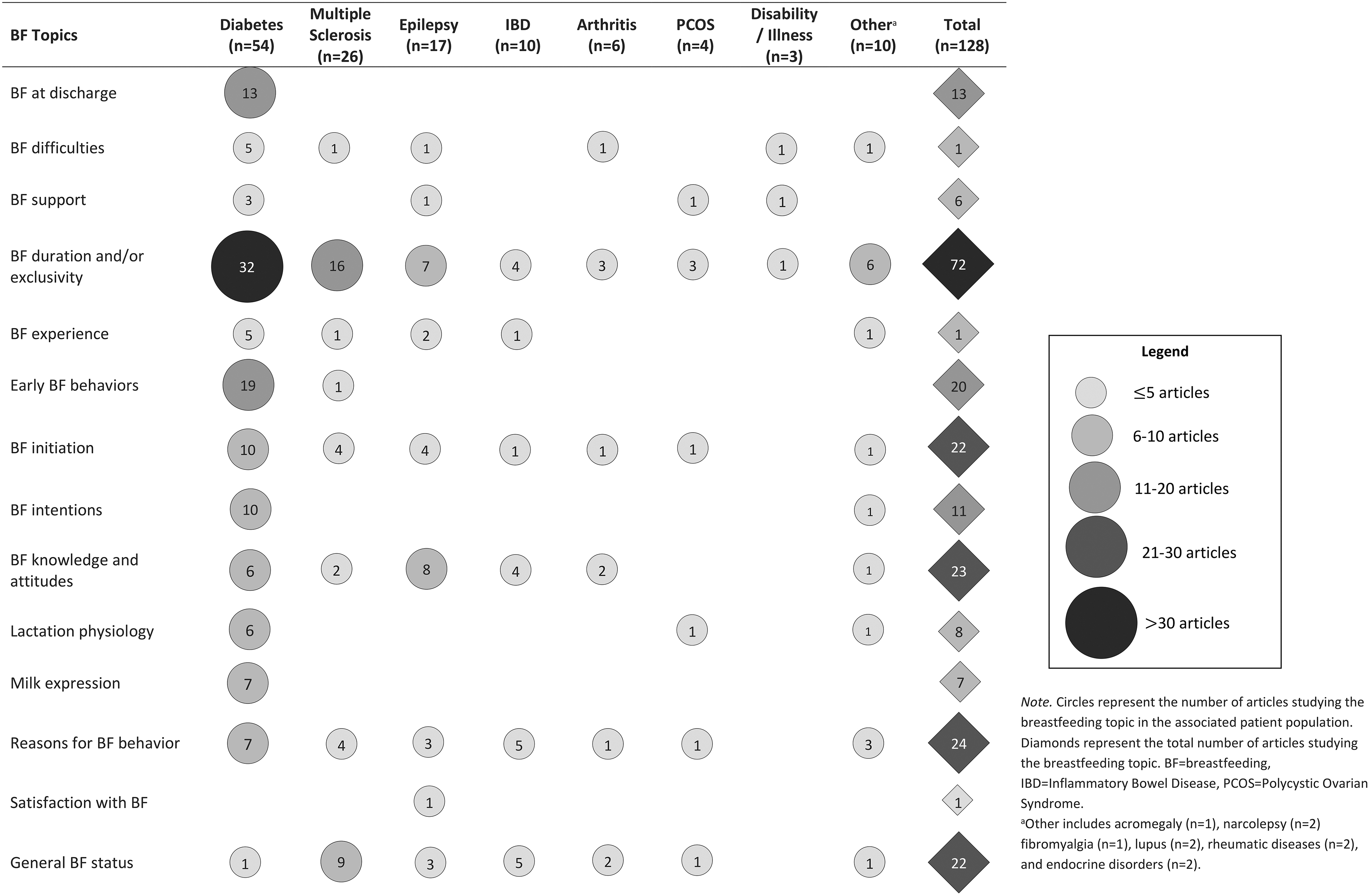
Matrix of breastfeeding topics and chronic diseases studied in included articles.
List of Breastfeeding Topics Generated from Content Analysis of Articles
Examples refers to quantitative variables that would be considered to fall under each topic; however, many topics include both quantitative and qualitative data types.
Diabetes
Of the 54 articles on diabetes,5,6,16–67 44 were quantitative, 5 were qualitative, 4 were systematic reviews, and 1 was mixed methods. There were 28 articles on Type 1 diabetes, 25 on both Type 1 and 2 diabetes, and 1 on Type 2 diabetes. Breastfeeding was a primary focus in most (n = 38) articles and approximately half (n = 23) included a breastfeeding definition. Sample sizes ranged from 14 women to 803,222 births, with almost half having <200 participants (n = 24). Articles frequently reported studies conducted in the United States (n = 16), followed by Australia (n = 7) and Sweden (n = 6).
Breastfeeding duration/exclusivity was the most-studied topic at various time points in the 2 years postpartum (n = 31), with most articles reporting within the first 6 months (n = 22) and fewer at 12 months or greater (n = 4). Exclusivity was reported in 24 articles. Generally, articles were aimed at comparing duration/exclusivity among women with and without diabetes, or identifying predictors of breastfeeding outcomes in diabetic women. Unique to diabetes were seven articles on the role of breastfeeding duration/exclusivity in influencing insulin requirements or glycemic control. Early breastfeeding behavior was the second most studied topic (n = 19) and frequently included timing of first breastfeed and in-hospital supplementation. Breastfeeding at hospital discharge was reported in 13 articles, including comparisons of rates or predictors in diabetic versus healthy women, and trends among diabetic women. Breastfeeding initiation and intentions were reported in 10 articles each, with comparisons to healthy women or in diabetic samples based on disease subtype, smoking, or race. Milk expression practices were reported in seven articles, often on the effectiveness of antenatal expression as an intervention to improve feeding outcomes, including one Cochrane review and two articles on pilot and full randomized controlled trial (RCT) data on this topic. Reasons for breastfeeding behavior were reported in seven articles, and breastfeeding knowledge and attitudes, such as ratings of confidence and importance of breastfeeding, were studied in six articles. Lactation physiology was examined in six articles, with a focus on delayed onset of lactogenesis II including one review on the topic. Presence of breastfeeding difficulties were studied in five articles, with only one breaking down difficulties by type. Feeding experiences were reported in five articles and generally reported on the balance of controlling glucose levels in relation to breastfeeding and infant care, and feeding support was reported in three articles.
Multiple sclerosis
Of the 25 articles on MS,68–92 21 were quantitative, 2 were qualitative, and 2 were systematic reviews. Breastfeeding was predominantly a secondary focus (n = 17), and 8 articles included a definition for breastfeeding. Sample sizes ranged from 9 to 803 women, with nearly two-thirds having <200 participants (n = 15). Articles frequently reported on studies conducted in the United States (n = 5) and Europe (n = 12), with 2 articles reporting on a single North American prospective study.
Breastfeeding duration/exclusivity was the most commonly studied topic (n = 16), with most articles reporting time points at 2-, 4-, or 6-months (n = 9) and including a measure of exclusivity (n = 9). Several articles focused on the role of breastfeeding in postpartum relapse of MS symptoms, with others describing the impact of MS therapy on duration and exclusivity, or comparing outcomes between women with and without MS. Nine articles reported on general breastfeeding status, mainly as a secondary outcome. Breastfeeding initiation was reported in four articles usually with comparisons based on prepregnancy disease activity or MS therapy. Reasons for breastfeeding behaviors were reported in four articles with a focus on the impact of resuming medication/treatment on feeding decisions. Two articles detailed breastfeeding knowledge and attitudes, including one study on the nature of physician advice and one study on women's perceptions regarding the effect of breastfeeding on MS and vice versa. Breastfeeding difficulties and experiences were both reported in one qualitative article on the broader lived experience of MS and motherhood.
Epilepsy
Of the 17 articles on epilepsy,93–109 13 were quantitative, 3 were qualitative, and 1 was a systematic review. Breastfeeding was a primary focus in 7 articles and secondary focus in 10 articles, and 5 articles included a definition for breastfeeding. Sample sizes ranged from 11 women to 78,744 children, with over two-thirds reporting sample sizes <200 (n = 12). Research was predominantly set in the United Kingdom (n = 3) and Asia (n = 7), including two articles detailing one longitudinal study conducted in both the United States and United Kingdom.
Breastfeeding knowledge and attitudes was the most-studied topic (n = 8), with many articles reporting on perceptions (e.g., usefulness) and sources of information on antiepileptic medications safety during lactation. Seven articles reported on breastfeeding duration/exclusivity at varying times up to 24 months postpartum, describing the prevalence of breastfeeding or mean duration in epileptic women altogether, by therapy type, or compared to control women, and three of these measured exclusivity. Four articles reported on breastfeeding initiation. Reasons for breastfeeding behavior was reported in three articles with a focus on the role of medications/treatment. Breastfeeding satisfaction and support were both detailed in one article on encouragement from various sources in relation to feeding outcomes, and breastfeeding difficulties was in one article reporting on women's ratings of epilepsy-related challenges with breastfeeding. Breastfeeding experiences were detailed in one qualitative article on the perinatal experience in women with epilepsy, which included themes on women's decision-making process.
Inflammatory bowel disease
Of the 10 articles on IBD,8,110–118 9 were quantitative and 1 was mixed methods. All articles included women with all forms of IBD (Crohn's disease, ulcerative colitis, or indeterminate colitis), except one article that focused exclusively on Crohn's disease. Articles were split in including breastfeeding as a primary (n = 5) or secondary (n = 5) focus, and one article included a definition for breastfeeding. Sample sizes ranged from 105 to 824 women, with a mix of both small (<200; n = 4) and medium (200–400; n = 4) scale studies. Studies were conducted in a variety of countries, with one article reporting a content analysis of user posts from social media and websites.
General breastfeeding status was reported in six articles, which ranged from exploring the role of breastfeeding on postpartum disease activity to reporting prevalence in IBD women altogether or by subtype. Reasons for breastfeeding behavior were described in five articles, with a focus on the role of medications/treatment and personal preference. Breastfeeding knowledge and attitudes was described in four articles, generally on women's perceptions of whether individuals with IBD can safely breastfeed. Data on breastfeeding duration was present in four articles, focusing on established breastfeeding (earliest reported time point of 24 weeks) and outcome comparison across disease therapy, activity, or subtype; no articles measured exclusivity. Breastfeeding initiation by IBD subtype was reported in one study, and breastfeeding experience was discussed in one mixed methods study describing women's experiences with feeding decisions and related symptom fluctuation.
Arthritis
Of the six articles on arthritis,9,119–123 four were quantitative, one was mixed methods, and one was a systematic review. Articles were split in including breastfeeding as a primary (n = 3) or secondary (n = 3) focus. One article included a breastfeeding definition. Sample sizes ranged from 27 to 3,225 women, with most (n = 4) having <200 participants. Each study was conducted in a different country.
Breastfeeding duration/exclusivity was the most commonly studied topic (n = 3), either in relation to postpartum disease activity or compared to healthy controls; one study each reported on breastfeeding to 4 weeks, 26 weeks, and up to 18 months, and only one measured exclusivity. Two articles reported on breastfeeding knowledge and attitudes; one mixed methods study described women's perceptions of information gaps, and one systematic review described knowledge and self-management interventions for arthritic women in relation to reproduction, including breastfeeding. Two articles reported on general breastfeeding status. One article reported on breastfeeding initiation, and one article reported on reasons for breastfeeding behavior related to medication use, mothers (e.g., no desire), or infants (e.g., difficulty latching).
Polycystic ovary syndrome
All four articles on PCOS were quantitative.7,124–126 Three articles included breastfeeding as a primary focus, and only one provided a breastfeeding definition. Sample sizes ranged from 135 to 4,898 women, with all but one (n = 3) having <200 participants. Two studies were conducted in Norway, and the other two took place in Australia and the United States.
Breastfeeding duration/exclusivity in PCOS women relative to healthy women or across disease therapies was reported in three articles, of which one limited focus to the first 6 months and two included up to 12 months postpartum; two of these measured exclusivity. Breastfeeding initiation in women with PCOS versus control women and breastfeeding difficulties and support, including occurrence of sore nipples and frequency of seeking lactation support, were reported in the same article. Lactation physiology was reported in one article describing changes in breast size and correlation with feeding outcomes in an RCT of prenatal metformin use in women with PCOS. General breastfeeding status and reasons for breastfeeding behavior, primarily the drivers behind “failed attempts” at breastfeeding, were reported in the same article.
Disability or illness
Of the three articles on disability or illness,127–129 two were qualitative and one was quantitative. All included breastfeeding as a secondary focus, were conducted in either the United Kingdom (n = 2) or the United States (n = 1), and did not provide a breastfeeding definition. The qualitative studies contained 12 and 17 women each and focused on physical and/or sensory disability (e.g., spina bifida). The quantitative study analyzed 11,699 women and focused on activity-limiting lifelong illness (e.g., musculoskeletal disorders).
One study reported on breastfeeding duration, comparing length of breastfeeding up to 3 months in women with disability versus fully able peers without measuring exclusivity. One study described breastfeeding difficulties, with women recounting their challenges with breastfeeding positioning. The remaining study included women's perceptions on breastfeeding support, namely the receipt of inadequate assistance from health professionals.
Others
Nine articles reported on breastfeeding in the context of other diseases, including rheumatic diseases (n = 2, e.g., connective tissue disease),130,131 lupus (n = 2),132,133 narcolepsy, 134 acromegaly, 135 Sjogren's syndrome, 136 hypopituitarism, 137 and fibromyalgia (n = 1 each). 138 Of these, seven were quantitative, one was mixed methods, and one was qualitative. Two articles included breastfeeding as a primary focus (both on women with lupus), and only one article included a breastfeeding definition. Sample sizes were small, ranging from 9 to 128 women, and studies were conducted in a range of countries.
Six articles reported on breastfeeding duration, with time points in the early postpartum (e.g., 6 weeks) or after the first year (e.g., 20 months), and none reported on exclusivity. Of these, four articles reported duration outcomes in samples with lupus, hypopituitarism, or rheumatic disease, whereas two compared outcomes in women with narcolepsy or Sjogren's syndrome versus healthy controls. Reasons for breastfeeding behavior was reported in three articles, two on lupus and one on Sjogren's syndrome, with a focus on the role of maternal desire and medication use. Breastfeeding difficulties and experiences were both reported in one qualitative study on mothers with fibromyalgia describing experiences with muscle pain, fatigue, and sore nipples. Breastfeeding intentions and initiation were each reported in one study, and both on lupus. Lactation physiology was reported in one study on prolactin levels in Sjogren's syndrome. Breastfeeding knowledge and attitudes was described in one study on rheumatic diseases, including women's reports of insufficient information about medications and breastfeeding, and concerns about balancing symptoms with feeding desires. One study on women with acromegaly reported on general breastfeeding status.
Discussion
Our scoping review summarized the extent and nature of published literature on breastfeeding in women with chronic diseases. We identified 128 relevant articles, which were predominantly observational and quantitative, conducted in North America or Europe, and analyzed small-to-moderate sample sizes (<200). Two-thirds were published from 2010 onward, which suggests a contemporary interest in this subject and rapidly evolving knowledge base. Definitions for breastfeeding were lacking. Articles spanned a range of diseases, including diabetes, epilepsy, PCOS, and rheumatic diseases. Breastfeeding topics covered in these articles largely pertained not only to behaviors and outcomes, but also included knowledge and attitudes, experiences, support, and lactation physiology. Although our review was not designed to synthesize findings across studies, our mapping of study characteristics, included diseases, and breastfeeding topics provides important information on what has been heavily studied, moderately studied, and not studied in this context.
Diabetes was the most-studied disease accounting for almost half of included articles, which largely focused on breastfeeding duration/exclusivity or early breastfeeding behaviors. This preponderance of articles suggests that a systematic review and meta-analysis may be useful to critically appraise evidence quality and quantify the potential disparity in feeding outcomes between women with and without diabetes across the postpartum. MS has also been heavily studied, with a focus on the bi-directional relationship between breastfeeding duration/exclusivity and MS symptoms. A recent meta-analysis (published after our search was executed) that analyzed several included articles from our review reported that pooled odds ratios for postpartum MS relapse were 0.63 (95% confidence interval [CI] = 0.45–0.88) for any breastfeeding and 0.52 (95% CI = 0.28–0.97) for exclusive breastfeeding for 2 months or more. 139 Findings from the critical appraisal in this meta-analysis and from our review both indicate that inconsistent or absent reporting of breastfeeding definitions and operationalization of feeding variables are a key limitation in this literature.
Our synthesis indicates that breastfeeding initiation and duration/exclusivity have been moderately studied across a range of diseases (aside from diabetes and MS), with an emphasis on investigating suboptimal feeding outcomes in women with disease relative to women without disease. Time points were concentrated in the first 6 months postpartum, which limits our understanding of long-term feeding outcomes in women with chronic diseases. Exclusivity is an important element underpinning the many health benefits of breastfeeding for infants, 140 yet it is an often overlooked aspect of breastfeeding measurement. Moreover, we observed that many articles utilized small or clinical samples, which hampers the internal and external validity of findings. Statistical power to adjust for confounders that can distort the chronic disease-breastfeeding relationship (e.g., socioeconomic status) may be limited, and sampling from a clinical setting can result in selection bias toward individuals with more severe disease. 141 Additional research that leverages large, population-based data sources and longitudinal data would bolster our understanding of differences in breastfeeding outcomes according to maternal disease. Breastfeeding knowledge and attitudes and reasons for breastfeeding behavior were also moderately studied topics across diseases, with a clear focus on the role of medications in not initiating, discontinuing, or decreasing breastfeeding. Women faced with taking medications while breastfeeding frequently cite concerns about adverse effects on their baby, even when safety evidence is available and with reassurance from health care professionals. 142 Given the widespread (and often necessary) use of medications in women with chronic disease, a further analysis of these articles would be useful for identifying aspects of decision making that may benefit from targeted knowledge translation.
Several diseases that are prevalent in reproductive-aged women were absent from included articles, such as hypertension, asthma, and thyroid disorders.1,143 Research on breastfeeding in these conditions is needed to explore disparities and ensure that appropriate feeding supports are deployed if needed. Of the 14 breastfeeding topics identified in our content analysis, 7 received minimal attention overall: breastfeeding intentions, experiences, difficulties, support, satisfaction, milk expression, and lactation physiology. Research on these topics, however, is imperative to understand why suboptimal breastfeeding might be occurring in women with chronic disease and to pinpoint information and support needs. For example, breastfeeding intentions are the strongest predictor of outcomes in the general population, 144 which aligns with several health behavior theories positing the influence of intentions. 145 One included study by Cordero et al. 67 found that 65% of women with diabetes intended to breastfeed, which is lower than published estimates of 80–85% in the general population. 146 It is possible that differences in feeding outcomes by disease status are (at least partly) explained by differences in women's preformed intentions, as opposed to events occurring after delivery. Two breastfeeding topics–breastfeeding at discharge and early feeding behaviors–were almost entirely studied in the context of diabetes. Establishing successful breastfeeding in the initial hours and days after delivery provides a crucial foundation for sustained breastfeeding. 147 Research that investigates differences in breastfeeding up to and including hospital discharge according to maternal disease may help frame the delivery hospitalization as an opportunity for targeted support.
It is possible that relevant articles were inadvertently missed during our study selection process. In alignment with a scoping review framework, we did not perform a critical appraisal or narrative synthesis of findings among included articles, which precludes us from commenting on either methodologic rigor or common conclusions across articles. Strengths of our approach include a peer-reviewed and double-pronged search strategy, and verification of study selection and extraction using multiple co-authors. A scoping review was the ideal methodology given our objective of mapping breastfeeding topics studied in women with chronic disease; we did not seek to synthesize data on a single research question, but rather showcase the breadth of published research in this area. As such, we were intentionally broad in our definition of chronic disease and through inclusion of articles with data on any breastfeeding-related topic, to provide a comprehensive summary of this body of literature.
Conclusion
The 128 articles presented in this scoping review on breastfeeding in women with chronic disease highlight a predominant focus on diabetes or MS, and on breastfeeding behaviors and outcomes. Further research on a broader range of diseases and breastfeeding topics may improve our understanding of the physiologic and psychosocial basis for potential breastfeeding disparities in this population. Building on literature published to date, we recommend that future studies leverage large and representative samples, include definitions of breastfeeding and related variables, and follow women beyond 6 months. Findings from our review can raise awareness among health professionals on the unique aspects of breastfeeding for women with chronic disease that have been studied, including the impact of breastfeeding on symptoms and vice versa, and knowledge and decisions about medication use. Counseling and support on these matters can ensure that women feel appropriately informed in their breastfeeding efforts.
Footnotes
Authorship Confirmation Statement
N.V.S. conceived the study idea and drafted the review protocol, with input from S.L., A.M., and K.H.C. N.V.S. executed the search strategy, N.V.S. and S.L. participated in study selection, and N.V.S., S.L., and M.J. completed data extraction and synthesis. N.V.S. wrote the initial article draft with contributions from S.L. and M.J. All authors provided critical feedback on the article, suggested revisions, and approved the final version.
Acknowledgment
We would like to thank Helen Lee Robertson for her support with developing the database search strategy for this review.
Disclosure Statement
The authors declared no potential conflicts of interest with respect to the research, authorship, and/or publication of this article.
Funding Information
The authors received no financial support for the research, authorship, and/or publication of this article. N.V.S. is supported by a Canadian Institutes of Health Research Canada Graduate Scholarship Doctoral Award. A.M. is supported by a New Investigator Award from the Canadian Institute of Health Research. S.L. is supported by the Graduate Studentship from Alberta Innovates and the Achievers in Medical Sciences Doctoral Scholarship from the University of Calgary.

References
Supplementary Material
Please find the following supplemental material available below.
For Open Access articles published under a Creative Commons License, all supplemental material carries the same license as the article it is associated with.
For non-Open Access articles published, all supplemental material carries a non-exclusive license, and permission requests for re-use of supplemental material or any part of supplemental material shall be sent directly to the copyright owner as specified in the copyright notice associated with the article.
