




Abstract
Background:
Endometriosis is a chronic and debilitating disease characterized by ectopic, endometrium-like tissue outside the uterine cavity.
Objective:
The current meta-analysis was conducted to evaluate the effect of breastfeeding and ingesting human breast milk on the subsequent risk of endometriosis.
Materials and Methods:
The English and Persian databases were systematically searched in accordance with the Mesh browser keywords and free-text words until March 12, 2022. The Newcastle–Ottawa was used to evaluate the quality of the included studies. Publication bias was assessed using Begg's and Egger's tests, and funnel plot. The heterogeneity of studies was evaluated using I2 statistics. Results of the random-effects meta-analysis were presented using odds ratios (ORs) and 95% confidence intervals (CIs).
Results:
In total, 18 articles with 10,994 subjects were included in the meta-analysis. Overall, the pool estimates show that breastfeeding (OR = 0.79, 95% CI: 0.71–0.88, I2 = 89%) and ingesting human breast milk (OR = 0.67, 95% CI: 0.50–0.83, I2 = 84.5%) have significantly a protective effect on the risk of endometriosis.
Conclusion:
Our findings confirm an inverse association between endometriosis risk and ingesting human breast milk, and breastfeeding. Therefore, the importance of breastfeeding for both mother and child should be considered by policymakers and health care providers.
Introduction
Endometriosis is a chronic and debilitating disease characterized by ectopic, endometrium-like tissue outside the uterine cavity, which has commonly three distinct phenotypes, including deep-infiltrating endometriosis, endometrioma, and superficial peritoneal lesions. 1 This disease affects 10–15% of reproductive-age women, with up to 70% being symptomatic.2,3 Infertility, menstrual irregularity, fatigue, and pain (e.g., dysmenorrhea, dyspareunia, chronic pelvic pain, dysuria, dyschezia) are the main pronounced complaints of these women, which have considerable adverse effects on their physical and emotional well-being.4,5
The pathogenesis of endometriosis is still debated but is thought to have various mechanisms such as hormonal, immunologic, inflammatory, genetic, epigenetic, and environmental, which can facilitate both the implantation and growth of ectopic tissue. 4 Moreover, emerging research emphasizes the role of environmental exposures at early-life stages in the pathogenesis of endometriosis. 6 It has been suggested that factors such as low birth weight, DES, and preterm birth may increase the risk of endometriosis in adulthood. Recently, the debate surrounding the potential association between exclusive breastfeeding and the risk of endometriosis has received increasing attention.
Some previous research has shown that the history of breastfeeding had a protective effect on the risk of endometriosis. However, some studies reported that breastfeeding can increase the risk of endometriosis among Chinese women. The advantageous effects of breastfeeding for both breastfed infants and breastfeeding women are widely acknowledged. There have been many recent studies that have placed particular emphasis on the lasting benefits of lactation for long-term maternal health, including helping to lose weight and reducing the risk of chronic diseases (e.g., anemia, cardiovascular disease, breast, and ovarian cancer).7–10
These effects of breastfeeding appear to be mediated by prolonged amenorrhea, increased circulating levels of oxytocin and prolactin, and inhibition of circulating gonadotropins. 7 Due to the increased expression of estrogen receptors in endometriotic lesions, it seems that decreased estrogen levels after breastfeeding may play an important role in the regression of endometriosis. 11
Previous research has yielded conflicting results regarding the effect of breastfeeding and ingesting human breast milk on the risk of endometriosis. Therefore, this study was conducted as a systematic review and meta-analysis to determine the effect of breastfeeding, and ingesting human breast milk on the subsequent risk of endometriosis.
Materials and Methods
We prospectively conducted the protocol of study on the PROSPERO register (international prospective register of systematic reviews) under the code CRD42022320800.
Search strategy, data sources, and data extraction
The current systematic review and meta-analysis were conducted based on the Preferred Reporting Items for Systematic reviews and Meta-Analyses (PRISMA) statement. 12
Original articles from English electronic databases including Medline (OVID), PubMed, Scopus, Embase, Web of Science (ISI), Cochrane Database of Systematic Reviews (CDSR), and CINAH were systematically searched for the period up to February 2, 2020 using the following search strategies in accordance with the Mesh browser keywords and free-text words: (“Endometriosis”[mh] OR Endometriosis[tiab] OR Endometrioses[tiab] OR Endometrioma[tiab] OR Endometriomas[tiab]) AND (“Breast Feeding”[mh] OR “Bottle Feeding”[mh] OR Bottle Feeding[tiab] OR Breast Feeding[tiab] Breastfeeding[tiab] OR Breast Fed[tiab] OR Breastfed[tiab] OR Milk Sharing[tiab] OR Exclusive Breast Feeding[tiab] OR Exclusive Breastfeeding[tiab] OR Wet Nursing[tiab] OR Bottlefeeding[tiab] OR Bottlefed[tiab] OR Breast Milk[tiab] OR Human Milk[tiab], “lactation”[mh] OR lactation[tiab]).
In addition, hand searching and perusing the reference lists of all identified articles and published systematic reviews were done to find additional sources. Also, various gray literature databases (e.g., Google Scholar, Global Index Medicus, Open Grey SIGLE, World Cat, NTIS, UW Libraries Search), thesis and dissertations, as well as conference proceedings were checked for collecting unpublished data.
In the next step by the Endnote program (ver.X9.3), duplicate records in databases were omitted in accordance with the PRISMA Systematic Review Flowchart. Subsequently, all articles were scanned by title and abstract. Then, the full text of articles was assessed to identify the articles that met the selection criteria. This process and quality assessment of articles was conducted by two reviewers independently to reduce the potential risk of bias. Any differences were resolved through discussion or consultation with the third reviewer reaching a consensus.
Article information was extracted using a structured form including the first author's name, year of publication, place of study, breastfeeding assessment tool, the category of breastfeeding, the sample size of each group, participant's features, study design, Newcastle–Ottawa Scale (NOS) score, and main finding of each article. The quantitative data were entered into Stata Software (Stata ver. 17).
Selection criteria
Included studies were required to meet all of the following criteria: (1) original research article; (2) observational studies (cohort or case–control); (3) full-text articles published in English or Persian between 2000 and March 2022; (4) quantitative estimates of the association between having been breastfed and endometriosis outcomes; (5) articles that compare endometriosis risk between women with and without a history of lactation.
Systematic reviews or those that had unexplained methods, clinical trials, as well as articles that were inaccessible in full text, were excluded from the meta-analysis.
Quality assessment
Two investigators (A.M. and S.Y.) independently evaluated the risk of bias for each selected study through the NOS. This scale is recommended by the Cochrane Collaboration for assessing the methodological quality of case–control, cohort, and cross-sectional studies. This scale evaluates the risk of bias in three domains: (1) participant selection, (2) comparability of study groups, (3) exposure assessment/outcomes with scoring between 0 and 9. Eventually, all the articles scoring more than seven points were classified as high quality. 13
Statistical analyses
The data were analyzed, and presented by Stata software version 16 and forest plot, respectively. The OR and relative risk for breastfeeding in endometriosis patients were extracted from the studies. For articles that did not report these data, if the number of subjects with and without a history of breastfeeding in each group was available, the OR and 95% confidence interval (CI) were calculated using Stata software. In all studies included in the review, we considered the reference category as a group that has no history of breast milk, and if the reference category in one study was having a history of breastfeeding, we converted it. In this study, each follow-up period was considered as separate data.
Since the follow-up period is an important factor, the analysis was performed in two follow-up periods of ingesting human breast milk: <6 months and >6 months. The I2, Tau 2 , and χ 2 statistics with associated significance values were used to test the statistical heterogeneity. The meta-regression was carried out when we observed a high level of heterogeneity. Subgroup analysis was performed based on the study setting, type of study, adjusted and crude OR, duration of breastfeeding, type of endometriosis, and duration of lactation. The funnel plot and Begg's correlation test were used to evaluate publication bias across and within the studies. We performed a sensitivity analysis to assess and remove the outlier study, and analyze again the remaining studies accordingly.
Results
Study description
The initial search generated 649 studies; of them, 404 articles were excluded as duplicates. Next 208 and 19 studies were excluded after the title/abstract and full-text screening, respectively. Finally, 18 studies with a total sample size of 10,994 met the inclusion criteria for this meta-analysis,14–31 of 18 included studies eight articles with 6,888 sample sizes related to the breastfeeding experience, and 10 articles with 4,106 sample sizes related to ingesting human breast milk. The article selection process is presented in flowchart1 (Fig. 1).
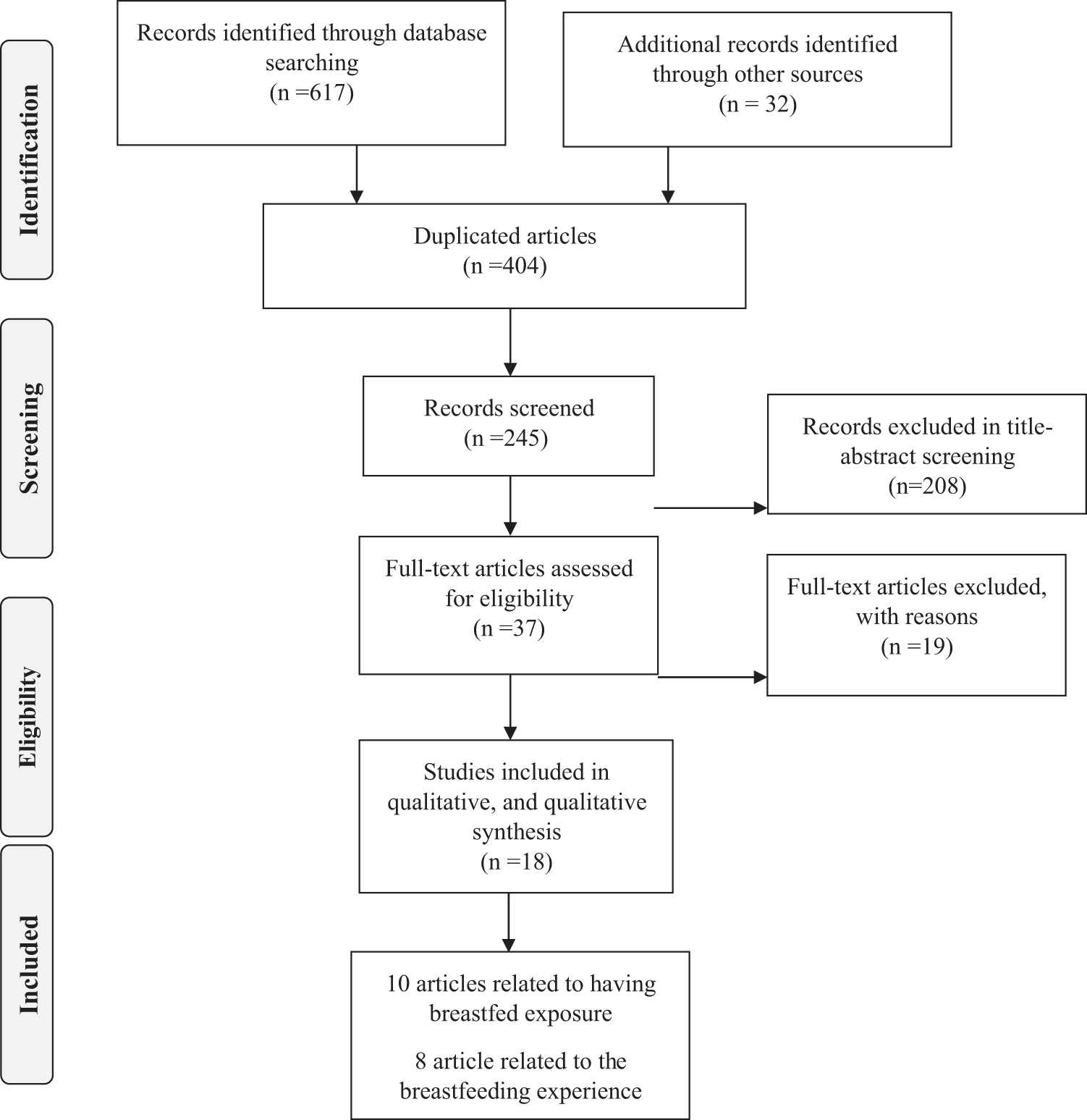
Flowchart of the selection of studies included in the meta-analysis.
Breastfeeding and risk of endometriosis for mothers
Characteristics of included studies
Of the eight included studies, the setting of three studies was located in the United States; for the remaining included studies it was located in Iran (three articles), French (one article), and Belgium (one article). Regarding the type of study, we have three cohort and five case–control studies. The study population of all studies included both primiparous and multiparous women with a mean age of >30 years. The quality of the two studies was high, and that of the rest of the articles was low. Six studies have reported that the lactation experience significantly associated with endometriosis but in two studies it was not associated with endometriosis (Table 1).
Characteristics of Studies Included in the Systematic Review Based on the Breastfeeding Experience
DEN, deep endometriotic nodules; HR, hazard ratio; NHANES, the national health and nutrition examination survey; NOS, Newcastle–Ottawa Scale; OR, odds ratio; PE, peritoneal endometriosis; RR, relative ratio.
Main results
The pool estimates of this meta-analysis reported that breastfeeding experience reduced the odds of endometriosis versus nonexperience. This decrease was statistically significant (OR = 0.79, 95% CI: 0.71–0.88, p = 0.001). The heterogeneity among studies was high (I 2 = 89%, Tau 2 = 0.0322). In addition, there was an outlier study included in the present meta-analysis 18 (Fig. 2).

The forest plot of the association between the breastfeeding experience and endometriosis.
Subgroup analysis
The subgroup analyses were conducted based on the adjusted/crude form of result, type of study, country, and quality of the study. The summary results of the subgroups are reported in Table 2. It shows a significant association between breastfeeding experience and reducing the risk of endometriosis in the United States but in other regions, it did not. The heterogeneity of articles published in the United States was higher than that in the other regions. The type of study and quality of studies were other confounding factors that affect the risk reduction of endometriosis with low heterogeneity of articles (Table 2).
The Summary Results of Subgroups of the Breastfeeding Experience Based on the Adjusted/Crude form of Result, Type of Study, Country, and Quality of the Study
A statistically significant test result (p ≤ 0.05).
CI, confidence interval; NA, not applicable; OR, odds ratio; RR, relative ratio.
Ingesting human breast milk and endometriosis risk
Characteristics of included studies
Of the 10 included studies, the setting of 3 studies was located in the United States. The remaining included studies were located in China (three articles), Iran (one article), Italy (two articles), and Japan (one article). Regarding the type of study, we have 1 cohort and 10 case–control studies. The study population of all studies included both primiparous and multiparous women with an age of >18 years. The quality of the two studies was high, and that of the rest of the articles was low. Five studies have reported that the ingesting human breast milk was significantly associated with endometriosis, but in five studies it was not associated with endometriosis (Table 3).
Characteristics of Studies Included in the Systematic Review Based on the Early-Life Exposure with Breast Milk
Main result
The pool estimates of this meta-analysis reported that the ingesting human breast milk reduced 38% of the odds of endometriosis versus nonexposed women. This decrease was statistically significant (OR = 0.67, 95% CI: 0.50–0.83, p = 0.001). The heterogeneity among studies was high (I 2 = 84.5%, Tau 2 = 0.0481) (Fig. 3).
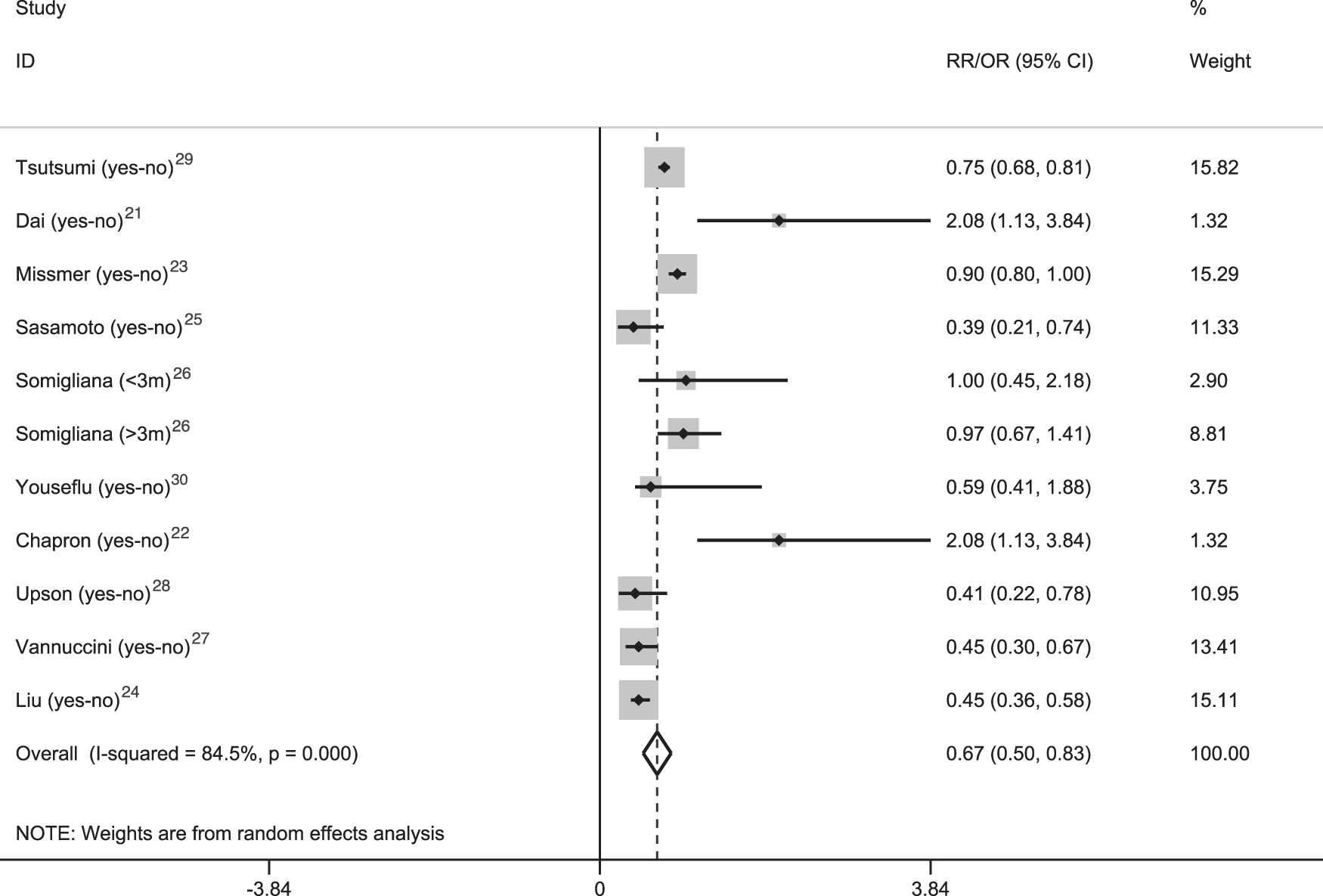
The forest plot of the association between the ingesting human breast milk and endometriosis.
Subgroup analysis
The subgroup analyses were conducted based on the adjusted/crude form of result, type of study, country, and quality of the study. The summary results of the subgroups are reported in Table 4. It shows a significant association between ingesting human breast milk and reducing the risk of endometriosis in the United States, Italy, and China. The heterogeneity of articles published in Italy was lower than that in the other regions. The adjusted/crude and quality of studies were another confounding factor that affects the risk reduction of endometriosis with low heterogeneity (Table 4).
The Summary Results of Ingesting Human Breast Milk Based on the Adjusted/Crude Form of Result, Type of Study, Country, and Quality of the Study Subgroups
A statistically significant test result (p ≤ 0.05).
CI, confidence interval; NA, not applicable; OR, odds ratio; RR, relative ratio.
The publication bias was evaluated using funnel plot and is presented in Figure 4. We have symmetrical distribution among studies. Also, there was no significant publication bias based on Egger's and Begg's tests (p = 0.5195 and p = 0.8879, respectively) (Fig. 4).

The funnel plot of breastfeeding and endometriosis.
Discussion
Breastfeeding and endometriosis
To our knowledge, this study is the first meta-analysis to examine the association between lactation and endometriosis risk. Our findings highlight the protective effect of breastfeeding experiences on the risk of endometriosis. However, significant heterogeneity was found across the included studies. The results of subgroup analysis show that this effect was significant only in high-quality studies, cohort studies, the adjusted form of odds ratios (OR) or relative ratio (RR), and studies conducted in the United States. It seems that this protective effect of lactation appears to be related to amenorrhea.7,32
Furthermore, the hormonal changes caused by pregnancy and lactation, including increased levels of progesterone and prolactin, may restrict implantation and/or growth of ectopic tissue. 32 However, a longer duration of breastfeeding could decrease the risk of being overweight, which in turn reduces the risk of endometriosis. 7 In this regard, in 2015, Chowdhury et al.'s study conducted a systematic review of the effect of breastfeeding on long-term maternal health. Their results reveal that breastfeeding reduced the risk of breast and ovarian cancer, diabetes, and postpartum depression. In their study, the association between breastfeeding and endometriosis risk was not evaluated. 33
Another study was conducted as a critical epidemiologic review by Shafrir et al. to evaluate the risk and consequences of endometriosis. In their study, only one study was used to evaluate the effect of lactation on the endometriosis risk. No meta-analysis was done in their study. 32
Ingesting human breast milk and endometriosis
There are conflicting results regarding the effect of ingesting human breast milk on endometriosis risk. Therefore, by pooling the findings of relevant studies, we can conclude more accurately. In our study, ingesting human breast milk had a protective effect on the risk of endometriosis. The results of the subgroup analysis show that this significant relationship was seen in case–control studies and studies conducted in the United States and Italy. In contrast, in Chinese studies, breast milk consumption increased the risk of endometriosis.21,22
They reported that the presence of higher levels of environmental toxicants, such as dioxin, in the breast milk of Chinese women can contribute to the pathogenesis of endometriosis. 21 Alternatively, the compositions of formula milk used in China and other countries may also differentiate the effect of breast milk on the risk of endometriosis. 21 In this regard, the results of Vannuccini et al. suggest that soy formula consumption during infancy may act as an exogenous source of hormones or enhance the production of endogenous steroids. 27
Moreover, this significant relationship was seen in high-quality studies that have a NOS score of more than seven. The possible mechanism underlying an association between breastfeeding exposure and endometriosis remains to be elucidated. However, it seems that various environmental and hormonal factors can affect the composition of breast milk and the consequent risk of endometriosis.6,34 Previous research studies reveal that formula-fed infants had higher level of estrogen and testosterone than breastfed infants, which can relate to late reproductive outcome, directly or indirectly. 35
In this regard, the previous systematic review that was conducted by Ottolina et al. to evaluate the effects of early-life factors on the risk of developing endometriosis in adulthood reveals that early-life exposure with breastfeeding can reduce the risk of endometriosis. Only three studies included in their meta-analysis and some studies with conflicting results were not included in the meta-analysis. 34
Also, in 2016, Olšarová and Mishra conducted a systematic review of 11 observational studies to evaluate effect of early-life factors such as preterm birth, maternal smoking, passive smoking, in utero exposure to diethylstilbestrol, and breastfeeding on the risk of endometriosis. Their study's search period was until June 10, 2018. They have included four articles related to breastfeeding, and they reported a positive effect of breastfeeding on the reduction of endometriosis risk, but they also did not perform a meta-analysis and had only qualitative reports. 6
Strength and limitation
An advanced search of various electronic databases, as well as an extensive searching of gray literature sources, to yield maximum relevant articles, was one of the main strengths of this study. A large number of subjects provide much greater opportunity to reach a reasonable conclusion between endometriosis and breastfeeding. Moreover, the methodological quality assessment and data extraction were performed by multiple reviewers.
Despite these strengths, our findings have some inherent limitations. First, significant heterogeneity was seen between the studies. High heterogeneity is common in the meta-analysis, and it is demanded to discover potential sources of heterogeneity. The different characteristics of each study can lead to heterogeneity of results. Therefore, the subgroup analysis was done based on several factors (such as type of study, crude or adjusted forms of OR, the origin of studies, and quality of studies) to identify the source of heterogeneity.
Moreover, the duration of breastfeeding was not reported in all studies, and some included studies only reported a history of breastfeeding or lactation as yes or no. Furthermore, the OR and relative risk of most included studies were adjusted for potential confounders, but some of them reported the crude form of them. Also, the adjustment factors of each study were different. However, we also performed a sensitive analysis on this basis. The type of formula may also affect the findings of studies; for example, Upson compared formula based on soy with breast milk.
Conclusion
Our finding confirms an inverse association between endometriosis risk and early-life exposure with breastfeeding, and lactation. Therefore, the importance of breastfeeding for both mother and child should be considered by policymakers and health care providers. Further studies originating from other countries, with large sample sizes, and strong study designs considering different confounders are required to draw better conclusions about this effect.
Footnotes
Acknowledgment
We thank the Clinical Research Development Center of Ayatollah Mousavi Hospital, Zanjan University of Medical Sciences for their collaboration.
Authors' Contributions
The research question was formulated by S.Y. A comprehensive search and data extraction were done by A.M. and S.Y. Two investigators (A.M. and S.Y.) independently evaluated the risk of bias for each selected study. Analysis, interpretation, and reporting were supervised by A.M. and M.A.-J. All authors contributed to the drafting and revising of the article, and agree with the final version of the article to be submitted to the journal; they also meet the criteria of authorship.
Declaration
All listed authors confirm that the result of this research is supported by an institution that is primarily involved in education or research.
Disclosure Statement
No competing financial interests exist.
Funding Information
No funding was received for this article.