




Abstract
Background:
There is an inconsistent result regarding the mode of fertilization and breastfeeding.
Objective:
This systematic review and meta-analysis aimed to determine the association between the mode of conception and breastfeeding continuity.
Materials and Methods:
The English electronic databases were searched for up to May 20, 2022. The Newcastle-Ottawa Quality Assessment Scale was used to evaluate the quality of the included studies. Publication bias was assessed using a funnel plot. The heterogeneity of studies was evaluated using I2 statistics. Results of the random-effects meta-analysis were presented using odds ratios (ORs)/relative ratio (RR) and 95% confidence intervals (CIs).
Results:
A total of 12 articles with 4,929 subjects were included in this systematic review and meta-analysis. The pool estimates of the meta-analysis show that spontaneous conception is associated with breastfeeding continuity up to 6 months (OR/RR = 0.66, 95% CI: 0.46–0.87) and more than 6 months after childbirth (OR/RR = 0.65, 95% CI: 0.32–0.98) compared to the Assisted reproductive technology (ART) conception. The heterogeneity among the studies was high. The level of breastfeeding, plurality, gestational age, and country were confounding factors that affect the heterogeneity of studies.
Conclusion:
Our findings confirm an inverse association between ART conception and breastfeeding continuity. Due to the importance of breast milk in improving the health of infants who are born in this way, it is recommended to take appropriate interventions in this field. Possible interaction between ART and breastfeeding continuity in different regions is important to point and future studies on this topic were recommended.
Introduction
Breast milk, as the best food for infants, provides all the nutrients needed in the early stages of life and contains bioactive and immunological substances that are not found in artificial alternatives. 1 However, it is estimated that only about 41% of infants were exclusively breastfed worldwide and this is expected to rise to 50% by 2025.2,3 Improving the health of mothers and infants by increasing breastfeeding rates requires special attention to groups that are more exposed to the cessation of breastfeeding. 4 As a result, identifying potential at-risk groups for the adverse consequences of breastfeeding is critical. One of these groups is infertile women. 5
Approximately 10–15% of the population of childbearing age experience infertility 6 and almost half of couples in developed countries are currently receiving assisted reproductive therapy. Assisted reproductive technology (ART) refers to fertility treatments and procedures that can help with difficulties or an inability to conceive children. ART techniques involve the manipulation of eggs, sperm, or embryos to increase the likelihood of a successful pregnancy. Many types of ART are available to treat infertility. 7
Assisted pregnancies are usually associated with multiple pregnancies, a higher risk of cesarean delivery, maternal bleeding, gestational hypertension, and gestational diabetes. 8 Mothers who conceive with fertility treatments are more likely to have preterm labor, multiple pregnancies, and cesarean childbirth delivery. However, these consequences are related to breastfeeding problems.9,10 Poor maternal mental and emotional health have a negative effect on breastfeeding, and women experiencing fertility treatments often have more stress and internal pressure. 11
Several studies have shown that mothers who become pregnant using fertility treatments are more likely to stop breastfeeding in early infancy compared to the mothers who become pregnant naturally.5,12–15 Furthermore, results of a study on fertility treatments and adequate milk supply revealed that mothers who give birth to babies through fertility treatment might be lower than the spontaneous conception. 16 Some studies, however, have not reported such an association.17–19 The results of a review based on observational studies showed that the effect of fertility treatments on breastfeeding was not significant and in some cases was contradictory. 20 Due to the importance of breast milk in improving the health of infants and clarifying the relationship between mode of fertilization and lactation, this systematic review and meta-analysis aimed to determine the association between mode of conception and breastfeeding continuity.
Materials and Methods
This systematic review and meta-analysis were conducted to assess the association between modes of conception in the breastfeeding continuity using the standard PRISMA checklist guideline. 21 We prospectively submitted the protocol of study on the PROSPERO register (international prospective register of systematic reviews) under the code CRD42022320949.
Search strategy and data sources
Original articles from electronic databases, including MEDLINE/Pub Med, Scopus, ProQuest, and Web of Science (ISI), were systematically searched for the period up to May 20, 2022, using the following search strategies in accordance with the Mesh browser keywords and free-text words:
PubMed: (“Reproductive Techniques” [mh] OR Reproductive Technique [tiab] OR Technique, Reproductive [tiab] OR Reproduction Techniques [tiab] OR Reproduction Technique [tiab] OR Reproduction Technics [tiab] OR Reproduction Technic [tiab] OR Reproductive Technology [tiab] OR “in-vitro fertilization” [mh] OR In Vitro Fertilization [tiab] OR In Vitro Fertilizations [tiab] OR Test-Tube Fertilization [tiab] OR Test Tube Fertilization [tiab] OR Test-Tube Fertilizations [tiab] OR Fertilizations in Vitro [tiab] Test-Tube Babies [tiab] OR Test Tube Babies [tiab] OR Test-Tube Baby [tiab] OR embryo transfer [mh] OR Embryo Transfers [tiab] OR Blastocyst Transfer [tiab] OR Tubal EmbryoTransfer [tiab] OR Tubal Embryo Stage Transfer [tiab] OR “intracytoplasmic sperm injection” [mesh] OR Intracytoplasmic Sperm Injection [tiab] OR Sperm Injection, Intracytoplasmic [tiab] OR Intracytoplasmic Sperm Injections [tiab] OR ICS [tiab] OR “ovulation induction” [mesh] OR Ovarian Stimulation [tiab] OR Ovarian Stimulations [tiab] OR “artificial insemination” [mesh] OR Eutelegenesis [tiab] OR Eutelegeneses [tiab] OR Artificial Insemination [tiab] OR Artificial Inseminations [tiab] OR “intrauterine insemination” [mh] OR “IUI” [mh] OR oocyte recipients [tiab]) AND (“Breast Feeding”[mh] OR “Bottle Feeding”[mh] OR Bottle Feeding[tiab] OR Breast Feeding[tiab] Breastfeeding[tiab] OR Breast Fed[tiab] OR Breastfed[tiab] OR Milk Sharing[tiab] OR Exclusive Breast Feeding[tiab] OR Exclusive Breastfeeding[tiab] OR Wet Nursing[tiab] OR Bottlefeeding[tiab] OR Bottlefed[tiab] OR Breast Milk[tiab] OR Human Milk[tiab])).
WOS
TS = ((“Reproductive Technique*” OR “Reproduction Technique*” OR “Reproduction Technic*” OR “Reproductive Technolog*” OR “Reproductive Techniques, Assisted” OR “in-vitro fertilization” OR “In Vitro Fertilization*” OR “Test-Tube Fertilization*” OR “Fertilizations in Vitro” OR “Test-Tube Bab*” OR “Test Tube Bab*” OR “embryo transfer*” OR “Blastocyst Transfer” OR “Tubal Embryo Stage Transfer” OR “intracytoplasmic sperm injection*” OR “ICSI” OR “ovulation induction” OR “Ovarian Stimulation*” OR “artificial insemination*” OR Eutelegenes?s[tiab] OR “intrauterine insemination” OR “IUI” OR “oocyte recipients”) AND (“Breast Feeding” OR Breastfed OR Breastfeeding OR “Breast Fed” OR “Milk Sharing” OR “Wet Nursing”)).
Scopus
TITLE-ABS-KEY((“Reproductive Technique*” OR “Reproduction Technique*” OR “Reproduction Technic*” OR “Reproductive Technolog*” OR “Reproductive Techniques, Assisted” OR “in-vitro fertilization” OR “In Vitro Fertilization*” OR “Test-Tube Fertilization*” OR “Fertilizations in Vitro” OR “Test-Tube Bab*” OR “Test Tube Bab*” OR “embryo transfer*” OR “Blastocyst Transfer” OR “Tubal Embryo Stage Transfer” OR “intracytoplasmic sperm injection*” OR “ICSI” OR “ovulation induction” OR “Ovarian Stimulation*” OR “artificial insemination*” OR Eutelegenes?s[tiab] OR “intrauterine insemination” OR “IUI” OR “oocyte recipients”) AND (“Breast Feeding” OR Breastfed OR Breastfeeding OR “Breast Fed” OR “Milk Sharing” OR “Wet Nursing”)).
ProQuest
TI,AB,SU((“Reproductive Technique*” OR “Reproduction Technique*” OR “Reproduction Technic*” OR “Reproductive Technolog*” OR “Reproductive Techniques, Assisted” OR “in-vitro fertilization” OR “In Vitro Fertilization*” OR “Test-Tube Fertilization*” OR “Fertilizations in Vitro” OR “Test-Tube Bab*” OR “Test Tube Bab*” OR “embryo transfer*” OR “Blastocyst Transfer” OR “Tubal Embryo Stage Transfer” OR “intracytoplasmic sperm injection*” OR “ICSI” OR “ovulation induction” OR “Ovarian Stimulation*” OR “artificial insemination*” OR Eutelegenes?s[tiab] OR “intrauterine insemination” OR “IUI” OR “oocyte recipients”) AND (“Breast Feeding” OR Breastfed OR Breastfeeding OR “Breast Fed” OR “Milk Sharing” OR “Wet Nursing”))
Moreover, an attempt to identify further relevant studies was made by hand searching, perusing the reference lists of all identified studies, published systematic reviews, as well as searching in gray literature sources to identify unpublished data (e.g., Google Scholar, Open Grey SIGLE, World Cat, Global Index Medicus (GIM), NTIS, UW Libraries Search, thesis, and dissertation).
Data extraction
Identified studies were retrieved and managed using the Endnote program (ver.X9.3). After omitting duplicate records in databases, all titles and abstracts and then, the full texts of the relevant articles were screened by two authors (S.Y. and A.M.), separately, and any disagreement regarding eligibility was discussed by a third author to reach a consensus (F.S.).
Data extracted from each selected article using data extraction forms that included the first author's name, year of publication, the number of participants, study setting, type of study, duration of follow-up, breastfeeding assessment tool, the duration of breastfeeding, participant's features, Newcastle-Ottawa Quality Assessment Scale (NOS) score, and main finding of each article.
Selection criteria
Studies were included in the systematic review if they had the following criteria: (1) original research article (2) observational studies (cohort, cross-sectional, or case–control), (3) full-text articles published in English up to May 20, 2022, (4) quantitative estimates of the association between mode of conception and breastfeeding outcomes. Systematic reviews or those studies that had unexplained methods and clinical trials, as well as articles that were inaccessible in full text were excluded from the meta-analysis.
Quality assessment of included studies
Two investigators (A.M. and F.S.) independently assessed the risk of bias and the methodological quality of the included studies using the NOS for observational studies. 22 Any discrepancy in the rating was resolved through discussion or consultation with a third reviewer (F.S.). This scale assesses the possibility of bias in the design, conduct, and analysis regarding the sampling method and the exposure assessment/outcome evaluation, as well as statistical matching/adjustments of the data. The star system with a maximum possible score of nine (overall score between 0 and 9) was assigned by NOS. Quality scores of each article were categorized as high (≥7 stars) and low (≤6 stars).
Statistical analysis
We planned to undertake meta-analyses using Stata software version 16. Results of the random-effects meta-analysis were presented using odds ratios (ORs) or relative ratio (RR), and 95% confidence intervals (CIs). The reference category in all included studies was spontaneous conception.
The degree of heterogeneity was assessed using I2, τ 2 , and χ 2 statistics. The sensitive analyses were performed, if we observed a substantial or considerable heterogeneity and verify the impact of the selected studies, one by one, on the subgroup and pooled results.23,24
Subgroup analysis was performed on the basis of the adjusted and crude OR/RR, study setting, type of study, plurality, gestational age, type of breastfeeding, and quality of the study. The publication bias was evaluated by using Begg's and Egger's tests and funnel plot.
Results
Description of the extraction and selection of the articles
This study was updated until up to May 20, 2022. A total of 1725 articles were extracted in the primary search based on the search strategy from the following databases: Scopus (535), ISI (25), PubMed (1156), and other sources (9). We excluded 206 duplicate articles and 1519 articles were entered into the screening process. In the title and abstract screening, 1,480 studies and 21 studies after the full-text review were excluded. Six articles had the inclusion criteria; we decided to exclude them from this analysis because four were conference abstracts and two articles had insufficient data, and did not receive data from the author.
A total of 12 articles with 4,929 subjects that met the criteria for inclusion were retrieved in this systematic review.4,5,12–15,25–30 Among of 12 included articles, 10 studies were related to the association between mode of conception with breastfeeding continuity of <6 months, and 7 studies were related to 6 months and upper periods. All extracted articles were published in the English language. A flowchart of the extracted articles and selection procedure is shown in Figure 1.
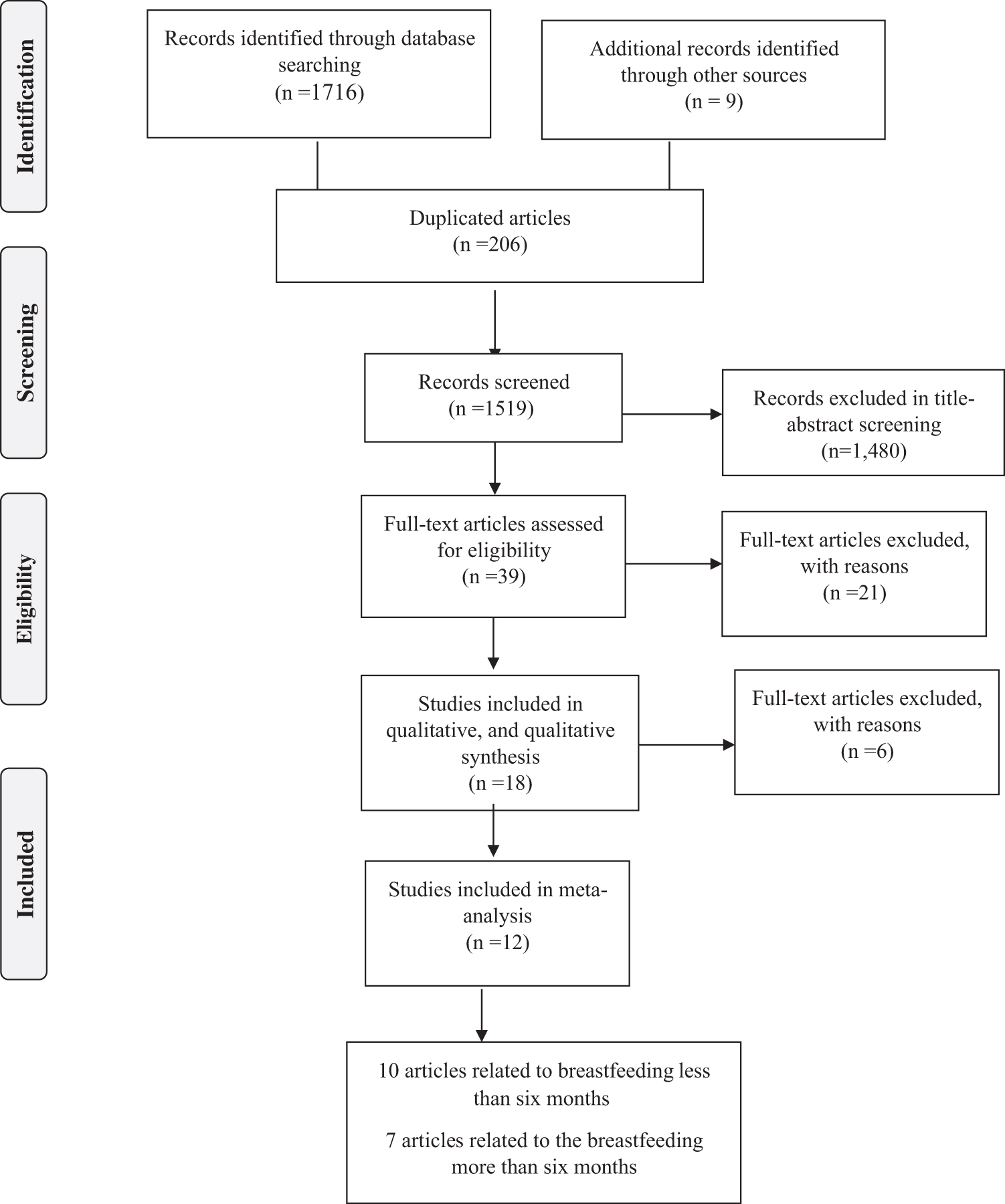
Flowchart of the selection of studies included in the meta-analysis.
Summary of included studies
Among 12 included articles, 2 studies were located in the United States of America (USA). Remaining studies were conducted in Iran (one article), Canada (one study), Taiwan (two studies), Australia (one study), China (one study), Brazil (one study), Spain (one study), and Italy (two studies).
Among 12 included articles, 9 articles were in cohort study design, 1 article was a case–control study, and 2 articles were cross-sectional study design. In 10 studies, breastfeeding outcomes were reported OR and the rest was in RR estimate. Among OR/RR estimates, five results were crude and seven were adjusted for controlling confounding variables.
All studies reported the association between mode of conception and breastfeeding outcomes in the time followed up period, separately. Therefore, data are separately present in the forest plots. The follow-up period for measuring the outcomes ranged from 1 hour to 18 months after childbirth.
The maternal age, parity, plurality, maternal race, education, gestational age, and mode of delivery were the confounder variables between mode of delivery and breastfeeding. There was an outlier study included in the present meta-analysis.
In Assisted reproductive technology (ART) conception, the mean age of participants was more than 28 years. In studies that the mean age did not report, age ranged 20 years and upper. Timing of breastfeeding initiation, successful first attempt, timing of introduction of formula, and duration of breastfeeding were the main breastfeeding outcomes that were reported. In seven of included studies, the association of ART conception with breastfeeding outcomes was statistically significant (Table 1
Summary Results of the Included Studies
OR, odds ratio; RR, relative ratio; USA, United States of America; WHO, World Health Organization.
Study quality
In this meta-analysis study, there were eight studies with high quality and four articles with low quality (Table 1).
The main analysis
The result of the current section is presented in two parts. The first part includes the breastfeeding <6 months outcomes and the second part includes at 6 months and longer.
Part 1
The main analysis of breastfeeding <6 months
The association between mode of conception and the odds of breastfeeding for <6 months was evaluated in the 10 included studies. The pool estimates of the meta-analysis show that spontaneous conception is associated with the odds of having to breastfeed for up to 6 months more than the ART conception based on OR/RR (OR/RR = 0.66, 95% CI: 0.46–0.87). This association was statistically significant. The heterogeneity among the studies was high (I 2 = 94.73%, p = 0.001). We have heterogeneity of 0% in two follow-up periods (<8 weeks and 3 months) (Fig. 2). Furthermore, the heterogeneity chi-squared was 433.50, i-squared was 94.7%, and the estimate of between-study variance τ-squared was 0.2047. We did a sensitivity analysis to assess and remove the outlier study and analyze again the remaining studies; accordingly, there were two outlier study included in this meta-analysis.4,29

The forest plot of the association between the mode of conception and breastfeeding at <6 months.
Subgroup analysis of breastfeeding <6 months
The subgroup analyses were reported in Table 2. It shows that the adjusted/crude form of result, type of study, type of estimate, country, quality of the study, level of breastfeeding, plurality, and gestational age were confounding factors that affect the heterogeneity of studies. The number of included studies in some categories was very low.
The Summary Results of Subgroup Analysis of Breastfeeding <6 Months
Significance test(s) of estimate size (ES) = 0.
CI, confidence interval; OR, odds ratio; RR, relative ratio; USA, United States of America.
Despite this, the association between mode of conception and the odds of having breastfeeding <6 month
Part 2
The main analysis of breastfeeding at 6 months and longer
The association between mode of conception and the odds of having breastfeeding were evaluated in the seven included studies at 6 months and upper. The pool estimates of the meta-analysis show that spontaneous conception is associated with the odds of having to breastfeed at 6 months and the upper was more than the ART conception based on OR/RR (OR/RR = 0.65, 95% CI: 0.32–0.98). This association was statistically significant. The heterogeneity among the studies was high (I 2 = 96.9%, p = 0.001). We have heterogeneity of 0% at one follow-up period (Fig. 3). Furthermore, the heterogeneity chi-squared was 260.96, i-squared (variation in estimate size [ES] attributable to heterogeneity) was 96.9%, and the estimate of between-study variance τ-squared was 0.2229.
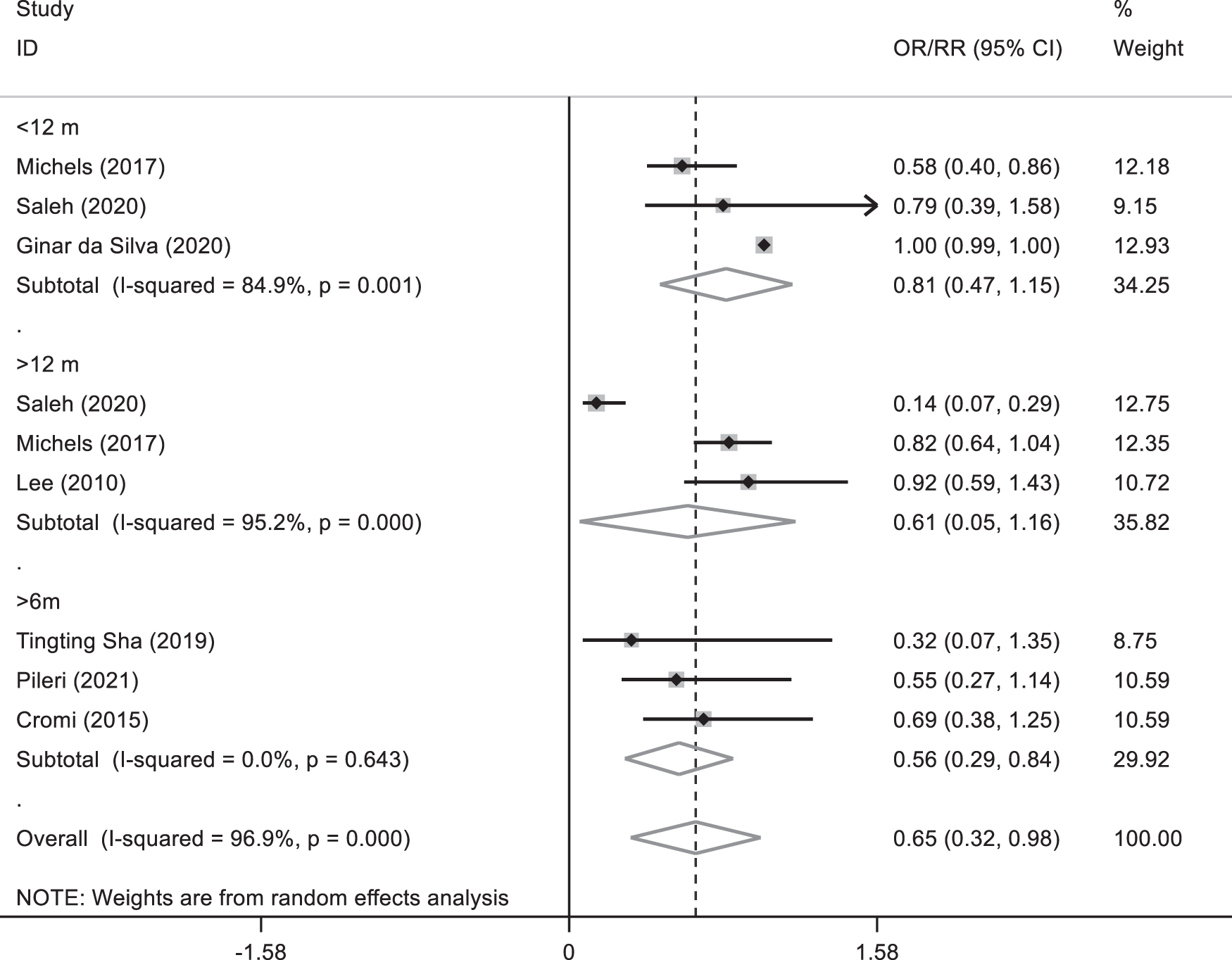
The forest plot of the association between the mode of conception and breastfeeding at more than 6 months.
Subgroup analysis of breastfeeding <6 months
The subgroup analyses were reported in Table 2. It shows that the type of estimate, country, and level of breastfeeding were confounding factors that affect the heterogeneity of studies. The number of included studies in some categories was very low. Despite this, the association between mode of conception and the odds of having to breastfeed at 6 month
The Summary Results of Subgroup Analysis of Breastfeeding at 6 Months and Longer
Significance test(s) of estimate size (ES) = 0.
CI, confidence interval; OR, odds ratio; RR, relative ratio; USA, United States of America.
The publication bias was evaluated by a funnel plot and presented in Figure 4. We have symmetrical distribution among studies. Also, there was no significant publication bias based on Egger's and Begg's tests (p = 0.3083 and p = 1.3655, respectively).

The funnel plot of mode of conception and breastfeeding.
Discussion
To our knowledge, this study is the first meta-analysis to assess the effect of ART on breastfeeding continuity. Our findings highlight the reduction of exclusive breastfeeding following the use of fertility treatment compared with spontaneous conception. There is some evidence to support the impact of infertility treatments on the negative consequences of pregnancy, childbirth, infancy, and breastfeeding. However, some of these results emphasize the role of both neonatal and maternal underlying factors (such as maternal age, operative delivery, labor induction, low–birth weight babies, preterm delivery, twins, etc.) rather than ART methods themselves in creating these consequences; therefore, these findings should be interpreted with caution. Also, high heterogeneity was observed across the included studies.
The subgroup analysis was done based on the duration of breastfeeding. The association between the type of conception and the odds of having breastfed for <6 month
In this regard, in 2020, Saus-Ortega et al conducted a systematic review of five studies, for assessing the breastfeeding outcomes in women who conceived through fertility treatments. 31 They reported that there are contradictory results regarding the effect of fertility treatment on breastfeeding outcomes. They state that due to the limited number of high-quality studies, it seems that infertility treatments do not affect breastfeeding outcomes. These findings are consistent with the results of our study. This difference can be due to several reasons. First of all, only five articles have been included in their study. On the other hand, no meta-analysis was performed in this study and it was interpreted only based on conflicting findings; whereas, in the meta-analysis, the results of all studies are pooled. 31
Also, in this meta-analysis, the relationship between the type of conception and duration of breastfeeding was investigated at different levels. Our findings reveal that there was no significant difference between the two groups in the initiation of breastfeeding in the first hour after birth. Seven studies were included in the meta-analysis to assess this relationship. Although this meta-analysis showed that the onset of breastfeeding in the first hour after birth was less following in vitro fertilization (IVF) pregnancy, this relationship was not statistically significant. Therefore, it seems that these women do not have a problem starting breastfeeding.
This meta-analysis also shows that the success rate of lactation at discharge, and 1 week after childbirth was significantly lower in women who underwent fertility treatment, but not different in 1, 2, and 4 months after delivery. Given the importance of this issue, the World Health Organization (WHO)/UNICEF Baby-friendly Hospital Initiative (BFHI) sets as quality criteria that at least 80% of mothers should receive breastfeeding assistance in the first 6 hours after birth, and at least 75% of them should be exclusively breastfed when discharged from the hospital. 32
Generally, in the first 6 months after birth, the success rate of breastfeeding in the infertility treatment group was significantly lower than in spontaneous pregnancy, but this relationship was not seen less or more than 12 months. In women undergoing IVF treatment, many risk factors such as the feeling of having low milk supply, less confidence in mothering, labor induction, cesarean delivery, presence of pregnancy complications, being first-time mothers, artificial milk advertisements, and many individuals, social, and cultural factors interfere with breastfeeding success.29,33 Due to the importance of special breastfeeding in the first 6 months after birth, the need for planning special breastfeeding care along with attention to provider and hospital factors in mothers who underwent IVF is doubly important.
Strength of study
The main strength of the meta-analysis is an advanced search in various electronic databases, as well as an extensive search of gray literature sources, to yield maximum relevant articles. A large number of subjects provide a much greater opportunity to reach a reasonable conclusion about breastfeeding outcomes following fertility treatment. Moreover, the methodological quality assessment and data extraction of each article were performed by multiple reviewers.
Limitations
Despite these strengths, our findings have some inherent limitations. First, significant heterogeneity was observed across the included studies. High heterogeneity is common in meta-analysis and requires the discovery of potential sources of heterogeneity. The different characteristics of each study can lead to heterogeneity of results. Therefore, the sensitive analysis was done to identify the source of heterogeneity. Moreover, the ORs and relative risk of most included studies were adjusted for potential confounders, but some of them reported a crude form of them. Also, the adjustment for confounders was different in each study. However, we also performed a subgroup analysis.
Conclusion
Our findings confirm an inverse association between ART conception and breastfeeding continuity. Due to the importance of breast milk in improving the health of infants who are born this way, it is recommended to take appropriate interventions in this field. Possible interaction between ART and breastfeeding continuity in different regions is important to point and future studies of this topic were recommended.
Footnotes
Acknowledgments
We would like to thank the Clinical Research Development Center of Ayatollah Mousavi Hospital, Zanjan University of Medical Sciences, Zanjan, Iran.
Authors' Contributions
The research question was formulated by A.M. A comprehensive search and data extraction were done by A.M and S.Y. Two investigators (A.M. and F.S.) independently evaluated the risk of bias for each selected study. Analysis, interpretation, and reporting were supervised by A.M. All authors contributed to the drafting and revising of the article and agree with the final version of the article to be submitted to the journal; they also meet the criteria of authorship.
Declaration
All listed authors confirm that the result of this research is supported by an institution that is primarily involved in research.
Disclosure Statement
No competing financial interests exist.
Funding Information
No funding was received for this article.

References
Supplementary Material
Please find the following supplemental material available below.
For Open Access articles published under a Creative Commons License, all supplemental material carries the same license as the article it is associated with.
For non-Open Access articles published, all supplemental material carries a non-exclusive license, and permission requests for re-use of supplemental material or any part of supplemental material shall be sent directly to the copyright owner as specified in the copyright notice associated with the article.
