




Abstract
Introduction:
Data on baseline rates of nonserious events in breastfed infants in the general population are sparse. This results in difficulty determining if there is an increase in infant nonserious events potentially due to prescription medication exposure through human milk. In this study, we determined the prevalence of nonserious events in infants consuming human milk whose mothers reported no exposure to any prescription medications, tobacco, or recreational drugs in the previous 14 days.
Materials and Methods:
Between August 2014 and December 2019, 487 breastfeeding mothers without any recent exposure to prescription medications, tobacco, or recreational drugs enrolled in the Human Milk Research Biorepository at the University of California, San Diego. Participants completed a semistructured telephone interview with trained research staff and provided information on maternal and child health, breastfeeding habits, recent medication, and lifestyle exposures, and completed a standard checklist of infant adverse reactions.
Results:
We found 131 (44.1%) participants reported one or more infant nonserious adverse events in the past 14 days at the time of their study interview. The most commonly reported nonserious events were rash (12.1%), irritability (9.4%), constipation (7.8%), poor sleep (7.1%), and fever (6.3%).
Conclusions:
These baseline frequencies provide a benchmark for rates of recent nonserious events in breastfed infants in the general population. These data can be used as a reference point for studies that examine adverse events in breastfed infants following maternal use of prescription medications or exposures due to other lifestyle habits such as tobacco or other substances. Clinical Trial Registration Number: NCT05553743.
Introduction
Human milk is considered the gold standard for infant nutrition. 1 The American Academy of Pediatrics recommends exclusive breastfeeding for the first 6 months of life, and a continuation of supplemental human milk with solid foods through the first year of life.2,3 Human milk has been associated with benefits for both the infant and the lactating individual. Babies that receive human milk have a lower risk of asthma, obesity, ear infections, and sudden unexplained death. 4 Lactating individuals have a lower risk of breast cancer, ovarian cancer, type 2 diabetes, and high blood pressure. 4
Medication consumption during lactation is common. About 96% of women take a medication at some point during lactation and 33% will take a prescription medication. 5 However, data on the impact of medications on human milk and the breastfed baby are limited. There are few studies that report the rates of nonserious adverse events in infants potentially exposed to medications through human milk. Most breastfeeding infant drug-induced adverse events (66–79%) occur within 2 months of life.6–9 Neurological (28.6%) and gastrointestinal (20.3%) symptoms have been the most commonly reported drug-induced adverse reactions in breastfed infants. 9
Central nervous system (CNS) drugs are associated with the majority (33–70%) of breastfeeding infant drug-induced adverse reactions.6,7,9 Drowsiness, respiratory depression, and sedation were the most common events reported with CNS drug usage.6–9 Antidepressants have been associated with 7.1–15% of adverse reactions, including CNS depression, gastrointestinal symptoms, agitation, lethargy, poor feeding, drowsiness, and low body temperature.6–8 Antibiotics accounted for 6–19.2% of total infant drug-induced adverse reactions and most commonly were associated with diarrhea in breastfeeding infants.6–8
Data on baseline rates of nonserious events in breastfed infants whose mothers do not report any recent prescription medication use are sparse. This results in difficulty determining if there is an increase in infant nonserious events potentially due to prescription medication exposure through human milk. A study on nonspecific symptoms in 323 healthy breastfed and bottle-fed infants reported cold, sniffles or sneezing, cough, and irritability as the most commonly reported symptoms. 10 According to a study on breastfeeding infants (up to 18 months) and atopic dermatitis, 11.5% of children had a current or previous diagnosis. 11 Another study compared adverse events in exclusively breastfed infants with those who supplemented with sugar water and found that breastfed infants were irritable 14.5% of the time and lethargic 5.6% of the time. 12 These studies reported rates of nonserious events with no information about feeding status, quantity of consumption, and potential exposure to prescription medications taken by the mother.
We aimed to determine the prevalence of nonserious events in infants consuming human milk whose mothers reported no recent exposure to any prescription medications, tobacco, or recreational drugs. These data are needed for studies that examine the frequency of side effects in breastfed infants whose mothers report prescription medication use as a benchmark for comparison with the general population who are unexposed to these agents.
Materials and Methods
Study population
Between August 2014 and December 2019, 1,924 lactating persons residing in the United States consented to participation in the Human Milk Research Biorepository (HMB) at the University of California, San Diego. Participants who reported exposure to vaccines, prescription medications, recreational substances, or tobacco in the 14 days previous to the study interview were excluded. Breastfed children born very premature (<34 weeks) or who were older than 4 years of age at the time of the interview were also excluded. Women who reported recent use of over-the-counter medications, caffeine, and alcohol were included. A total of 487 mother–infant pairs met study criteria and were included in the analysis. The selection of the study population is depicted in Figure 1.
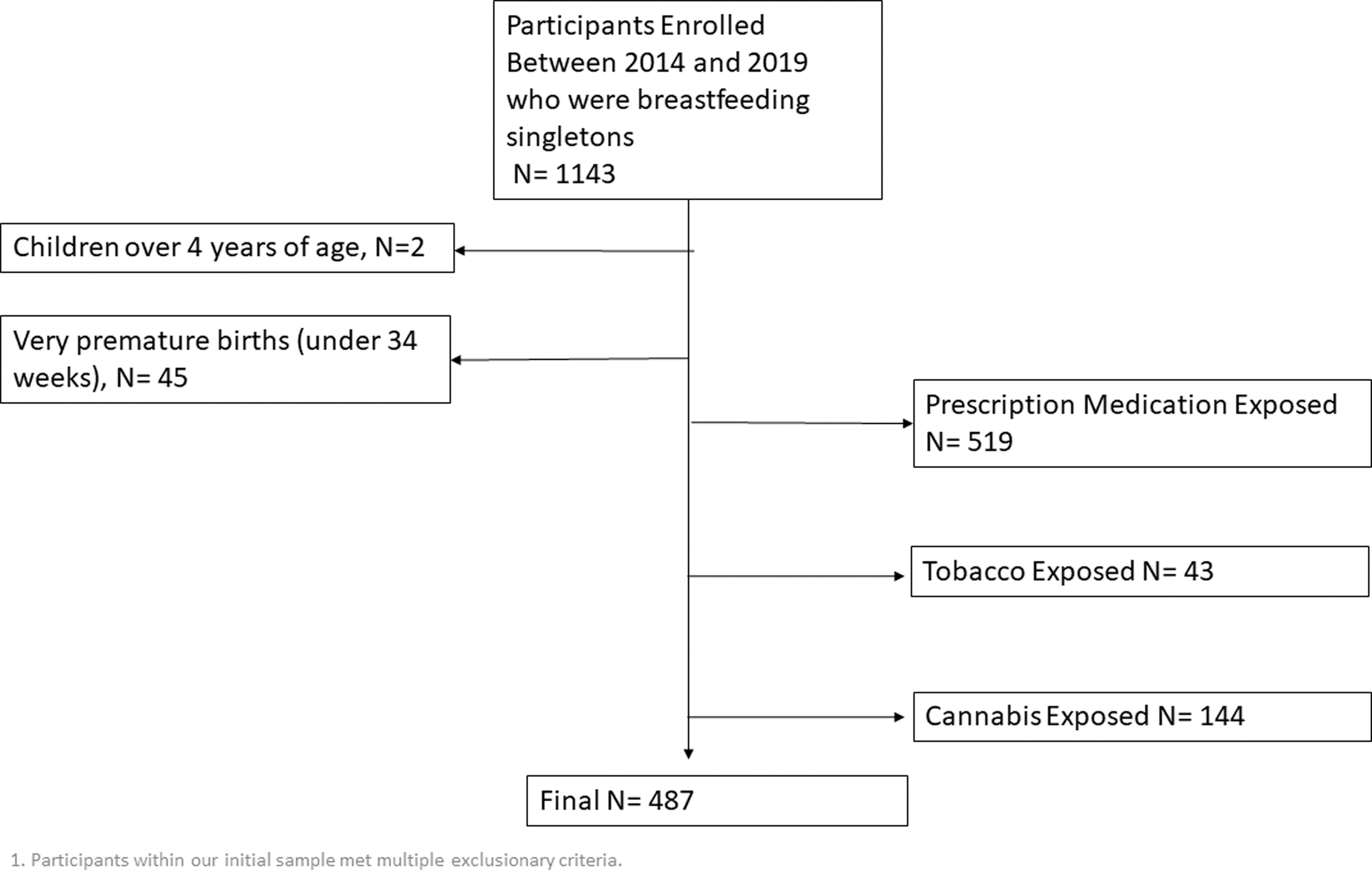
Study population.
Study design
The design and mechanics of the HMB have been described previously. 13 In brief, women who consented for the study were recruited into the HMB from anywhere in the United States through multiple sources, including self-referral, health care provider referral, social media or consumer advertisements, MotherToBaby counseling, and MotherToBaby pregnancy studies referral. Demographics, maternal, child health history, breastfeeding habits, and daily exposures and lifestyle habits were gathered by maternal interview either in person or by telephone. Infant adverse reactions in the 14 days before milk sample collection were queried through a structured questionnaire.
A checklist of adverse events was adapted from two studies that reported drug-induced infant adverse reactions.7,8 Sixteen adverse reactions were included in the checklist: drowsiness, sedation, poor feeding, rash, bruising or bleeding, constipation, diarrhea, stools with blood or abnormal color, fever, low body temperature, restlessness, irritability, poor sleep, high pitched crying, abnormal movements, and abnormal skin color. Each participant was prompted to reflect upon the prior 14 days and if their child expressed symptoms not related to a change in habit. Each adverse reaction was individually queried, and the maternal response was recorded as “yes,” “no,” and “not asked.”
The study was approved by the Institutional Review Board at the University of California San Diego (IRB no. 130658) and written consent was obtained from all participants.
Statistics
Maternal and child demographic variables and the 16 infant nonserious adverse events were summarized using frequencies and percentages. Maternal and child age, child birthweight, and gestational age at delivery were reported utilizing the median and range values. All analyses were completed in Microsoft® Excel® 2016.
Results
Characteristics of the mothers and their breastfed infants are shown in Table 1. A majority of the lactating individuals were non-Hispanic (89.9%), White (81.9%), had postgraduate education (52.1%), and made a combined household income over $60,000 (82.5%). Two hundred forty-four (50.1%) women reported recent use of over-the-counter medications, 295 (60.5%) women reported recent alcohol use, and 414 (85.0%) women reported caffeine consumption in the past 14 days.
Select Maternal and Infant Characteristics from Breastfeeding Women Enrolled in Mommy's Milk Between 2014 and 2019, n = 487
BMI, body mass index; GED, general educational development.
The median gestational age at delivery was 39 weeks with a range of 34–42 weeks. The median birth weight at delivery was 3.40 kg with a range of 1.95–5.03 kg. The median child age at time of the interview and breast milk sample collection was 6.2 months. Most of the children were exclusively breastfed with complementary solid foods (45.9%) or exclusively breastfed without any solid foods (36.5%). More than half of the children (54.4%) were breastfed 5–8 times a day.
We found 131 (44.1%) of participants reported one or more infant nonserious adverse events. As shown in Table 2, the most commonly reported nonserious events were rash (12.1%), irritability (9.4%), constipation (7.8%), poor sleep (7.1%), and fever (6.3%). Other adverse events such as diarrhea (3.9%) and stools with blood or abnormal color (1.8%), restlessness (3.0%), high pitched crying (2.4%), and drowsiness (1.2%) were less frequently reported. Similarly, sedation (0.2%), bruising or bleeding (0.4%), and abnormal movements (0.4%) were uncommon. Abnormal skin color or low body temperature was not reported by any mother about her infant in our study population.
Nonserious Events in Infants Consuming Human Milk Whose Mothers Enrolled in Human Milk Research Biorepository 2014–2019 and Reported No Use of Prescription Medications or Recreational Substances in the Previous 14 Days, n = 487
Discussion
To our knowledge there have been no previous studies published on the prevalence of nonserious adverse events in breastfed infants whose mothers have not reported recent use of prescription medication. Less than half (44.1%) of the participants reported any nonserious events in their breastfed infants. The most common nonserious adverse events were rash (12.1%), irritability (9.4%), and constipation (7.8%). This prevalence of rash was similar to a previous study that reported 11.5% of children up to 18 months old had a current or previous diagnosis of atopic dermatitis. 11 In addition, we found that 9.4% of infants were reported as irritable within the past 14 days, which is slightly less than a previous study by Boskabadi et al in which 14.5% of infants were reported to be irritable. 12 However, in that study, the authors did not report on maternal exposures or feeding patterns, which limit the interpretation of the results. 14 We found low frequencies of the other adverse events.
This study has several limitations. Our study population was predominately non-Hispanic, White, and of high socioeconomic status, and thus was not a representative sample of the general lactating population. Furthermore, our study population included infants exposed to maternal caffeine and alcohol ingestion. These exposures may contribute to the frequency of nonserious events reported. In addition, we relied on maternal report of infant events for the past 14 days, Mothers who are not taking prescription medications or recreational substances might differentially recall fewer adverse events in their infants for this reason. However, the study participants were prompted through a semistructured interview with trained research personnel.
Conclusion
To our knowledge this is the first report summarizing the frequency of nonserious events in breastfed infants whose mothers report no recent exposure to prescription medications or recreational substances. These data can be used as a reference point for studies that examine adverse events in breastfed infants following maternal use of prescription medications or exposures due to other lifestyle habits such as tobacco or other substances.
Footnotes
Acknowledgments
We thank the women who participated in this study and who gave so generously of their time and effort to provide milk samples and clinical information. We also thank student research assistants Angelique Ghadishah, Shyla Butala, Samantha Boccia, Genesis Campbell, and Katrina Kennedy who helped with data collection.
Authors' Contributions
Conceptualization, methodology, investigation, data curation, writing—original draft, and project administration by K.B. Methodology, investigation, data curation, formal analysis, and writing—original draft by A.K. Supervision and writing—review and editing by C.D.C.
Disclaimer
The content is solely the responsibility of the authors and does not necessarily represent the official views of any of the funding bodies. In addition, the funders had no role in study design, data collection and analysis, decision to publish, or preparation or review of the article.
Disclosure Statement
C.D.C. receives funding for breastfeeding research from the Gerber Foundation, Takeda Pharmaceuticals, and Gilead Sciences. None of the other authors have any disclosures.
Funding Information
The study was supported by the University of California, San Diego Center for Better Beginnings, and the National Institutes of Health, Clinical Translational Award grant UL1TR001442.