




Abstract
Introduction:
Mothers of preterm infants are at risk for inadequate milk production. Pumping logs are often used to both encourage lactation in the first week and track its efficacy. Our objectives were to determine whether mothers of preterm infants who keep pumping logs are demographically different from those who do not and to determine whether this practice affects the amount of mother's own milk (MOM) fed to their infants. We also aimed at determining whether there is a correlation between: (1) time to first breast milk expression, (2) cumulative frequency of expression in the first week, and (3) milk volume on day 7 with subsequent milk volumes and percent of infant diet consisting of MOM.
Methods:
Mothers of infants born ≤32 weeks and ≤1,500 g were enrolled within 48 hours of birth and encouraged to keep a pumping log. Data were collected on maternal characteristics, patterns of milk expression, and milk volumes on days 7, 14, 21, and 28 after delivery. Infant data were collected via chart review.
Results:
Mothers who kept pumping logs provided their own milk for a greater percentage of their infant's feeds at the time of achieving full feeds (p = 0.017). The total number of expressions in the first week was correlated with milk volume on day 21 (p = 0.016) and the provision of a higher percentage of MOM feeds at discharge (p = 0.03). Milk volume on day 7 correlated with volumes obtained at days 14, 21, and 28 (p < 0.001).
Conclusions:
Pumping logs may affect the availability of MOM for preterm infants. Frequency of pumping in the first week and milk volume on day 7 may impact long-term lactation success for these women.
Introduction
The use of human milk for feeding preterm infants has important short- and long-term benefits. Mother's own milk (MOM) feedings are associated with a lower incidence of morbidity in the neonatal intensive care unit (NICU), including ileus, sepsis, feeding intolerance, and necrotizing enterocolitis when compared with formula feedings.1–4
These benefits extend beyond the neonatal period into childhood with improved neurodevelopmental outcomes.5,6 However, mothers who deliver prematurely are at risk for inadequate milk production.7–9 They experience delayed secretory activation and delayed coming to volume.10–12 Low milk production in the first weeks is associated with early cessation of lactation.13,14
Production of <500 mL of milk in a 24-hour period by day 14 is associated with a decreased rate of MOM feeding at hospital discharge.7,15,16 This underscores the importance of early intervention, particularly in the first week after delivery, to improve mothers' ability to provide adequate milk throughout their infants' hospital stay. 17 Consistent with this, the American Academy of Pediatrics has recommended that all mothers of preterm infants receive formal lactation support starting at the time of delivery. 18
To appropriately devise strategies to improve lactation among mothers of preterm infants, it is important to identify the predictors of success. Pumping logs (documentation of breast milk expression including timing of pumping sessions and the volume of milk produced) are commonly used to communicate granular details about pumping patterns and they are one tool that may help women meet the needs of their hospitalized infant. 19
The act of keeping a log may itself contribute to increased milk production and improve success in providing adequate MOM for premature infants in the NICU. 20 Fewtrell et al. reported that keeping a pumping log was associated with increased milk production in women delivering prematurely. 21 However, the generalizability of such findings is uncertain, because compliance with pumping logs is often incomplete, resulting in inadequate data. 7
When utilized, pumping logs have the potential to provide detailed information on the frequency and timing of milk expression, which may shed light on the potential targets for improving milk supply. There is conflicting evidence about the effect of the timing of first milk expression on the establishment and duration of lactation. While multiple prior studies have shown that an earlier time to first expression is desired, the details about what is considered “early” are not well established.12,13,17,22,23
For example, Murase et al. reported that delayed time to first expression of colostrum is associated with low milk volumes and increased need for formula feeding yet the median time to first expression was 20 hours. 22 Conversely, Parker et al. 23 found that mothers of preterm infants who first express milk “later” after delivery are more likely to continue providing milk for their infant at hospital discharge when compared with shorter times to first expression. In this study, “later” was defined as 181–360 minutes after delivery.
Our objectives were to determine whether mothers of preterm infants who keep pumping logs are demographically different from those who do not and to determine whether this practice affects the amount of MOM fed to their infants. We also aimed at determining whether there is a correlation between: (1) time to first breast milk expression, (2) cumulative frequency of expression in the first week, and (3) milk volume on day 7 with subsequent milk volumes and percent of infant diet consisting of MOM.
Methods
Patient recruitment and setting
Mothers of preterm infants born at ≤32 weeks and with a birth weight ≤1,500 g were approached for consent within 48 hours of birth. We excluded infants with major congenital anomalies and those who were not expected to survive. Infants hospitalized for <3 weeks were excluded from analysis. This prospective cohort study included subjects who represented a convenience sample of women who delivered between July 2020 and September 2021 and was approved by the Institutional Review Board at Northwell Health.
The infants were delivered at either Cohen Children's Medical Center (a 57-bed level 4 regional perinatal referral center with 2,100 admissions annually in New Hyde Park, NY) or North Shore University Hospital (a 52-bed level 3 regional perinatal referral center with 1,100 admissions annually in Manhasset, NY).
Data collection—maternal pumping patterns
As part of hospital protocol, all women who deliver prematurely are offered lactation consultation services within 48 hours of delivery and given instructions on hand expression as well as pumping. They are provided a hospital-grade double electric breast pump that is available for rent via outside vendors on discharge from the hospital.
At the time of consent, information on milk expression since delivery was collected, including time to first expression, previous breastfeeding experience, and time of initial lactation consultation. Demographic information (gestational age, birth weight, race, marital status, maternal age) and infant feeding information (time to first oral colostrum administration, MOM feeds in first week, proportion of MOM at full feeds and at discharge) was obtained from the electronic medical records of the mothers and their infants.
Mothers are routinely encouraged to keep track of their pumping sessions when they are consulted by the lactation service. At the time of consent, the study team asked mothers to record milk expression sessions with date, time, and volume produced (i.e., pumping logs) either on paper or electronically. They were told that they would be contacted via phone and asked about milk volume produced in a 24-hour period at days 7, 14, 21, and 28 after delivery.
They were shown how to measure milk output in mL on the containers provided for milk collection by the hospital. When the study team asked about volume on day 7, they were asked about cumulative frequency of expression in the prior 7 days (including both hand expression as well as pumping). If the infant was discharged before study completion, the mothers were still contacted. A total of three attempts were made to contact each subject to obtain the information. For the purposes of the study, women were designated as having “kept pumping logs” if they provided information about the volume produced in a 24-hour period during any of the 4 weeks they were contacted.
Data collection—infant feeding patterns
To investigate the effect of pumping logs on the availability of milk, infant feeding data were obtained from the electronic medical records. The time to first colostrum administration was obtained from the infant's chart. We determined the percent of MOM feeds at the time of achieving full feeds (the 24-hour period after total parenteral nutrition was discontinued, 100 mL/kg/day of enteral feeds—per our systems feeding protocol) and the percent of the infant diet that consisted of MOM at discharge (the 24 hours before discharge from the hospital).
Statistical analysis
For the examination of differences between the women who provided pumping logs and those who did not, women were designated as providing logs if they reported any volumes to the study team when contacted at one or more time points over the course of the study. Those who provided no volume information were designated as never having logged.
The analyses of maternal and infant characteristics by whether mothers had ever logged were performed using Wilcoxon rank sum tests for continuous variables and Fisher's exact tests for categorical values. For analyses involving infant-specific variables, a single baby was randomly selected from each family of multiple infants. Due to the high percentage of infants who had 100% MOM at full feeds (79%, 34 of 43 infants) and 100% MOM at discharge (67%, 29 of 43 infants), these variables were dichotomized as 100% MOM (yes/no) for analysis.
Using data collected from the mothers who reported volumes, Spearman correlation coefficients were calculated to evaluate the relationship between self-reported patterns of milk expression in the first week (total number of expressions in the first week, and the time to the first expression) and self-reported milk volumes at pre-determined time points at days 7, 14, 21, and 28 after delivery.
Similarly, Spearman correlation coefficients were calculated to evaluate the relationship between the self-reported quantity of milk produced in a 24-hour period in the first week and the self-reported milk volumes at pre-determined time points at days 14, 21, and 28 after delivery. Wilcoxon rank sum tests were used to examine the relationship between self-reported patterns of milk expression and hospital recorded 100% MOM at full feeds (yes/no), and to examine the relationship between the self-reported patterns of milk expression and hospital recorded 100% MOM at discharge (yes/no).
All analyses were performed with data as available. SAS version 9.4 (SAS Institute, Inc., Cary, NC) was used to perform the analyses. A p-value of <0.05 was used to determine statistical significance.
Results
Forty-eight mothers were enrolled, of whom 5 were excluded (3 for not expressing milk, 1 infant expired within a week, and 1 infant was discharged within a week). Of the 43 mothers of preterm infants included in the analysis, 31 provided information about pumping practices at least once during the 28 days after delivery (see enrollment chart; Fig. 1).
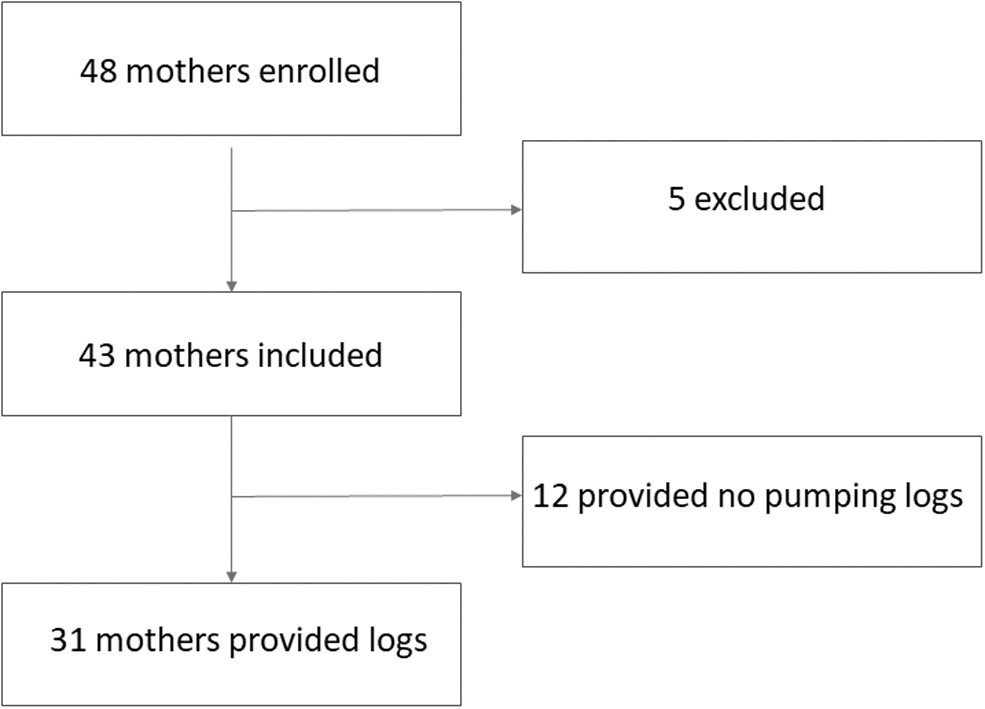
Enrollment chart.
We considered the women who provided ANY pumping information (frequency and/or volumes) to the study team during any of the four time points they were contacted as “provided logs.” The median maternal age of the 43 consented mothers included in the analysis was 32 years (interquartile range [IQR] 28–36), and the median gestational age of infants at birth was 28 weeks (IQR 26–30).
Twenty-one percent of the births (9 of 43) were multiple gestations with 7 sets of twins and 2 sets of triplets. There were no significant differences in the characteristics or demographics of mothers who provided any logs (n = 31) and those who did not (n = 12) (Table 1).
Demographics
nlog = 31, nno log = 11.
nlog = 26, nno log = 5.
nlog = 27, nno log = 6.
IQR, interquartile range.
Of the 31 mothers who provided logs, 31% (n = 19) logged all 4 weeks, 19% (n = 6) logged 3 weeks, 13% (n = 4) logged 2 weeks, and 6% (n = 2) logged 1 week. Mothers who provided pumping logs were significantly more likely to provide 100% MOM for their infants at the time of achieving full feeds, compared with mothers not providing any logs (87% versus 50%, respectively, p = 0.017). The time to the first colostrum administration, percentage MOM feeds in the first week after delivery, and percentage of infants who received 100% MOM at discharge were not significantly different between the two groups of women (Table 2).
Comparison of Women Who Provided Pumping Logs and Those Who Did Not
Bold value indicates statistical significance (p < 0.05).
nlog = 23, nno log = 7.
IQR, interquartile range; MOM, mother's own milk.
Of the mothers providing pumping information, there was no significant correlation between the time to first expression and the volumes of milk produced on days 7, 14, 21, and 28 (Fig. 2). Cumulative frequency of expression in the first week was significantly correlated with milk volume on day 21 (rs = 0.51, p = 0.016), but not on days 7, 14, and 28 (Fig. 3). Cumulative frequency of expression in the first week was not associated with percent MOM feeds at the time of achieving full feeds yet was significantly associated with providing 100% MOM feeds at discharge (p = 0.03, n = 26).

Effect of time to first milk expression on milk volumes produced in a 24-hour period on days 7, 14, 21, and 28. Correlations were not statistically significant (p > 0.05).

Effect of cumulative frequency of milk expression in the first week on milk volumes produced in a 24-hour period on days 7, 14, 21, and 28. Correlation statistically significant for day 21 (rs = 0.51, p = 0.016).
The median cumulative frequency of expression in the first week was 47 times (IQR: 40, 52) in babies who received 100% MOM feeds at discharge (n = 24) compared with 28 times (IQR: 24, 45) in babies who received <100% MOM feeds at discharge (n = 7) (Fig. 4). Milk volume on day 7 was significantly correlated with volumes subsequently obtained on days 14, 21, and 28 with correlation, rs = 0.91, 0.86, and 0.77 (n = 24, 22, and 20) respectively (p < 0.001 for all comparisons) (Fig. 5). The volume of milk produced on day 7 was not significantly correlated with % MOM at full feeds or % MOM at discharge.

Comparison of cumulative frequency of expression in the first week between mothers providing 100% MOM and 0–100% MOM at discharge. Difference statistically significant (p < 0.05). MOM, mother's own milk.

Effects of milk volume produced on day 7 on milk volume produced on days 14, 21, and 28. All correlations are statistically significant (p < 0.05).
Discussion
Pumping logs are a tool used to promote lactation, track its efficacy, and identify obstacles. They can serve an important role in educating mothers on appropriate timing and frequency of pumping, as well as targeted milk volumes. They are also essential sources of data for studies on milk expression for premature infants. 7 However, compliance with keeping logs and completeness is not consistent, and this has been considered a weakness in previous studies on lactation by mothers of premature infants.
We found that women who keep any logs are not significantly different with regard to major demographic characteristics from those who do not keep logs. While 72% of the consented women provided information about pumping, only 31% continued to log throughout all 4 weeks. Further investigation into the reasons for this is warranted.
A significantly greater percentage of mothers providing logs also supplied 100% MOM at the time their infants achieved full feeds than mothers not submitting logs. It is likely that the first 7 days after delivery constitute a critical opportunity to create a structured approach to pumping and lactation. The act of maintaining a pumping log may encourage and remind women to pump and ultimately produce more milk.
Among the women providing logs, the time to first expression was not associated with subsequent milk volumes in our study, which is in contrast to what has been reported in the literature.12,13,17,22 It is possible that our small sample size is responsible for this. Also, women in our study first expressed milk at a median time of 15 hours after delivery. This is late compared with the timing reported in the literature and may account for the lack of effect.
Similar to what has been previously reported, we saw an effect of the frequency of expression on later milk volumes.13,16,23 In our study, we looked at the cumulative frequency of expression in the first week. A higher frequency of expression was associated with provision of 100% MOM at discharge as well as milk volume on day 21 (although not on days 7, 14, or 28). It is possible that women have overcome initial obstacles to lactation by day 21.
Despite the relatively late median time to first expression in our population, the cumulative frequency of expression may be an important factor. A larger sample size will be needed to detect any potential effect of cumulative frequency of milk expression in the first week on milk volumes on days 7, 14, and 28.
Milk volume on day 7 was correlated with volumes on days 14, 21, and 28. This is consistent with previous reports and highlights the importance of early intervention to establish milk supply in the first week after delivery.13,24 In a recent study, during the first 2 weeks after delivery, a higher percentage of MOM feedings predicted an exclusive MOM diet at discharge. 25 Our findings suggest that professional assessment of lactation and provision of a structured plan for lactation early are critical.
There were several limitations in this study. All of the data were self-reported, which may not always be accurate and despite being instructed to keep track of milk expression information, we did not investigate the reasons why some of these women may not have been able to keep track of their pumping patterns. Women may not be comfortable sharing all information with the study team, especially if they are having difficulty expressing milk.
More automated and anonymous reporting may increase the response rates in future studies. Differences in pumping at home and at the hospital, with and without the baby, number of visitations, family support, and social considerations likely play a major role in milk production and warrant further investigation. In addition, this entire cohort of women delivered during the COVID-19 pandemic, and it is not clear whether COVID-related stressors and restricted visitation in the NICU had any effect on these logs or pumping in general.
Another limitation is that we did not collect information on direct breastfeeding. This may have affected the volume of milk produced in a 24-hour period, especially in those infants who were discharged by the time the 28-day data were collected. Finally, only 31% of the mothers provided pumping information for all 4 weeks. The inability to detect correlations between milk expression patterns and milk volumes may have resulted from the inclusion of different mothers at each time point due to the lack of availability of data.
In conclusion, frequency of pumping in the first week and volume of milk obtained on day 7 may impact long-term success in lactation for mothers of premature infants. The first week appears to be a critical period for establishing practices that determine milk volumes throughout the first month. Pumping logs may be a useful tool for setting targets and patterns that increase milk production.
Footnotes
Acknowledgments
The authors want to thank the lactation consultants at Cohen Children's Medical Center and North Shore University Hospital and Debra Potak for her assistance and support.
Authors' Contributions
C.G.-J., V.S., D.Y., and D.M. performed conceptualization, methodology, and writing-original draft and writing-reviewing and editing. M.B. and B.W. performed writing-reviewing and editing and supervision. J.C. performed the formal analysis.
Disclosure Statement
No competing financial interests exist.
Funding Information
No funding was received for this article.