




Abstract
Background:
Research on race/ethnicity and breastfeeding has consistently found lower rates for Black mothers compared with other U.S. women, due to various social, cultural, and historical factors. Aggregate analyses illuminate racial/ethnic differences, but they only provide partial insight into the factors contextualizing breastfeeding decisions and rates. We examined articles addressing Black women and breastfeeding (1980–2020) to assess publication trends.
Materials and Methods:
A targeted literature search in PubMed for research on Black women and breastfeeding (1980–2020). The search used nine different keyword combinations: (“breastfeeding” OR “lactation” OR “infant feeding,”) AND (“rac*” OR “African American” OR “Black”). After removing duplicates, non-U.S. research, and irrelevant articles, 221 articles were reviewed. Articles were coded for year, type (quantitative, qualitative, mixed method, conceptual/literature review, commentary/editorial), and journal target audience (e.g., nursing).
Results:
More than 50% of all articles were published after 2013. The period of 2018–2020 accounts for 25% of all published articles. The research is also mostly quantitative (60.2%). Qualitative studies made up only 16.7% of articles. A few studies used mixed methods (5%). More than half of all qualitative studies were published after 2014.
Conclusions:
Research on Black women and breastfeeding has slowly increased since 1980, but much of the work has only been done post-2000. Research is also mostly quantitative analyses. Quantitative and qualitative methods rely on different research aims, styles, and objectives. To provide a fuller understanding of Black women's relationship to and experience of breastfeeding, we suggest that scholars cultivate a stronger focus on qualitative and mixed methods for future research.
Introduction
Promoting and protecting breastfeeding are major U.S. public health prerogatives. Promotion efforts have focused on increasing initiation and duration rates, and exclusivity of breastfeeding, to bring behaviors more in line with recommendations to exclusively breastfeed an infant for the first 6 months and continue breastfeeding alongside other foods for one or more years of a child's life.1–3
Improving U.S. breastfeeding initiation and duration rates has been part of the Healthy People Initiative since the initiative's inception in 1979. 4 Through Healthy People data collection and other research efforts, there is a body of evidence showing consistently lower breastfeeding rates for Black mothers as compared with other racial/ethnic groups in the United States.5–7
Recent data from the National Immunization Survey (NIS) for children born in 2019 show that 83% of Hispanic infants, 85.3% of white infants, and 90.8% of Asian infants have ever been breastfed, compared with 74.1% of Black infants. 5 Racial/ethnic disparities persist across different breastfeeding metrics (e.g., breastfed at 3, 6, and 12 months; exclusively breastfed for 3, 6 months) and across survey years (e.g., NIS data from 2012 to 2019). 5
The data generally show that Asian, white, and Hispanic women all have higher rates of breastfeeding initiation compared with Black women. The breastfeeding gap grows smaller at 3, 6, and 12 months, and even smaller when considering exclusive breastfeeding.6,7 A few women across all racial/ethnic groups can maintain longer breastfeeding durations, and particularly exclusive breastfeeding, without much needed social and cultural support.8,9
Further, Black women's general relationship to breastfeeding, and especially their lower rates of contemporary breastfeeding, has to be considered within a historical and cultural context of the relative devaluation of Black motherhood, 10 Black women's wet nursing of white infants under the institution of slavery,11,12 and institutionalized racism that Black women continue to experience in health care and social service settings.13,14
With the recent update of U.S. breastfeeding recommendations, 3 the authors sought to assess the state of research on Black women and breastfeeding to provide insight for future research on addressing racial/ethnic breastfeeding disparities.
This brief report utilizes three research questions to assess the state of scholarly knowledge on cisgender Black women and breastfeeding in the United States over a period of four decades (1980–2020): (1) How many studies have been published addressing Black women and breastfeeding? (2) What research methods are most frequently used? (3) What fields or disciplines are most frequently represented in the published scholarship?
Materials and Methods
Data
The authors conducted a targeted literature search in the PubMed database for research on Black women and breastfeeding, during the period of 1980–2020. We focused on PubMed for our search topic because it catalogs >30 million citations and abstracts from biomedical literature, with most citations drawn from biomedicine and health fields, and adjacent disciplines such as life sciences and behavioral sciences. 15
The database search terminology used nine different combinations of the following keywords: (“breastfeeding” OR “lactation” OR “infant feeding”) AND (“rac*” OR “African American” OR “Black”). After removing duplicates, non-U.S. research, and irrelevant articles, the dataset included 221 unique articles. All citations were downloaded and formatted in an SPSS dataset for further analysis. The study did not involve human subjects and was thus exempt from institutional review.
Measures
The SPSS dataset included basic citation variables for each article, including year of publication, author names, title, and journal. Articles were additionally coded for article type, based on five emergent classifications: empirical-quantitative, empirical-qualitative, empirical-mixed methods, conceptual/literature review, and commentary/editorial. The authors also created a proxy measure for the field/discipline of the research, assessed by target audience of the journal in which the article was published.
During initial coding, there were 32 distinct categories identified for field/discipline. These were condensed into 11 higher-order categories: (1) pediatrics, (2) breastfeeding, (3) maternal and child health, (4) nursing, (5) nutrition, (6) public health, (7) women's health, (8) medicine (general), (9) OB/GYN, (10) other health specialty areas (e.g., asthma, cancer, diabetes), and (11) multidisciplinary social/behavioral health research.
Analytic strategy
The authors used a descriptive statistical approach, examining frequencies and crosstabulations of the data to address annual publication trends for number of articles, type of article, and fields/disciplines represented between 1980 and 2020.
Results
Figure 1 displays trends in annual publications on Black women and breastfeeding. Notably, during the first three decades of the analytic period (1980s, 1990s, 2000s), there were less than five articles published each year. Publications on the topic began to increase after 2010. More than 50% of articles identified in the search were published after 2013. The period of 2018–2020 alone accounts for 25% of all identified published articles.

Annual publications on Black women and breastfeeding, PubMed Database 1980–2020 (n = 221).
Figure 2 displays trends in the types of articles published over time on Black women and breastfeeding. Quantitative empirical analyses have consistently been the most frequently published article type across the analytic period. Out of the 221 articles in the analytic sample, 133 (60.2%) were quantitative studies.
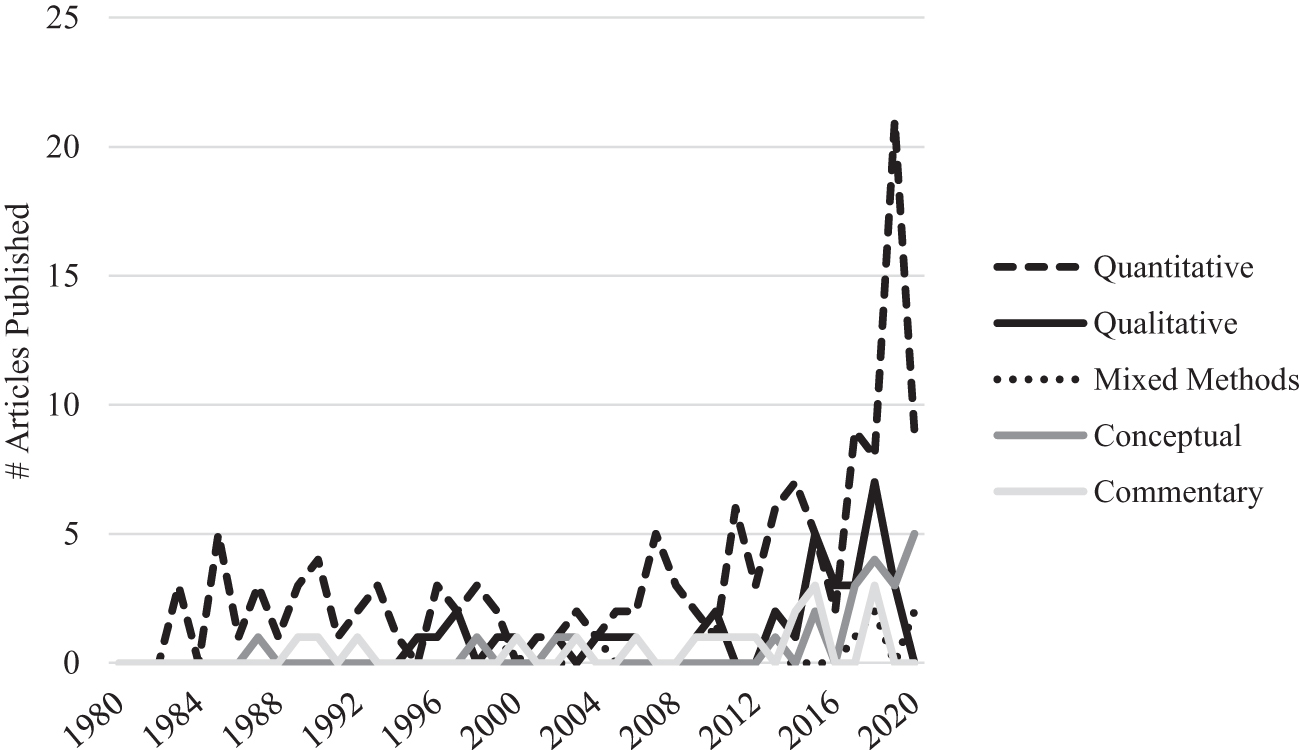
Annual publications, by study type, on Black women and breastfeeding, PubMed Database 1980–2020 (n = 221).
The next most frequent category was qualitative research with 37 of 221 articles (16.7%). There were also 22 conceptual and literature review articles (10%), 18 commentaries/editorials (8.1%), and 11 articles using mixed (quantitative and qualitative) methods (5%).
Focusing on just the empirical research in the sample, between 1980 and 1994, the only published studies were quantitative in nature. The first qualitative study was published in 1995. For the next 20 years (1995 to 2014), there was an average of less than one (0.8) qualitative study published annually. More than half (56.7%) of all qualitative studies in the sample were published after 2014. The first mixed-method study was published in 1999.
Since then, there has been approximately one mixed method study published every other year (0.5 studies annually between 1999 and 2020). Overall, quantitative research appears at 3.5 times the rate of qualitative research and 12 times the rate of mixed-method research among PubMed articles on Black women and breastfeeding (1980–2020).
The final research question focused on the field/discipline of published articles, indicated by the target audience of the journal (Table 1). For brevity, we focus here on the top five in the table. The most frequent publication outlets were multidisciplinary breastfeeding journals (22.2%), followed by nursing journals (14%), pediatric journals (13.1%), public health journals (12.2%), and nutrition journals (10%).
Target Audience for Published Articles on Black Women and Breastfeeding, PubMed Database 1980–2020
For example, cancer, asthma, diabetes.
Table 1 further indicates the most frequent journal titles that appeared in each target audience category. For example, among multidisciplinary breastfeeding journals, articles were typically split between Breastfeeding Medicine and Journal of Human Lactation.
Discussion
Research on Black women and breastfeeding has slowly increased since 1980, but over 50% of the articles analyzed here were published after 2010. A full 25% of the articles were published between 2018 and 2020. These publication trends indicate that research on the topic of race/ethnicity and breastfeeding, with a specific focus on Black women, is a relatively newer area of scholarly attention.
The analysis here also shows that the existing research is dominated by quantitative analyses: for every qualitative study in the analytic sample, there were 3.5 quantitative articles published. Qualitative and mixed-method work also began later than quantitative analyses, starting in the mid-to-late 1990s.
While quantitative research can provide useful aggregate analyses, illuminate sub-group differences in breastfeeding behaviors and outcomes, and address many individual correlates of breastfeeding initiation and duration (such as maternal age, education, relationship status, among other factors), these analyses can only provide partial insight into the more complex social and cultural factors that contextualize and influence Black women's relationship to, and experience of, breastfeeding.
For instance, qualitative social scientific and historical analyses are important for generally contextualizing ongoing racial/ethnic disparities in maternal and child health, linked to legacies of slavery, contemporary systemic racism, and other sociopolitical forces that detrimentally influence health and life course outcomes of marginalized groups.11–14,16
Quantitative and qualitative methods rely on different research aims, styles, and objectives; therefore, they make different contributions to scholarly knowledge. 17 In terms of future research, we suggest that scholars should cultivate a stronger focus on qualitative and mixed-methodological approaches, in addition to quantitative work, to provide a well-rounded knowledge base on Black women and breastfeeding.
This analysis does have some limitations. First, the authors only focused on the PubMed database in developing their analytic sample. Although not directly related to the current analysis, a 2015 study on systematic review practices for therapeutic interventions indicated that PubMed had thorough coverage and noted only “modest impact” on findings from searching additional databases (specifically EMBASE). 18 Yet, some types of articles are less likely to be indexed in PubMed because they do not focus on biomedical and health fields.
Second, the authors did not code for each study's research questions, sample, or findings to assess their specific contributions to scholarly knowledge; rather, the focus was on more general publication trends. Sampling additional research databases (e.g., social science, humanities) and analyzing specific contributions of individual studies are both important tasks for future analyses of the state of knowledge on Black women and breastfeeding.
Footnotes
Authors' Contributions
K.M.J.: Conceptualization (equal), Funding acquisition (lead), Methodology (lead), Formal analysis (lead), Writing—Original Draft (lead), and Visualization (lead). S.K.: Conceptualization (equal), Investigation (lead), and Writing—Original Draft (supporting).
Disclosure Statement
No competing financial interests exist.
Funding Information
Funding for this project was provided in part by [redacted for review].