




Abstract
Background:
It is well-known that stress and high levels of cortisol can negatively impact lactation outcomes. Mindfulness techniques are also known to be effective at reducing stress, and there has been some research into the effects of these techniques on breastfeeding. However, there has not yet been an integrative review examining the outcomes of the research carried out on this subject in the past 10 years.
Objectives:
The objective of this integrative review was to assess the effect of mindfulness techniques on lactation. This includes the effects on maternal stress, both perceived and physiologic, milk composition and volume, as well as the effects on the infants.
Methods:
The electronic databases Cumulative Index to Nursing and Allied Health Literature (CINAHL), PubMed, Scopus, and Cochrane were searched using the key terms “meditate, meditation, relaxation or mindfulness” and “breastfeeding or lactation.”
Results:
Nine articles met the inclusion criteria. Six key themes were identified. Mindfulness techniques reduce perceived and physiologic maternal stress and increase infant growth, particularly in the late preterm early term infant population. Infant behavior was also impacted by maternal mindfulness techniques as well as maternal milk volume, expression, and breastfeeding/pumping frequency. However, the effectiveness of mindfulness techniques is dose dependent.
Conclusions:
Mindfulness techniques are a simple and practical tool for postpartum breastfeeding people that have the potential to improve both lactation and infant outcomes.
Introduction
The value of human milk cannot be overstated. It serves as the optimal source of nutrition for infants and provides both short- and long-term health benefits for both the infant and the mother. 1 Human milk is crucial for the infant's immune system, growth, and overall development. 2 Apart from the health benefits for infants, breastfeeding also provides mothers with improved postpartum recovery and is associated with a decrease in the development of breast and ovarian cancer, diabetes, cardiovascular diseases, and osteoporosis. 3
However, it is widely recognized that exclusive breastfeeding rates throughout the world are low. Globally, only 48% of mothers exclusively breastfeed their infants up to 6 months. 4 Initiatives to improve breastfeeding rates primarily focus on providing additional support, and less research has been carried out on the effects of maternal physiological and psychological state. Stress can influence the hypothalamic–pituitary–adrenal axis and negatively impact lactation either directly by inhibiting prolactin and oxytocin or indirectly by acting on specific regions in the central nervous system. 5 Furthermore, the milk ejection reflex can be impaired by lower levels of oxytocin caused by acute physical and mental stress. 6
Furthermore, breastfeeding is a dynamic process between mother and infant that consists of the complex signaling between the dyad. 7 It has been found in the literature that increased maternal cortisol (owing to stress) negatively impacts human milk output, milk composition, infant behavior, and infant growth.8–10
Mindfulness techniques have been found to effectively decrease physiological markers of stress, for example, cortisol, in a range of populations. 11 These techniques are practical in that they are of low cost, low risk, and easily implementable in a wide variety of settings. Complementary and alternative medicine are becoming increasingly popular, yet despite the use of these practices, there have been few studies that focused on the specific impact of the mindfulness modality on the postpartum population. 12
There have been previous reviews that explored the effectiveness of psychological relaxation interventions using relaxation therapy to improve breastfeeding outcomes, 13 as well as studies that explored the effects of specific mindfulness techniques on different breastfeeding and infant outcomes.13–19 Therefore, the goals of this integrative review were to: (1) explore literature from the past decade to determine if mindfulness techniques as a whole have an effect on lactation and (2) explore if mindfulness interventions implemented in postpartum breastfeeding mothers would impact their infants.
Methods
Methodology
The methodological steps proposed by Whittemore and Knafl in 2005 were followed in this integrative review to decrease bias and improve the rigor of this study. 20 The framework for the integrative review methodology is as follows. First, the problem to be researched was clearly identified and defined. Second, a Boolean literature search was conducted across four databases (Cumulative Index to Nursing and Allied Health Literature [CINAHL], PubMed, Scopus, and Cochrane). The data were then evaluated and analyzed. Finally, the data were presented in a table of evidence and synthesized to form conclusions. The Preferred Reporting Items for Systematic Reviews and Meta-Analyses (PRISMA) was also utilized to improve the clarity and transparency of this literature review 21 (Fig. 1). This integrative review includes all the new studies published after the publication of the systematic review by Mohd Shukri et al. in 2018 investigating the effectiveness of relaxation interventions on breastfeeding outcomes. 22
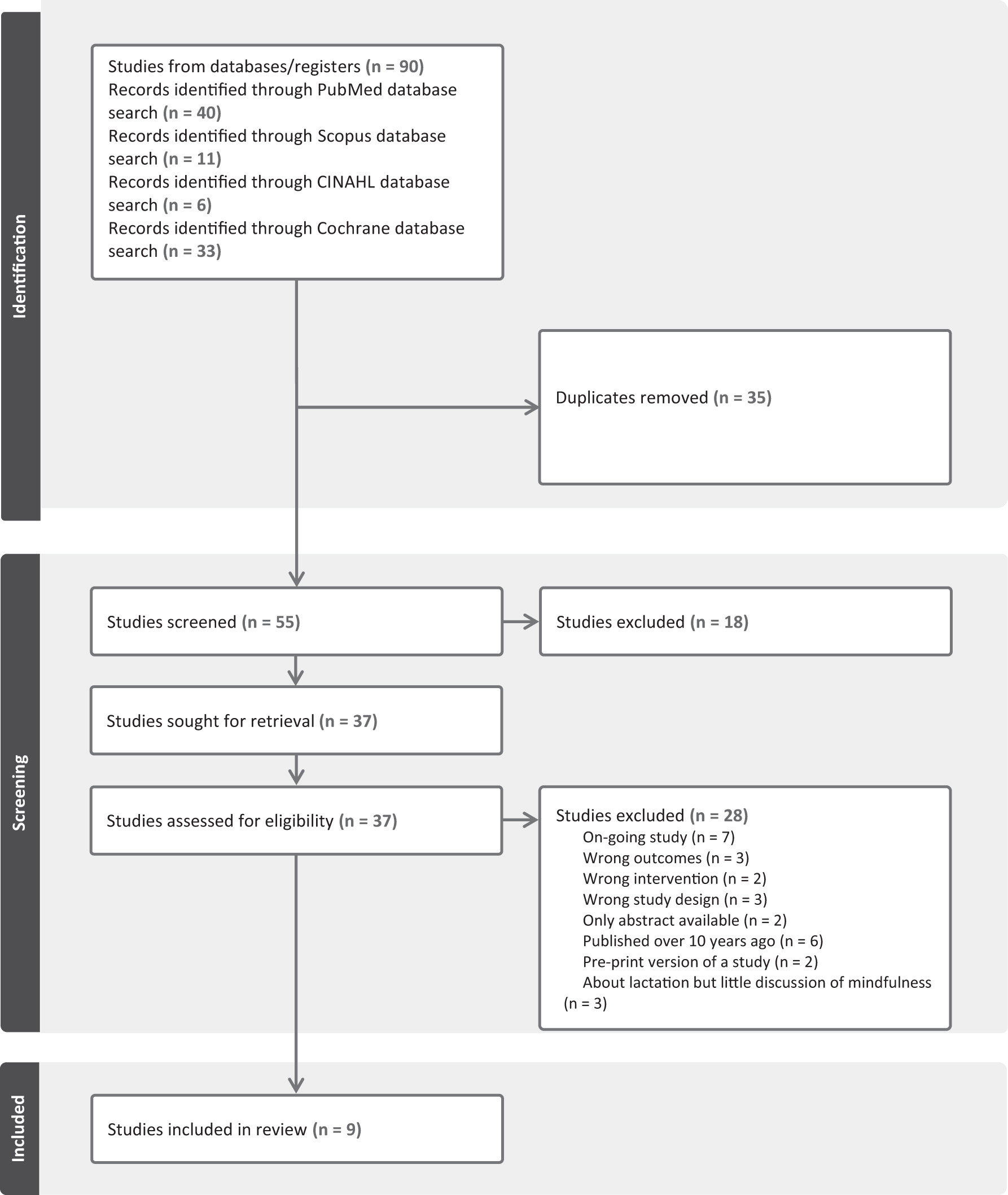
PRISMA flowchart. PRISMA, Preferred Reporting Items for Systematic Reviews and Meta-Analyses.
Data sources
A Boolean literature search was conducted across CINAHL, PubMed, Scopus, and Cochrane using the keywords “Meditation OR meditate OR relaxation OR mindfulness” AND “Breast Feeding OR lactation.” Using this search strategy (see Table 1), 90 articles were identified. After removing duplicates, 55 articles remained. PRISMA guidelines were followed throughout this phase of the literature review. 21
Search Strategy
MeSH, Medical Subject Headings.
Operational definitions
The following terms are key concepts in this article, and they were defined as such.
Mindfulness
A state of heightened awareness achieved through a diverse number of mind–body practices with a common objective of concentrating on the interaction between the body's physical sensations and the mind. It is the practice of intentionally paying attention to one's present-moment experiences without evaluation. The goal of practicing mindfulness interventions is to modify the neuro-immuno-endocrine system to improve health and overall well-being.
Meditation
Meditation is a type of mind–body practice in which an intentional focus and open attitude are developed to decrease intruding thoughts about the past or future. The objective was to focus the mind and train attention and awareness to achieve a mentally clear and emotionally calm and stable state. There are many forms of meditation, such as focused attention, open monitoring, and automatic self-transcendence. These techniques all typically use a quiet and relaxing setting and a still and comfortable position.
Relaxation techniques
Relaxation techniques are cognitively based techniques designed to decrease both psychological and physiological stress. These techniques include deep breathing, guided imagery, progressive muscle relaxation, meditation, yoga, and light therapy, whereby certain hues of light are used to influence mood.
Screening and inclusion criteria
The articles' abstracts were initially reviewed and if they met inclusion and relevance criteria, a full-text screening was then completed. Articles were included if they were published between January 2013 and January 2023, written in English, and discussed the effects of mindfulness relaxation techniques on human lactation.
Of the 55 articles, 7 were removed as they are currently ongoing studies without results. Six other studies were excluded because they were published over 10 years ago, whereas three other studies were about lactation, but had little discussion of mindfulness. Three more studies were excluded owing to wrong outcomes measured, two had the wrong intervention, and three had the wrong study design. Moreover, two articles were excluded due to containing only an abstract without a full study following. Finally, two other articles were excluded because they were the preprint version of studies that were included in this review. Nine articles overall met the criteria for inclusion and are discussed in this review.
Analytic strategy
The framework developed by Melnyk and Fineout-Overholt 23 for determining an article's level of evidence was used to score the nine articles. The analytic strategy utilized in this review consisted of initially extracting methodological data from the articles. This included extracting data relating to the study locations and populations, methods of data collection, interventions, and outcomes. The extracted data was organized into a table of evidence which allowed for comparison and categorization to ultimately identify themes (Table 2).
Article Summary
BMI, body mass index; CAM, complementary and alternative medicine; CD, compact disc; CG, control group; CI, confidence interval; DBP, diastolic blood pressure; DOL, day of life; HR, heart rate; IIFA, IOWA Infant Feeding Attitude Scale; NICU, neonatal intensive care unit; PASS, Perinatal Anxiety Screening Scale; PMR, Progressive Muscle Relaxation; PSS, perceived stress scale; RCT, randomized controlled trial; RG, intervention group; RM, Malaysian Ringgit; SBP, systolic blood pressure; STAI, State-Trait Anxiety Inventory; WHO, World Health Organization.
Evidence Supporting the Six Key Themes
Results
Study characteristics
Studies included were published between 2013 and 2023. Samples were derived from six countries (two studies from China, one from Malaysia, two from the United States, one from Iran, one from the United Kingdom, and one from India). Of the included studies, six were randomized controlled trials (RCTs), which is Level II evidence. 23 Within these RCTs, four were double-blinded, one was single-blinded, and one was nonblinded. The other three included studies in this review consisted of a systematic review (Level I), a clinical trial with a control group (Level IV), and a pilot feasibility study (Level VI). 23
Demographics
Four studies reported the race and ethnicity of the participants. Of the studies that reported race/ethnicity, the sample populations were for the most part homogenous. For example, in one study, 73% of participants identified as White, 24 and in another study 100% of the participants identified as Malay. 22 However, the study with the most heterogeneous population included different subgroups within race/ethnicity, which could also explain the heterogeneity of their sample. 13
Household income was reported in six of the included studies. Income was one of the demographic areas that had more variation among participants as compared with other demographic data. This heterogeneity could be owing to the fact that levels of income were reported as broad ranges, thus allowing the data to appear more evenly distributed than it may be in reality. Conversely, marital status (reported in six studies) was found to be an extremely homogeneous area with the vast majority of participants being either married or cohabitating with a partner.
Seven of the studies had data on the education level of the participants. Across five of the studies that reported education level, the participants homogenously had high levels of education with >50% of them having completed at least a bachelor's degree.13–15,17,18
Additional demographic data included the age of the participants, which was reported in eight studies. One study looked at participants' use of private versus public insurance where it was found that half of the participants used private insurance and the other half had public insurance. 17 Another study reported whether participants gave birth at a private or a public hospital (90% gave birth at a public hospital). 18 Finally, one study looked at whether the participants lived in urban or rural areas with most of them residing in urban areas. 15
Key themes identified
After synthesizing the information contained in the selected articles, six major themes relating to the relationship between mindfulness techniques and lactation emerged. The themes are as follows:
Mindfulness techniques decrease maternal stress, anxiety, and cortisol. Mindfulness interventions impact human milk volume, expression, and breastfeeding frequency. Mindfulness techniques influence infant behavior. Mindfulness techniques influence infant growth. Mindfulness techniques are effective, simple, and easily implementable tools. Mindfulness techniques have dose and duration-dependent effects.
The themes and their supporting evidence were organized as given in Table 3.
Mindfulness techniques can decrease maternal stress, anxiety, and cortisol
The first key theme was that the use of mindfulness techniques (yoga-assisted relaxation and audio meditation recordings) has been found to be effective in reducing both perceived and physiological markers of stress and anxiety in lactating postpartum mothers.13–15,18,19,24 Furthermore, maternal cortisol, a biomarker of stress, and milk cortisol concentrations were also found to be decreased in conjunction with the utilization of mindfulness techniques.13,14 One study that compared different mindfulness techniques (meditation, music, or relaxation light) found that meditation was the most effective at reducing both perceived and physiological markers of stress in breastfeeding mothers. 19 Another study found that mothers who engaged in frequent meditation had a clinically significant decrease in depression symptoms. 17
Impact of mindfulness interventions on human milk volume, expression, and breastfeeding frequency
Second, it was noted in several articles that the use of mindfulness techniques increased human milk output.14,15,17 Breastfeeding frequency and pumping episodes were also associated with frequent meditation.13,17 Moreover, relaxation techniques were found to improve the success of milk expression, particularly in mothers of preterm infants. 15 In the study that measured the effectiveness of different mindfulness techniques, four participants experienced the let-down reflex during the meditation recording session. 19
Influence of mindfulness techniques on infant behavior
Many of the studies investigated the effects of the mindfulness techniques on improvements in infant behavior and found a positive association between the two.13–15,18 Infant crying duration was found to be significantly shorter when the infants' mothers were in the meditation intervention group as compared with the control group. 13 Improvements in infant sleeping duration were also found across multiple studies.14,18
Mindfulness interventions improve infant growth
Infant weight gain was promoted through the use of mindfulness interventions, particularly in late preterm and early-term infants.13,18 Late preterm and early-term infants exact nutrient requirements and optimal growth patterns are not as well-known as compared with infants born at lower gestation ages 25 ; therefore, it was interesting to note that infants in the mindfulness intervention group had significantly higher growth velocity despite the lack of direct nutritional intervention. 13 Another study found that infants in the mindfulness intervention group, who were either within the expected weight and body mass index scores according to World Health Organization (WHO) growth standards or slightly below the 50th percentile, experienced a significantly higher weight gain from baseline to the study's endpoint. 14 This increase in weight gain represented a close match to the optimal growth of breastfed infants, which suggests that the mindfulness intervention may allow the breastfed infants to achieve an ideal growth pattern more closely. 14
Mindfulness techniques are an effective, simple, and easily implementable tool
The use of mindfulness techniques is an inexpensive method that can be easily implemented in multiple settings. Several studies advocated for the use of these techniques to be considered an integral part of neonatal care in the neonatal intensive care unit (NICU) as these are situations where high levels of stress and anxiety are experienced and there are concerns about infant growth as well as breastfeeding failure.13–15 Another study also noted that mindfulness training is an easy and low-cost skill that can improve breastfeeding self-efficacy in mothers with premature infants, which could be expected to then increase rates of successful breastfeeding. 16 Furthermore, a study that examined the effectiveness of mindfulness interventions in healthy mother–infant dyads found that these techniques are simple and practical and could easily be used in future interventions aimed at increasing the rates and duration of breastfeeding. 14
Dose- and duration-dependent effect of mindfulness techniques
Dose and duration of mindfulness interventions impacted their effectiveness. Dose refers to how many times the intervention was used, and it is measured in days. Duration is defined as the total amount of time spent using the mindfulness intervention, and it is measured in minutes. For instance, one study found that a greater duration, that is, an increased amount of time spent listening to a meditation tape, was associated with greater infant weight and that a larger dose, that is, number of days, of the meditation tape was associated with a more significant reduction in maternal stress. 18 Another study analyzed the dose-dependent effect where the researchers encouraged participants to engage in the daily use of a mindfulness-focused meditation audio recording. 17 The number of days the intervention was used was recorded as data.
It was found that mothers who meditated for at least 7 days (a minimum of one meditation session per day) experienced a 100% increase in skin-to-skin contact and that this higher frequency meditation was associated with increased milk volume, increased pumping sessions, and reduction of depression symptoms. 17 Another study found positive and significant correlations between the frequency of use of a relaxation intervention and infant weight z-score change, food responsiveness change, and breastfeeding frequency. 13 This study also found a negative correlation between the frequency of use of the intervention and infant crying duration. 13
Discussion
In a previous systematic review published by Mohd Shukri et al. in 2018, relaxation interventions were shown to be effective in significantly increasing milk yield and fat content in human milk as well as reducing maternal stress. 22 This integrative review synthesized research carried out on the use of mindfulness techniques and their effect on lactation and infant outcomes, and it reinforces earlier findings that these techniques do indeed have a positive impact. The utilization of mindfulness interventions, whether it be meditation, progressive muscle relaxation, or deep breathing therapy, promotes a reduction in both perceived and physiological stress and anxiety in postpartum breastfeeding mothers. These interventions were also found to have a positive impact on infant growth and behavior, and these findings hold weight for both healthy mother–infant dyads as well as late preterm and early-term infants.
It is essential to note however that the effectiveness of these interventions depends on the frequency with which they are performed. In order for the mindfulness interventions to be successful, it is imperative that they be done regularly.17,18 Furthermore, in several studies, the mindfulness interventions were self-administered and self-reported,13,14,17,24 which means that some of the results where no significant difference was found in infant behaviors, maternal stress, milk volume, and composition could be owing to low adherence to the intervention protocol.17,18,22,24 In studies where the intervention was not self-administered or self-reported, significant reductions in stress, improvements in infant behavior, and increases in milk output were observed.15,19
Furthermore, in the studies where the interventions were self-administered and self-reported, it is interesting to consider the reasoning behind why some mothers were using the techniques with a higher frequency. One study performed in Beijing China found greater use of the intervention by mothers of female infants, which could potentially explain the study's findings of significantly higher weight gain in the female intervention infants. 18 This highlights the importance of exploring mothers' attitudes, beliefs, and customs to ensure the effectiveness of interventions.
The significantly positive impacts of the mindfulness interventions on reducing maternal stress were theorized in many of the studies to be linked to the effects on infant growth and behavior.13,14 Parent–offspring conflict theory could help explain this phenomenon from an evolutionary standpoint as mother–infant tension over metabolic resources could be improved by reducing maternal stress. 26 One study proposed that reducing maternal stress through mindfulness techniques could result in the transfer of maternal energy from stress to investment in the infant via breastfeeding, by allowing for increased transfer of human milk and/or by affecting the infant through human milk hormones. 13 The hormones found in human milk can directly impact infant growth through the promotion of tissue growth, or indirectly by impacting infant behavior. 27
Another study also put forth the idea that the effects on infant behavior and growth may be owing to changes in human milk intake or composition as a result of the mindfulness interventions. 14 Maternal stress serves as a physiologic signal and can impact human milk composition or volume. It was found that mothers with decreased stress because of mindfulness interventions produced milk with lower concentrations of cortisol and had more efficient or frequent milk ejection, which could affect infant behavior as well as influence nutrient intake. 14 Psychological mother–infant signaling is evident in several studies because by experimentally manipulating the maternal psychological state through mindfulness interventions, effects on infant behavior and growth were observed.14,15,18 An explanation for this could be that by reducing maternal stress, mothers were able to spend better quality time bonding with their infants (for instance, increased skin-to-skin time), which could then facilitate improved infant sleep.
Moreover, the use of mindfulness interventions was found to be a safe, low-cost, and easily implementable tool for improving lactation outcomes.13–16 These interventions allow for flexibility and can be self-administered from any setting or performed by a trained professional in a clinic or outpatient setting. Their effectiveness in both low-risk healthy mother–infant dyads and in mothers with late preterm/early-term infants, or hospitalized infants illustrates that this is a therapy with the potential to be beneficial for all. Furthermore, owing to the high-stress levels experienced by mothers of hospitalized infants (or infants experiencing other health challenges), these interventions would be particularly helpful to prescribe as part of a holistic complementary aspect of neonatal care in the NICU.
Clinical implications
Based on the findings of this integrative review, mindfulness interventions may be beneficial to many parents of hospitalized infants. These interventions require minimal resources to implement; however, education and training of staff would be essential. From this review, it was also noted that interventions had better outcomes when there was continued follow-up with the parent. During the antenatal period, health care providers should teach parents about mindfulness interventions. For example, parents could be taught to pair pumping and/or breastfeeding sessions with listening to an audio-guided meditation. Because human milk rates at discharge for NICU infants remain suboptimal, incorporating mindfulness interventions may improve the lactation journey for parents with sick children. We encourage hospital staff to investigate ways that they can incorporate mindfulness interventions into their daily clinical practice.
Future research
There is a need for research that includes more diverse patient populations and takes specific care to include racial and ethnic data that are representative of the general population. Research protocols would be enhanced with well-described periods of intervention and objective measurements of their outcomes. Because only two studies examined milk composition, further research in this area is warranted. It is well known that when the breast is more effectively emptied, the fat composition of the milk is higher. Specific studies examining the impact of mindfulness on breast emptying and caloric density of the milk could hold promise for improving growth rates of infants cared for in the NICU.
Limitations
There are several limitations to this review. First, the author has undergone meditation training courses and has a current meditation practice, so it is possible that unconscious bias was introduced into the review process when identifying results.
Second, this is an integrative review, meaning that it uses data from various study designs. Although this can contribute to an enhanced understanding of the topic, it is also challenging to integrate findings from such a wide array of study designs, which leaves the possibility for error. 20
Furthermore, all the studies included in this review identified the issue of small sample sizes, which limits the generalizability of their findings. Also, many of the studies had interventions that were self-administered and self-reported, and this resulted in low compliance, which could have affected the data. In addition, owing to the nature of the intervention, it was not possible to blind intervention group mothers, which could have influenced their expectations and affected outcomes.
Finally, not all the studies included demographic data pertaining to race and ethnicity, income, education level, and marital status. This could lead to potentially biased results that may not be generalizable or reflective of the general population.
Conclusions
Evidence suggests that the use of mindfulness intervention techniques positively impacts postpartum breastfeeding mothers and their infants. Mindfulness techniques, and meditation, are useful for decreasing maternal stress and anxiety and increasing milk output and ejection frequency as well as breastfeeding and/or pumping frequency. Consequently, this positively influences the infant's behavior and growth.
Although these techniques can be beneficial, their effectiveness depends on how frequently they are used. However, owing to the fact that they have a low cost of learning and performing, lack the need for special equipment, and are easily implemented, they should be considered for use both in the clinical setting and wherever possible. Because these tools improve breastfeeding self-efficacy, they could be utilized in other interventions aimed at increasing the rates and duration of breastfeeding. Moreover, nurses in the NICU could be trained in these techniques to render them an integral part of neonatal care. Ultimately, mindfulness intervention techniques could help achieve breastfeeding goals, ameliorate the lactation experience, and improve infant outcomes.
Footnotes
Acknowledgments
The authors thank the incredibly talented Frank Campbell, the Medical Education Liaison Librarian, for his help and support during the research process. Thank you, Frank!
Authors' Contributions
K.G.: Conceptualization, methodology, data curation, writing, investigation. D.S.: Supervision, writing—reviewing and editing.
Disclosure Statement
The authors have no relevant financial interests or affiliations with any commercial interests related to the subjects discussed within this article.
Funding Information
The authors received no specific grant or financial support for the research, authorship, and/or publication of this article.