




Abstract
Background and Objective:
There is a question as to whether melatonin levels in breast milk are impacted by the cooling rate postpasteurization. Past research that has used in the Australian donor bank's breast milk Holder Pasteurization technique has reported varying findings regarding melatonin levels postpasteurization. Where breast milk was cooled slowly, a significant reduction in breast milk melatonin levels was observed. Conversely, where a rapid cooling method was used, there was no significant reduction in melatonin levels. The aim of this study was to investigate whether the cooling process between the different pasteurization techniques impact on melatonin levels in breast milk postpasteurization.
Materials and Methods:
Twenty-seven nighttime breast milk samples were collected, with each sample divided into three; one remained unpasteurized, one was pasteurized and rapidly cooled to 4°C, and the other was pasteurized and cooled slowly to 4°C.
Results:
Melatonin levels were significantly reduced in both the rapidly cooled and slow cooled breast milk samples when compared to their unpasteurized counterpart (p < 0.001). There was no significant difference in melatonin levels between the two cooling methods (p = 0.91).
Conclusion:
This study showed that both the rapid and slow cooling pasteurization processes had a similar reduction in melatonin levels in breast milk. However, even after pasteurization melatonin was still present. Therefore, it is recommended that donor banks still take into consideration circadian timing hormones such as melatonin and the time of day breast milk is expressed.
Introduction
Donor breast milk banks provide breast milk to infants when mothers cannot supply their own breast milk, when there is a delay in breastfeeding after a premature birth due to a baby's inability to suckle; the mother is separated from the baby or due to illness of the mother. Donor breast milk banks pasteurize breast milk before it is being provided to a baby to ensure bacteria and viruses are destroyed.1,2
Melatonin is a hormone found in breast milk which helps support the natural development of the infant's circadian biology, allowing for sleep to be promoted, digestion relaxed, and cell restoration to be supported.3–5 In preterm infants, melatonin seems to be very important, with research showing a significant decrease in inflammation, oxidative stress, and cell death after melatonin was administrated.4,6,7 Furthermore, melatonin can significantly improve sepsis and clinical outcomes within 24–72 hours of being administered to preterm infants with neonatal sepsis.6,8,9
Recently research by Booker et al. 10 investigating the effects of pasteurization on melatonin levels in breast milk showed a significant decline in melatonin after high temperature pasteurization, a process applied to donor milk. They used the Australian Holder Pasteurization (HoP) guidelines, where samples are cooled slowly from 62.5°C to 21°C within 2 hours and then from 21°C to 5°C within the next 4 hours. 1
In contrast, Chrustek et al. 11 used the European Milk Bank Association (EMBA) guidelines 12 for pasteurization, that is, to heat breast milk to 62.5°C for 30 minutes then place straight into the refrigerator at 4°C to cool rapidly. They found no significant differences in melatonin levels between pre- and postpasteurized breast milk. One possible explanation for this contradiction in studies could be to the different cooling processes used for each study. Therefore, the aim of this study was to investigate whether the different cooling pasteurization techniques impact melatonin levels in breast milk.
Materials and Methods
A within-samples repeated measures study design was used for this project. This study was part of a larger study approved by Austin Health Human Research Ethics Committee (HREC/81999/Austin-2022). Collection of breast milk samples was performed by the participants in their own home. Based on previous research protocols, breast milk samples were collected between 10 pm and 5 am, when melatonin levels are typically the highest. 13 A total of 27 breast milk samples were collected from six mothers, with each sample divided into three groups: (1) unpasteurized control, (2) pasteurized using slow cooling method (slow pasteurization), and (3) pasteurized using rapidly cooled method (rapid pasteurization). Slow pasteurization was conducted as per the Australian guidelines for HoP. 1 The HoP process involved heating the breast milk samples to 62.5°C for 30 minutes and then cooling from 62.5°C to 21°C within 2 hours and from 21°C to 5°C within the next 4 hours. Alternatively, the rapid pasteurization was conducted as per EMBA guidelines, 12 which involved heating the breast milk to 62.5°C for 30 minutes then placing it straight into the refrigerator at 4°C to cool rapidly. Melatonin levels in the breast milk samples were measured using a commercially available precoated enzyme-linked immunosorbent assay (ELISA) Melatonin Elisa 96T (Serum/Plasma) kit (RE54021; IBL). The results were read using CLARIOstarPlus (BMG Labtech) at 405 nm wavelength.
Statistical analysis
Statistical analyses were performed using statistical software for social sciences (SPSS) and statistical package (version 29) for Windows (SPSS, Inc., Chicago, IL). Melatonin levels (pg/mL) were compared across sample groups using repeated-measures analysis of variance and Bonferroni post hoc tests. A p-value <0.05 was considered statistically significant.
Results
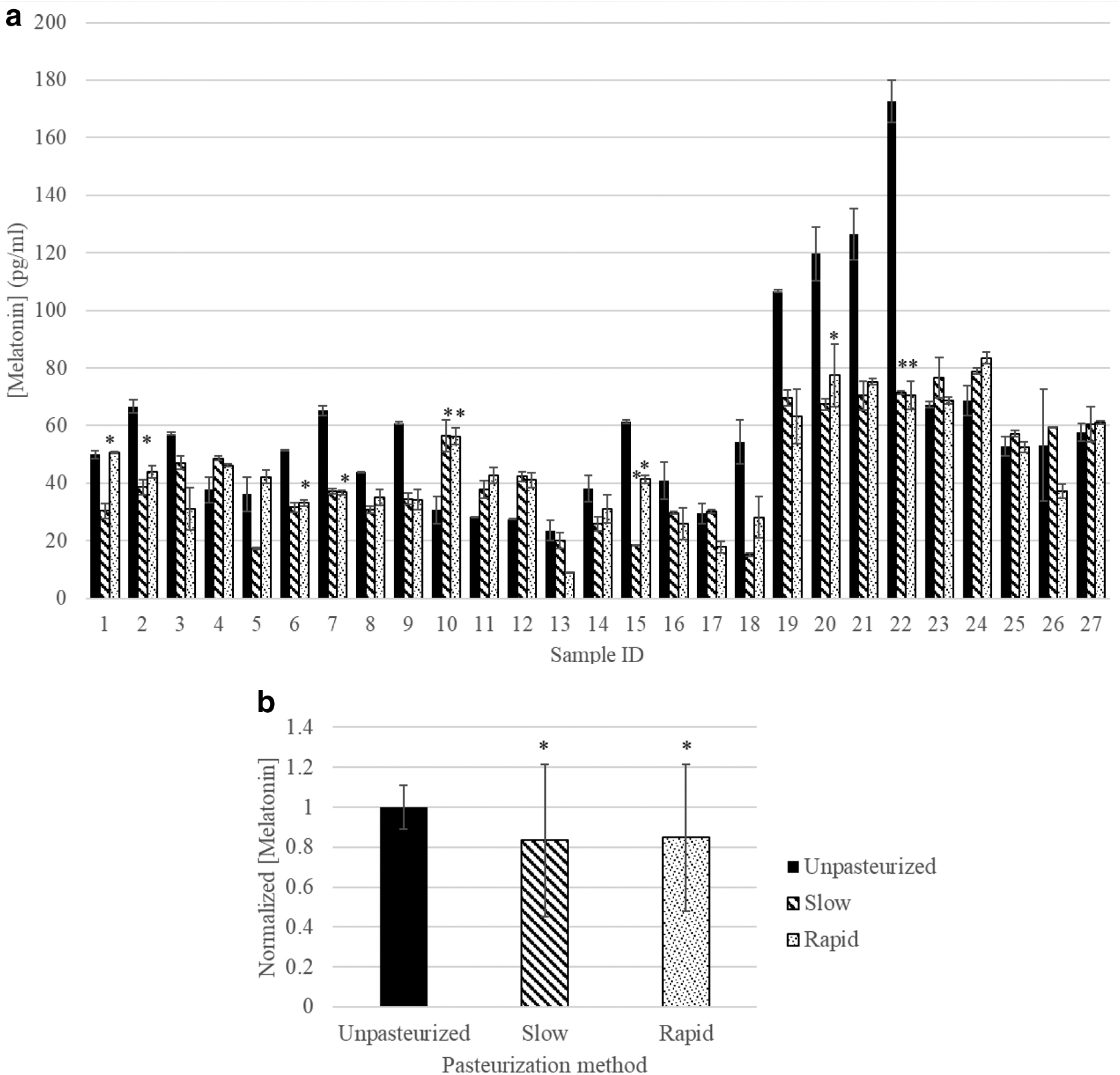
A total of 27 samples were analyzed. The results showed that there was varied basal melatonin levels in the unpasteurized breast milk samples across each sample, ranging from 23.47 to 172.60 pg/mL (mean ± standard deviation = 60.32 pg/mL ±34.38). Following pasteurization, the melatonin level range decreased to 15.23–78.94 pg/mL (mean ± standard deviation = 44.60 pg/mL ±19.62, p = 0.003), and 8.99–83.50 pg/mL (mean ± standard deviation = 45.78 pg/mL ±18.66, p = 0.004) for slow and rapid cooling, respectively. Figure 1a shows the individual variation. To compare the effect of pasteurization cooling methods across all 27 samples, each pasteurized sample, regardless of cooling method, was normalized to their unpasteurized control counterpart. The normalized unpasteurized sample averaged to 1 ± 0.11 pg/mL, with significant reduction observed for both the slow and rapid cooled pasteurized samples averaging 0.84 pg/mL ±0.38 (p = 0.039) and 0.8 pg/mL ±0.37 (p = 0.05), respectively. There was no significant difference observed between the slow and rapidly cooled pasteurized samples, p = 0.91. Figure 1b shows the unpasteurized samples normalized for each sample and related rapid and slow cooled samples.
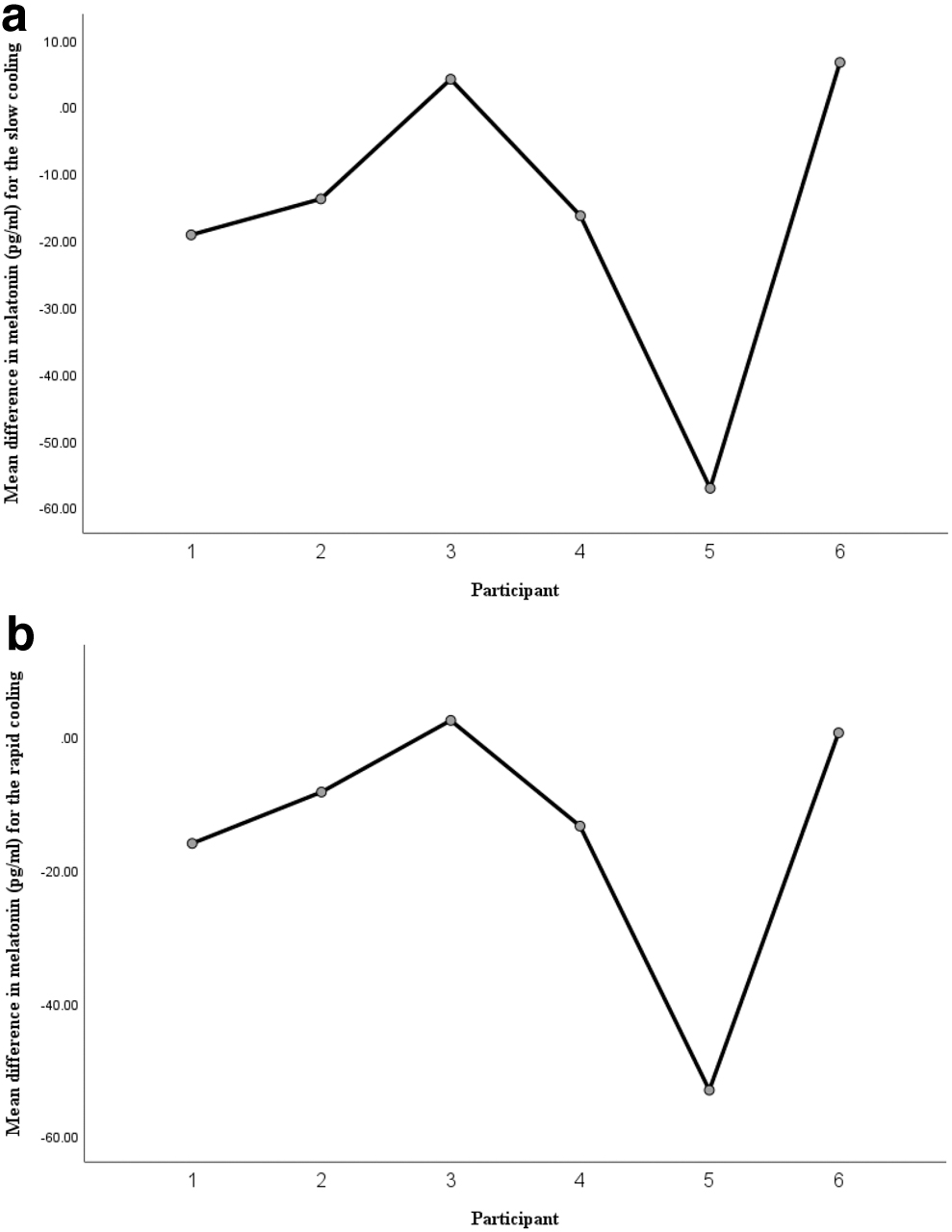
In regards to individual participants, there was also a significant variation in melatonin reduction between participants' samples (slow cooling, p < 0.001, rapid cooling, p = 0.001) (Fig. 2a, b).
Discussion
The findings from this study showed that there was a significant difference in melatonin levels between unpasteurized and pasteurized breast milk, regardless of whether it had been rapidly or slowly cooled. This finding supports the previous research by Booker et al., 10 that HoP significantly reduces melatonin in breast milk and is contrary to the findings of Chrustek et al. 11 who found no significant difference. The current study was conducted with a larger sample size than both those previous (10 and 18 samples, respectively10,11), helping to affirm the results. Additionally, all samples were collected during times of peak melatonin levels to allow for more robust results. 13
Even though the results showed a significant decrease in melatonin for both pasteurization groups, the amount of melatonin reduction varied immensely between samples and within the same participant. Our results showed that melatonin levels didn't decrease significantly when the levels were not relatively high to begin with. For example, one sample which had an unpasteurized melatonin level of 57.20 pg/mL remained relatively stable following slow (47.13 pg/mL) and rapidly cooled pasteurization (31.17 pg/mL). Whereas another sample had an unpasteurized melatonin level of 172.60 pg/mL which reduced significantly to 71.45 and 70.44 (p < 0.001) following slow and rapid cooling pasteurization, respectively. This suggests that there may be a threshold level of excess melatonin required before a subsequent reduction in melatonin levels due to pasteurization is observed. Liu et al. 14 have shown that there are at least 18 different interacting partners of melatonin comprising of receptors, enzymes, transporters, and other proteins. It may be that these interacting partners offer melatonin protection or temperature-resistant stability from that experienced during pasteurization. Thus, the only time melatonin levels are significantly reduced by pasteurization is when melatonin levels are high enough to begin with, saturating its interacting partners and providing free unprotected temperature sensitive/unstable melatonin to be degraded by pasteurization. This would only be possible at times when melatonin levels are at their peak, such as between the time points that we collected our samples.13,15 In addition, the reduction of melatonin between participants variety significantly, even though they collected samples at the sample time of day. A possible explanation for the variance in melatonin reduction requires further exploration but could be due to the diet over the 5 days of collection of the mothers. For instance, research on cow's milk has shown that different levels of fat content or vitamins may affect pasteurization nutrition.16,17 Furthermore, given the variety of targets Lui et al. 14 report melatonin to interact with factors that influence their production and availability may explain the variation of melatonin degradation observed across participants even though samples were collected during times reported to have peak melatonin levels. If Chrustek et al. 11 were working with samples outside of this timeframe, it might help explain the differences in the two studies results.
In addition, while the findings from this study showed that there was a significant reduction in melatonin levels after pasteurization, regardless of cooling rate melatonin was still present in both processes. What level of melatonin is considered clinically important in breast milk is difficult to ascertain; however, research looking at nighttime melatonin in serum across different ages found that infants during the first 6 months of life had low melatonin at around 27.3 ± 5.4 pg/mL but then dramatically increased between 1 and 3 years of age to 329.5 ± 42.0 pg/mL. 18 After pasteurization, our study still had a melatonin mean of ∼45 pg/mL (range ∼10–80 pg/mL). Therefore, it is recommended the donor banks still take into consideration circadian timing hormones, such as melatonin, in breast milk and the time-of-day breast milk is expressed. This is because research shows that breast milk, if consumed by the infant at a different time to when it was expressed (i.e., nighttime breast milk high in melatonin during the day time), it could potentially impact on their circadian rhythm and sleep patterns.19–21
This study helps to confirm that overall there is a reduction in melatonin after HoP, whether this is via slow or rapid cooling. However, there are some questions that remain. Even though within acceptable margin of error, some samples did slightly go up. Following extraction and evaporation, the Melatonin ELISA kit manufacturer instructs that samples need to be reconstituted by vortexing for at least 1 minute. In our experience, the samples needed at least 3 minutes of vortexing to fully reconstitute evaporated samples; otherwise, visible pellet remained on the side of the Eppindorf tube. While this timeframe is within the manufacturer's parameters, it was noted that when samples were tested following only 1-minute vortexing, the melatonin levels were significantly higher in post- versus prepasteurization. However, upon retest when samples were vortexed for 3 minutes the reverse was observed. Thus, differences between studies may be related to insufficient reconstitution of evaporated samples, even though they may have worked within the limits of the manufacturer's instructions. In addition, this study did not collect the age of the mother or infant. Due to the changes in fat content or nutritional composition during an infants development, this could potentially impact of the availability and deterioration of melatonin levels.
Conclusion
Melatonin is considered an important hormone that helps to support the neurodevelopment and sleep of infants, especially those born preterm. This study revealed that both rapid and cooling pasteurization processes had a similar reduction of melatonin levels in breast milk; however, even after pasteurization melatonin remained. Considering the growing evidence of research showing that giving breast milk high in melatonin at the wrong time of day could potentially interrupt an infant's circadian timing, it is recommended that donor banks still consider the time of day breast milk is expressed and the amount of melatonin present.
Footnotes
Acknowledgment
The team would like to thank all the mothers that took time out to participate in the study and to the team that volunteered their time.
Authors' Contributions
L.A.B., C.F., J.S., M.D-C., D.L.W., and T.C.S. were responsible for study design, data interpretation, and composing and editing the manuscript. L.A.B., C.F., T.C.S., and M.D-C. performed the analysis, and J.S., D.L.W., and T.C.S. contributed to the interpretation. All authors were involved in preparing the article. All authors approved the final article as submitted and agree to be accountable for all aspects of the work.
Disclosure Statement
No competing financial interests exist.
Funding Information
No funding was received for this article.