




Abstract
Background:
Exclusive breastfeeding is recommended through age 6 months, and 24.9% of all U.S. mothers, but only 19.8% of African American or Black (AA/B) mothers, achieved this goal (2020). Smartphone technology, specifically short message service (SMS or texting), may provide a strategy to reach and engage AA/B women who otherwise face barriers related to racism in accessing breastfeeding resources. Unfortunately, few mobile health applications are designed for AA/B women.
Methods:
We created a culturally sensitive breastfeeding promotion and support text message library that begins at 28 weeks prenatally and continues through 10 weeks postpartum. We tested feasibility and acceptability with a proof-of-concept (POC) trial that enrolled 20 AA/B women, and we tested content and perceived usefulness with a pilot study that enrolled 28 AA/B women.
Results:
In the POC trial, 95% of participants received all messages, demonstrating feasibility, and none requested fewer or to stop messages, demonstrating acceptability. In the pilot, >85% of participants responded positively regarding the number and helpfulness of the texts received, and whether the information was needed. Using a validated measure for online content for parents, >70% of POC and pilot study participants found that the information was very relevant or relevant, completely understandable, taught them something new, and “will help me improve the health or well-being of my child.”
Conclusion:
A new breastfeeding-supportive text messaging program intended for AA/B mothers appears feasible, acceptable, informative, and relevant. This is the first breastfeeding text messaging application of which we are aware that is tailored for the AA/B population.
Background
Exclusive breastfeeding through 6 months is recommended by professional bodies worldwide, with profound health benefits for mothers, infants, and society, yet this continues to be an elusive goal with profound racial inequities persisting.1–5 Nationally, 83.9% of all mothers but only 75.5% of African American or Black (AA/B) mothers initiate breastfeeding. 6 The HealthyPeople 2030 goal for 6 months of exclusive breastfeeding is 42.4%: as of 2020, 24.9% of all mothers but only 19.8% of AA/B mothers are achieving this goal. 7
These continuing racial inequities in breastfeeding rates reveal the need for new strategies to support and promote breastfeeding for AA/B mothers. Smartphone technology may provide a way to reach and engage AA/B women who otherwise face barriers related to racism, as well as to poverty, low health literacy, and other social determinants of health, in accessing breastfeeding resources. 8 Approximately 83% of all AA/Bs, 76% of those with income <$30,000, and 95–96% of those ages 18–49 years own a smartphone. 9 There is evidence that mobile health (m-health) applications including telephone support, short message service (SMS) text messaging, and internet-based support can increase rates of exclusive breastfeeding.10,11 The total number of studies that focused solely on breastfeeding-supportive SMS text messaging with or without telephone support is limited, and most m-health apps are not designed specifically for AA/B mothers.12–18
This gap in m-health products designed with a focus on AA/B women’s breastfeeding creates additional racial inequity; research is needed to overcome this barrier. In prior work, we elucidated topics and features that AA/B expectant women considering breastfeeding would like to see in a phone app, and SMS texting was endorsed. 19 The goal of this current research is to address a gap in breastfeeding support for AA/B women via development and testing of a culturally sensitive texting program focused on the needs of AA/B women.
Methods
Design
This was a prospective nonrandomized unblinded cohort study with the following three aims: first, to create a library of sequenced culturally sensitive text messages for dissemination from 28 weeks prenatally through 1 year postpartum; second, to test the feasibility of sending, and acceptability of receiving, breastfeeding-supportive text messages (proof-of-concept [POC] trial); and third, to evaluate the content and perceived usefulness of breastfeeding-supportive text messages from prenatal to postpartum periods (pilot study).
Conceptual basis
Development of the texting program was broadly modeled on the successful “Text4Baby” Mobile Health Messaging Program developed over a decade ago. 20 Text4baby was designed to reach expectant women living in high-poverty areas and low-income neighborhoods with actionable and engaging messages about maternal and infant health and safety, and evaluation has demonstrated its success in both reach and impact.21,22 The conceptual model for the current breastfeeding texting program (Fig. 1) is the “The Integrated Model for explaining motivational and behavioral change, or the I-CHANGE Model.” This approach is derived from the work of DeVries and colleagues and integrates other conceptual models of health behavior, including the work of Bandura on self-efficacy and Ajzen’s Theory of Planned Behavior.23–25 We postulate that although sociodemographic factors are relatively fixed, maternal attitudes toward breastfeeding and breastfeeding self-efficacy are malleable. and that the effect of social support and pressure with respect to breastfeeding can be influenced by sending informational messages to the mother. We hypothesized that each of these maternal domains, i.e., attitudes, self-efficacy, and support, may be impacted by breastfeeding-supportive text messages timed to arrive at points critical for decision-making and actions.
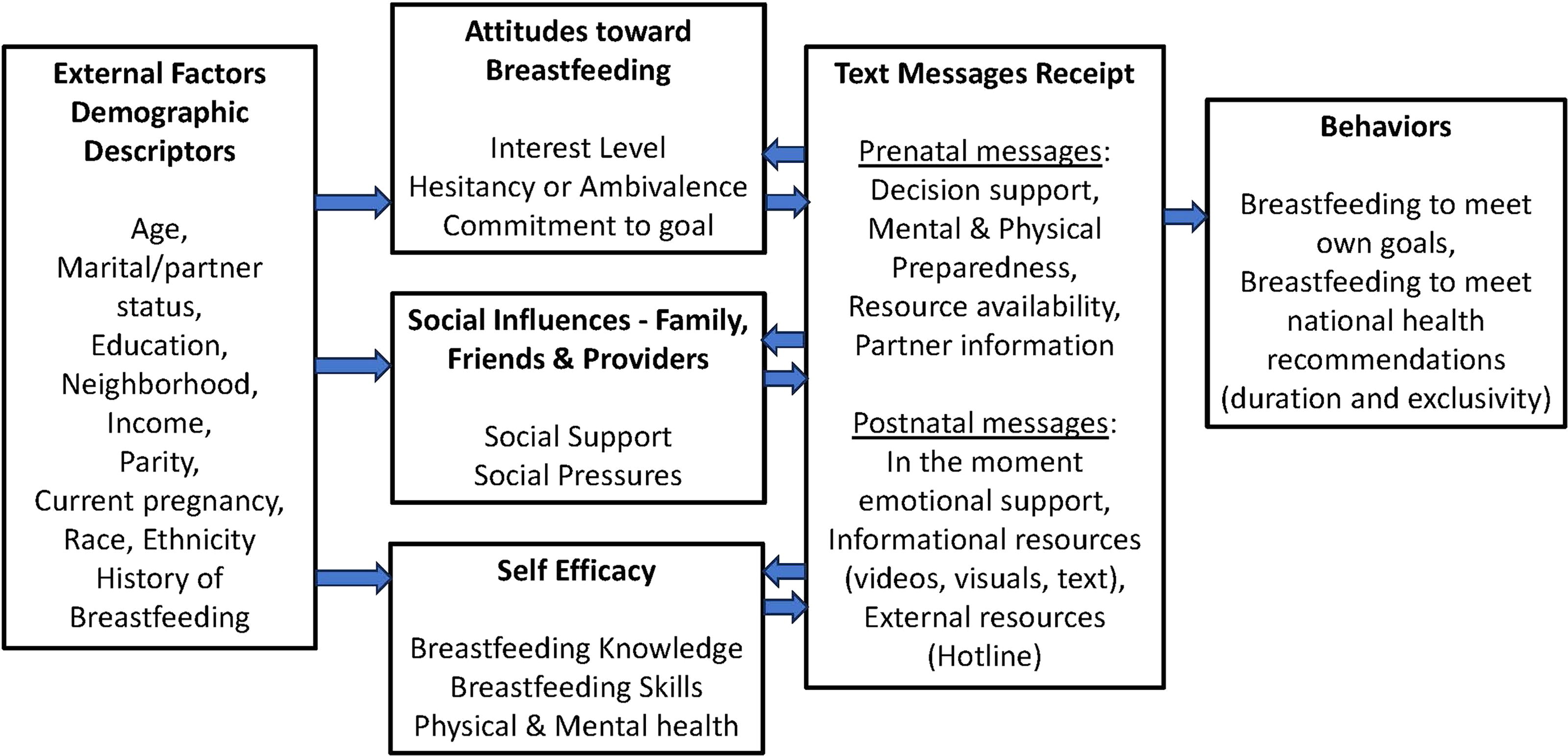
I-CHANGE model supporting texting development.
Population and setting
The primary population of interest is low-income expectant and delivered women who self-identify as AA/B with any interest in breastfeeding. The study was conducted at a free-standing urban inner-city outpatient center (Ahuja Midtown Center) that is connected with an academic tertiary care medical center and provides both obstetrical and pediatric services to the surrounding community; most families served are publicly insured. Women were eligible for the study if 18 years or older, self-identify as AA/B, speak English, had an infant feeding plan of “might or will breastfeed,” and had daily access to a mobile phone with text message capability.
In the POC trial, we aimed to enroll 10 women at 28–35 weeks gestation and 10 women either at 38–39 weeks gestation or at 1–7 days postpartum; for the pilot trial we aimed to enroll 30 women at 24–34 weeks gestation. Both groups had to meet general eligibility as described, and those who joined the POC trial were not eligible for the pilot. Women were recruited at the Ahuja Midtown Center in person by screening obstetrical schedules (expectant women) or pediatric schedules (delivered women) for eligible potential participants, followed by approach with permission of the treating provider. The study was approved by the University Hospitals Cleveland Medical Center Institutional Review Board, and informed consent was obtained from each participant in person.
Study interventions and conduct
The text message library was created using online and local resources following literature review, review of online resources including Coffective™, and consultation with lactation providers serving AA/B women.8,26–29 We followed recommended steps in creating and pretesting a text messaging program. 30 Message content and frequency were also based on prior work with stakeholders, in which expectant AA/B women were interviewed about the desirability of receiving motivational breastfeeding-supportive text messages (SMS by phone) during pregnancy and after delivery, their preferred message content and optimal message frequency. 19 In that preliminary work, most participants (n = 23, 77%) endorsed wanting representation (pictures or emojis of AA/Bs) which guided choices of materials, and 19 (66%) requested motivational messages, which were therefore included. The topics of greatest interest for “How-to information (short videos with URL or websites)” were, in order of interest, breastfeeding positions (29, 97%), how to use a breast pump (29, 97%), good latch (28, 93%), milk expression and storage (28, 93%), managing engorgement (26, 87%), and back to work (24, 80%). Participants (87% or more) additionally requested breastfeeding help phone numbers, links to learn if their medications were compatible with breastfeeding, and information about their legal rights for public breastfeeding and return to work. This work guided message content. The text message library includes three to four messages per timed interval: intervals varied from weekly (28 weeks gestation through delivery), to daily (delivery through 2 weeks postpartum), to weekly again (from 2 to 10 weeks postpartum), and then monthly to 1 year. Messages are largely unique and provided only once, although messages on certain requested topics such as breastfeeding positions were repeated an additional time. Example messages are provided in Table 1.
Examples of Timed Texts
Proof-of-concept study
The library was programmed into REDCap using Twilio to distribute SMS to participant phones. 31 Participants received 4 sequential weeks of messages, with intent for 10 to receive a prenatal message block and 10 to receive a postnatal message block. Participants were able at any time to “stop all” messages and unsubscribe or to “stop so many” messages and decrease to a single message per time point. Demographic information, weekly user experience surveys, and an end-of-study Information Assessment Method (IAM) for parents were administered via SMS from REDCap. 32 Participants were invited to complete a structured interview by phone at the end of the study participation. For those who did not respond to weekly surveys, or who did not respond to an interview request, study team members were able to call and make sure technical difficulties were not a barrier. For those who received postnatal messages, two survey questions about infant feeding were added to the weekly user experience survey to assess the feasibility of simultaneously collecting infant feeding information.
Pilot trial
Expectant participants began receiving text messages at 28 weeks or no later than 34 weeks gestation (if enrolled after 28 weeks) and continued through 10 weeks postpartum. Available options to “stop all” and “stop so many” were identical to the POC trial. Participants who delivered prior to 36 weeks gestation were excluded in the study because messages were not tailored for supporting breastfeeding among premature infants. All instruments and data collection time points were the same as those of the POC trial, except that the user experience survey was expanded to include a specific question about message helpfulness and to elicit participant opinion about specific messages, so content could be revised. Participants were asked to notify the study team when their baby was born so messages could switch from prenatal to postnatal; as a backup, the study team reviewed the daily delivery log due to lessons learned in the POC trial. Compensation was $5 per survey completed and $10 for the end-of-study interview for both the POC study and the pilot trial.
Measures and data collection
The demographic survey included basic identifiers for study contact, self-identified race and ethnicity, educational level, marital/partner status, parity, history of breastfeeding, and preferred time of day for messages. A record of texts sent was logged in the REDCap database; we could not determine via this hosting platform if messages were read; however, if the participant responded to a survey, this indicated the message was read since a survey link was embedded. All information was collected either via interview (by phone) or SMS survey.
The POC user experience survey was focused on acceptability and included the following questions: “The number of texts I received this week were” (Responses: too many/just right/too few); “The text messages shared information that was new to me” (Responses: Yes, definitely/somewhat/No, not at all); and “The text messages shared information that I needed” (Responses: Yes, definitely/somewhat/No, not at all). In the pilot, queries were added to evaluate usefulness and content: “The text messages shared information that was helpful to me for breastfeeding” (Responses: Yes, definitely/somewhat/No, not at all) and “I have feedback about a specific text message” which included branching logic to permit a detailed response (“If yes, which message?”—Free text box to type in message, “What should we know”: [Responses: I liked it/I did not like it/I thought it should be changed to (Free text box to type in message and “Why change it?”]).
The questions regarding infant feeding, “In the last 24 hours, my baby was ever breastfed or received breast milk (yes/no)” and “In the last 24 hours, my baby received other foods or milk than breast milk (Yes/No)” assess any and exclusive breastfeeding, respectively, over the past 24 hours.33,34 SMS has been shown to be a reliable and valid method of collecting infant feeding data, 35 and this exploratory outcome was intended to assess the feasibility of information collection in the study population.
The IAM for parents is a validated survey for parents that measures parent rating of internet-based parenting information. 32 The end of the study interview was an investigator-initiated survey to assess current infant feeding (pilot participants only), the relevance and content of messages, whether any information was missing, whether any bias was detected, and whether the participant would recommend the texting program to a friend.
Data analysis
A sample size calculation was not performed since this was a POC trial followed by a pilot. Quantitative data are described by means, percentages, ranges, and frequencies. Qualitative data were evaluated for relevance, and specific comments were used to improve messaging content.
Results
Proof-of-concept
Demographic description
Participant age was a mean of 22.7 years (standard deviation [SD], 3.2), all self-described as non-Hispanic Black, 18 (90%) were single/unmarried, 16 (80%) were high school graduates, 15 (75%) were primiparous, and all those who had prior children (5) had breastfed them.
Exposure
Thirteen participants were enrolled prenatally, of whom six received only prenatal texts and seven received both pre- and postnatal texts; seven participants were enrolled postnatally. One of these did not receive any texts because of a technical problem (did not enter her date of delivery and postpartum texts did not get activated). Of the 19 participants who did receive texts, the total number of breastfeeding message texts received by all participants was 507 (mean = 26.7 texts per participant; range, 13–37) over the 4-week study period. No participant chose to stop messages or receive fewer messages.
User experience survey
Of the 19 participants receiving texts, 15 participants completed at least one user experience survey, of whom 7 completed for all 4 weeks. Of 76 possible user experience surveys, 59% (45) were completed. With respect to the number of texts received, 98% (44/45 responses received) said the number of texts received was “just right” (versus too many or too few). Regarding whether the information was “new to me,” 51% (23/45 responses) said “yes, definitely,” whereas 49% (22/45) said “somewhat,” with none endorsing “no.” Finally, in response to whether the text messages “shared information that I needed,” 69% (29/42 responses) said “yes, definitely” and 31% (13/42) said “somewhat,” with none endorsing “no.”
Of 13 mothers who received postnatal texts, 9 provided 19 responses (range, 1–4) to the exploratory questions regarding infant feeding. One mother did not report giving any breast milk and five reported providing exclusively breast milk.
Information Assessment Method for parents
Ten of 19 eligible participants completed the IAM. The text message information was described as relevant and understandable, and each participant planned to use the information (Table 2).
User Experience Surveys—Pilot
Bold text indicates the most frequent response.
End-of-study interview
One participant completed the end of study structured interview. She described the texts as “really helpful,” did not have difficulty opening the messages, did not identify missing information, would recommend the texting program to family and friends, and, with respect to bias, endorsed that as a Black mother, she felt the messages related to her.
Pilot
Demographic description
Of 31 eligible and enrolled maternal participants, 2 delivered prematurely and were excluded from the study per protocol and 1 withdrew shortly after enrollment, leaving 28 participants. These women were a mean of 26.9 years old (SD, 5.2; range, 18–37 years), all self-identified as Black and 26 (93%) as non-Hispanic, 27 (96%) were single/unmarried, all were high school graduates or equivalent and 5 (19%) had some higher education, 22 (79%) had prior children of whom 16 (73%) had breastfed their children.
Exposure
Participants were enrolled prenatally from 24 through 34 weeks gestation (mean, 30.4 weeks [SD 2.9]) and each received a full set of text messages from 28 weeks gestational age (or from their enrollment if after 28 weeks) through 10 weeks postpartum without send failures. Participants received up to 41 prenatal breastfeeding message texts (mean 27.1 [SD 10.1] per participant) at 13 time points (weeks 28–40) and up to 47 (mean 40.5 [SD 6.4] per participant) postnatal breastfeeding messages at 20 time points. No participant chose to stop messages or receive fewer messages.
User experience survey
Of the 28 maternal participants, 5 did not respond to any user experience surveys. The 23 responding participants answered a mean of 6.1 (range, 1–12) of 13 possible prenatal surveys and a mean of 2 (range, 0–6) of 9 possible postnatal surveys. Including all participants, the survey response rate was 40% prenatally and 20% postnatally. Participants responded to four questions on a three-point Likert scale regarding the number of texts received, the helpfulness of the texts for breastfeeding, and whether the information was needed, with 85% or more responding positively (Table 2). Participants were invited at each user survey to comment on specific texts (like, dislike, suggest change): three participants liked five texts related to four topics (public breastfeeding, 2; a “great job” kudo, 1; supplies needed for breastfeeding, 1; and unknown content, 1), and 2 participants suggested additional information topics (partner support, 1; cigarette smoking while breastfeeding, 1). Of the 28 participants, 16 provided a total of 52 responses (mean = 3 per participant; 33% of possible postpartum feeding responses) to the exploratory questions regarding infant feeding.
Information Assessment Method for parents
In total, 4 of 28 eligible participants completed the IAM. The text message information was described as relevant and understandable, and each participant planned to use the information. All participants’ responses were positive to, “what do you think about the information,” including three endorsing being taught something new, and all endorsing, “expecting any benefit for you or your child” (Table 3).
Information Assessment Method-Parent—Combined Proof-of-Concept and Pilot
End-of-study interview
Four participants completed the end-of-study structured interview. In response to “Overall what did you think about the text messages?” the participants replied, “It was great, I loved getting them,” “Helpful, wish they sent more texts,” and “Helpful, seemed to get a text message that was something I had been thinking about . …” Regarding what was missing, two participants responded “nothing” and one requested more information on “Dads and postpartum issues.” Each responded that the information in the texts was “easy to understand” and that the number received was not overwhelming. Each would recommend the program to a friend, and none identified racial or other bias in the messaging.
Discussion
We were able to create a prenatal through postnatal breastfeeding-supportive text messaging library intended for AA/B mothers (Aim 1) and successfully conducted a 4-week POC study (Aim 2), followed by a pilot of the full program (Aim 3). Of the 20 AA/B mothers participating in the POC trial, 19 received all sent messages, demonstrating intervention feasibility, and none requested fewer messages or to stop messages, demonstrating acceptability. Of the 28 mothers participating in the pilot study, >85% of participants responded positively regarding the number of texts received, the helpfulness of the texts for breastfeeding, and whether the information was needed. Only two participants requested changes in message content; in both cases, for additional information. In participant responses to a validated measure for online content for parents, >70% from the POC and the pilot studies found that the information was very relevant or relevant, completely understandable, taught them something new, and “will help me improve the health or well-being of my child.” These results strongly support the perceived usefulness of the breastfeeding-supportive messages for the intended population of AA/B mothers.
Other studies have examined the effectiveness of text messaging to support breastfeeding, although none have focused on AA/B mothers in terms of content, cultural context, and representation. In Yangon, Myanmar, 353 literate pregnant women were randomized to maternal and child health care messages versus breastfeeding promotional text messages three times per week from 38 weeks of pregnancy through 6 months postpartum; those receiving breastfeeding-supportive messages were significantly more likely to exclusively breastfeed at each month postpartum through 6 months. 12 In Australia, 240 postpartum, predominantly “Anglo-Celtic,” well-educated women were randomized to a weekly breastfeeding query at weeks 0–8 postpartum versus usual care; at week 9 significantly more intervention women were exclusively breastfeeding. 13 In a very comparable trial in the United States, 300 postpartum women (52.8% AA/B) were similarly randomized, but no significant differences were found in exclusive breastfeeding at 6 weeks postpartum. 14 In Nagpur, India, 1,036 expectant women living in poverty and delivering at a baby-friendly hospital were randomized to hospital staff retraining only versus hospital staff retraining and daily infant feeding-supportive text messages with weekly lactation counselor phone calls from prenatally through 6 months; exclusive breastfeeding rates were significantly higher through 6 months in the intervention group. 15 In an internet-only based study, a U.S. study including 346 mainly well-educated Caucasian women randomized to attention control with injury prevention information versus daily breastfeeding-supportive messages from a breastfeeding app from 3 to 4 weeks before delivery through 3 months postpartum found that rates of breastfeeding exclusivity and duration did not differ between groups. 16 Although conducted in markedly different populations with a wide range of message frequency, content, timing, and duration, these studies are encouraging. Of note, international rather than U.S. studies were able to demonstrate changes in breastfeeding rates in response to texting programs. These and our results support the planned conduct of a larger trial of the current text messaging library for AA/B mothers.
The main study limitation was lower-than-expected responses to the weekly user experience surveys, with 59% completion in the POC study and an overall 29% completion rate in the pilot study. Higher rates of completion in the much shorter POC study suggest that participant response fatigue with weekly surveys may have been a factor. Because rates of completion in the pilot were higher prenatally (40%) than postnatally (20%), it is also likely that the challenges of day-to-day infant care were a factor. Although each survey was incentivized ($5), it is possible that participants did not consider the incentive attractive enough, and in future studies, other incentives (for example, diapers or diaper coupons) and larger dollar amounts with less frequent engagement contacts may be useful. Similarly, fewer than expected participants agreed to the end-of-study interview, and just 30% of participants completed the IAM-parents survey. It is therefore possible that results were biased in a positive direction if those who responded to interviews and surveys were more enthusiastic about the program than those who did not. However, even including those who did not respond to any surveys, no participant asked to stop all or “so many” text messages. Because message receipt could be verified for only those who responded to surveys, we speculate that continuing to receive messages suggested passive approval of the program and messages. Breastfeeding outcomes were not systematically measured, but this was not the primary study goal.
Strengths of the study include the study’s novel focus on supporting breastfeeding among AA/B mothers. Other breastfeeding-supportive texting programs have either enrolled predominantly non-AA/B women or those stratified by race only in a post hoc analysis, and these programs did not tailor content and representation to AA/B women.12–16 Additional study strengths are the inclusion of scheduled prenatal and postnatal messaging that may positively impact breastfeeding as part of a multilevel approach and the use of a validated survey for content assessment.29,36,37
Lessons learned relate to study conduct rather than the content of the text message library. Larger incentives and less frequent check-ins for data collection, along with built-in backup data collection methods such as phone outreach and chart review, will likely facilitate future work.
In conclusion a new breastfeeding-supportive text messaging program intended for AA/B mothers is feasible and acceptable, with content that participants found useful, informative, and relevant. To the best of our knowledge, this is the first breastfeeding text messaging application that is tailored for the AA/B population. Future directions include a clinical trial to test its effectiveness in promoting breastfeeding initiation, continuation, and exclusivity.
Footnotes
Acknowledgments
Thank you to Rebecca Baas of the Center for Child Health Policy (CCHP) for her administrative support, and to Mollie Evans also of CCHP for assistance with recruitment and enrollment. This work was supported by an Ohio Department of Health BH23 Innovations to Advance Breastfeeding and Health Equity grant to University Hospitals Cleveland Medical Center, Cleveland, OH.
Authors' Contributions
The study was conceptualized by L.F. and all authors contributed to study design. The texting library was created by L.F. and operationalized into REDCap and Twilio by S.R. S.M. and L.B. recruited and enrolled participants and conducted all study interviews and interventions. All authors contributed to study revisions and study data interpretation, and S.R. oversaw the data analysis. The first draft of the article was written by L.F. and reviewed by all authors with specific revisions by S.R.; all authors read and approved the final article.
Author Disclosure Statement
No competing financial interests exist.
Funding Information
The project work was conducted under an Ohio Department of Health Breastfeeding Equity Grant Bureau of Maternal, Child, and Family Health, BH23 Innovations to Advance Breastfeeding and Healthy Equity award to University Hospitals Cleveland Medical Center. Study data were collected and managed using REDCap electronic data capture tools hosted at University Hospitals and funded by a Clinical and Translational Science Award (CTSC)-UL1TR002548.
Ethical Approval
All procedures performed in studies involving human participants were in accordance with the ethical standards of the institutional and/or national research committee and with the 1964 Helsinki Declaration and its later amendments or comparable ethical standards. The study was approved by the Institutional Review Board (IRB) of University Hospitals Cleveland Medical Center.