




Abstract
Background:
The aim of this study is to determine the effect of music-assisted kangaroo care, applied to mothers with premature babies in the intensive care unit on the amount of breast milk, the initiation time of breastfeeding, and the level of anxiety.
Methods:
The study was carried out with mothers whose premature babies were hospitalized in the neonatal intensive care unit. The sample size of the study was 99 mothers.
Results:
85.5% of the mothers were aged >35 years, 30.1% were high school graduates, 38.6% had equal income and expenses and 77.1% had a cesarean section. The state and trait anxiety levels of the mothers in the music assisted kangaroo care (MAKC), kangaroo care (KC), and control (C) groups decreased after the first day according to the follow-up times. The trait anxiety levels of the mothers in the MAKC group experienced on the first and sixth days were lower than those of the mothers in the KC and C groups, with the statistically significant differences (p < 0.05). It was found that the mothers in the MAKC group started breastfeeding earlier than those in the KC and C groups, and the difference was statistically significant (p < 0.05).
Conclusion:
A significant difference was found between the MAKC and KC groups and the control group in terms of an increase in the amount of milk, a decrease in trait anxiety levels, and early initiation of breastfeeding (p < 0.05).
Introduction
The main causes of neonatal deaths include premature birth, low birth weight, infections, respiratory distress, asphyxia, congenital anomalies, and birth traumas. 1 Premature babies may not survive owing to immature respiratory, circulatory, musculoskeletal, immune, and gastrointestinal problems. 2 They cannot be directly breastfed since sucking and swallowing reflexes are not fully developed.3–5 For this reason, different pharmacological and nonpharmacological applications are employed to increase breast milk and maintain breastfeeding.6–8 The nonpharmacological applications used for the initiation of breast milk secretion and increasing the amount of milk include loving thoughts for the baby, skin-to-skin contact, music, oxytocin massage, meditation, breathing exercises, drinking herbal tea, and eating dates.9–11 Kangaroo care (KC) and music application, one of the nonpharmacological applications, is seen as an appropriate and safe, alternative method for initiating the mother–infant relationship in the early period for premature babies and breastfeeding the baby.12–14
While there is limited research in the literature on KC and music therapy applications, no study on the physical and psychological effects of music-assisted kangaroo care (MAKC) on mothers and babies has been found. For this reason, this study was conducted to determine the effect of MAKC applied to mothers with premature babies in the intensive care unit (ICU) on the amount of breast milk, the initiation time of breastfeeding, and the level of anxiety.
Methods
Type of the study
This is a randomized controlled trial.
The population and sample of the study
The study was carried out with mothers whose premature babies were hospitalized in the neonatal intensive care unit (NICU) of a private hospital between June 2022 and December 2022. The sample size of the study was calculated on the G*Power 3.1 software in a pilot study by evaluating the variance in scale values of three independent groups (MAKC, KC, and C). In the pilot study, the sample size was calculated as 90 mothers, including 30 in each group, based on an effect size of 0.34 (moderate), a significance level of 0.05 (type 1 error = 0.05), and a power value of 80%. Considering 10% attrition, 99 mothers were included in the study. However, the study was completed with a total of 83 mothers (MAKC: 30; KC: 29; C: 24). The Research Randomizer software was employed to determine the group of individuals meeting the sampling criteria.
Inclusion criteria
The study included mothers who were aged ≥18, had no physical barriers to visiting their baby in the hospital, had no psychological ailments, had given birth before 37 weeks of gestation, had no problems with breastfeeding, spoke Turkish, had no communication problems, and were literate.
Exclusion criteria
Mothers who did not comply with the 6-day long study program, lost their baby, or had already started breastfeeding, whose baby was referred to a different institution, or whose baby had a metabolic or physical disability that prevented breastfeeding were excluded from the study. Study data were reported according to the CONSORT protocol (Fig. 1).
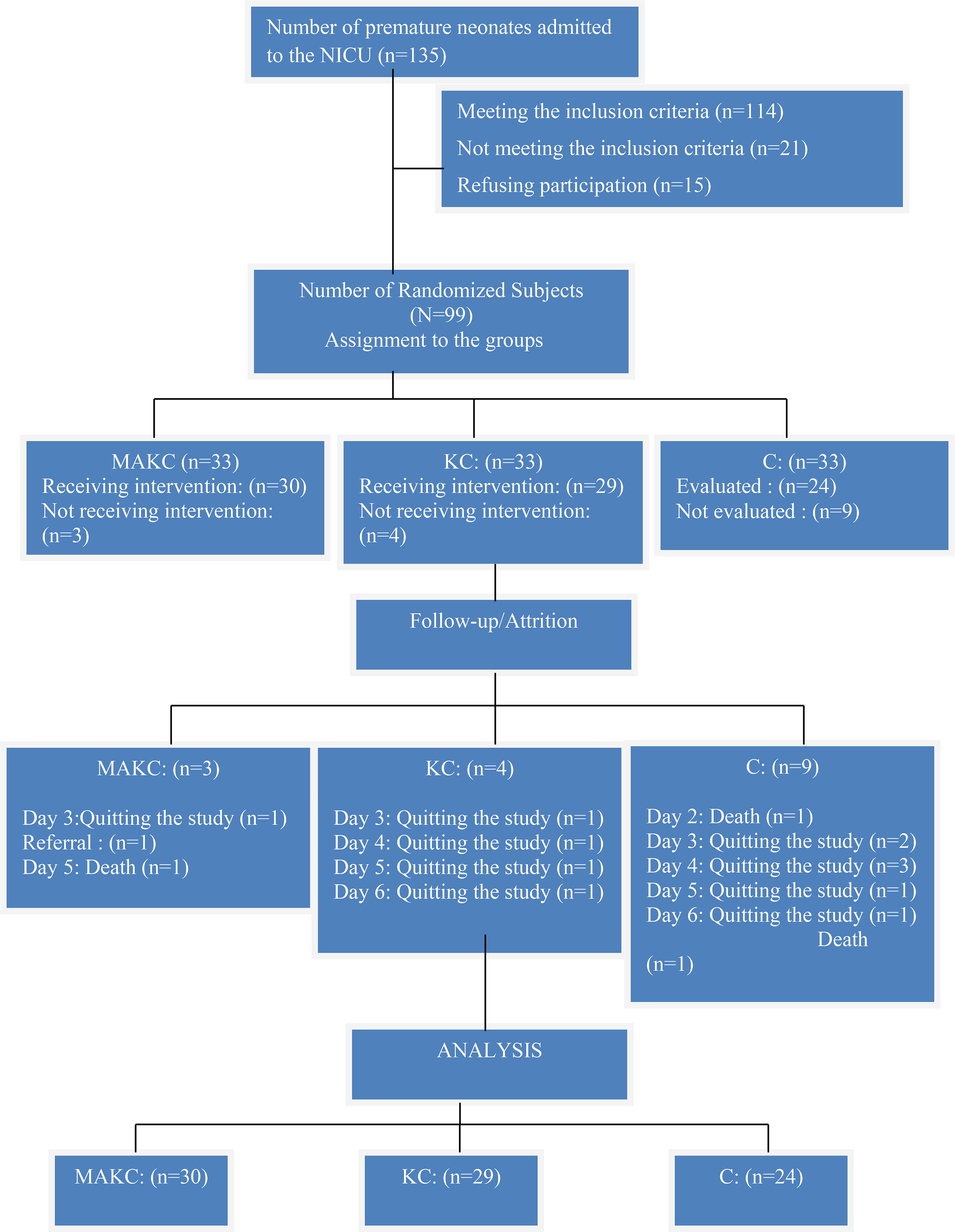
CONSORT flow chart.
Data collection tools
Study data were collected using three forms listed below.
Personal information form
This form was created by the researcher following a review of the literature. It consisted of nine questions about the socio-demographic and obstetric characteristics of the mother.
Form for recording breast milk supply
This form was used to record the amount of first expressed breast milk and the amount of breast milk expressed within 24 hours in milliliters.
Spielberger’s State-Trait Anxiety Inventory
This scale was developed by Spielberger et al. in 1970 to determine the level of anxiety experienced by people. The Turkish validity and reliability study of the scale was carried out by Öner and Le Compte in 1985, and the reliability coefficients of the inventory were found between 0.83 and 0.87 for the “Trait Anxiety Scale” and 0.94 and 0.96 for the “State Anxiety Scale”. The scale can be applied to individuals over the age of 14. It has two subscales. 15
Study flowchart by groups
Control group
The mothers received routine hospital care.
Kangaroo care/music-assisted kangaroo care
The mothers were given KC/MAKC as follows:
Day 1: Mothers were informed about the purpose and flow of the study, and then they signed a voluntary participation consent form. They filled out the personal information form during face-to-face interviews. After they were informed about the educational program, they were given individual interactive instruction accompanied by a PowerPoint presentation. The demonstration technique was used for teaching mothers breast milk expression with a machine and KC or MAKC practice. Then, they were asked to fill out the State and Trait Anxiety Inventory individually. After the mothers applied KC or MAKC for 30 minutes, they expressed breast milk with a pump, and the quantity was recorded in milliliters in the breast milk follow-up form.
Day 2-4-5: Mothers were taken to the NICU. After they applied KC or MAKC for 30 minutes, they expressed breast milk with a pump, and the quantity of the milk was recorded in milliliters in the breast milk follow-up form.
Days 3–6: Mothers were taken to NICU, and they applied KC or MAKC. They filled out the State Anxiety Inventory. They expressed breast milk with a pump, and the quantity of the milk was recorded.
Data analysis
Study data were analyzed on the SPSS for Windows 23.0 software package (IBM Corp. Armonk, NY: USA, Released 2014). The multivariate analysis of variance (ANOVA) in repeated measurements was used for intragroup comparisons in MAKC, KC, and C groups, and the LSD test was employed as a posthoc test. Intergroup evaluations were performed with the one-way ANOVA. LSD test was used as a posthoc test. The mean amount of milk in MAKC, KC, and C groups and the amount measured at different times were analyzed with multivariate ANOVA in repeated measurements. Descriptive statistics were presented using mean ± standard deviation values, and categorical variables were presented as counts and “%”. Chi-square was used to compare the percentage values of the groups. A value of p < 0.05 was considered statistically significant.
The ethical aspects of the study
The approval of the Ethics Committee of a private hospital (no: 1/1; date: 02.06.2022), the institutional permission of a private hospital (date: 25.07.2022), and voluntary written consent of the mothers were obtained.
Results
According to the findings, 85.5% of the mothers were aged >35 years, 30.1% were high-school graduates, 71.1% did not work, 94.0% had health insurance, 38.6% had equal income and expenses, 86.7% had a nuclear family, and 77.1% had a cesarean section. Statistical evaluations indicated that the difference between the groups in terms of mothers’ socio-demographic characteristics was insignificant (p > 0.05) (Table 1).
Distribution of Mothers’ Socio-Demographic Characteristics by Group
C, control group; KC, kangaroo care group; MAKC, music-assisted kangaroo care group.
The intergroup comparison of the amounts of the first expressed milk at repeated times indicated that the mean amount of milk of the mothers in the MAKC and KC groups expressed on the 3rd, 4th, and 6th days was significantly higher than that of the mothers in the C group (p < 0.05). The mean 24-hour total milk amounts of mothers in MAKC and KC groups expressed on the 3rd, 5th, and 6th days was significantly higher than that of the mothers in the C group (p < 0.05). According to the test results performed at repeated times within the group, the “amount of milk” measured in the 6 days showed a statistically significant difference (p < 0.05) between the groups in terms of the amount of the first expressed milk and the total amount of milk expressed in 24 hours (Table 2).
Distribution of Mean Daily and 24-Hour Total Milk Amounts by Groups According to Mothers’ Follow-Up Times
p1: one-way ANOVA (intergroup comparison). Each different letter indicated by superscripts (a.b.c) in the rows shows statistical significance according to the LSD posthoc test (b > a).
p2: one-way ANOVA (intergroup comparison). It shows statistical significance according to the LSD posthoc test.
ANOVA, analysis of variance; C, control group; KC, kangaroo care group; MAKC, music-assisted kangaroo care group; SD, standard deviation.
The state and trait anxiety levels of the mothers in the MAKC, KC, and C groups decreased after the 1st day according to the follow-up times. State anxiety level was similar in MAKC, KC, and C groups, and there was no statistical difference (p > 0.05). The trait anxiety levels of the mothers in the MAKC group experienced on the 1st and 6th days were lower than those of the mothers in the KC and C groups, and the difference was statistically significant (p < 0.05) (Table 3).
Percentage Distribution of the State and Trait Anxiety Levels in Groups According to Mothers’ Follow-Up Times
C, control group; KC, kangaroo care group; MAKC, music-assisted kangaroo care group; p, chi-square.
Considering the average initiation time of breastfeeding, it was found that the mothers in the MAKC group started breastfeeding earlier than those in the KC and C groups, and the difference was statistically significant (p < 0.05) (Table 4).
Distribution of the Initiation Time of Breastfeeding by Group
Each different letter indicated by a superscript (a.b.c) in the rows shows statistical significance according to the LSD posthoc test (b > a).
The p value was obtained from the Kruskal–Wallis test.
C, control group; KC, kangaroo care group; MAKC, music-assisted kangaroo care group; SD, standard deviation.
Discussion
Since premature babies cannot suckle on the breast, they may experience health and nutrition problems. Various nonpharmacological methods, such as skin-to-skin contact, oxytocin massage, listening to music, meditation, breathing exercises, and consumption of foods that increase milk, can be preferred for the solution of breastfeeding problems.9,11,12 Although there are studies in the literature on the positive effects of KC and music therapy as separate methods on premature babies and maternal health, 16 there is no study in which both methods are used together. Therefore, this study was conducted to examine the effects of KC and MAKC on the amount of breast milk, the initiation time of breastfeeding, and the anxiety level of mothers.
Mothers who cannot adequately contact their babies and breastfeed them directly in NICU experience stress and anxiety, and this situation negatively affects the amount of breast milk and the time when they start breastfeeding directly.17,18 Some studies indicated that only music therapy2,8,19 or KC12,16,20 increased the amount of breast milk. Similar results were obtained in this study, too. The amount of first expressed milk on the 3rd, 4th, and 6th days was higher in MAKC and KC groups than in the C group. Also, the total amount of milk expressed in 24 hours increased statistically on the 3rd, 4th, 5th, and 6th days in MAKC and KC groups compared with the C group (p < 0.05). However, it was found that the MAKC application did not increase the amount of milk more than the KC application (p > 0.05) (Table 2). This may have been because a standard piece of music was used instead of the mothers’ choice. In this context, it can be said that there is a need for studies that include music therapy applications according to the preferences of mothers along with KC to increase breast milk.
In studies on the examination effects of KC12,20 and music therapy7,19 on the amount of breast milk, it was determined that breast milk increased significantly, especially on the 3rd postpartum day. Similarly, it was determined in our study that the difference in the increase in the amount of milk took place especially after the 3rd day. In our study and other studies, most of the mothers had a cesarean section (Table 1), and limited mother–infant interaction caused stress in mothers and neonates, which may have played a role. Some studies indicated that breast milk production occurred at a later time in mothers who had a cesarean section than in those who gave vaginal birth.21,22
Premature babies have undeveloped sucking and swallowing reflexes, their systems are immature, and they have no or very limited contact with their mother, all of which adversely affect the first breastfeeding time. 23 A study showed that premature babies who received KC started sucking on the breast earlier (2.4–2.6 days) than babies in the control group.3,24 In our study, mothers in the MAKC group started breastfeeding earlier than the mothers in the KC and C groups, and the difference between the groups was statistically significant (p < 0.05). Those in the MAKC group started breastfeeding 3.5 days before the control group and 2.5 days before the mothers in the KC group (p < 0.05). In addition, mothers in the KC group started breastfeeding 0.9 days earlier than the mothers in the C group; however, the difference was statistically insignificant (p > 0.05) (Table 4). These results are significant in terms of showing that MAKC positively affects the early initiation of breastfeeding. No studies about the effect of music therapy on the initiation time of breastfeeding have been found in the literature. However, in studies where music therapy was applied, discharge times were analyzed, and it was determined that music therapy was effective in early discharge. 7 Therefore, this result shows that there is a need for different studies on the effect of MAKC on the initiation time of breastfeeding.
One of the most important factors affecting mother’s milk production and the initiation time of breastfeeding is the stress that mothers experience after birth. Prolactin and oxytocin hormones, which are especially effective in milk production and release, are suppressed under stress.16,25,26 The hormone oxytocin, which is critical for the release of the produced milk from the milk ducts, increases as the mother breastfeeds or expresses milk and the baby approaches the mother’s breast and touches it and the nipple.26–28 Some studies indicated that music therapy8,19,29 and KC16,30 were effective in increasing breast milk and reducing mothers’ anxiety levels. In this study, it was determined that the level of state anxiety experienced by the mothers decreased over time, but this decrease was not significant enough to reveal a statistical difference between the groups (p > 0.05). In addition, it was determined that the trait anxiety of the mothers who practiced MAKC and KC was lower (p < 0.05) than the trait anxiety experienced by the mothers in the C group (Table 3). This result may have been affected owing to different scales that were used to measure mothers’ anxiety levels in other studies, and the different institutions where the studies were conducted. On the other hand, our study was conducted in a private hospital and the mothers had easy access to information about the health status of their babies, which may have affected the results positively.
Conclusion
According to the results of our study, MAKC application has positive effects on increasing the amount of breast milk, reducing the level of trait anxiety, and starting early breastfeeding. It is recommended that every mother should be provided with an environment where they will only see and care for their baby (MAKC/KC) by offering them education and counseling about the ICU, they should be given education about continuing the MAKC application, relevant institutions and organizations should be collaborated to increase the effective use of the MAKC application in NICUs, and that more studies on the application of MAKC to mothers of premature and nonpremature babies should be conducted.
Footnotes
Acknowledgments
We are grateful to the mothers who agreed to participate in the study. We would like to thank the thesis follow-up jury and our instructors who helped with the preparation of the education program content.
Authors’ Contributions
E.B.: Idea, data collection, and literature review. E.B. and K.E.: Design, spelling, and critical review.
Disclosure Statement
There is no conflict of interest between the authors.
Funding Information
The authors received no financial support for the research and the writing and publication of this article.