




Abstract
Objective:
Breastfeeding, depending on its duration, has been suggested to benefit children’s cognitive development. We aimed to examine this issue by using the Japan Environment and Children’s Study, a nationwide prospective birth cohort study.
Methods:
We evaluated the relationship between feeding methods and cognitive development in 2- and 4-year-old children. We classified the children based on the following feeding method during the first 6 months postpartum: (1) exclusive breastfeeding group, solely breastfeeding; (2) partial breastfeeding group, solely breastfeeding for ≤5 months and combination of breastfeeding/formula for the rest of months; (3) formula-fed group, solely formula feeding for ≥4 months; and (4) others. Cognitive development was assessed by trained testers using the Kyoto Scale of Psychological Development 2001.
Results:
Data on 1,329 boys and 1,398 girls were analyzed. Multiple regression analysis was performed using the exclusive breastfeeding group as the reference. Boys of age 2 years in the formula-fed group had significantly lower developmental quotients (DQs) in the language-social developmental (L-S) area (partial regression coefficient [B]: −4.624, p = 0.01), whereas no significant difference was observed in those of age 4 years. Girls of age 2 and 4 years in the formula-fed group had significantly lower L-S area DQ (B: −3.637, p = 0.03 and B: −3.414, p = 0.03, respectively). In the partial breastfeeding group, no significant differences in the L-S area DQ were observed in 2- and 4-year-old boys and girls.
Conclusions:
Exclusive breastfeeding for the first 6 months postpartum may be more beneficial for verbal cognitive development in 4-year-old girls than solely formula feeding for ≥4 months. Furthermore, breastfeeding combined with formula for the first 6 months postpartum may not have a disadvantage on cognitive development in boys and girls of age ≥ 2 years, when compared with that observed with exclusive breastfeeding during the first 6 months postpartum.
Introduction
According to evidence-based meta-analyses and systematic reviews, the World Health Organization recommends exclusive breastfeeding for longer than the first 6 months.1–3 Depending on its duration, breastfeeding, especially exclusive breastfeeding, has been suggested to benefit children’s cognitive development.4–7 However, the data on which this notion is based did not include Japanese studies. Furthermore, it has been suggested that the benefits of breastfeeding vary by country, including differences between developing and developed countries.2,6,7
In the present study, we used the Japan Environment and Children’s Study (JECS) to examine whether exclusive breastfeeding for the first 6 months benefits children’s cognitive development more than other feeding methods in Japan.8,9 The JECS is a nationwide prospective birth cohort study in which children’s cognitive development was objectively assessed by trained testers in the Sub-Cohort Study. 10 Previous foreign studies reported that the benefits of breastfeeding varied according to the trajectories of children’s age. However, few studies have examined the sexes separately. Therefore, this study evaluated 2- and 4-year-old children and sexes separately.
Materials and Methods
Design and participants
The JECS protocol was conducted in accordance with the guidelines of the Declaration of Helsinki. The study was reviewed and approved by the Ministry of the Environment’s Institutional Review Board on Epidemiological Studies (No. 100910001) and the Ethics Committees of all the participating institutions. JECS recruitment occurred between January 2011 and March 2014 and included pregnant women nationwide.8,9 Participants were recruited from 15 Regional Centers located in Hokkaido, Miyagi, Fukushima, Chiba, Kanagawa, Koshin, Toyama, Aichi, Kyoto, Osaka, Hyogo, Tottori, Kochi, Fukuoka, and South Kyushu/Okinawa. Written informed consent was obtained from all the participants. Participants of the Sub-Cohort Study, comprising 5% of the participating children who were randomly selected and met the eligibility criteria, were extracted from the JECS. 10 For this Sub-Cohort Study, extended outcome measurements were planned, comprising face-to-face interviews with specialized staff to evaluate neurological development based on the Kyoto Scale of Psychological Development 2001 (KSPD) for 2- and 4-year-old children.11–16
The present study used the jecs-ta-20190930 ver008 and the jecs-qa-20210401 ver005 datasets. The datasets contain the cognitive developmental results of 2- and 4-year-old children based on the KSPD. Data from 2- and 4-year-old children were matched to compare relative changes. Considering this study included children from singleton pregnancies, multiple-birth children were excluded. Preterm-born children (delivered at <37 weeks of pregnancy) and those with any congenital anomalies were also excluded. 17 Only children who met the requirements of this study at ages 2 and 4 years were included.
Feeding method
Self-administered questionnaires were used to estimate the maternal feeding method for children at approximately the first 6 months postpartum.
We classified participants into four groups based on feeding method during the first 6 months postpartum: (1) exclusive breastfeeding group, solely breastfeeding for 6 months; (2) partial breastfeeding group, solely breastfeeding for ≤5 months and combination of breastfeeding and formula for the rest of months, including combination of breastfeeding and formula for 6 months; (3) formula-fed group, solely formula feeding for ≥4 months—this group includes the following cases: solely formula feeding for 6 months or either solely breastfeeding or combining breastfeeding and formula for the first 1 or 2 months postpartum and solely formula for the later months; and (4) other group, participants who did not meet the conditions mentioned in the aforementioned three groups (Tables 1 and 2).
The Characteristics of Participants (Total = 2,727)
Exclusive breastfeeding group: solely breastfeeding for 6 months. Partial breastfeeding group: solely breastfeeding for ≤5 months and combination of breastfeeding and formula for the rest of months. Formula-fed group: solely formula feeding for ≥4 months. Other group: participants who did not meet the conditions mentioned in the aforementioned three groups.
SD, standard deviation; IPV, intimate partner violence; EPDS, Edinburgh Postnatal Depression Scale; MIBS, Mother–Infant Bonding Scale; KSPD, Kyoto scale of psychological development 2001; C-A, cognitive-adaptive; L-S, language-social; DQ, developmental quotient.
Feeding Method Status Detail During the First 6 Months Postpartum (Total = 2,727)
Exclusive breastfeeding group: solely breastfeeding for 6 months.
Partial breastfeeding group: solely breastfeeding for ≤5 months and combination of breastfeeding and formula for the rest of months, including combination of breastfeeding and formula for 6 months.
Formula-fed group: solely formula feeding for ≥4 months. This group includes the following cases: solely formula feeding for 6 months or either solely breastfeeding or combining breastfeeding and formula for the first 1 or 2 months postpartum and solely formula for the later months.
Other group: participants who did not meet the conditions mentioned in the aforementioned three groups.
b, breastfeeding; b&f, combination of breastfeeding and formula-fed; f, formula-fed.
The reasons for including a formula-fed group were (1) the small number of children included in the “solely formula for 6 months” and “either solely breastfeeding or combination of breastfeeding and formula for the first 1 or 2 months postpartum and solely formula for the later months” groups (Table 2); and (2) in Japan, employers are prohibited by law from allowing women to work during the first 8 weeks postpartum. 18 Therefore, we assumed that mothers who return to work after approximately the first 2 months postpartum may have to select an exclusive formula for the remaining 4 months.
Cognitive development in 2- and 4-year-old children
The KSPD, a standardized developmental assessment tool for Japanese children, covers the cognitive-adaptive (C-A) and language-social (L-S) areas of development.11–16 The C-A and L-S areas correspond to nonverbal and verbal cognitive development, respectively. Scores were combined to form the developmental quotient (DQ), calculated (in days) by dividing the developmental age in days by the chronological age and multiplying by 100. Administrative procedures and evaluations were strictly standardized to ensure tester reliability in this survey. The testers received rigorous training before being certified to conduct the testing to ensure the administration’s reliability. The testers were certified by the JECS.
Statistical analysis and covariables
We compared feeding methods and children’s cognitive development using an analysis of variance (ANOVA). Bivariate and multiple regression analyses were used to assess the association between feeding methods and children’s cognitive development.
The multiple regression analyses were adjusted for maternal age at delivery, whether the pregnancy was unplanned, use of infertility treatment, marital status, highest level of education (maternal and paternal), smoking during pregnancy (maternal and paternal), maternal alcohol consumption during pregnancy, annual household income, whether the mother had any neuropsychiatric disorders, psychoactive drug use during pregnancy, psychological intimate partner violence during pregnancy, physical intimate partner violence during pregnancy, maternal depression symptoms (Edinburgh Postnatal Depression Scale ≥9) at 6 months postpartum,19,20 maternal bonding failure (Mother–Infant Bonding Scale scores ≥5) at 1 year postpartum,21,22 whether pregnancy complications occurred, whether obstetric labor complications occurred, mode of delivery, children’s birth weight, gestational week of delivery, family structure, number of siblings (including the participant), children’s age at beginning attendance at a daycare center, location of the Regional Center, and children’s sex for overall. These confounding factors were based on previous studies. 6 No multicollinearity was observed in the analysis. For reference, parity and the number of children were multicollinear.
All analyses were performed using SAS statistical software (version 9.4; SAS Institute Inc.).
Results
Overview
Of the 104,059 records in the dataset, those of 2,727 children from singleton pregnancies without preterm birth (delivery of <37 weeks of pregnancy) and congenital anomalies who had undergone evaluation using the KSPD at ages 2 and 4 years were analyzed (Fig. 1). Table 1 shows the participants’ characteristics. In total, there were 1,329 boys and 1,398 girls. Overall, 1,240 (45.5%) participants were included in the exclusive breastfeeding group, 1,111 (40.7%) in the partial breastfeeding group, 179 (6.6%) in the formula-fed group, and 197 (7.2%) in the other group. Table 2 shows the details of the participants’ feeding method status during the first 6 months postpartum. Table 3 shows the results of the one-way ANOVA for feeding methods and children’s KSPD scores. Table 4 shows bivariate analysis results for feeding methods and children’s KSPD scores.
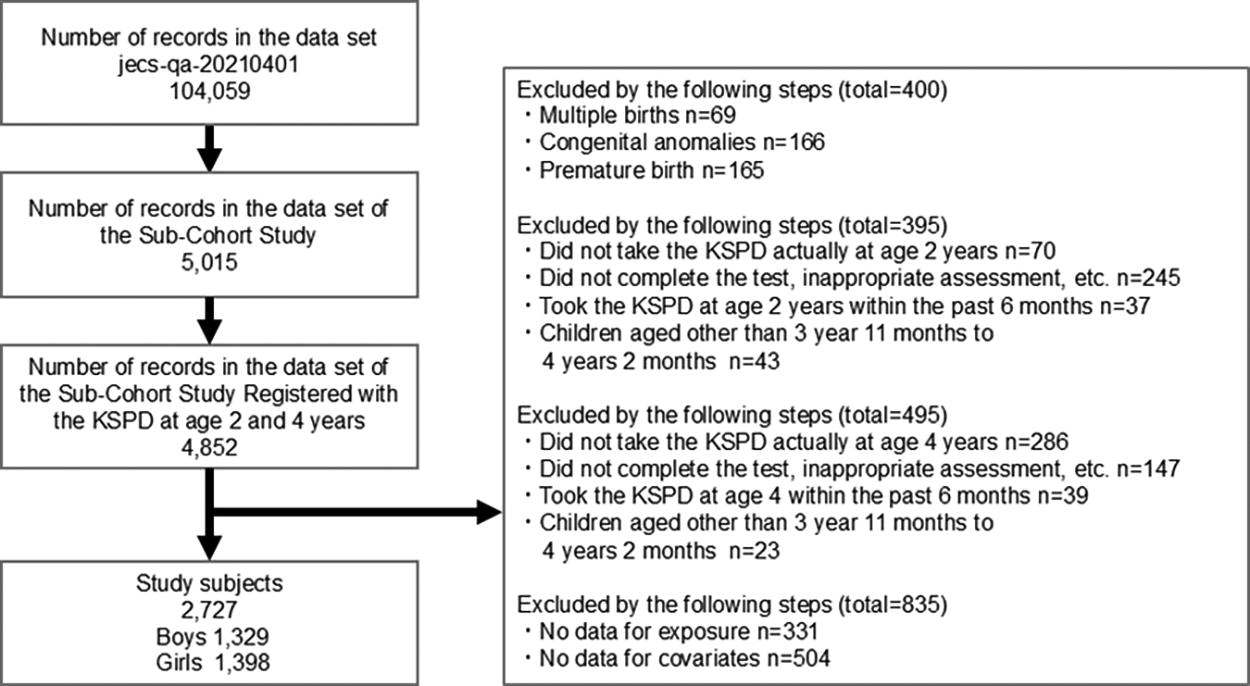
Flow chart depicting research participants’ selection. KSPD, Kyoto Scale of Psychological Development 2001.
ANOVA of Feeding Method for the First 6 Months Postpartum and KSPD at Age 2 and 4 Years
Exclusive breastfeeding group: solely breastfeeding for 6 months. Partial breastfeeding group: solely breastfeeding for ≤5 months and combination of breastfeeding and formula for the rest of months. Formula-fed group: solely formula feeding for ≥4 months. Other group: participants who did not meet the conditions mentioned in the aforementioned three groups.
ANOVA, analysis of variance; KSPD, Kyoto Scale of Psychological Development 2001; SD, standard deviation; DQ, developmental quotient; C-A, cognitive-adaptive; L-S, language-social.
Bivariate Analysis of Feeding Method for the First 6 Months Postpartum and KSPD at Ages 2 and 4 Years
Exclusive breastfeeding group: solely breastfeeding for 6 months. Partial breastfeeding group: solely breastfeeding for ≤5 months and combination of breastfeeding and formula for the rest of months. Formula-fed group: solely formula feeding for ≥4 months. Other group: participants who did not meet the conditions mentioned in the aforementioned three groups.
KSPD, Kyoto Scale of Psychological Development 2001; DQ, developmental quotient; C-A, cognitive-adaptive; L-S, language-social; SD, standard deviation; B, partial regression coefficient; CI, confidence interval; β, standardized partial regression coefficients; VIF, variance inflation factor.
Boys of age 2 years
Multiple regression analysis showed that boys of age 2 years in the formula-fed group had significantly lower L-S DQ scores (partial regression coefficient [B]: −4.624, 95% confidence interval [CI]: −8.005 to −1.243, β: −0.076, p = 0.01) than those in the exclusive breastfeeding group (Table 5). However, partial feeding and other groups did not significantly differ from the exclusive breastfeeding group in L-S DQ scores (Table 5). All groups did not significantly differ from the exclusive breastfeeding group in C-A DQ scores.
Multiple Regression Analysis of Feeding Method for the First 6 Months Postpartum and KSPD at Ages 2 and 4 Years
Adjusted for age of mother at the delivery, unplanned pregnancy, infertility treatment, marital status, maternal highest level of education, paternal highest level of education, maternal smoking during pregnancy, paternal smoking during pregnancy, maternal alcohol consumption during pregnancy, annual household income, maternal neuropsychiatric disorders, psychoactive drug use during pregnancy, psychological intimate partner violence during pregnancy, physical intimate partner violence during pregnancy, depression symptoms (Edinburgh Postnatal Depression Scale scores ≥9) at postpartum 6 months, bonding failure (Mother, Infant Bonding Scale scores ≥5) at postpartum 1 year, pregnancy complications, obstetric labor complications, mode of delivery, birth weight of children, family structure, number of children included participant, attendance age of daycare center at age 2 years (for C-A, L-S DQ at age 2 years), attendance age of daycare center at age 4 years (for C-A, L-S DQ at age 4 years), location of the Regional Center, and sex of children for overall.
Exclusive breastfeeding group: solely breastfeeding for 6 months. Partial breastfeeding group: solely breastfeeding for ≤5 months and combination of breastfeeding and formula for the rest of months. Formula-fed group: solely formula feeding for ≥4 months. Other group: participants who did not meet the conditions mentioned in the aforementioned three groups.
KSPD, Kyoto Scale of Psychological Development 2001; DQ, developmental quotient; C-A, cognitive-adaptive; L-S, language-social; B, partial regression coefficient; CI, confidence interval; β, standardized partial regression coefficients; VIF, variance inflation factor.
Boys of age 4 years
Multiple regression analysis showed that boys of age 4 years in the formula-fed group did not have significantly lower L-S DQ scores than those in the exclusive breastfeeding group (Table 5). The partial feeding and other groups did not significantly differ from the exclusive breastfeeding group in L-S DQ scores (Table 5). All groups did not significantly differ from the exclusive breastfeeding group in C-A DQ scores.
Girls of age 2 years
Multiple regression analysis showed that girls of age 2 years in the formula-fed group had significantly lower L-S DQ scores (B: −3.637, 95% CI: −6.838 to −0.435, β: −0.064, p = 0.03) than those in the exclusive breastfeeding group (Table 5). The partial feeding and other groups did not significantly differ from the exclusive breastfeeding group in L-S DQ scores (Table 5). All groups did not significantly differ from the exclusive breastfeeding group in C-A DQ scores.
Girls of age 4 years
Multiple regression analysis showed that girls of age 4 years in the formula-fed group had significantly lower L-S DQ scores (B: −3.414, 95% CI: −6.540 to −0.288, β: −0.059, p = 0.03) than those in the exclusive breastfeeding group (Table 5). The partial feeding and other groups did not significantly differ from the exclusive breastfeeding group in L-S DQ scores (Table 5). All groups did not significantly differ from the exclusive breastfeeding group in C-A DQ scores.
Overall participants of age 2 years
Multiple regression analysis showed that the formula-fed group (overall participants of age 2 years) had significantly lower L-S DQ scores (B: −4.037, 95% CI: −6.342 to −1.732, β: −0.068, p = 0.001) than the exclusive breastfeeding group (Table 5). The partial feeding and other groups did not significantly differ from the exclusive breastfeeding group in L-S DQ scores (Table 5). All groups did not significantly differ from the exclusive breastfeeding group in C-A DQ scores.
Overall participants of age 4 years
Multiple regression analysis showed that the formula-fed group (overall participants of age 4 years) did not have significantly lower L-S DQ scores than the exclusive breastfeeding group (Table 5). The partial feeding and other groups did not significantly differ from the exclusive breastfeeding group in L-S DQ scores (Table 5). All groups did not significantly differ from the exclusive breastfeeding group in C-A DQ scores.
Discussion
This study suggests that exclusive breastfeeding for the first 6 months postpartum may be more beneficial for verbal cognitive development in 2- and 4-year-old girls than solely formula feeding for ≥4 months. In contrast, exclusive breastfeeding for the first 6 months postpartum may benefit verbal cognitive development in 2-year-old boys than solely formula feeding for ≥4 months; however, no significant benefit was found in 4-year-old boys.
Notably, cognitive development in any area did not differ between the partial and exclusive breastfeeding groups, regardless of age. This indicates that breastfeeding combined with formula for the first 6 months postpartum may not have a disadvantage on cognitive development in boys and girls of age ≥ 2 years compared with exclusive breastfeeding during the first 6 months postpartum.
Regarding exclusive or any other breastfeeding method, previous studies from different countries have provided evidence for the association between breastfeeding and cognitive development. 7 A cluster-randomized trial in the Republic of Belarus suggested, with strong evidence, that prolonged and exclusive breastfeeding improves children’s cognitive development at the age of 6.5 years. 5 An Australian cohort study reported that verbal cognitive development was higher in 6-year-old children who were exclusively breastfed for >6 months than in those who were never breastfed. 4 A Philippine cohort study reported that an increased duration of breastfeeding was of small significant benefit to children’s cognitive development at ages 8.5 and 11.5 years. 23 A cohort study in the United Kingdom reported that breastfeeding was associated with intelligence quotient (IQ) at the age of 4 years. 24 A cohort study in the United States also reported that breastfeeding duration was associated with receptive language and verbal and nonverbal intelligence at the age of 7 years. 25 A French cohort study reported that a longer breastfeeding duration was associated with better cognitive development and a dose–response relationship at ages 2 and 3 years. 26
One possible reason for the beneficial effects of breast milk is that the components of breast milk itself, particularly the long-chain polyunsaturated fatty acids, which are present in breast milk but usually absent in formula, may contribute to enhanced patterns of myelination in the developing brain. 27 However, this does not fully explain the effect of breastfeeding on brain development. Therefore, factors contributing to the beneficial effects of breastfeeding include aspects of mother–infant interaction, such as touch and warmth, and other substrates in breast milk, such as hormones, that are not present in formula. 7
Furthermore, previous studies from different countries have reported a negative association between breastfeeding and cognitive development. A national longitudinal survey in the United States revealed that breastfeeding had little or no effect on intelligence between the ages of 5 and 14. 28 An Australian cohort study reported no association between breastfeeding duration and childhood IQ at the age of 4 years. 29 The Twins Early Development Study in the United Kingdom reported that breastfeeding was of little benefit to early life intelligence and cognitive growth from toddlerhood to adolescence (of age 2–16 years). 30 An Irish cohort study reported that breastfeeding was not significantly associated with cognitive development at ages 3 and 5 years. 31 A Danish cohort study also reported that a breastfeeding duration of ≤1 month was associated with approximately three-point lower IQ than longer periods; however, there was no evidence of a dose–response relationship at the age of 5 years. 32
However, these previous studies did not examine sex-based differences. Our JECS in Japan found a beneficial association between breastfeeding and verbal cognitive development in both boys and girls of age 2 years but only in girls of age 4 years. It is presently unclear whether this difference is due to differences in sensitivity to breastfeeding or in child-rearing methods based on sex differences. Therefore, further research is required in this regard.
Limitations
This study had several limitations. First, the Sub-Cohort Study was based on a 5% extraction of 104,059 records in the dataset. In total, 2,727 (2.6%) participants were included in the current study, and there may have been an intrinsic bias in the subsample used. Second, the differences in child-rearing practices between boys and girls were not examined.
Strengths of the study
This was a large, prospective birth cohort study in which certified testers objectively assessed the cognitive development of 2,727 children of age 2 and 4 years. Sex-based differences were also observed.
Conclusion
Exclusive breastfeeding for the first 6 months postpartum may be more beneficial for verbal cognitive development in 2- and 4-year-old girls than solely formula feeding for ≥4 months. In contrast, exclusive breastfeeding for the first 6 months postpartum may be more beneficial for verbal cognitive development in 2-year-old boys than solely formula feeding for ≥4 months; however, no significant benefit was observed in boys of age 4 years.
Furthermore, breastfeeding combined with formula for the first 6 months postpartum may not have a disadvantage on cognitive development in boys and girls of age ≥ 2 years, when compared with that observed with exclusive breastfeeding during the first 6 months postpartum.
Footnotes
Acknowledgments
The authors are grateful to all the participants of the study. Members of the JECS group as of 2022 are as follows: Michihiro Kamijima (principal investigator, Nagoya City University, Nagoya, Japan), Shin Yamazaki (National Institute for Environmental Studies, Tsukuba, Japan), Yukihiro Ohya (National Center for Child Health and Development, Tokyo, Japan), Reiko Kishi (Hokkaido University, Sapporo, Japan), Nobuo Yaegashi (Tohoku University, Sendai, Japan), Koichi Hashimoto (Fukushima Medical University, Fukushima, Japan), Chisato Mori (Chiba University, Chiba, Japan), Shuichi Ito (Yokohama City University, Yokohama, Japan), Zentaro Yamagata (University of Yamanashi, Chuo, Japan), Hidekuni Inadera (University of Toyama, Toyama, Japan), Takeo Nakayama (Kyoto University, Kyoto, Japan), Tomotaka Sobue (Osaka University, Suita, Japan), Masayuki Shima (Hyogo Medical University, Nishinomiya, Japan), Hiroshige Nakamura (Tottori University, Yonago, Japan), Narufumi Suganuma (Kochi University, Nankoku, Japan), Koichi Kusuhara (University of Occupational and Environmental Health, Kitakyushu, Japan), and Takahiko Katoh (Kumamoto University, Kumamoto, Japan).
Authors’ Contributions
T.N. and H.N.: designed the study. T.N., H.N., T.S., H.K., Y.O., A.S., Y.N., S.Y., K.F., M.H., and K.H.: carried out the study. T.N. analyzed the data. T.N., H.N., T.S., T.F., T.M., H.K., Y.O., A.S., Y.N., S.Y., K.F., M.H., and K.H.: interpreted the findings. T.N. and H.N.: wrote the paper. All authors read and approved the final version of the article.
Author Disclosure Statement
No competing financial interests exist.
Funding Information
This study was funded by