




Abstract
Background and Objective:
Tryptophan is an essential amino acid that is not produced in the body and can only be consumed through diet. Tryptophan is a precursor for serotonin, which, in turn, helps produce melatonin. Melatonin exhibits a circadian rhythm, peaking at night and dissipating during the day, with basal levels significantly differing between mothers. Both tryptophan and melatonin are found in breast milk. The aim of this project is to determine if the variations in tryptophan levels found in breast milk are related to the amount of melatonin detected in breast milk and the amount of tryptophan consumed in a mother’s diet.
Method:
Three hundred and eighty breast milk samples were collected by participants at four timepoints across 5 consecutive days, along with a food diary. Melatonin and tryptophan in these samples were measured.
Results:
No significant relationship was found between tryptophan and melatonin in breast milk or diet. There were also no significant changes in tryptophan across the day or night, suggesting no circadian rhythm timing like melatonin.
Discussion:
The findings from this study differ from earlier research, suggesting that more work needs to be completed in this area to understand the variation of melatonin in breast milk across mothers.
Introduction
Tryptophan is an essential amino acid that is not produced in the body. Instead, it must be obtained by consumption of foods such as dairy, chicken, chocolate, and banana. 1 Tryptophan is a precursor of serotonin, with research showing that an increased dietary intake of in tryptophan can directly increase serotonin in the blood. 1 Serotonin, in turn, synthesizes melatonin, a sleep-inducing hormone.1,2 Past research shows that the consumption of cereals enriched with tryptophan can help improve sleep and increase urine 6-sulfatoxymelatonin (melatonin metabolite) and 5-hydroxyindoleacetic acid levels (waste product of serotonin) in adults. 3
Breast milk contains both melatonin and tryptophan. Melatonin is associated with regulating the sleep–wake cycle4,5 and changes cyclically over the course of the day and night. Melatonin in breast milk can barely be detectable during the day but rises in the evening peaking around 3 a.m., 6 exhibiting a similar 24-hour circadian pattern to the mother. 7 Past research also shows that tryptophan, even though not produced by the body, shows a similar circadian pattern in breast milk.8,9
Infants are not born with a fully robust circadian rhythm, this occurs within the first 3–6 months. 10 Developing a robust circadian rhythm is essential as it regulates a range of bodily functions including an individual’s sleep and feeding patterns, alertness, core body temperature, hormone production, glucose and insulin levels, urine production, cell regeneration, and many other biological activities. 11 Thus, understanding how diet may influence the makeup of breast milk may help optimize the circadian rhythms in breast milk and support optimal infant development.
The levels of melatonin observed in breast milk can vary significantly between mothers,7,12 suggesting that there could be external influential factors. Melatonin has been shown to be important in protecting multiple health outcomes in infants, with research showing that administering melatonin to preterm babies in neonatal wards significantly reduces oxidative stress and cell death by decreasing inflammation.13,14 Furthermore, significant improvements in sepsis and clinical outcomes have also been reported within 24, 48, and 72 hours following melatonin administration to preterm infants with neonatal sepsis.13,15,16 Therefore, understanding why some mothers have significantly higher melatonin levels in their breast milk is important. The objective of this study is to investigate if the variation in melatonin is associated with the amount of tryptophan in breast milk and, in turn, if this is related to the amount of tryptophan consumed in a mother’s diet. As such, the aims are to investigate if (1) higher intake of tryptophan in a mother’s diet is associated with higher breast milk tryptophan levels, (2) higher dietary tryptophan intake results in higher breast milk tryptophan concentration and higher breast milk melatonin concentration, and (3) tryptophan and melatonin in breast milk are associated.
Materials and Methods
Study design
This project was a prospective longitudinal study design. The study design involved collecting breast milk samples at periodic intervals (four times per day) across a consecutive 5-day period. Samples were collected between September and October 2023. The present study was approved by the Austin Health Human Research Ethics Committee (HREC/81999/Austin-2022).
Participants
Eligible participants met the following inclusion criteria: (1) over 18 years of age, (2) currently breastfeeding, and (3) were able to express 5–10 mL of breast milk at four time intervals each day over 5 days. Mothers were ineligible to participate if they met any of the following exclusion criteria: (1) not breastfeeding several times per day; (2) taking medications to aid sleeping, such as melatonin or herbal supplements; or (3) had a diagnosis of postnatal/postpartum depression as identified in the mood check measurement. All participants provided written consent.
Measurements
Food diary
Participants completed a food diary for 5 days while they collected the breast milk samples. Participants were instructed to record the number of servings of the different food groups and drinks consumed for breakfast, lunch, dinner, and snacks. Participants were also asked to note the time they ate each meal. The food diary was accompanied by a food serving chart, which was based on the Australian Dietary Guidelines: Standard Serves factsheet, to help participants determine serving sizes per food group. 17 Tryptophan content was calculated using the Food Standards Australia New Zealand–Australian Food Composition Database calculator, which gives information on nutrients for each food (per 100 mL/g), as well as customized range, in a wide range of foods available in Australia (https://afcd.foodstandards.gov.au/default.aspx). Tryptophan content was calculated for each food item and a total was calculated for breakfast, lunch, and dinner for each participant as well as total for each day.
Breast milk samples
The collection of breast milk samples was performed by the participants in their homes. Five- to ten-milliliter tubes were supplied by the research team, and participants collected breast milk that was expressed at four time periods across the day (12–4 a.m., 5–11 a.m., 12–5 p.m., 6 p.m.–12 a.m.) for 5 consecutive days. Based on previous research indicating the peaks and troughs of tryptophan in breast milk, 18 the protocol was to collect two daytime and two nighttime samples to capture this fluctuation. Participants stored their samples in a freezer and labeled each sample with the date and time of collection.
Procedure
Expressions of interest were sought from mothers via local flyers and online via social media. Mothers were then contacted by the research team and given more details of the study, and the Participant Information Consent Form was provided. Informed signed consent was freely given by all participants. A sample collection kit was then dropped off or posted to the participant. This kit included 10 mL tubes, gloves, and instructions needed for breast milk collection, the sample log to write collection date and time, and a food and sleep diary. All samples were frozen as they were collected. At the 5 days’ completion, the samples were collected by a research team member and stored securely at −20°C in a central location. Participants were compensated for their time via a $100 AUD gift voucher.
Statistical analysis
Statistical analyses were performed using IBM SPSS Statistics (version. 29) for Windows (SPSS Inc., Chicago, IL). A p value <0.05 was considered statistically significant. Univariate analysis was performed to generate a summary of statistics including mean ± standard deviation (SD) and frequencies (n%). As the data were nonlinear and did not meet the assumptions of linear regression, nonparametric analysis using Kendall’s tau was undertaken. The unadjusted and adjusted partial correlation, controlling for mother and infant age and total energy intake (kJ) was also conducted, and Bonferroni post hoc was then completed. All reported with a significant at the alpha = 0.05 level. Due to the variation in participant tryptophan and melatonin in breast milk, overall dietary tryptophan was then converted into a binary variable based on a median split to convert it to a centralized tendency, and additional nonparametric t tests were undertaken to look at associations. Samples were analyzed using a commercially available precoated enzyme-linked immunosorbent assay Melatonin Elisa 96T (Serum/Plasma) tray from Immuno-Biological Laboratories (IBL), and the results were read using CLARIOstarPlus (BMG Labtech) at 405 nm wavelength. Tryptophan was analyzed by the La Trobe University Proteomics and Metabolomics Platform using liquid chromatography–mass spectrometry methods.
Results
A total of 19 mothers were recruited into the study with a mean age of 30.88 ± 4.73 years old and an infant of 9.77 ± 5.97 months. A total of 380 breast milk samples were collected, 95 at each of the 4 timepoints across 5 days. Table 1 outlines the characteristics and average tryptophan and melatonin across each timepoints. Missing data ranged from 2% to 5%. As such a complete case analysis was acceptable.
Mean, Standard Deviation, Median, and Interquartile Range of the Participant Characteristics and Samples Collected
IQR, interquartile range; SD, standard deviation.
Overall, the analysis found no relationships between dietary intake, tryptophan, or melatonin in the breast milk samples (Table 2).
Kendall’s Tau_b Correlation Between Variables
Significant at the 0.05 level (two-tailed).
Significant at the 0.01 level (two-tailed).
In addition, breast milk tryptophan concentration did not show a circadian rhythm similar to melatonin, with tryptophan in breast milk consistent throughout the day and night, only slightly increasing during the day and reducing at night (Fig. 1). Tryptophan was also not significantly related to melatonin at any of the timepoints (Fig. 2). There was also no significant relationship between time of breakfast, lunch, or dinner and tryptophan or melatonin levels in breast milk samples.
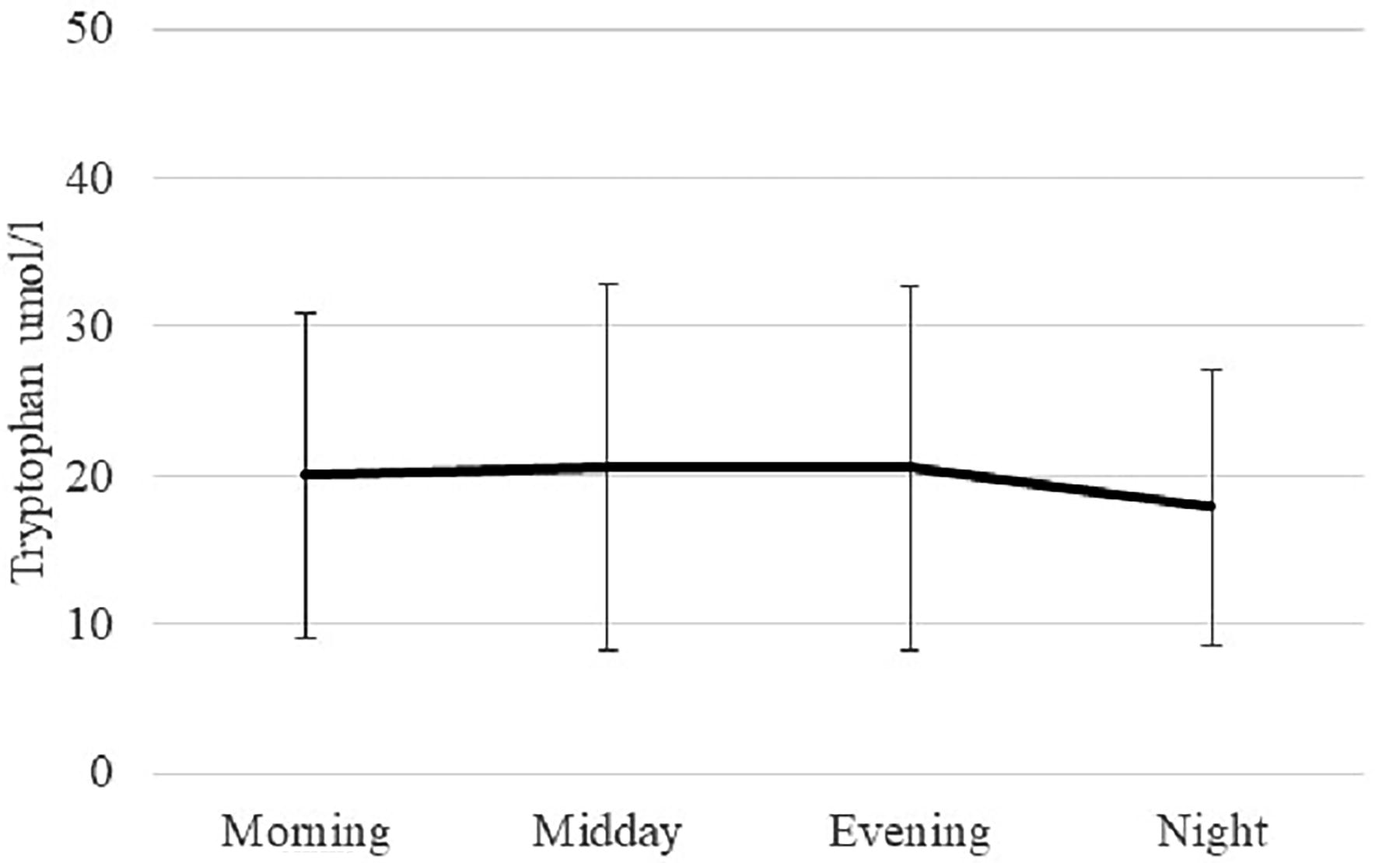
Mean tryptophan in breast milk at four timepoints over the day/night.
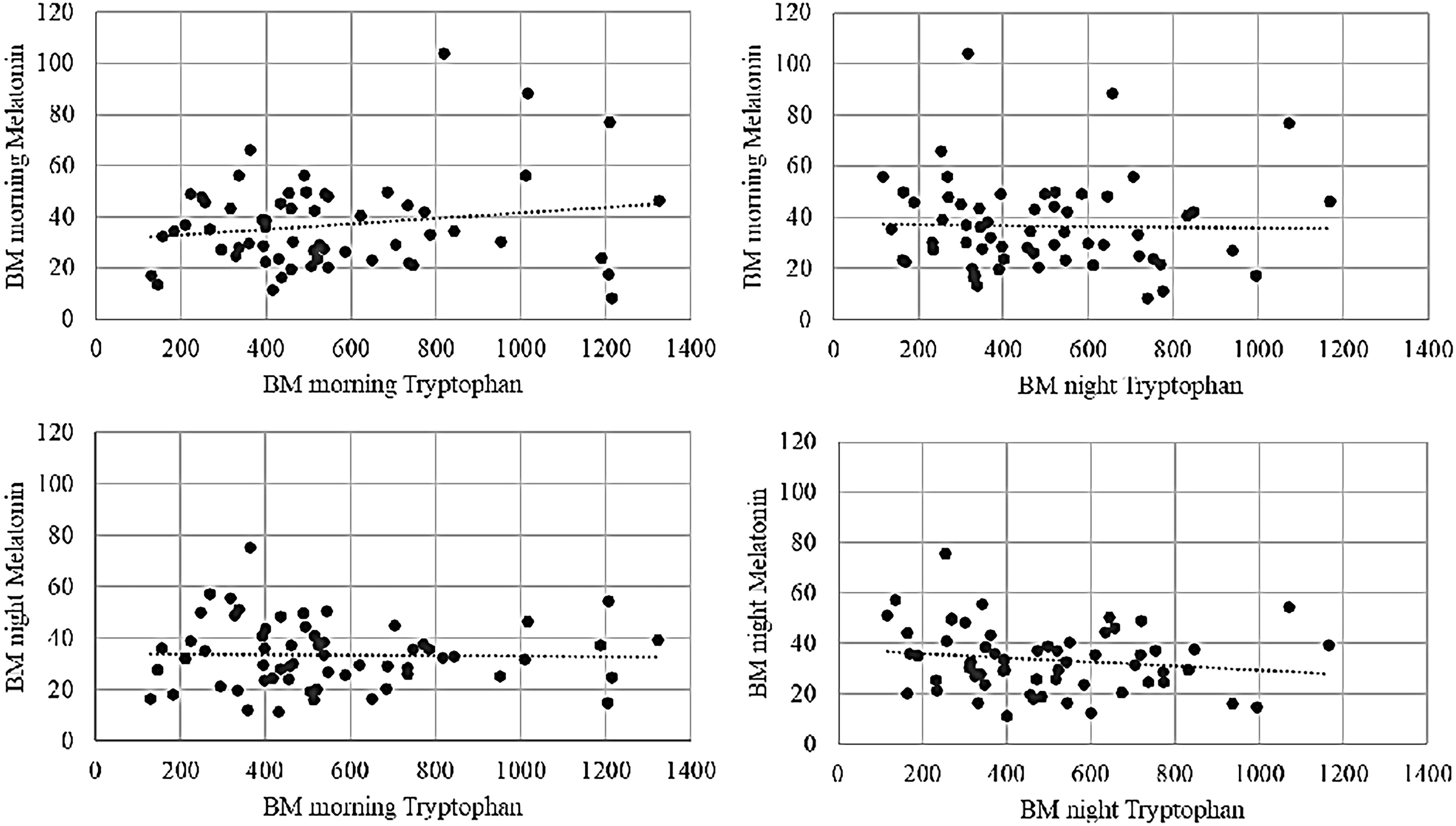
Relationship between breast milk melatonin and tryptophan at the same timepoints.
Discussion
This study found no relationship between tryptophan consumption in a mother’s diet and the level of tryptophan or melatonin observed in breast milk. This study also found no similar circadian timing pattern or relationship between tryptophan and melatonin in breast milk. The levels of tryptophan in this study remained steady throughout the day and night. This is contradictory from past studies such as reported by Cubaro et al. 9 who reported that tryptophan showed a circadian rhythm similar to that of melatonin in breast milk. That project, however, had a small sample size, with only eight breastfeeding mothers recruited and assayed and samples grouped into two 12-hour blocks (AM versus PM). This current study had a significantly larger sample and grouped breast milk into four timepoints across the day and night. Furthermore, grouping our samples into similar 12-hour blocks did not find different results.
Past research has shown that tryptophan-enriched foods could have a significant impact on adult melatonin output, with melatonin in urine increasing in participants who consumed tryptophan-enriched cereal. 3 However another study found that tryptophan supplementation did not increase saliva melatonin, 19 suggesting that there may be differences or a delay in the effect of tryptophan consumption on melatonin levels depending on how melatonin is measured. Even though there is some evidence that increased dietary tryptophan intake can improve melatonin production and urine secretion, this study showed that it might not translate to increased levels in breast milk, with no relationship observed between tryptophan in a mother’s diet and the amount detected in breast milk. This is similar to a recent study which found that total tryptophan level in breast milk was unaffected by oral administration of L-tryptophan or alpha-lactalbumin. 20 Differences may be largely due to the different timing of ingested tryptophan, rather than the total amount ingested per 24 hours. 21 However, this current study found no relationship between the time a mother had breakfast, lunch, or dinner and tryptophan levels or a difference in the total tryptophan or energy ingested over a 24-hour period. Diet still may be playing a role in breast milk tryptophan levels, but little is known about the digestion time delay between tryptophan-rich food consumption and subsequent presence in breast milk and the accumulation effects. Research suggests that only 1–2% of dietary tryptophan is converted to serotonin in the brain, which is then synthesized into melatonin and circulated in the bloodstream. 22
Impact and significance
Past research shows that increased tryptophan intake can increase melatonin output. Therefore, it is important to understand how mothers can naturally increase tryptophan and melatonin levels in breast milk. In this study, a large variation of melatonin was observed in breast milk across participants and different days, which is similar to past studies from the authors.7,12 However, we did not observe a correlation between melatonin levels in breast milk and the amount of tryptophan in the breast milk or the amount of tryptophan consumed by mothers in their diet. This suggests that the variation in melatonin seen between mothers and across different days may be due to other factors. A larger and more tightly controlled study is needed to ascertain the delay in food tryptophan and the presence in breast milk and to determine why there is such a variation of melatonin in breast milk, across consecutive days, between mothers.
Conclusion
This study highlights the wide variation of basal melatonin levels in breast milk observed across consecutive days within mothers and between mothers. Melatonin has important health benefits for infants including helping to establish a stronge circadian rhythm, which can have ongoing effects in adulthood and development. Understanding the factors that can impact melatonin levels is important because it will help understand how to increase these levels.
Footnotes
Acknowledgment
The authors thank all the mothers who took time out to participate in the study.
Authors’ Contributions
L.A.B., M.M., and T.C.S.: were responsible for study design, data interpretation, and composing and editing the manuscript. L.A.B. and J.E.W.: were responsible for data collection. L.A.B., T.C.S, M.M., and C.F.: performed the analysis and contributed to the interpretation. All authors were involved in preparing the article. All authors contributed equally to this work. All authors approved the final article as submitted and agreed to be accountable for all aspects of the work.
Author Disclosure Statement
No authors have any conflicts of interest to declare, with respect to the research, authorship, and/or publication of this article.
Funding Information
The authors have no funding to disclose.