




Abstract
Background:
Use of marijuana and its derivatives has become increasingly common, without clear knowledge of health impacts. This uncertainty includes breastfeeding mothers and infants who may chronically ingest marijuana.
Case Presentation:
We present an infant with altered mental status initially thought to be the result of acute symptomatic exposure to tetrahydrocannabinol (THC). The infant subsequently developed classical symptoms of intussusception.
Conclusion:
This case raises the question of chronic THC exposure/ingestion in infants as a risk factor for intussusception. This association has been reported in adult populations, but not to date, in pediatric patients.
Introduction
Marijuana, derived from the cannabis plant, is a widely used psychoactive substance, including during pregnancy and breastfeeding. Use has increased in the United States as medicinal and recreational legalization and cultural acceptance has progressed. Delta-9-tetrahydrocannabinol (THC) is the primary psychoactive ingredient. Current guidelines discourage marijuana use during pregnancy and breastfeeding due to limited data informing health and developmental outcomes in exposed infants. This is compounded by the fact that the formulations and potency of marijuana products have substantially evolved over time.1,2
It is known that marijuana metabolites are present in breast milk, although the extent of transfer and effects on breastfed infants are not entirely clear. Studies have demonstrated varied indicators of accumulation but do indicate that concentrations in breast milk may exceed those in maternal blood. This may relate to the lipophilic nature of THC. A recent study found an over 2-week half-life of THC excretion to breast milk in mothers who were confirmed to have abstained from use for multiple weeks.3,4 These data indicate that chronic regular use would be expected to lead to consistent THC excretion into breast milk, and thus transfer to a breastfeeding infant.
We propose chronic exposure to THC via breastfeeding as a newly recognized potential contributing or causative factor for the development of intussusception in an infant. This phenomenon has been recently reported in adults who chronically use marijuana, but to date, it has not been reported in infants or children.5,6 Intussusception, the invagination of a proximal segment of bowel into a directly adjacent segment, is the most common cause of abdominal emergency in young children. Categorization is based on anatomical location and typically associated with junctions between fixed and freely moving portions of bowel, commonly ileocolic. Viral and bacterial gastroenteritis is considered a causative factor in 30%, with the proposed mechanism as alteration in peristalsis. Older children have a higher association with pathological lead points, however, 90% of cases have no identifiable cause. Abdominal pain and bloody stool are well recognized presenting symptoms of intussusception. Less commonly, pediatric patients present with initial lethargy or altered mental status.7–9
Case Report
We present an 8-month-old term breast fed female with no significant medical history who presented to the pediatric emergency department via an ambulance due to altered mental status and concern for symptomatic exposure to THC and/or opiate. The mother reported chronic daily THC use via smoking. She reported smoking THC only outside the home, never in proximity to the infant. The parents denied use of any additional controlled or illicit substances by household members.
Parents reported fussiness and nasal congestion in the infant earlier in the day and gave “Gripe Water” and “Soothing Time” teething tablets. Later in the day, the mother reported smoking marijuana in the form of “wax” outside the home. The infant breastfed approximately 4–5 hours after this without any immediate reported concerns. However, after feeding, the infant had difficulty crawling with inability to support herself and was limp when picked up. She reportedly intermittently screamed and “passed out,” prompting parents to take her to the nearest fire station. On presentation, she was intermittently agitated and “quiet” and with examination notable for constricted pupils and subjective response to administration of intranasal naloxone. On pediatric emergency department evaluation, urine drug metabolite screening was THC positive and opiate negative, including fentanyl screen.
On day 2 of hospitalization, the infant developed bilious emesis and hematochezia with subsequent ultrasound showing targetoid soft tissue in the right upper quadrant region measuring 3.0 × 2.6 cm with free fluid and decreased Doppler flow suggestive of ileocolonic intussusception (Fig. 1). Air enema successfully reduced the intussusception but symptoms recurred the day after, and a repeat ultrasound showed recurrent ileocolic intussusception. The infant required laparotomy for reduction of intussusception, after which the infant had an unremarkable recovery.
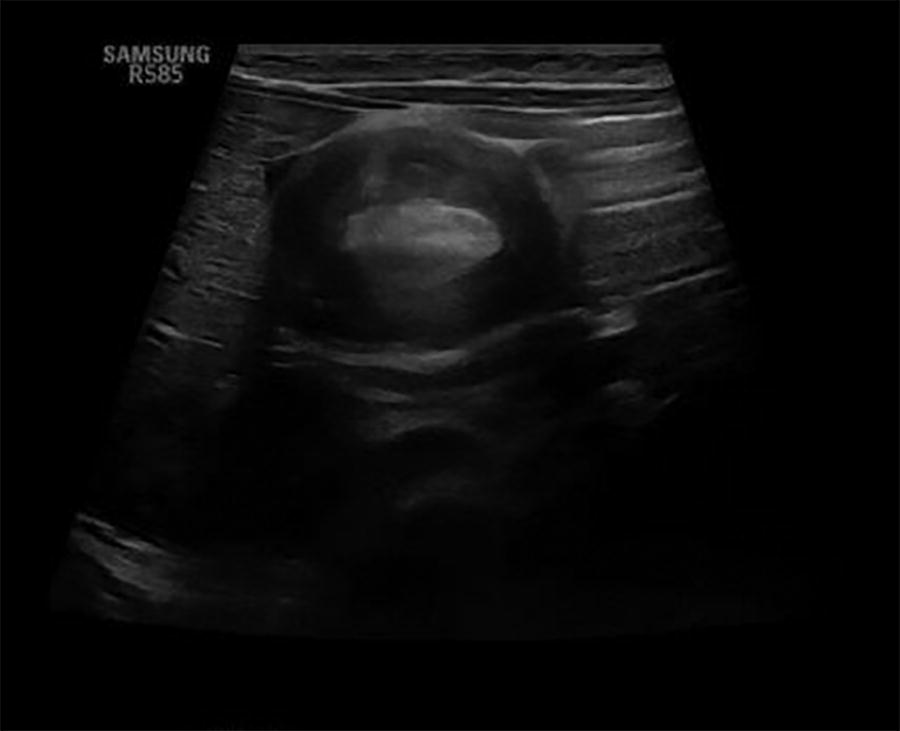
Right upper quadrant ultrasound showing the targetoid soft tissue suggestive of ileocolic intussusception.
Discussion
There have been recent reports in adult medical literature identifying an association between chronic THC exposure and development of intussusception. THC acts on multiple cannabinoid receptors in the gastrointestinal tract, which may lead to diminished peristalsis and has been shown to delay gastric emptying. It has been hypothesized that the influence of these factors on motility predisposes to development of the classical lead point of an intussusception. These mechanisms have also been proposed as causative for the now widely recognized cannabinoid hyperemesis syndrome.5,6
To our knowledge, these associations have not been made in pediatric patients, which is not surprising, as young children do not intentionally or regularly consume THC. However, breast-fed infants of mothers who use THC are chronically passively exposed to unclear degrees. This raises the question of a potential association with chronic passive THC exposure and associated increased risk of intussusception in pediatric patients. This is particularly poignant given increasing legal and cultural acceptance of THC use, which has led to increased maternal use, including during breast feeding.
Ongoing clinical evaluations in pediatric patients will be important in clarifying this emerging association. It is recommended that clinicians diagnosing and treating intussusception in pediatric patients explore potential related exposures to THC and its chronicity, particularly in breastfed infants. In cases where association is established, it is prudent to counsel breastfeeding mothers about the possibility of chronic THC exposure and development of intussusception. This case also serves as an important reminder to maintain a broad differential diagnosis for acute presentations of altered mental status in infants, including in cases of suspected substance exposures.
Informed Consent
The guardian of this pediatric patient has provided written informed consent for publication.
Footnotes
Authors’ Contributions
L.S.: Conceptualization (lead), Writing—review and editing, (lead). A.B.: Writing—review and editing (equal). H.D.: Writing—review and editing (equal). R.A.: Writing—review and editing (equal).
Author Disclosure Statement
No authors have applicable conflicts of interest.
Funding Information
No funding has been received in support of this article.