




Abstract
Human milk (HM) research has its origins in the early 20th century, emerging from the field of dairy science. Early pioneers such as Drs. David Forsyth, Lucy Naish, and Disney Cran were among the first to formally study HM, building on centuries of recognition of its importance. Clinicians such as Dr. Ruth A. Lawrence, a true “giant” in the field, played a pivotal role in translating HM research into medical education and clinical practice. This commentary highlights the milestones, key contributors, technical advancements, and future directions of HM research, tracing its journey from modest beginnings to its establishment as a rapidly evolving scientific discipline.
Introduction
The study of human milk (HM) has been profoundly shaped by the work of pioneering researchers (Fig. 1). Dr. David Forsyth, a trailblazer in the field, authored The History of Infant Feeding from Elizabethan Times in 1911, an extensive analysis of 16th-century texts detailing historical accounts of infant feeding practices. He noted the absence of feeding bottles and the limited availability of artificial foods, which were restricted to bread and legumes. 1 Forsyth also examined the composition of HM, a novel concept in the early 20th century, and contributed to our understanding of the evolution of neonatal nutrition.
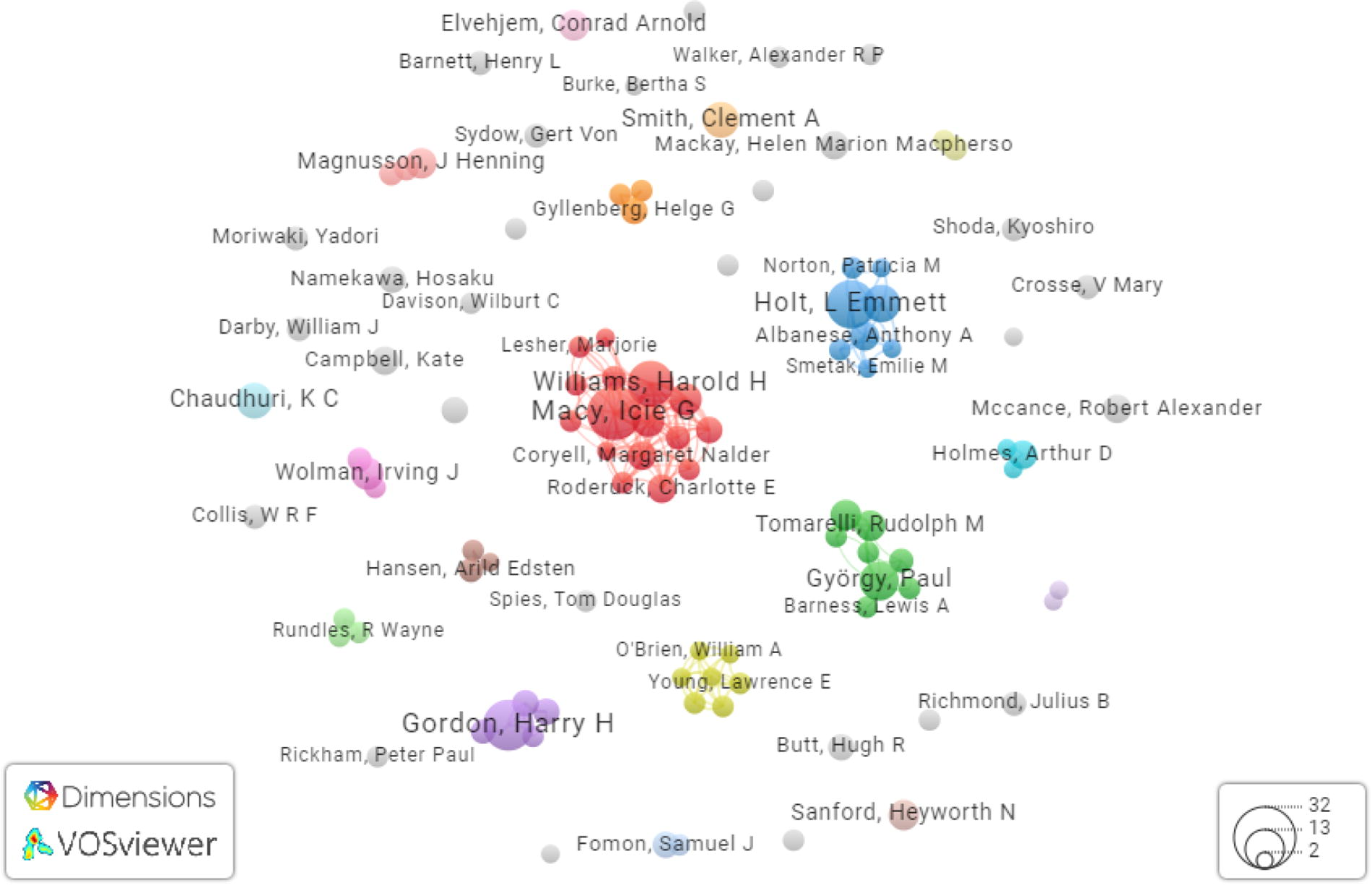
Network map of most prolific 100 human milk researchers by publication and coauthorship from 1940 to 1960. Artificial intelligence-generated coauthorship analysis, connections shared between coauthors, with clustering described by color and size by the publication number. Number of publications total between 1940 and 1960: 4,367. Search “Human milk” OR “breast milk.” Source Dimensions AI®.
In 1920, Dr. Icie Gertrude Macy earned her PhD in physical chemistry from Yale University under the mentorship of Dr. Lafayette Mendel, codiscoverer of vitamin A. 2 Dr. Macy recalled a formative lecture by Dr. Mendel: “Dr. Mendel had given a provocative lecture on the dairy and milk industry…the United States government was investing vast sums of money in research on domestic animals for commercial purposes…in contrast…to the amount spent on the health of mothers and infants.” She further noted, “I left the lecture hall inspired and determined that the health of mothers, infants, and children was to be my first priority in research in the future.” Her seminal work, Composition of Human Colostrum and Milk, remains influential in the field, and her leadership at the Merrill-Palmer School’s Nutrition Research Project, where she directed research for 31 years, cemented her legacy as a leader in HM science.
In 1935, Hungarian-born physician Dr. Paul György, who codiscovered vitamin B6, continued his groundbreaking work on HM as Chief of Pediatrics at the University of Pennsylvania in the 1940s. A former assistant to Dr. Ernest Moro—known for identifying the predominance of Bifidobacteria in the intestines of breastfed infants—Dr. György collaborated with Professor Richard Kuhn, a future Nobel Laureate, to isolate riboflavin. Together with Dr. Th. Wagner-Jauregy, he contributed significantly to our understanding of HM’s biological properties. Today, the Macy-György Award, presented by the International Society for Research in Human Milk and Lactation (ISRHML), honors their enduring contributions to advancing HM research.
Building on the foundational work of early 20th-century researchers, the late 20th century saw pivotal advancements in HM research led by scientists such as Dr. Mary Frances Picciano. 3 A Macy-György Award recipient and cofounder of the ISRHML, Dr. Picciano made profound contributions to nutrition policy and research. Coauthor of the widely used textbook Human Nutrition and over 100 scientific publications—many in collaboration with her husband, Dr. John Milner—she significantly advanced the understanding of HM’s role in maternal and child health. These scientists, along with the likes of Dr. Thorsten Fjellstedt, an advocate of the U.S. National Institute of Child Health and Human Development who organized the first ISRHML meeting in 1985, and Dr. Lawrence Smith (Boston Floating Hospital), who in 1922 recruited Young and Sutherland to solve the dilemma of preserving HM by drying, laid the foundation for modern HM science in pediatric medicine. 4
Dr. Ruth Lawrence often credited her inspiration to “these giants” in the field—Dr. Jackson, Niles Newton, and Marshall Klaus. Accepted into the University of Rochester School of Medicine and Dentistry in 1946, a remarkable achievement for a woman at the time, Dr. Lawrence later became Yale University’s first-ever female intern. She went on to complete her pediatric residency and neonatal fellowship before returning to the University of Rochester Medical Center, where she broke new ground by leading the well-baby and newborn nursery. As a pediatrician and breastfeeding mother of nine, Dr. Lawrence seamlessly balanced her personal and professional lives. She would stop by the hospital nursery to breastfeed her baby and then begin rounds with her interns. Not one to miss an opportunity to educate, she introduced an “education cart” filled with pamphlets on the science of breastfeeding and the benefits of HM. She was also known for carrying the latest HM research articles—carefully annotated with her insights—in her medical bag, symbolizing her commitment to merging research and practice.
Having broken barriers throughout her career and played an enormous role in advancing maternal–infant care, Dr. Lawrence advocated for “rooming-in,” the previously unheard-of practice of keeping baby and mother in the same room to breastfeed after birth. In the 1980s, Dr. Lawrence wrote the seminal text on breastfeeding, now in its ninth edition, titled Breastfeeding: A Guide for the Medical Professional. 5
Maternal and Infant Health
Early studies of HM provided critical insights into lactation and maternal and infant health. The pioneering work of Robert Jensen and Stuart Patton laid the foundation for the field by investigating key HM components, including casein, whey, and lipids. 6 Patton, in particular, made significant contributions to understanding the structure and function of the human milk fat globule and its membrane (HMFGM). His research elucidated the complex architecture of the MFGM, a unique trilayered membrane derived from mammary epithelial cells, which plays an essential role in delivering bioactive compounds, such as polar lipids and glycoproteins, to the infant. These findings highlighted the importance of milk fat not just as an energy source but also as a vehicle for immune and developmental factors, reshaping the scientific understanding of lactation and infant nutrition.
Jensen and Patton’s elegant studies bridged the gap between basic science and public health by demonstrating the intricate relationship between “lipids and lactation.” Jensen’s seminal work, Lipid Metabolism and Membrane Functions of the Mammary Gland, established HM science as a critical field within public health research. 6 In 1995, Jensen edited the Handbook of Milk Composition, which became a cornerstone in the field by comprehensively addressing topics such as vitamins A, K, D, and E, with contributions from experts such as Canfield, Giuliano, and Graver. 7
By the early 2000s, research in HM experienced significant growth, with global studies—including observational and randomized controlled trials—examining the effects of dietary interventions on milk constituents. Nearly a century after David Forsyth’s groundbreaking work, researchers began to focus on the critical relationship between maternal diet and HM composition. These advancements not only expanded the understanding of how maternal nutrition influences HM but also highlighted the importance of HMFGM as a key component with potential implications for infant immune development, gut health, and neurodevelopment.
Technological Innovations
Advancements in milk analysis have long been influenced by dairy technology. In 1949, the Kjeldahl method, initially developed in the mid-19th century for nitrogen analysis, was adapted for rapid milk examination. 8 Subsequent innovations introduced calorimetric kits and, more recently, infrared spectrometry, which originated in dairy science. Cutting-edge techniques now include chromatographic methods and high-performance liquid chromatography coupled with mass spectrometry, enabling detailed analyses of milk components. Tools such as enzyme-linked immunosorbent assays, immunocytometry, and electrochemical impedance spectroscopy have expanded our capacity to investigate milk’s biochemical properties. 9 Emerging research on HM cells—comprising both breast- and blood-derived cells—provides critical insights into the biological pathways of lactation and highlights the potential physiological roles of HM cells in supporting infant development. These innovations continue to refine our understanding of HM’s complex composition and its implications for health. 10
Advances in HM research have facilitated groundbreaking discoveries, particularly in understanding HM oligosaccharides (HMOs) and their roles in the gut–brain–immune axis. The Human Milk Institute at the University of California, San Diego, is a prime example of a center of excellence, conducting innovative studies on topics such as 2’-fucosyllactose, a beneficial HMO whose secretion can be affected by genetic variation. Globally, research on HM is flourishing, with active contributions from leading institutions in Australia, Canada, Spain, the United Kingdom, Ireland, China, and Italy (Fig. 2). These groups advance the field through collaborative efforts that bring together diverse perspectives and expertise. Recent publications highlight the increasing tendency for international collaboration, a significant shift from earlier decades. This collective approach is driving new insights into the complexities of HM and its essential role in health and development.

Network map of most prolific 100 human milk researchers by article publication and coauthorship in 2023–2024 in PubMed. Artificial intelligence-generated coauthorship analysis, connections shared between coauthors, with clustering described by color and size by the publication number. Number of articles in 2024 and 2023 in PubMed: 23,736. Search (“Human milk” OR “breast milk”) Source Dimensions AI®.
Outcomes and New Frontiers
While exclusive HM feeding is recommended in the first 6 months of life, it is not always achieved due to biological and socioenvironmental barriers. Thus, further exploration of the varying levels of HM compositions, components whether related to individual mothers such as diet, diurnal, or across different population factors, is critical. This is particularly important when considering the unique needs of high-risk infants who may rely on stored milk, pasteurized donor milk, or require donor milk-based food supplements. 11
Exploring HM’s bioactive agents and studying HM consumption’s functional outcomes remain more relevant than ever. For example, Valentine and Wagner have demonstrated that maternal diet may alter the fatty acid and vitamin content of HM. 12 In addition, studies have revealed that DHA content is generally lower in North American HM compared with other global populations, 13 thereby raising the question of infant outcomes in such a setting, given that higher DHA content in HM has been linked to improved vision and neurodevelopmental outcomes. 14
The pace of HM research has been, at times, plodding. For instance, lactoferrin was discovered in cow’s milk in 1939 and HM in 1960, and its significance in innate immune activities has only been confirmed in recent years. In our recent review, we highlighted the potential clinical relevance of compounds with anti-inflammatory, anti-infectious, and anticancer qualities, such as the MFGM, which have yet to be studied in clinical trials. 15
Similar to early pioneers in HM research, many early-career investigators are leveraging advancements in technology, often adapted from the dairy industry, to translate the latest findings into clinical practice. Emerging areas of interest include updated pasteurization techniques, such as ultraviolet-C and high-pressure pasteurization,16,17 exploring the therapeutic potential of breast milk cells, 18 and measuring the effects of milk storage on the microbiome. 19 While the dairy industry primarily measures quality based on consumer preferences such as taste, the context for HM is fundamentally different. For hospitalized infants reliant on donor milk, quality is determined by measurable health outcomes, such as improved growth, survival, and overall development. These metrics, chosen by health care providers or families, highlight the critical role of innovation in optimizing HM for vulnerable populations.
Conclusion
HM research has undergone transformative changes while remaining anchored by recurring themes. These include the discovery of novel components through advanced technologies, recognition of the critical role of breast milk within the maternal–infant dyad, and its profound positive effects on child health. Education and collaboration have also been pivotal in promoting breastfeeding within communities and health care systems. Early pioneers, including Dr. Ruth Lawrence, elevated HM research from its origins in dairy science to a multidisciplinary field rooted in nutrition, public health, and clinical care. Future endeavors in the field of HM research will build on the past insights and discoveries of the “giants in the field,” among whom Dr. Lawrence stands as a towering figure. Her visionary leadership and unwavering dedication have paved the way for continued innovation and a deeper understanding of HM’s critical role in health and development. Investigating the effects of maternal health and environmental factors on HM composition and subsequent childhood outcomes remains a vibrant and essential area of scientific exploration inspired by her enduring legacy.
Footnotes
Author Disclosure Statement
No competing financial interests exist.
Funding Information
No funding was received for this article.