




Abstract
Abstract
In this article, we present results on the identification and behavioral analysis of social bots in a sample of 542,584 Tweets, collected before and after Japan's 2014 general election. Typical forms of bot activity include massive Retweeting and repeated posting of (nearly) the same message, sometimes used in combination. We focus on the second method and present (1) a case study on several patterns of bot activity, (2) methodological considerations on the automatic identification of such patterns and the prerequisite near-duplicate detection, and (3) we give qualitative insights into the purposes behind the usage of social/political bots. We argue that it was in the latency of the semi-public sphere of social media—and not in the visible or manifest public sphere (official campaign platform, mass media)—where Shinzō Abe's hidden nationalist agenda interlocked and overlapped with the one propagated by organizations such as Nippon Kaigi and Internet right-wingers (netto uyo) during the election campaign, the latter potentially forming an enormous online support army of Abe's agenda.
Introduction
In the midst of summer 2014, two extensive newspaper articles, one published July 31 in the Tōkyō Shimbun and the other published the following day in the Asahi Shimbun, stirred up the political scene in Japan. Both newspapers, based on own investigative research, reported details about Nippon Kaigi (Japan Council)—an organization most people had not even heard of before—describing it as Japan's largest right-wing organization, having ∼35,000 members and strong ties, as well as numerous personal overlaps, with the Liberal Democratic Party (LDP), particularly the members of Prime Minister (PM) Shinzō Abe's second and third cabinet. Many of these links were not directly pointing to individual lawmakers—but according to Asahi Shimbun, as many as 289 members of the diet were members of the affiliated Nippon Kaigi Discussion Group of the Diet (Nippon Kaigi kokkai giin kondan-kai), most of them of the conservative wing of the LDP, amounting to about 40% of the entire Parliament.
Nippon Kaigi was formed in 1997 from a merger of two other organizations, namely the National Council to Defend Japan (Nihon wo Mamoru Kokumin no Kaigi), an association of conservative politicians, former military staff, and intellectuals, and the Society to Protect Japan (Nihon wo Mamoru Kai), an association of conservative religious groups such as the Shintō Shrine Association (Jinja Honchō) or the religious sect Seichō ni ie. Despite their heterogeneous origins, these groups share common goals, namely the preservation of Japan's beautiful traditional national character, embodied by the imperial household, the adoption of a new constitution suited to a new age, giving Japan the right to maintain a full-fledged military, and the revision of the masochistic history curriculum in schools as well as the rampant spread of gender-free education to instill patriotism and morality in the Japanese youth and traditional family values.
The articles by the two Tōkyō-based newspapers were triggered by the revelation that two local LDP politicians, Zenji Nojima (who was also acting as chairman of a bipartisan gender-equality group) and Akihiro Suzuki (who subsequently left the LDP over the incident), who had come under fire for sexist comments during a speech by assemblywoman Ayaka Shiomura of Your Party (Minna no Tō) on the city's childbearing policy at the Tokyo Metropolitan Assembly on June 18, 2014, in fact were members of regional outlets of the Nippon Kaigi. Shiomura, on being confronted with sexist sneers such as “You are the one who must get married as soon as possible!” (自分が早く結婚したらいいじゃないか Jibun ga hayaku kekkon shitara ii janai ka) or “Can't you even bear a child?” (産めないのか umenai no ka) from the anonymity of the audience, was barely able to suppress her tears in front of the assembly for the remainder of her speech.
In a statement reprinted in Tōkyō Shimbun's abovementioned article, U.S.-based anthropologist Tomomi Yamaguchi argues that it is hardly surprising, in light of Japan Council's support for traditional family values, that the antifeminist hecklers in the Tokyo Metropolitan Assembly were members of the Council's provincial assemblyman's alliance. In his statement, Yamaguchi even goes as far as drawing a parallel between the despicable behavior of the two assemblymen and hate speech, namely the recently publicly voiced forms of extreme racism generated largely by organizations such as the Citizens' Group Refusing to Permit Special Rights for Resident Koreans (Zainichi Tokken wo Yurusanai Shimin no Kai, abbreviated as Zaitokukai).
It took Nippon Kaigi quite some time to respond to these accusations by the two newspapers. On September 29, the public relations department of the organization eventually posted the following statement on its website, 1 starting with a summary of the “problematic points” of the article, and accusing the newspapers, particularly Tōkyō Shimbun, of (1) wrongfully connecting the problematic statements of its regional members to the activities of Nippon Kaigi at large, (2) drawing a connection between hate speech groups and Nippon Kaigi, (3) branding Nippon Kaigi as “religious rightists” (shūkyū uha) and “right wing” (uyoku), and (4) describing the group as “people who want to go to war.” Particularly Nippon Kaigi's response to the former two accusations requires a closer look from the perspective of this article. The group argues that the “remarks by these two diet members have no relationship to the activities of this organization at all” and that “relating our organization to hate speech (…) gives a manipulative vicious impression and is unjust” and that “this organization does not support any activities that directly address foreigners or minorities with methods such as hate speech.” 1
By distancing themselves merely rhetorically from the misbehavior of these two local LDP politicians and members of local outlets of the organization but avoiding to walk the talk, such as an expulsion from the organization, the officials of Nippon Kaigi indirectly endorse the behavior of these individual members. One could argue that this an orchestrated strategy by which individual members constantly test the discursive boundaries of what one is allowed to say and what not, while the organization these individuals belong to officially distances itself from these allegedly merely individual statements, which allegedly do not overlap with the official views of the whole group. This strategy is facilitated and supported by the argument that Nippon Kaigi claims to be a decentralized grassroots movement with many regional outlets. Moreover, by trying to discredit the coverage of the newspapers as “malicious/deliberative fabrication” (that is, as fake news), the organization exhibits a stance toward the mass media reminiscent of other populist organizations and parties around the world as well. This is why Kato, 2 commentator with the New York Times, has recently compared the activities of Nippon Kaigi to those of the Tea Party.
In this article, we attempt to show that it was not in the visible or manifest public sphere of official campaign platforms and the legacy media, but in the latency of the algorithmic semi-public of social media—which has recently turned into a battle field of not only Internet right-wingers (netto uyo) but also of automated social/political bots—where Abe's hidden nationalist agenda was playing an important role in Japan's general election of 2014, while Abe himself was riding on the ticket of his economic policy called Abenomics. Put differently, it was not only with the support of “assertive conservative organizations” 3 such as Nippon Kaigi but also with the help of netto uyo, manipulating a huge cyber army of bots on Twitter pushing a similar nationalist agenda, that Abe was successful in the last election.
Internet Right-Wingers (Netto Uyo) and the Emergence of the Latent Algorithmic Public Sphere
First, let us take a closer look at Yamaguchi's claim that an immediate connection exists between the two LDP hecklers, Nippon Kaigi, and the recent outbursts of hate speech by the netto uyo, particularly its notorious offline offspring Zaitokukai. Netto uyo, who differ from the old right-wing movements in Japan—being famous for their black trucks, parading the streets of urban areas, propagating their rightist ideology and playing militaristic music—are commonly defined as “individual ‘heavy’ net users who are sympathetic to right-wing/nationalist views,” with “few of them actually being real-life activists or members of right-wing/nationalist organisations.” 4 Netto uyo became known to a larger audience through a number of Internet-generated controversies that erupted around 2002–2004 in the Internet forum 2-channel, such as “those over the World Cup Soccer hosted by Korea and Japan, ‘Hate-Korea’ comic books, the so-called Nanjing Massacre comic book, and Dokdo/Takeshima, to name just a few,” exhibiting “xenophobia towards immigrants, depict[ing] Korea and China negatively, and uphold[ing] revisionist history, justifying and glorifying Japan's wartime actions. They also support political leaders' official visits to Yasukuni Shrine, revision of Article 9 of the constitution, and patriotic education.” 4
While netto uyo “are extremely vocal online and clearly identifiable as a discursive group, when it comes to real-life political actions, netto uyo's involvement is limited to occasional net-driven phenomena such as dentotsu (‘phone attack’–organized phone complaints on specific issues to government offices or left-leaning media), matsuri (sudden and extreme concentration of postings in a specific thread for a limited time), and enjō (rush of critical or accusatory comments and trackbacks to a specific blog or SNS) targeting left/liberal opinions and sites.” 4 Based on interviews with Internet right-wingers, Tsuji 5 associates the following ideological attitudes with the netto uyo: an anti-Korean and/or anti-Chinese racism/exclusivism, the claim that the PM should visit Yasukuni Shrine, a revision of the constitution allowing for the maintenance of a proper military, the public chanting of the national anthem and display of national flags in school, and a general distrust toward the mainstream media. Sakamoto 4 describes netto uyo as follows:
(…) netto-uyo nationalism is aggressive and shrill, but fragmentary. Its coherence mainly comes from the symbol of the ‘Koreans’ as Japan's detested Other. While the hostility towards Korea, as well as towards China and North Korea is a shared trend among all variants of neo-nationalism and revisionism in post-1990s Japan, there are some elements that are unique to netto-uyo nationalism: it is a postmodern and subcultural nationalism aided by digital media and global accessibility to information. A product of borderless Internet technology, 2-chan nationalism also exhibits parochial principles of nationalism.
The number of netto uyo is hard to estimate, since most of them would never make an offline appearance such as in the demonstrations organized by the Zaitokukai. According to media activist Tsuda et al., 6 the core of Internet right-wingers consists of 50,000–100,000 users who actively post messages or comments, and a latent population of 1,200,000 passive netto uyo.
The difference between netto uyo, Zaitokukai, and neoconservatist or even right-wing organizations such as Nippon Kaigi is in fact a blurry one. In the abovementioned newspaper article, in the July 31, 2014, issue of the Tōkyō Shimbun, Tomomi Yamaguchi argues that the relationship of Zaitokukai and Nippon Kaigi is only at first sight paradoxical, because although Zaitokukai criticizes conservative mainstream organizations such as Japan Council for being genteel conservatives (kireigoto hoshu), it is organizations like Japan Council incubating issues such as the so-called military comfort women and xenophobia.
Sugano, 7 author of the best-selling book An Inquiry into the Japan Council (Nippon Kaigi no kenkyū), supports the argument that ideological connections between Nippon Kaigi and the netto uyo actually exist. When conducting research for his book, he not only attended demonstrations of Zaitokukai, documenting these events by camera and video, but also analyzed the group's online activities, particularly looking into the publications and documents that the commentators affiliated with this right-wing group referred to online. He found out that many of the authors (journalists, academics) of the publications discussed and consumed by the netto uyo were in fact all affiliated with Nippon Kaigi in some way or other. Hence, Sugano argues that members of Nippon Kaigi not only entertain close connections to many LDP politicians and the intellectuals writing for the before-mentioned publications but also uphold some kind of symbiotic relationship with the netto uyo.
Against this background, we argue that it is necessary to take a closer look at the activity of Internet right-wingers to understand why nationalism did in fact play a role in Abe's 2014 electoral campaign, “but not as a banner boldly brandished, but more subtly as patriotic mood music” in the semi-public sphere of social media. 8 Put differently, it lies within the scope of this article to analyze and visualize the activities of Internet right-wingers and how they overlap with those of the LDP and Nippon Kaigi, thus forming a gigantic online support army for Abe's nationalistic agenda. Applying Shimizu's 9 concept of latent publics (senzai-teki kōshū),10,11 we describe this phenomenon as the emergence of a latent public sphere.12–14 Referring to the circulation of rumors in his landmark study, Shimizu 9 was the first to define rumors as “latent” public opinion, emerging when people were in fear and uninformed, especially in times of crisis or when the mass media were failing to provide information and an open space for discussion and thus for the formation of a manifest (kenzai-teki) public opinion regarding a certain issue.
Ōishi
11
In social media, the latency of this phenomenon is based on a new kind of computer-mediated communication that sociologist Kitada has called connective sociality (tsunagari no shakai-sei).13,14,16–21 According to Kitada, 17 it is crucial that connective sociality is generated mostly through an autotelic (or phatic) use of communication media—autotelic because, according to Kitada, we are facing a kind of communication that is not primarily aimed at communicating a message, but rather at the act of communicating as such. It is communication in its barest—or binary—form, so to speak, with little if any semantic content. The function of this new kind of connective communication increasingly lies in being connected and maintaining relationships instead of content-oriented dialogue.
In fact, this kind of connective sociality has become very salient among netto uyo, first on the aforementioned Internet forum 2-channel. It was around the turn of the century that the distinct connective and autotelic communication style of the netto uyo turned into a hermetic “cynicism” toward the mass media, politics, and progressive educators. This kind of cynicism, according to Kitada, 17 is nondialogical and destructive because it can choke off any serious online debate: among the netto uyo it is considered uncool to take the views of others seriously who are not familiar with this kind of communication and want to engage in a serious debate. We argue that political bots play an important role in this cynical online strategy of Japanese Internet right-wingers.
Nowadays, social media completely has incorporated the kind of autotelic communication style generating the connective sociality described by Kitada into its very platform architecture, which is why Van Dijck 21 also calls this phenomenon “platformed sociality.” Social platforms such as Twitter or Facebook thus amplify the cynical and autotelic communication style. On social media, it is not even necessary to use language, since the specific functional communication operators of these platforms—such as I-like-buttons, @-marks, #, Retweet (RT)-functions, or links22,23—enable the user to execute a technical operation that addresses a specific communicative (or rather connective) function.
In fact, we are thus dealing with two types of social connectivity on social media, which need to be distinguished: the “articulated” connectivity of friends or followers, and “behavioral” connectivity, 24 the latter including not only written dialogical enunciations but also a much larger share of habitualized or gut-fired 21 high-frequency connective actions based on the aforementioned functional operators. A growing number of studies concerned with online conversational practices seem to substantiate this assumption, discussing the difference in the conversational practices of mentioning and Retweeting or links in terms of their connective potential.25,26 It is particularly these high-frequency connectivities that potentially generate ad hoc publics by merely “signaling” affirmative or negative attitudes (not opinions) and are gradually ruling over content and debate. 27
From the perspective of social movement theory, Bennett and Segerberg have coined the term connective action to describe the role of connective sociality for new forms of protest movements, which they differentiate from the classical type of collective action in social movement studies. 28 Social media is thus essentially based on what Kitada meant by autotelic communication par excellence—a communicative space generated by functional connectivity that differs significantly from a Habermasian public sphere based on rational discourse.13,18 Moreover, it is important to add that the latent public sphere based on these connectivities increasingly consists of calculated publics, 29 coproduced by algorithms incorporated into the architecture 20 of social media as a closed platform which limit potential communicative contingencies, thereby creating echo chambers around users. 29 Hence, given the growing importance of algorithms for this kind of nonverbal communication, one might thus also speak of an “algorithmic connective sociality” to grasp the kind of networked sociality between human (users) and nonhuman actors (algorithms, bots) 30 emerging on social network sites.
The activities of netto uyo, based on the aforementioned autotelic and connective communication style and their merely virtual presence, could be thus described as right-wing connective action enabled by the connective sociality generated on social media. It is only from the perspective of connectivity that one could understand how the “fragmented, decontextualized, and bite-sized images and statements” making use of “abundant nationalistic vocabulary and sentiments that positioned ‘Japan’ over ‘Korea’” posted by the netto uyo could lead to the formation of a dangerous virtual movement even though “these fragmented postings did not develop into a coherent narrative” that could have mobilized toward collective action in the sense of traditional social movement theory. 4 The cynical connective behavior of the netto uyo triggered a process that Sunstein has described as group polarization,31,32 namely a process through which a group of people with similar views start to radicalize each other's position. The netto uyo have thereby not only created their own nationalistic echo chamber31,33 but have also managed to connect to the outside world based on certain opportunity structures provided by Abe's nationalistic agenda or Nippon Kaigi, leading to the emergence of a symbiotic but latent relationship further discussed in this article.
Specific Characteristics of the 2014 General Election: Social Media and Abe's Hidden Nationalist Agenda
In 2013, Japan ranked 11th in terms of active Twitter users worldwide and second if one only takes those users into account who actually Tweet, making the Japanese language the second most used language on Twitter. 34 Nevertheless, one might be surprised by the fact that social media did not play an essential role in electoral campaigns in Japan until 2014. According to Williams and Miller, 35 it was only after the 2009 general election that politicians first jumped on the social media bandwagon, inspired by the success that Obama was having with the platform. With populist Ōsaka Mayor Tōru Hashimoto being the sole exception (ranking among Japan's top 25 most popular Twitter users based on the number of followers), Japanese politicians do not belong to the most popular Tweeters in Japan to this day. Most and foremost, this reluctance had legal reasons, since online campaigning during the official election campaign period was banned in Japan until the revision of the Public Offices Election Law in 2013. It was based on this legal revision—allowing political parties and their candidates to actually campaign online during the full election period for the first time—and the fact that the 2014 general election was a snap election—announced by PM Shinzō Abe only 1 month before actually taking place, so campaigning may be expected to take place in a very limited and concentrated time frame—that we chose this particular election as a suitable case study for an analysis of political campaigning on social media.
LDP's online strategy assumed its shape in 2009, namely at a time when the party was in the opposition. 6 The party's online campaign strategy, which was designed by Hiroshige Seko, a former PR manager who had worked as a section manager in the Public Relations Department at Nippon Telegraph and Telephone (NTT)'s head office and is today serving as Minister of Economy, Trade, and Industry, was twofold. On the one hand, it included online advertisements via ad banners placed on Facebook and the login page of NicoNico Dōga, Japan's counterpart of YouTube.
On the other hand, the LDP in 2012 officially endorsed the Jimintō (LDP) Net Supporters Club (J-NSC) as its online support group—originally founded as a volunteer organization in 2009—with many of its 15,000 members allegedly overlapping with the pro-Abe fraction of netto uyo. 36 To become a member of this group, one merely needs to be at least 18 years old and hold a Japanese passport, a party membership with the LDP is not necessary. The stated aim of J-NSC is to “amplify the strength of the LDP in order to reach a Japan full of dreams, hope and pride.” 37 Interestingly, it was exactly at around the same time when J-NSC became an official support group of the LDP that Abe started actively to use Facebook himself, exploiting it as a kind of virtual kōen-kai (a local party support group), posting messages consisting of either welcome addresses (挨拶 aisatsu) or media criticism. According to Tsuda et al., 6 it is in particular his critical stance toward progressive or left-leaning media outlets that has become an integral part of Abe's online identity.
The 2014 general election was specific for another reason as well. Described as one of the most boring and apolitical elections since decades by some political commentators, the election is also considered an ideal-typical example of Abe's refined political campaign strategy. Abe refrained from campaigning on nationalist issues in the last election despite his strongly nationalistic political agenda: he has in fact longstanding official relationships with numerous nationalist or revisionist organizations and associations besides Nippon Kaigi, such as the History Review Committee (Rekishi Kentō Iinkai), the Diet Member's Council of the 50th Anniversary of the War (Shūsen Gojūnen Giin Renmei), or the Young Diet Member's Committee to Consider the Future of Japan and History Education (Nihon no Zentō to Rekishi Kyōiku o Kangaeru Wakate Giin no Kai), just to mention a few.
Instead of campaigning on the ticket of his actual political goals—a revision of the constitution, the question of security threats and collective self-defence, energy policy, Trans-Pacific Partnership (TPP), regional inequality, or the planned patriotic reform of education—Abe focused almost exclusively on his economic agenda in his 2014 campaign, as he had already done in the 2012 election. The fact that the Party of Future Generations (次世代の党 Jisedai no Tō), which campaigned on a forthright right-wing nationalist agenda, lost 17 of its 19 seats in the election might be considered proof that this strategic decision by Abe and his campaign team was the right choice.
According to Kingston, 8 the LDP had realized that “nationalism and ideology are toxic to mainstream voters.” Kingston describes the fact that Abe's LDP has become more ideological despite its economic populism, keeping its nationalist agenda hidden from voters and instead publicly appealing to the public with an agenda focusing almost exclusively on economic reform during elections, as the Abe conundrum. Political scientist Koichi Nakano supports this observation by arguing that the party that once used to be the political arm of Keidanren and Nōkyō has now become the party of right wing organizations such as Nippon Kaigi. 8 Kingston summarizes Abe's strategy in the 2014 general election as follows 8 :
[N]ationalism was not a decisive factor in campaigning 2014, but it was a key element in the positive context facilitating the LDP's unsurprising victory. Overall, nationalism was tangential to the LDP–Komeito coalition retaining its two-thirds majority, and mostly implicit since Prime Minister Abe campaigned on Abenomics rather than his nationalist agenda. (…) Abe relied on a “bait-and-switch” strategy of running on the economy and then claiming a broader mandate encompassing his unpopular agenda on security and the constitution, a ploy that goes a long way in explaining the Abe conundrum. Nationalism mattered, however, because the culture wars waged in Abe's Japan, driven by nationalist issues, aroused and pleased his base constituencies. So the dog didn't have to bark in the campaign because it had been a prominent and menacing presence beforehand, reassuring right-wing organizations about where Abe stands on the issues that matter to them most and they delivered the vote accordingly. While analysis of campaign rhetoric or party pledges and manifestoes might lead one to dismiss the importance of right-wing ideology or nationalism in campaign 2014, if one looks in the right places where politics is happening (…).
Our analysis of Twitter data supports Kingston's assumption that politics was not happening in the visible or manifest public sphere of official campaign platforms or the mass media in the 2014 general election, but that the latent public sphere of social media was the “right place” to look. Hence, it was in the latency of social media that Abe's hidden nationalist agenda was supported not only by Nippon Kaigi or J-NSC but also by the netto uyo, forming a gigantic online support army of a nationalist agenda similar to that of Abe, even though many of them take up an anti-Abe position.
Sampling and Method: Detecting Social Bots in the 2014 General Election
Social bots are “computer-generated programs that post, Tweet, or message of their own accord.” 38 If the main objective of their activity is a political one, one also speaks of political bots, which are used to “manipulate public opinion, choke off debate, and muddy political issues.” In the past, it was particularly “insensitive political moments when public opinion is polarized” 38 —such as the election campaign of Donald Trump or the U.K.'s Brexit referendum—that bots tend to be activated. However, the activity of social bots on Twitter and their potential effect on the political public sphere have only very recently become the subject of public debate and academic research. Their potential impact on events such as the last U.S. election, the Ukrainian conflict, or the Brexit referendum raised the concern that bots could have had an effect on the outcome or framing of these events.38–40
It is thus not surprising that democratic societies consider social bots a real and increasing threat. For instance, Howard and Kollanyi, 38 who conducted a study on the role of bots before the Brexit referendum, arrived at the conclusion that one-third of the Twitter traffic regarding the referendum was generated by merely 1% of the accounts, a large majority being automated or semiautomated bots. Moreover, they found that hashtags associated with arguments for leaving the European Union were overrepresented disproportionately. According to Kollanyi et al., 40 a similar disproportion could be observed in the case of the U.S. election, with twice as many pro-Trump hashtags as pro-Clinton ones and one-third of the pro-Trump Twitter traffic driven by bots. Hegelich and Janetzko, 39 in their analysis of Ukrainian social botnets active during the Maidan protests, found out that bots on Twitter not only promote certain topics by massive repetition of messages and Retweeting of selected Tweets but can also exhibit a behavior they call mimicry: the bots try to hide from simple detection algorithms based on duplicate Tweets by constantly changing the content of their Tweets, imitating user behavior by posting nonpolitical information such as news reports, sexist jokes, and links to downloads for popular films. 39 However, it is not unlikely that these links might have a function of their own, namely directing users to sites containing malware that infiltrates their Twitter accounts.
For the case of Japan's 2014 general election, we were able to detect numerous cases of attempts to make use of computational propaganda. Through our study of Tweets collected in the weeks before and after the day of the election, we were able to unveil the activity of several botnets. Although various researchers have already looked into the use of social media by politicians and the various political parties for campaigning,35,41 the role of social bots (in the widest sense) in Japan has not yet been studied thoroughly.
For the purpose of our study, we collected 542,584 Tweets via the public Twitter streaming API* by filtering via a set of keywords relating to the election in the period from December 8 to 30, 2014. † Unlike prior studies of botnets that focus on behavioral characteristics of bots (such as their Tweeting frequency), we used a corpus-linguistic approach to detect botnets. The collected Tweets were first tokenized and annotated with part-of-speech tags using MeCab. 42 A preliminary inspection of sorted concordances revealed an enormously large number of near-duplicate Tweets, often appearing to push a certain political agenda. This observation suggested targeted campaigns by networks of social bots, attempting to inflate the frequency and importance of certain topics by posting many copies of the same Tweet (with small modifications such as links to different websites) or by massive Retweeting. We therefore implemented a simple and efficient algorithm for automatic identification of duplicates: Tweets were normalized by deleting whitespace, punctuation (including @ and #), URLs, and RT markers; a hash structure was then used to recognize exact duplicates of the normalized Tweets. The algorithm identified 431,050 Tweets (79.4%) as duplicates.
Focusing on such near-duplicates for the detection of social bots is reasonable given our focus on political propaganda in a semi-public sphere characterized by such autotelic connectivity. As a general bot detection method, its recall is limited, of course. Copying and Retweeting of the same Tweet (with minor variations) is a very efficient strategy to push a given topic, however, and has repeatedly been observed in prior research.38–40 It is thus plausible that many social bots will indeed adopt this behavior. Regarding precision, our algorithm may also retrieve near-duplicate Tweets with very similar surface realizations even though they are genuine user content (see Pattern 4: Bot-Like User Behavior section for an example). In our context, such cases are easily recognized in the qualitative analysis of the identified repetition patterns and automatically generated duplicate clusters.
Even if Retweets—which account for 56.7% of the data and are duplicates by definition—are excluded, there are still 143,869 (61.2%) duplicates among the remaining 234,914 Tweets. To determine whether these duplicates reflect the activity of social bots, we analyzed the repetition patterns of all 3722 unique Tweets for which our simple algorithm detected five or more copies. Figure 1 shows a correlation plot of duplication count (without Retweets) against number of distinct user accounts for each of these unique Tweets. This approach is based on the assumption that botnets exhibit a unique footprint in the ratio
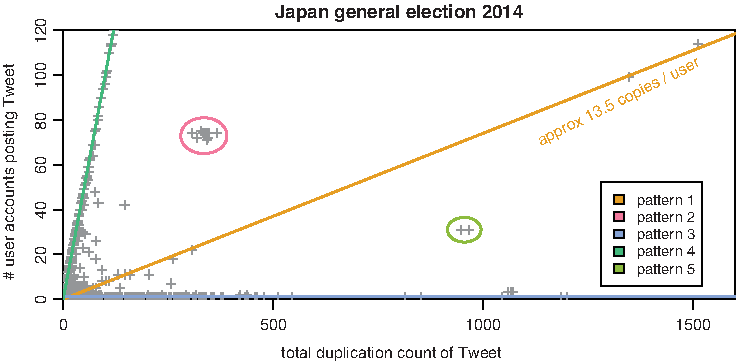
Correlation plot of duplication count (without Retweets) against number of distinct user accounts for each unique Tweet.
Our analysis revealed five distinctive repetition patterns, which are highlighted in different colors in Figure 1. ‡ Pattern one: Tweets with almost exactly 13.5 copies per user account (orange regression line); pattern two: a tight cluster of 11 Tweets with remarkably similar statistics (red circle above the orange line); pattern three: frequent repetitions of the same Tweet from a single account (forming a horizontal blue line at the bottom of the plot); pattern four: repetition across a large number of different accounts with only a single copy from each account (steep light green line at the left-hand side of the plot); and pattern five: a tight cluster of two Tweets with similar statistics (dark green circle below the orange line). Four of these five patterns can be associated with two computational propaganda campaigns A and B, which are further discussed below.
Campaign A (patterns 1, 2, 5): pro-Abe computational propaganda
To analyze pattern one, we restricted our content analysis to Tweets near the regression line with more than 100 repetitions in total (corresponding to a coordinate above 100 on the horizontal axis). These Tweets are messages in support of Abe, many of them attacking a blog called Ponkichi, which takes an anti-LDP, anti-TPP, and anti-immigration stance. Account names support this assumption (often including Abe's name, as in @ABE_CRUSADER, @JNSC_ABEMAMOROU, @GOSPEL_ABERULER). One of the account names even included the acronym JNSC of the aforementioned group J-NSC. Here are two salient examples from pattern one:
1. ABE_CRUSADER Mon Dec 08 10:18:25+0000 2014
このクソブログ書いてる『ポン吉』ってヤツ最低! → http://t.co/AI1zBF3vIB 安倍総理を叩くなや! TPP・移民受け入れ・道州制に反対する倭猿は一匹残らず死ね!! もう一回地震起きて津波で流されろ!!
1. ABE_CRUSADER Mon Dec 08 10:18:25+0000 2014
The guy whom is writing this f***ing blog “Ponkichi” is disgusting!→http://t.co/AI1zBF3vIB Do not attack PM Abe! All those Japanese apes (wazaru) opposing TPP, the acceptance of immigrants and the regional reform system should die!! A tsunami from another earthquake should wash them away!!
2. JNSC_ABEMAMOROU Mon Dec 08 10:19:24+0000 2014
我々は、南朝鮮人になりすましながら安倍晋三総理大臣を誹謗中傷し、 TPP・移民受け入れ・道州制に反対する倭猿を陥れる活動をしています。安倍晋三総理大臣の政策を正当化するためにも良識のある方は是非、ご協力ください。『ポン吉』のような卑劣な倭猿を陥れましょう!
2. JNSC_ABEMAMOROU Mon Dec 08 10:19:24+0000 2014
We are engaged in activities to get rid of those Japanese apes (wazaru) whom are slandering PM Abe Shinzō, oppose TPP, the acceptance of immigrants and the regional reform system while pretending to be South Koreans. Those with a good sense please cooperate to vindicate the policies of PM Abe Shinzō. Let's get rid of sneaky Japanese apes like “Ponkichi”!
As we can tell from example two, this botnet campaign is also responsible for the fact that Minami Chōsen, a somewhat disrespectful term for South Korea regularly used by right-wing extremists, is one of the most frequent nouns in our corpus of Tweets. The term occurs in 12,389 Tweets with a very similar content in our data set, of which only a negligible proportion of 0.3% (36 Tweets) are Retweets. These Tweets also show an extremely high duplication ratio of 97.0%, spread across 271 different user accounts.
Although the account names appearing in pattern two and five (tight clusters highlighted by red and green circles), such as @END_OF_JAP, @HorobeWazaru, @Wazaru_Messatsuas, @HorobiroWazaru, @KiesareWazaru, or @WazaruBokumetsu, might lead to the opposite assumption (hinting at the activity of Internet right-wingers), the botnets behind pattern two and five were used to attack the aforementioned anti-TPP and anti-Abe blog Ponkichi as well. Here are two examples of unique Tweets from each pattern, both bearing a striking similarity to the Tweets of pattern one, even though they are no textual near-duplicates:
1. KiesareWazaru Mon Dec 08 19:17:49+0000 2014
http://t.co/SGZrc0BdTS ←このブログを書いている『ポン吉』という和猿は、 TPP ・移民受け入れ・道州制に反対している最低最悪の工作員だ。こいつは生きていてはいけない。最低最悪の和猿『ポン吉』を自殺に追い込もう。
1. KiesareWazaru Mon Dec 08 19:17:49+0000 2014
http://t.co/AI1zBF3vIB ← The Japanese ape whom is writing this blog called “Ponkichi” is a disgusting and rotten secret agent! He shouldn't be allowed to live. Let's chase this disgusting and rotten Japanese ape “Ponkichi” into suicide!
2. Kimoizo_JAP Mon Dec 08 10:20:24+0000 2014
我々は、南朝鮮人になりすましながらアメリカ・自民党・安倍総理を叩き、 TPP に反対する和猿を陥れる活動をしています。 TPP 反対派の和猿共を陥れたい方は【てきとう】の活動にご協力ください。
2. Kimoizo_JAP Mon Dec 08 10:20:24+0000 2014
We are engaged in activities to get rid of those Japanese apes (wazaru) opposing the USA, the LDP, and PM Abe Shinzō while pretending to be South Koreans. Those who wish to get rid of the anti-TPP group of the Japanese apes please support [appropriate] activities.
Pattern 3 (campaign B): right-wing computational propaganda
We gained hints on the activity of another botnet from a co-occurrence analysis of hashtags in our corpus. Two trigrams of hashtags were particularly salient: #自民党 (LDP) #セクハラ (sexual harassment) #解散 (dissolution of parliament) and #自民党 (LDP) #議員 (diet member) #野次 (heckling), which appeared always in this particular sequence. These two trigrams occur in almost 20,000 Tweets in our data set, and were all posted by two user accounts, @Stupid00002 and @excreta_ZAiFX (both now suspended), that formed a small but highly active botnet. As is already obvious from the hashtag collocates “sexual harassment” and “heckling” and the fact that @Stupid00002 was a fake account of the female politician Ayaka Shiomura (Fig. 2), the Tweets sent from this botnet relate to the aforementioned incident in Tōkyō's municipal assembly.

Political bot: suspended fake Twitter profile of Shiomura Ayaka (@Stupid00002).
Our automatic duplicate analysis showed that 99.4% of these Tweets are multiple, slightly modified copies of only 57 unique Tweets; the four most frequent ones were sent more than 460 times each. Many of these Tweets contain rumors or false accusations. Eighteen of these 57 unique Tweets refer to “radioactive contamination” (放射能汚染), allegedly kept secret from the public by politicians or the mass media, 19 are attacking the political establishment, appealing to “squash” (ぶっ潰す) certain political parties and their leaders. The remaining original Tweets contain blatant nationalistic messages, such as Tweets referring to Matoko Sakurai, founder and former leader of Zaitokukai or links to videos of demonstrations of the very same group uploaded at Nico-Nico Dōga or YouTube (including a video of a demonstration in Ginza appealing to “Crush Anti-Japanese Mass Media and the Occupational Constitution” (反日マスコミと占領憲法をぶっ潰すデモ in 銀座). It is obvious that the aim of this botnet was to bandwagon on existing hashtags, trying to push these hashtags themselves and to relate right-wing propaganda to this incident involving two regional members of Nippon Kaigi.
To test the accuracy of the automatic duplicate detection, we manually grouped the 57 unique Tweets identified by the algorithm, finding seven cases of near-duplicates that had been missed by the automatic analysis. We subsequently compared these manually identified near-duplicates to the results of a hierarchical clustering of the 57 unique Tweets from the automatic analysis, based on the unweighted Levenshtein (or minimum edit) distance § between normalized Tweets. All but two of the near-duplicates could have been identified automatically with a cutoff distance of 5, which confirms the usefulness of our approach.
Figure 3 shows the hierarchical clustering in the form of a dendrogram. The colored nodes represent unique Tweets that were grouped manually because of their very similar content. The three green nodes, the two pink nodes, and the five red nodes are in fact groups of near-duplicates that our simple algorithm failed to detect. The orange node represents a Tweet that is semantically very similar to the red ones, but has a quite different surface realization and can therefore not be considered to be a near-duplicate in a strict sense.

Dendrogram of a hierarchical clustering of unique Tweets based on Levenshtein distance.
Pattern 4: bot-like user behavior
On inspection of a sample of Tweets from pattern four (steep green line at the left-hand side of the plot), it soon became clear that this pattern does not represent the activity of a botnet, but rather originates from Twitter share buttons on the websites of newspapers, magazines, and similar content providers. In particular, a large number of the duplicates in our sample shared links to articles published in the political online magazine Politas. 43 While each Tweet is sent deliberately by a genuine user, the content is automatically generated by the share button.
This example illustrates that conspicuous repetition patterns are not always due to the activity of social or political bots but can also reflect the highly habitualized or intuitive user behavior that Kitada has described as connective sociality and that has dramatically changed the frequency and the way in which users engage with each other. Stieglitz et al. 44 arrive at the conclusion that one can (still) differentiate between bots and human users based on their metrics (number of followers, Retweets, and used links per day). However, one might argue that in terms of their behavior, typical users exhibit a very narrow activity on social media with their rigid structure of possible usages (posting, liking, sharing), which is not too different from the calculable or programmed behavior of a social bot, exploiting the narrowness of these options. In reverse, this means that it is also because of the narrow infrastructure of the platforms and the adapted, increasingly predictable behavior of human users that nonhuman algorithmic bots can easily imitate user behavior. Their effectiveness is thus not only based on the technological improvement of algorithms but also on the changing behavior of the typical Twitter user, who is deeply entangled into a technically evoked algorithmic sociality based on the high-frequency connectivity on social media.
Van Dijck13,14,21 has argued that the social in social media refers not only to the (human) connectedness but also to the (automated) connectivity of algorithms. Social media are, and have always been, “the result of human input shaped by computed output and vice versa,” namely “a sociotechnical ensemble whose components can hardly be told apart.” Hence, if the behavior of nonhuman actors (fully automated or semiautomated bots) will become more sophisticated and the behavior of human actors (users) will become even more bot-like, the behavior of users and bots will gradually converge and both will become even more indistinguishable.
One can argue that although near-duplicate detection as a means to detect social bots is not a perfect procedure due to the reasons discussed above, one can also argue that the difficulty of detecting social bots is not merely a technical one, since the behavior of the typical social media user appears to complicate their detection as well. Hence, while the computational methodology presented in this article might enable researchers to detect salient bot patterns, it is only meaningful in its current form in combination with a manual interpretation of the detected patterns.
Discussion
Our corpus-based Twitter analysis revealed several dominant patterns of political bot activity that we were able to identify automatically by a statistical analysis of Tweet duplication patterns. As our study shows, easily usable and cheap technologies have become an important factor in the latent public sphere of social media, also in the case of Japan, potentially endangering the functioning of the political sphere. Nevertheless, it is difficult to identify the actors who utilize these botnets merely based on statistical findings. Judging from the topics of the Tweets and also the netto uyo-like jargon and racist terminology as well as the names of many fake accounts, we argue that it was most likely Internet right-wingers who operated the botnets send these Tweets. In fact, the two computational propaganda campaigns discussed in the Sampling and Method: Detecting Social Bots in the 2014 General Election section can be attributed to two competing camps of Internet right-wingers, namely an extreme right-wing and a pro-LDP fraction of the netto uyo.
It is difficult to assign particular goals to a certain computational campaign and measure its effectiveness. We argue that there are at least three ways in which bot activity can influence the latent semi-public and the manifest public sphere. (1) The bots can push certain topics, claims, or slogans so that they become trending topics/hashtags on Twitter, either to be noticed by actual users, including journalists, or to target quantitative analytics and thus affect the work of journalists or pollsters indirectly. In this case, botnets are used as a tool for agenda setting or (re)framing political events or topics.45,46** (2) The bots can bandwagon on already popular hashtags and topics by sending their intended message together with these hashtags. This can be done either in a very arbitrary way by combining totally unrelated hashtags or topics, or with the particular goal to “bridge” certain frames by mentioning two or three hashtags related to separated discursive frames in one Tweet with the aim to link “two or more ideologically congruent but structurally unconnected frames regarding a particular issue or problem” and thereby relate a movement with similar views or grievances to “public opinion preference clusters.” 48
Based on the abovementioned theoretical concept of autotelic connective sociality, we describe this social media strategy as connective frame bridging. As our study has revealed, botnets were used in particular for the latter purpose, namely to propagate and multiply ultranationalist positions by bandwagoning on existing hashtags and bridge nationalistic frames. This strategy reveals an ideological proximity and symbiotic relationship between Abe's LDP and the netto uyo that needs to be further explained and contextualized.
From the perspective of the netto uyo, the beginning of the 2000s provided excellent “discursive opportunity structures,” 49 allowing them to push their nationalist agenda. Higuchi 3 argues that although other scholars 50 might claim that it is nonsense to link the netto uyo or Zaitokukai with politics or political ideologies because of their lack of institutionalization or institutional links to the political establishment, since “institutional, hard political opportunity structures (…) remained closed” to them, it was Japan's changing dominant political discourse in the 2000s that allowed Internet right-wingers to link their nationalist online discourse to larger politics at least on a discursive level.
For the case of Japan, the discursive opportunity structures that opened up for the netto uyo—namely the kind of demands that appear “legitimate in a given political system” 3 —included the unsolved diplomatic issues of East Asian history, such as the so-called comfort women issue and territorial disputes with China and South Korea. Despite the different terminology of the latent discourse of the netto uyo and the public political discourse, the netto uyo created “an affinity between the discourse of the nativist movement and the statements of politician and the media in Japan” 3 by linking their rather irrational anti-Chinese and anti-Korean agenda †† to Abe's foreign-policy aspirations. Put differently, although the netto uyo were “not able to establish points of contact with institutional politics,” they managed to relate their own racist discourse “with the changing discursive opportunities surrounding ‘history’ and ‘East Asia.’” 3
However, as our discovery of right-wing and pro-LDP botnet activity has also shown, this does not mean that the netto uyo represent a homogenous group collectively committed to a fixed position beyond basic xenophobia. Sakamoto 4 argues that netto uyo are not only divided into supporters and enemies of Abe's politics, but are in fact also far too cynical to respond to “invitations to join right-wing activities outside cyberspace,” suggesting that “‘right-wingers are in fact zainichi Koreans’ and ‘right-wingers and Koreans should both leave Japan.’” As we have seen in the examples given above, we have found this rhetorical figure of accusing somebody to be in fact Korean in the Tweets of the pro-LDP computational propaganda campaign.
In any case, one can argue that despite the ideological fragmentation of the netto uyo, it was not only the pro-LDP campaign that explicitly supported Abe's official campaign platform but in fact even also the right-wing computational propaganda campaign that supported, if not Abe himself, then at least his hidden nationalist agenda in the 2014 general election. We argue that it is the ideological marker of anti-Japanese (反日 han'nichi) that functioned as a connective frame-bridging empty signifier, connecting the nationalistic discourse of Internet right-wingers with Abe's political views.
Abe was successfully playing his own game in the 2014 general election in this regard, apparently being fully aware of the power of the Internet, and social media in particular. The extent to which Abe was able to appeal not only to the young conservative users of social media and potential LDP voters, but potentially also to the Internet right-wingers becomes more than obvious from the chosen location of his last public appearance in the election campaign. Abe and Finance Minister Tarō Asō—being a manga fan himself and the otaku's most favorite politician—finished the LDP campaign tour with a boisterous rally in front of the Gundam Café in Akihabara. Officially, the rally was hosted in Akihabara to support Miki Yamada, LDP's running candidate in Tōkyō's first electoral district.
However, the reason for choosing this particular location apparently did not merely lie in supporting Yamada but was also aiming at producing video footage of Abe delivering his final speech in the heartland of the Internet-savvy otaku, a proportion of them also being active as netto uyo. 17
It can be assumed that his strategy was successful, since videos of this well-orchestrated event, featuring propagandistic images of a large audience waving rising-sun flags, thereby visually resembling the annual flag parades at Yasukuni shrine organized Satoru Mizushima's nationalistic association Ganbare Nippon, circulated quickly via social media soon after the event. In fact, at least parts of the netto uyo seem to have responded rather positively to the nationalistic imaginary of the video and the words of Abe's campaign speech.
Murai and Suzuki, 51 who studied Abe's comments on Facebook during the campaign, particularly highlight the following comment of a user to this video, which is exemplary for the abovementioned discursive link between Abe and the pro-Abe fraction of the netto uyo: “The mass media will certainly intensify their negative campaign against you. But, ‘Japanese citizens’ are on the side of Mr. Abe. We can never be defeated! Anti-Japanese activities of China and Korea, traitor activities of mass media, and disastrous politics of DPJ have all sparked Japanese citizens to stand up.”
In fact, it becomes obvious from this comment that a fraction of the netto uyo consider Abe an ally in their fight against allegedly anti-Japanese forces, particularly the Japanese mass media—and Abe let them pass with it, since nationalistic comments like the one quoted above have never been deleted from Abe's Facebook account. As our own analysis shows, the connection between anti-Japanese (反日 han'nichi) and mass media (マスコミ) is a very salient collocation in our Twitter corpus as well, together with the word traitor (売国 baikoku) and the term occupation (占領 senryō).
The rhetorical figure of denouncing political or ideological enemies as anti-Japanese in fact originated already in the latter half of the 1990s. It was at this time that right-leaning magazines such as Seiron and Shokun! began to frequently use the term in articles, attaching this label to proponents of what their authors considered as the supposedly incorrect and masochistic view of Japanese history. Not only were critical historians blamed for this view but also NHK and left-leaning media outlets such as the Asahi Shimbun were denounced as anti-Japanese in these publications. Jōmaru 52 states that one can observe an escalation with regard to the frequency of the term anti-Japanese in both magazines since the end of the 1990s, appearing only in two articles between 1985 and 1989, in six articles between 1990 and 1994, in 26 articles between 1996 and 1999, in 24 articles between 2000 and 2004, and in 52 articles between 2005 and 2009.
Sugano, 7 who has looked closely into the computer-mediated communication of netto uyo on social media and 2-channel, found that many netto uyo are in fact long-time readers of publications such as Seiron, Shokun!, WiLL, or Rekishi-tsū, showing a preference for articles by writers affiliated with Nippon Kaigi. Nippon Kaigi's in-house organ Nippon no Ibuki started to use the concept in a very similar way since the end of the 1990s as well, arguing that Japan needs to rectify its educational system, which is distorted by the supremacy of test scores and educational qualifications, “excessive” focus on human rights and individualism, a masochistic view of history, and strong biases supportive of Nikkyōso (Japan Teachers Union), all having culminated in an anti-Japanese education at Japanese schools (from the June 1998 issue of Nippon no ibuki 53 ).
Interestingly, Jōmaru 52 and Sugano 7 both also diagnose a pro-Abe bias of these right-leaning magazines, with the LDP leader being disproportionally covered in articles, who has been fighting his own battle against the mass media since around 2009 as well, particularly blaming the reporting of left-leaning mass media outlets to have been an important factor for his resignation in 2007. Even though he did not use the term anti-Japanese himself, instead speaking of “disgraceful adults” when criticizing representatives of opposing liberal or left-leaning organizations, Abe thereby appealed “to the online nationalists and suggested that he agreed with their conservatism,” echoing “the online activists' complaints about the left-wing bias of traditional media outlets.” 51
Moreover, Abe not only became a member of the Diet Members League to Consider the State of Public Broadcasting” (Kōkyō Hōsō no Arikata ni tsuite Kangaeru Giin no Kai) in June 2009, an association of 60 LDP lawmakers founded by Keiji Furuya, but also made an appearance on the notoriously right-wing Internet and TV channel Nihon Bunka Channel the same year. In a broadcast entitled Future Japan and the Problem of Mass Media (Korekara no Nihon to masu media no mondai), Abe discussed with anchorman Satoru Mizushima, founder of the channel and of the aforementioned right-wing group Ganbare Nippon, what he considered to be problematic about the mass media, in particular accusing Japan's public broadcasting system NHK of being biased in some of its historical documentaries. 54
In 2012, Abe repeated one of the core statements he had already made in the interview on Channel Sakura on another occasion, stating that addressing the people through online video broadcasts or posts on social media rather than through the mass media were “the fairest and most interactive forums for lively political discussion” because one is able to “avoid the arbitrary editing that occurred in the mass media.” 51 As our analysis of Twitter data shows, the social media strategy of Abe's LDP was successful, at least in quantitative terms. The list of the most frequent collocates of terms such as treason (売国 baikoku) or traitor (売国奴 baikokudo) does not include the LDP, but in fact most of the other political parties, namely the Japan Communist Party, the Democratic Party of Japan, Kōmeitō, and the Social Democratic Party.
One can argue that Abe is successfully using a political strategy that is very similar to recent strands of right-wing populism appearing elsewhere, namely the combination of antielitism and antipluralism currently being so popular among populist politicians all over the world. It is typical for this kind of right-wing populism that its proponents “claim that they, and they alone, represent the people.” 55 By addressing political opponents or journalists as enemy of the people—or as enemies of “the Japanese” (han'nichi) or “disgraceful adults,” as in the Japanese case—populist politicians and right-wing nationalists alike, morally legitimize their right to exclusively represent “the people” by claiming that “whoever does not support populist parties might not be a proper part of the people.” 55
Furthermore, this moralized form of antipluralism is not only based on the claim of exclusive representation of the “true people” but also linked to an antielitist stance toward the established political, academic, or journalistic elite. 55 As we have seen, this antielitist stance is also true for Abe's political views. It should not be necessary to mention this, but the alleged organic unity of “the people” or “the Japanese” is of course nothing but a meta-political illusion, for “the people can never be grasped and represented.” 55 In fact, one could not think of a more adequate Japanese epitome of the current political populism than Abe's campaign slogan “Taking back Japan” (日本を、取り戻す Nippon o torimodosu) (from whom? for whom?) in Japan's 2012 general election—an antielitist/antipluralist populist slogan that was in fact also appropriated by parts of the netto uyo and members of Zaitokukai, as Yasuda 56 has revealed through interviews with Internet right-wingers, who frequently describe the goal of their activities as one of taking back Japan.
One might conclude that despite all the differences in their particular terminology, Abe's LDP, Nippon Kaigi, and netto uyo share a distinctly antielitist and antipluralist stance, aimed not only at the allegedly biased mass media but also against progressive educators, embodied by the left-leaning Japan Teachers Union, who are made responsible for the supposedly masochistic history education taught at schools, and academics, namely scholars of history, whose critical research is made responsible for what is taught as schools. 6
Although further analysis could even bring to light that there are in fact personal overlaps between the netto uyo and subsidiary organizations of the LDP such as J-NSC, it is very unlikely that Abe or the LDP maintains these botnets themselves. Nevertheless, despite Abe's clear stance against Zaitokukai—expressing an “extreme repentance” (極めて残念 kiwamete zan'nen) toward the racist demonstrations of Zaitokukai in a parliamentary address on May 7, 2013 (which was most likely triggered by the global gaze on Japan for its bid to host the 2020 Olympics) ‡‡ —the nationalistic computational propaganda of all fractions of the netto uyo is directly or indirectly supporting his hidden nationalistic agenda. Abe benefits from their activity, or to put it in the slightly altered words of Morris-Suzuki, 57 in “the Internet age, direct intervention by politicians in the media is no longer needed,” since “they can get their Facebook [and Twitter] friends [and botnets] to do it for them” (addenda in brackets by authors).
The symbiotic relationship described in this article could thus be considered as an answer to the puzzle that Kingston describes as the Abe conundrum, namely the question why and how Abe manages to remain so popular and win elections even though most Japanese disagree with the neoconservative and nationalist policies he enacts in-between elections. We argue that Abe is using a tightrope-walking populist strategy that appeals both to the conservative fraction of the LDP and right-wing groups such as Nippon Kaigi or the netto uyo alike and that shares, despite marginal terminological differences, many thematic overlaps with these groups. Thereby, the LDP leader could make an appearance as the “good” Abe in the manifest public sphere during the election, while the nationalistic agenda of the Facebook-savvy “bad” Abe is supported from inside the latent algorithmic public sphere that has emerged in social media.
Footnotes
Acknowledgment
This work was supported by the Emerging Fields Initiative of Friedrich-Alexander-Universität Erlangen-Nürnberg (project title: Exploring the ‘Fukushima Effect’).
Author Disclosure Statement
No competing financial interests exist.