




Abstract
Representation learning on networks offers a powerful alternative to the oft painstaking process of manual feature engineering, and, as a result, has enjoyed considerable success in recent years. However, all the existing representation learning methods are based on the first-order network, that is, the network that only captures the pairwise interactions between the nodes. As a result, these methods may fail to incorporate non-Markovian higher order dependencies in the network. Thus, the embeddings that are generated may not accurately represent the underlying phenomena in a network, resulting in inferior performance in different inductive or transductive learning tasks. To address this challenge, this study presents higher order network embedding (HONEM), a higher order network (HON) embedding method that captures the non-Markovian higher order dependencies in a network. HONEM is specifically designed for the HON structure and outperforms other state-of-the-art methods in node classification, network reconstruction, link prediction, and visualization for networks that contain non-Markovian higher order dependencies.
Introduction
Networks are ubiquitous, representing interactions between components of a complex system. Applying machine-learning algorithms on such networks has typically required a painstaking feature engineering process to develop feature vectors for downstream inductive or transductive learning tasks. For example, a typical link prediction task may require the computation of several network statistics or characteristics such as centrality, degree, and common neighbors. 1 And then a node classification task may require a different feature subset or selection, requiring yet another feature engineering task. This adds significant computational complexity especially with increasing graph sizes. This challenge inspired representation learning algorithms for networks that led to generalized feature representations as low-dimensional embeddings, learned in an unsupervised manner, and thus being flexible enough for different downstream network mining tasks.2–4
However, the research on network representation learning has largely focused on first-order networks (FONs), that is, the networks where edges represent the pairwise interactions between the nodes—assuming the naive Markovian property for node interactions (Fig. 1b).2,5–9 In recognition of the possible higher order interactions between the nodes beyond first order, recent research has led to methods that try to capture the higher order proximity in the network structure. These methods often define a “higher order proximity measure” based on the multihop node connectivity pathways. Such higher order methods perform better in common network mining tasks such as link prediction, network reconstruction, and community detection. 2 However, these methods infer the higher order proximities from the FON structure, which in itself is limiting in capturing the variable and higher order dependencies in a complex system. 10

A toy example showing how higher order neighborhood can be inferred from HON. Given the sequential data provided in
Recent research in the network science domain has pointed out the challenges with the FON view and the limitations it poses in network analysis (e.g., community detection,11–15 node ranking, 16 dynamic processes, 17 risk assessment, 18 and anomaly detection 19 ), and proposed higher order network (HON) representation methods that have been shown to be more accurate in capturing the trends in the underlying raw data of a complex system.10–12,17,20,21 Unlike the conventional FON in which every node represents a single state, a node in this HON structure represents the current and previous states (illustrated in Fig. 1c), thus capturing valuable higher order dependencies in the raw data.10,11,20,21
This study advances a representation learning algorithm for HON—higher order network embedding (HONEM)—and shows that representation learning algorithms developed for FON, including ones that capture higher order proximities, are limited in their performance on HON. HONEM is scalable and generalizable to a variety of tasks such as node classification, network reconstruction, link prediction, and visualization.
To that end, this study addresses the following key questions:
How to develop a network embedding method that captures the dependencies encoded in the HON structure? Does a network embedding developed specifically for HON offer an advantage in common network mining tasks compared with embedding methods based on FON?
Contributions
The main idea of HONEM is to generate a low-dimensional embedding of the networks such that the higher order dependencies (represented in HON) are accurately preserved. HONEM takes HON directly as input and is thus able to capture higher order dependencies present in the raw data that are encoded in HON.
Consider the following example. We are provided human trajectory/traffic data of the area around a university campus. Suppose from the trajectory data, we observe that students who live on-campus are more likely to visit the central library after visiting the downtown area, while people living in a certain residential area are more likely to go to the business area of the city after passing through the downtown area (assuming none of the four locations overlap with each other). In Figure 1, each of the nodes represents the following: C: on-campus dorm, B: residential area, A: downtown area, E: library, D: business area. Suppose we model such dependencies as FON (Fig. 1b), and then try to infer second-order dependencies from FON structure to derive the node embeddings (as typically done in existing methods5–8
). In the FON structure, both the library and the business area are two-steps away from the campus dorms (or the residential area). Therefore, we may conclude that students living on-campus have an equal probability of visiting the library and the business area through downtown. As a result, all the abovementioned methods based on FON will miss important higher order dependencies or infer higher order dependencies that do not exist in the original raw data. By modeling these interactions as HON, instead (Fig. 1c), we observe that node C and E have a second-order dependency through node
To summarize, the key contributions of HONEM are as follows:
Data-agnostic: HONEM extracts the actual order of dependency from the non-Markovian interactions of the nodes in raw data by allowing for variable orders of dependencies rather than a fixed order for the entire network, as used in prior work.5,6,8,22
Scalable and parameter-free: HONEM does not require a sweep through the parameter space of window length. HONEM also does not require any hyperparameter tuning or sampling as is often the case with deep learning or random walk-based embedding methods.
Generalizable: HONEM embeddings are directly applicable to a variety of network analytic tasks such as network reconstruction, link prediction, node classification, and visualization.
Higher Order Network Embedding
In summary, the HONEM algorithm comprises the following steps:
Extraction of the higher order dependencies from the raw data.
Generation of a higher order neighborhood matrix, given the extracted dependencies.
Applying truncated singular value decomposition (SVD) on the higher order neighborhood matrix of the network to discover embeddings, which can then be used by machine-learning algorithms.
Preliminaries
Let us consider a set N of interacting entities and a set S of variable-length sequences of interactions between entities. Given the raw sequential data, the HON can be represented as
Using these higher order nodes and edges in
One approach to address the above challenge is to learn embeddings on higher order nodes
Extracting high-order dependencies
The first step of the HONEM framework is to extract higher order dependencies from the raw sequential data. To accomplish this task, we modify the rule extraction step in the HON construction algorithm. 10 Please note that the HON algorithm simply results in the network representation of the data but does not generate any embeddings or feature vectors. HON is simply a network representation of the raw data. HONEM, on the contrary, learns embeddings from the said HON to automate the process of feature vector generation. We briefly explain the rule extraction in the HON algorithm below:
Rule extraction (HON)
In the FON, all the nodes are assumed to be connected through pairwise interactions.
To discover the higher order dependencies in the sequential data, given a pathway of order k:
Step 1: Count all the observed paths of length =
Step 2: Calculate probability distributions d for next step in each path, given the current and previous steps.
Step 3: Extent the current path by checking whether including a previous step
This procedure is repeated recursively until a predefined parameter, MaxOrder, is reached. However, the new parameter-free version of the algorithm (which is used in the study) does not require setting a predefined MaxOrder, and extracts the MaxOrder automatically for each sequence. The parameter
The above method only accepts dependencies that are significant and that have occurred a sufficient enough number of times. This is required to ensure that any random pattern in the data will not appear as a spurious dependency rule. Furthermore, this method admits dependencies of variable order for different paths. Using this approach, we extract all possible higher order dependencies from the sequential data. These dependencies are then used to construct the HON. For example, the edge
Modified rule extraction for HONEM
In the HONEM framework, we modify the standard HON rule extraction approach by preserving all lower orders when including any higher order dependency. This is motivated by a limitation of the previously proposed HON algorithm.
10
In the original HON rule extraction algorithm, after extracting all dependencies, the HON is constructed with the assumption that if higher orders are discovered, all the lower orders (except the first-order) are ignored. However, discovering a higher order path between two nodes does not imply that the nodes cannot be connected through shorter pathways. For example, if q and j are connected through the third-order path
Note that in HONEM, we extract the higher order dependencies from the sequential data and not from the FON topology, as is done by other methods in the literature.5,6,8,24 Therefore, our notion of “higher order dependencies” refers to such dependencies that are extracted from sequential data over time. Although these methods are able to improve performance by preserving higher order distances between nodes given the topology of the FON, they are unable to capture dependencies over time. This is important because not all the connections through higher order pathways will occur if they do not exist in the raw sequential data in the first place.
Higher order neighborhood matrix
In the second step of our framework, we design a mechanism for encoding these higher order dependencies into a neighborhood matrix. In this context, we refer to higher order dependencies as higher order distances. We define a
It is possible, however, that two given nodes are connected through multiple higher order distances (i.e., multiple paths). In this case, the average probabilities of all paths (or the average edge weights in HON) are considered as the higher order distance. For example, suppose node j can be reached from node i via either path 1:

For
It is worth mentioning that the higher order neighborhood matrix provides a richer and more accurate representation of node interactions in FON and thus can be viewed as a means of connecting HON and FON representation. In many network analysis and machine-learning applications—such as node classification and link prediction—working with the HON representation is inconvenient, and requires some form of transformation. HONEM provides a more convenient and generalizable interpretation of HON, while preserving the benefits of the more accurate HON representation.
Higher order embeddings
In the third step, the higher order embeddings are obtained by preserving the higher order neighborhood in vector space. A popular method to accomplish this is to obtain embedding vector

The widely adopted method for solving the above equation is SVD. Formally, we can factorize a given matrix

where  are the orthogonal matrices containing content and context embedding vectors.
However, this solution is not scalable to sparse large networks. Therefore, we use truncated SVD
25
to approximate the matrix

where  contain the first d columns of
Experiments
We used three different real-world data sets representing transportation and information networks, and assess the performance on the following tasks: (1) network reconstruction; (2) link prediction; (3) node classification; and (4) visualization. We compared HONEM to a number of baselines representing the popular deep learning and matrix factorization-based methods. We provide details on the data and benchmarks first, before presenting the performance results on the aforementioned tasks. We also provide a complexity analysis of HONEM in the next section.
Data sets
The HONEM framework can be applied to any sequential data set or HON describing interacting entities to extract latent higher order dependencies among them. To validate our method, we use four different data sets for which raw sequential data are available and there is a higher or variable order of dependency among the nodes. Table 1 summarizes the basic FON and HON properties for each of the data sets. To emphasize the versatility of HONEM, these data sets are drawn from three different domains: vehicular traffic flows from two Italian cities (Rome and Bari), Web browsing patterns on Wikipedia, and global freight shipping. Specifically, the four data sets are as follows:
Basic properties of each data set
The gap between the number of first-order and higher order nodes and edges in each data set indicates the density of higher order dependencies in each data.
FON, first-order network; HON, higher order network.
Traffic data of Rome: This is a car-sharing data provided by Telecom Italia big data challenge 2015,* which contains the trajectories of
Traffic data of Bari: This is another car-sharing data (provided by Telecom Italia big data challenge 2015) containing trajectories of
Global shipping data: Provided by Lloyd's Maritime Intelligence Unit; this contains a total of
Wikipedia game: Available from West and Leskovec
26
; this contains human navigation paths on Wikipedia. In this game, users start at a Wikipedia entry and are asked to reach a target entry by following only hyperlinks to other Wikipedia entries. The data include a total of 4043 articles with
We define the ratio
Baselines
We compare our method with the following state-of-the-art embedding algorithms, which only work on FON representation of the raw data.
DeepWalk
24
: This algorithm uses uniform random walks to generate the node similarity and learns embeddings by preserving the higher order proximity of nodes. It is equivalent to Node2Vec with
Node2Vec 5 : This method is a generalized version of DeepWalk, allowing biased random walks. We used 0.5, 1, and 2 for p and q values and report the best performing results.
LINE 6 : This algorithm derives the embeddings by preserving the first- and second-order proximities (and a combination of the two). We ran the experiments for both the second-order and combined proximity, but did not notice a major improvement with the combined version. Thus, we report results only for the embeddings derived from second-order proximity.
Graph factorization (GF) 27 : This method generates the embeddings by factorizing the adjacency matrix of the network. HONEM will reduce to GF if it only uses the first-order adjacency matrix.
LAP 28 : This method generates the embeddings by performing eigen-decomposition of the Laplacian matrix of the network. In this framework, if two nodes are connected with a large weight, their embeddings are expected to be close to each other.
GraRep 22 : This is a powerful higher order embedding method that preserves the k-order proximity of the nodes. It uses SVD to factorize the higher order neighborhood of the nodes obtained by the random walk transition probabilities. We use k = 5 as this value yields the highest performance for this baseline.
Among the above baselines, Node2Vec, DeepWalk, LINE, and GraRep learn embeddings using higher order proximities. GraRep in particular goes beyond second-order proximity and is the closest method to ours, but it extracts the higher order proximity from the FON structure and only accepts a fixed order of dependency. We also used locally linear embedding (LLE) as a baseline in our early experiments. However, LLE failed to converge on several dimensions in link prediction and network reconstruction experiments. Therefore, we did not include it in the final results.
Network reconstruction
Network embedding can be interpreted as a compression of the graph.2,8 An accurate compression should be able to reconstruct the original graph from the embeddings. To accomplish this, we use the embeddings to predict the original links of the network. This task is closely related to the link prediction task, where the goal is to predict the future links using the existing links of the graph. However, in the reconstruction task, we use the existing links as ground truth. Please note that this is different from the link prediction task, which is trying to predict the probability of link formation in the future.
Network reconstruction is an important evaluation task for representation learning algorithms, as it provides an insight into the quality of the embeddings generated by the method. We measure the reconstruction precision for the top k evaluated edge pairs using
Figure 2b shows the network reconstruction results with varying k. We notice that although the performance of other baselines is data dependent, HONEM performs significantly better on all data sets. Results on both the traffic data sets display similar trends, and methods such as LINE, which perform relatively well on these data sets but fail on the larger data sets (shipping and Wikipedia). HONEM not only performs better than GF, which preserves the first-order proximity, but also outperforms Node2Vec, DeepWalk, LINE, and GraRep, which preserve the higher order proximity based on FON. GraRep is the second-best performing baseline in all data sets except the shipping data, but still does poorly compared with HONEM. With the increase in k, all of the actual edges are recovered but the number of possible pairs of edges becomes too large, and thus, almost all methods converge to a small value. However, there is still a large gap between HONEM and other baselines even at the largest k on all data sets.

Link prediction
We posit that embeddings derived from HON perform better for link prediction as those embeddings are more accurately capturing the higher and variable order dependencies in a complex system, which are missed by the FON representation that contemporary embedding methods work on. Methods based on FON do not capture the non-Markovian higher order interactions of the nodes, which creates a potential for link formation. For example, suppose there is a directed edge in HON from
We use mean average precision (
Effect of dimensionality
Overall, HONEM provides superior performance in dimensions of 64 or larger. We notice that while Node2Vec provides a better MAP score on the traffic data sets in lower dimensions (smaller than 64 in Bari and smaller than 32 in Rome), it fails to improve over higher dimensions. We further investigated our results by visualizing the node precision,
Comparison of Precision@k (
Even though Node2Vec provides better MAP score in lower dimensions, it fails to accurately predict the top-k links.
HONEM, higher order network embedding; MAP, mean average precision.
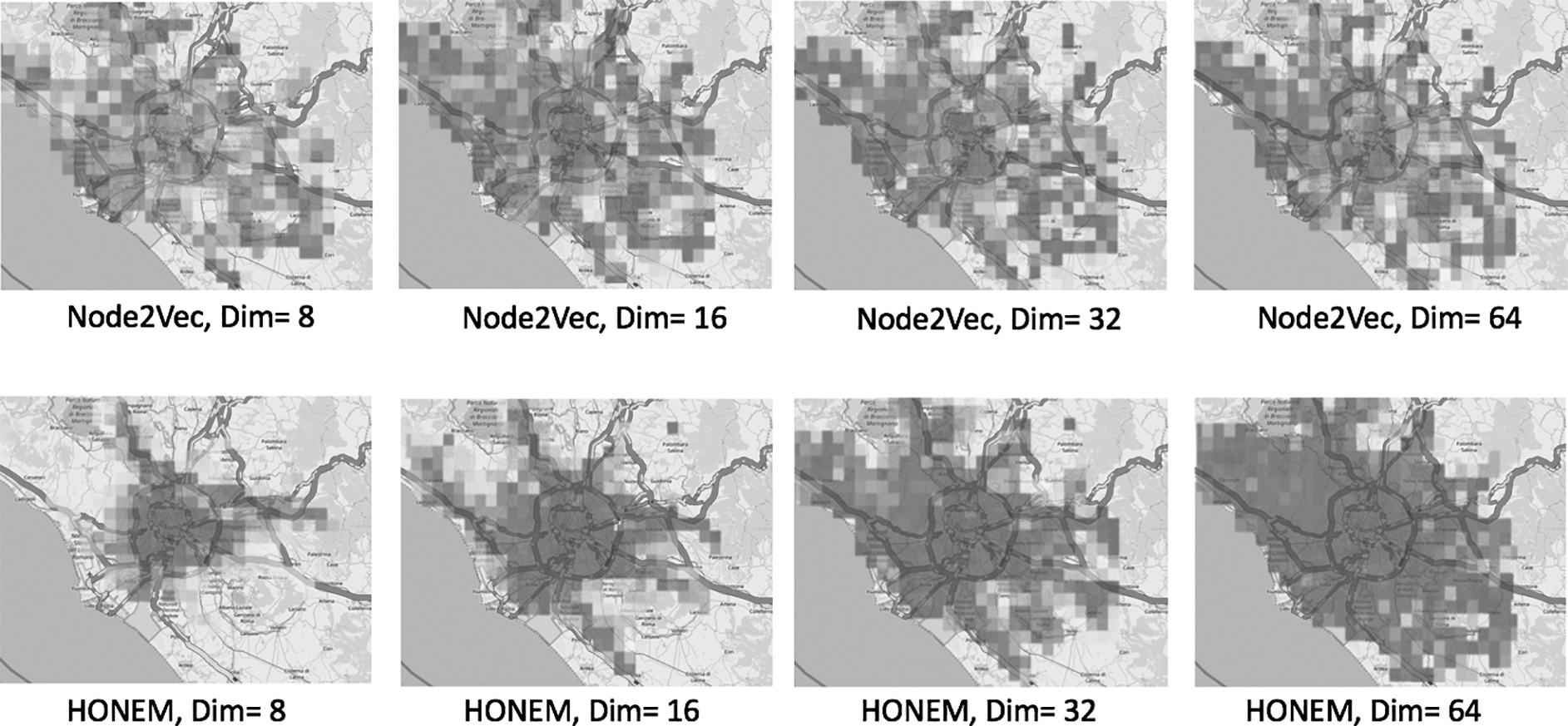
Variation of node precision with embedding dimension for Rome. The highlighted green lines indicate the major traffic routes of the city. The node color intensity indicates the link prediction precision for node i [
Node classification
We hypothesize that higher order dependencies can reveal important node structural roles. In this section, we validate this hypothesis using experiments on real-world data sets. Our goal is to find out whether HONEM can improve the node classification accuracy by encoding the knowledge of higher order dependencies.
We answer the above question by comparing state-of-the-art node embedding methods based on FON and our proposed embedding method, HONEM, capturing higher order dependencies. We evaluate our method on four different data sets and compare the performance with state-of-the-art embedding methods based on FON. In the traffic data, nodes are labeled given the likelihood of having accidents (i.e., “Low” or “High”). In Wikipedia, the nodes are labeled based on whether or not they are reachable within less than 5 clicks in the network. In the shipping data, nodes are labeled given the volume of the shipping traffic (i.e., “Low” or “High”). We use 70% of the data for training and 30% for testing. Our experiments show that compared with five state-of-the-art embedding methods, HONEM yields significantly more accurate results across all data sets regardless of the type of classifier used.
We evaluated the node classification performance using area under receiver operating characteristic curve across four different classifiers: Logistic Regression, Random Forest, Decision Tree, and AdaBoost. The results are shown in Figure 4. We observe that HONEM performs consistently better than other embedding methods. Specifically, we analyzed the HONEM advantage in each data set. We noticed that in the traffic data sets, nodes with more higher order dependencies are more likely to have an accident (Pearson correlation: 0.7535, p < 0.005). In the Wikipedia data, reachable nodes are more likely to have higher order dependencies (Pearson correlation: 0.6845, p < 0.001). In the shipping data, nodes with higher shipping traffic contain more higher order dependencies (Pearson correlation: 0.8612, p < 0.005). Such higher order signals do not emerge in methods based on FON (regardless of the method complexity). Furthermore, we notice that HONEM is fairly robust to the type of classifier. However, Decision Tree performs poorly regardless of the embedding method, as it picks a subset of features that do not fully capture the node representation in the network. In line with expectations, ensemble methods perform better overall, even though Logistic Regression offers competitive performance on the Wikipedia data set.
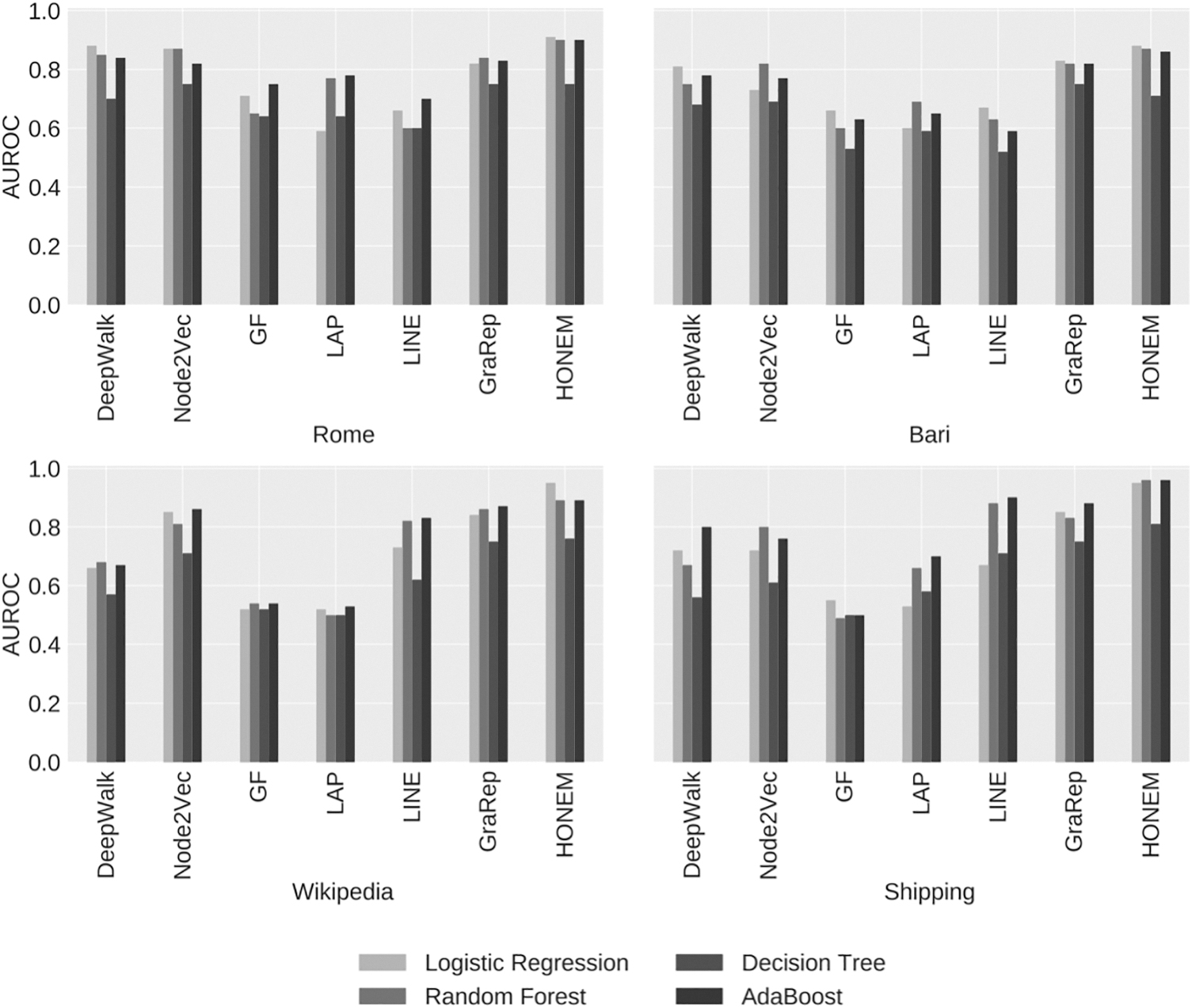
Node classification results. HONEM performs better across all data sets and is fairly robust to the type of the classifier.
Visualization
To provide a more intuitive interpretation for the improvement offered by HONEM, we compare visualizations of the produced embeddings against those of the baseline methods. As a case example, we visualize the subgraphs corresponding to two different topics from the Wikipedia data set. This is shown in Figure 5. Topics were selected from standard Wikipedia categories. Here, we show results for mathematics and geography, as they arguably represent two topics that are comparable in terms of generality but are also distinct enough to allow for meaningful interpretation. We use t-SNE 29 to map 128-dimensional embeddings to the 2-dimensional coordinates. Figure 5 shows two separate clusters for the embeddings derived from HONEM. However, it is possible to notice that a number of mathematics entries are interspersed with geography entries. These are the nodes of encyclopedic entries such as Sphere, Quantity, Arithmetic, Measurement, which, although primarily categorized under mathematics, are also related to many other topics—including geography.
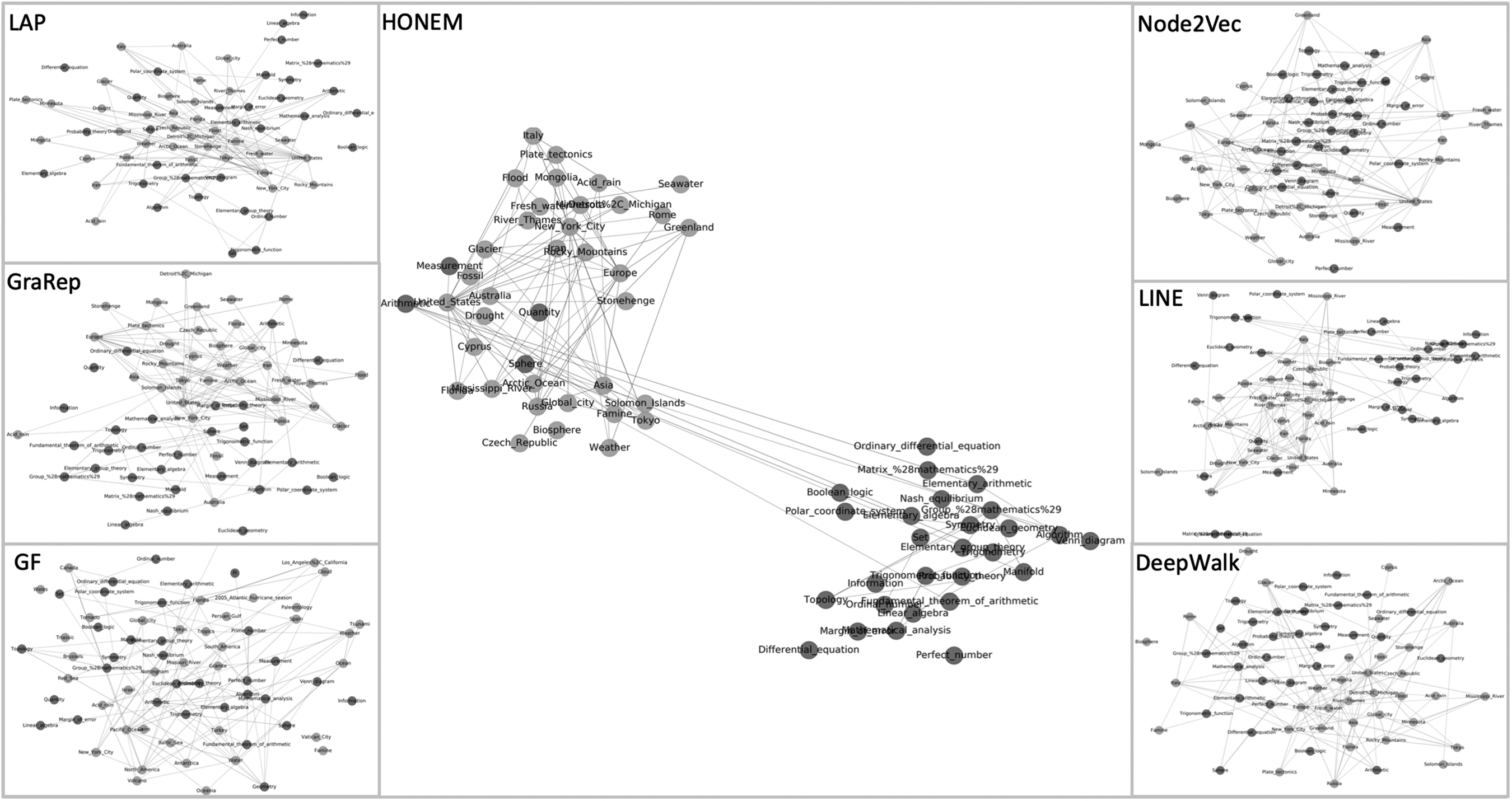
Visualization of mathematics and geography topics in the Wikipedia data set.
Figure 5 shows also the visualization results for the baselines. We observe that for many methods, the clusters are not as neatly distinguishable as those produced by HONEM. Specifically, DeepWalk, Node2Vec, and GraRep display separate clusters, but there are many misclassified nodes within each cluster. With GF and LINE, it is even more difficult to identify proper clustering among the articles. This indicates that higher order patterns are important to distinguish clusters and capture node concepts within the network.
Analysis of Running Time
The running time of HONEM consists of the time required for extracting the higher order dependencies and the time required for factorizing the higher order local neighborhood matrix. In practice, this is dominated by the time complexity of extracting higher order dependencies. To analyze this complexity, suppose the size of raw sequential data is L, and N is the number of unique entities in the raw data. Then, the time complexity of the algorithm is
We compare the running time of HONEM with the state-of-the-art baselines on the shipping data. We tested the running time on other data sets and found the shipping data to be the most challenging, both in terms of the number of nodes and edges, and network density. All the experiments were run on the same machine (Intel(R) Xeon(R) CPU E7-4850 v4 @ 2.10GHz). The results are shown in Figure 6. The running time of HONEM is robust to the embedding dimension. We notice that GF is the only method having better running time than HONEM. This is understandable since GF directly factorizes the first-order adjacency matrix of the network, while HONEM requires extra time for extracting the higher order neighborhood. However, the difference in running time of HONEM and GF translates to significantly better performance in link prediction, network reconstruction, and node classification. Moreover, higher order dependencies only need to be extracted once for each data set (regardless of the embedding dimension). However, for fair comparison, we added this time for experiments over all dimensions.

Comparison of the running time on the global shipping data. HONEM provides the best running time after GF. Both methods are robust to embedding dimension.
Related Work
Higher order networks
Networks have become a common way of representing rich interactions among the components of a complex system. As a result, it is critical for the network model to accurately capture the inherent phenomena in the underlying system. This has motivated a new line of research on HON models that are capable of capturing complex interactions beyond the pairwise node relations. Motif-based higher order models,12,30,31 multilayer higher order models,32,33 and non-Markovian higher order models10,11,17 are examples of efforts for more accurate network models. In particular, non-Markovian models have been shown to be more accurate in community detection,11–15 node ranking, 16 dynamic processes, 17 risk assessment, 18 and anomaly detection 19 system.10–12,17,20,21 In this work, we use the non-Markovian network model proposed by Xu et al. 10 due to its accuracy and efficiency in modeling higher order dependencies.
Network representation learning
Recent advances in graph mining have motivated the need to automate feature engineering from networks. This problem finds its roots in traditional dimensionality reduction techniques.34–36 For example, LLE 34 represents each node as a linear combination of its immediate neighbors, and LE 28 uses the spectral properties of the Laplacian matrix of the network to derive node embeddings.
More recently, methods based on random walks, matrix factorization, and deep learning have been proposed as well, although applicable to FONs. DeepWalk 24 learned node embeddings by combining random walks with the skip-gram model. 37 Node2Vec 5 extended this approach further, proposing to use biased random walks to capture any homophily and structural equivalence present in the network. A random walk-based method for knowledge graph embedding is proposed in Yu et al. 38 Role2Vec 39 further leverages attributed random walks to capture the behavioral roles of the nodes. In contrast, factorization methods derive embeddings by factorizing a matrix that represents the connections between nodes. GF 27 explicitly factorizes the adjacency matrix of the FON. LINE 6 attempts to preserve both first-order and second-order proximities by defining explicit functions. GraRep 22 and HOPE 8 go beyond second order, and factorize a similarity matrix containing higher order proximities. Walklets 40 approximates the higher order proximity matrix by skipping over some nodes in the network. Qiu et al. 41 show that LINE, Node2Vec, DeepWalk, and predictive text embedding 42 are implicitly factorizing a higher order proximity matrix of the network. Rossi et al. 4 propose another taxonomy by categorizing the existing embedding methods into role-based9,39,43,44 and community-based methods.5,6,22,24,45 A new crop of methods have been proposed recently that allow for dependencies of arbitrary order.7,22 However, this order needs to be set by the user beforehand. Therefore, these methods are unable to extract the order of the system from raw sequential data and fail to identify the higher order dependencies of the network without trial and error. HONE 9 uses motifs as higher order structures, however, these motifs do not capture higher order dependencies stemming from non-Markovian interactions in the raw data. In addition, several deep learning-based methods have also been proposed. SDNE 46 uses autoencoders to preserve first-order and second-order proximities. DNGR 47 combines autoencoders with random surfing to capture higher order proximities beyond second order. However, both methods present high computational complexity. Models based on convolutional neural networks were proposed to address the complexity issue.45,48–50
Finally, dynamic approaches have been recently proposed to capture the evolution of the network with embeddings.51–57 These methods still feature a computationally demanding task of dynamic network modeling. Furthermore, these methods are developed based on the FON structure and require specification of a time window, making them data dependent.
To the best of our knowledge, there is a gap in the literature when it comes to representation learning approaches that capture the higher order dependencies based on the raw data. HONEM fills an important and critical gap in the literature by addressing the challenges of learning embeddings from the higher order dependencies in a network, thereby providing a more accurate and effective embedding.
Note that although the raw trajectory data are collected over a period of time, we view this as a single snapshot to build both FON and HON. All the corresponding higher order dependencies in this snapshot are encoded as rules into the HON structure, which HONEM uses as higher order neighborhood information. Other static methods based on FON use the same sequential data but only consider pairwise relations to build the FON. Therefore, HONEM is not a dynamic network representation learning approach. We leave the exploration of the dynamic scenario for future work.
Conclusion
In this study, we developed HONEM, a representation learning algorithm that captures the higher and variable order dependencies in the HONs. HONEM works directly on HON and is able to discover embeddings that preserve the higher order dependencies based on non-Markovian interactions of the nodes. We show that the contemporary representation learning algorithms fail to capture higher order dependencies, resulting in missing important information and thus inaccuracies when dealing with HON. HONEM, on the contrary, extracts the significant higher order proximities from the data to construct the higher order neighborhood matrix of the network. The node embeddings are obtained by applying truncated SVD on the higher order neighborhood matrix. We demonstrate that compared with five state-of-the-art methods, HONEM performs better in node classification, link prediction, network reconstruction, and visualization tasks. We show that HONEM is computationally efficient and scalable to large data sets.
There are several directions for future improvements. In particular, different weighting mechanisms for modeling the effect of distance matrix for various orders can be explored. The HONEM framework creates a new path for the exploration of HONs. In the context of network embedding, various decomposition methods—other than truncated SVD—can be applied to learn the node embeddings from the proposed higher order neighborhood matrix. We also plan to implement the dynamic version of HONEM that can update the embeddings based on snapshots of HON over time.
Footnotes
Author Disclosure Statement
No competing financial interests exist.
Funding Information
This study is based on research supported by the Army Research Laboratory under Cooperative Agreement Number W911NF-09-2-0053 (PI: N.V.C.). G.L.C. acknowledges support from the Indiana University Network Science Institute.

Abbreviations Used
References
Supplementary Material
Please find the following supplemental material available below.
For Open Access articles published under a Creative Commons License, all supplemental material carries the same license as the article it is associated with.
For non-Open Access articles published, all supplemental material carries a non-exclusive license, and permission requests for re-use of supplemental material or any part of supplemental material shall be sent directly to the copyright owner as specified in the copyright notice associated with the article.
