




Abstract
While recent debate recognizes the importance of big data (BD) and knowledge management (KM) in firm performance, there has been a paucity of literature regarding big data analytics technological (BDAT) and knowledge exploration–exploitation capabilities (KEEC) in the context of business process innovation (BPI). This study aims to identify whether BD and KM can be established in these emerging issues. We used a survey questionnaire to collect data from various firms and industries. We used structural equation modeling (SmartPLS and SPSS) to validate the research model with a sample of 155 companies in a developing country such as Indonesia. The result demonstrates a positive relationship between KEEC and BPI, followed by several significant findings such as BDAT with KEEC; KEEC on big data knowledge management (BDKM); BDKM and BPI; and BDAT on BDKM. In contrast, BDAT is nonsignificant for direct relationship on BPI, and interestingly, it becomes a significant result after mediated by BDKM. Similarly, BDKM has successfully mediated the relationship between KEEC and BPI. The management level ideally develops and increases such a knowledge creation/acquisition practices and BDAT in an organization to gain more meaningful benefits from these two capabilities. BDAT, KEEC, and BDKM simultaneously are a clear antecedent approach, which ultimately results in flexibility, effectiveness, and effectivity of BPI. The cases of this research are profit firms in a developing country such as Indonesia. A future study could be considered in different settings such as type of industries or more specific company's type, the economy level of countries (comparing between developed and developing countries), and environmental dynamical. A novel field of study is the inclusion of knowledge exploration-exploitation and BDAT that drives BPI.
Introduction
In the new digital business process, the traditional way of information technology (IT) business process seems not sufficient enough to maximize the firm's business work due to the current complexity of business process innovations (BPI).1–3 There is a growing body of literature that recognizes that big data (BD) and knowledge management (KM) strategy become a central issue for the company to obtain competitive advantage and business innovation.4–6 In recent years, adopting big data analytics (BDA) into daily operational activities of companies has magnificent results.7–9 However, recent studies of BDA mostly only focused on a very computational aspect such as computational intelligence for a cyber-physical system, 10 machine learning, 11 Internet of things, 12 and prediction technique13,14 rather than management or managerial contributions in KM field and BPI15,16 in KM field.
It is still questionable how firms develop a strategy to pursue the innovative business process in the BD era. The issue is that most companies consider BD adoption only as a set of computational tools. In a survey of BD adoption, the company's executives (respondents) state that the failure of BD implementation does not appear from the technology side (only 7.5%), 93% of main obstacles are from people and process issues. 17 From another perspective, BD technology is analyzed as a complex socio (people skills or knowledge) and technical processes (technological tools), which are not equal only to technological tools but composed both social process and technology and their combination.17,18 Hence, BD adoption ideally should be analyzed and understood not only as a technical tool but also as a knowledge capability or management perspective.
BD can be separate into two main areas of its capabilities and benefits 19 : the first line is related to managerial or organizational processes and known as big data analytics capability that provides value and competitive advantage.4,20 The second line is focused on technological or computational process or data analysis process and known as BDA. 21 The study shows that a company's survival by its ability to obtain both management side (process, people, knowledge) and technical side (software, hardware, other IT resources) of innovation capability. 3 Thus, it needed to simultaneously manage the management and technology side of innovation efforts in the context of BPI.
Obtaining business process performance, knowledge creation/acquisition practice is required.22,23 The lack of a direct empirical measurement for technical-focused and knowledge-focused of BDA adoption on BPI has yielded a knowledge gap. Focus only on technologies part without considering knowledge processes is a failure strategy. 24 In short, whatever the technology initiative, however, much depends on the alignment of components, such as people, knowledge resources, and technology tools. 25 Otherwise, technology adoption would be unbeneficial when it does not fit into the current innovation strategy. However, knowledge strategy still limited knowledge and less evidence in the setting of BPI and BD adoption strategy. Most strategies of knowledge creation still focused on general context of firm performance5,21 instead of two sides of innovations such as business process and BD. Thus, there is still unexplored knowledge and theoretical development of knowledge creation or knowledge acquisition strategy in the context of BD and BPI.
Researchers26,27 with their ambidexterity theory of organizational learning strategy successfully increased the firm's performance advantage. By extending their works, we provide the two approaches of knowledge capabilities, namely knowledge exploration-exploitation capabilities (KEEC) in the term of BPI. In practice, knowledge exploration pursuing and exploring new sources of knowledge, idea, and information potentially lead to flexibility innovation. 28 On one side, knowledge exploitation involves existing knowledge, and it is more related to efficiency and effectiveness innovation of business process that maximizes current resources in the company. Additionally, scholars argue that by enabling the exchange of existing knowledge base, the firm can obtain efficiency and effectiveness innovation of business process. 29 We then involving KEEC as a knowledge-focused perspective approach for increasing BPI.
In BPI, obtaining flexibility, efficiency, and effectiveness innovation is essentially more uncertain and requires more complex IT resources. 30 Business process flexibility requiring the technology reinforcing (being consistent with the exploring new values of technology features) and business process effectivity and efficiency innovative more requiring existing values of IT. Moreover, prior research mostly separates BD and KM to lead business performance.5,21 In our study, we develop a combination of BD-KM and called it as “big data knowledge management (BDKM)” that can mediate between big data analytics technological (BDAT) and KEEC process to the context of BPI. This new mediator will allow firms to reassess their knowledge resources and BD system on business to achieve efficiency and effectiveness. Regarding the literature above, we then infer a new term of how BPI (flexibility, effectivity, and efficiency) capabilities require drawing upon BDAT approach in a technological way to support BPI goals.
Finally, to attain any meaningful practical and theoretical contributions, as well as to identify critical areas of further research, this study attempts to answer the following related research questions:
Does the KEEC result in BPI gains and whether the resulting increase through the mediating role of BDKM? Does BDAT result in BPI of BD adoption gains and whether the resulting increase through the mediating role of BDKM?
Moreover, the novel contribution of this research is the inclusion of KEEC and BDAT that drives BPI.
Theoretical Review and Hypothesis Development
BDAT, KEEC, and BPI
Nowadays, proper IT or BD technology has become promising within business process operations as a tool for getting more efficiently, effectively, and timely within an enterprise operation analytics. 15 Recently, other researchers discuss the intercorrelation between BD and KM. 31 The phenomenon of KM and ambidexterity as capabilities to support business performance has attracted the researcher's attention.5,26,27 The organizational ambidexterity or knowledge ambidexterity has two subcapabilities, namely exploration and exploitation capability. The exploration refers to generate new information and knowledge, whereas the exploitation of knowledge consists of refinement, generation, implementation, and maximizing existing information and knowledge. The challenging part is now how we develop a new term of BDAT to support KEEC.
By its technology side, BDAT can enhance organizational activities such as a knowledge exploration process. BDAT could enable the machine to collect and manage information and knowledge and facilitate knowledge creation process. 32 For instance, BD with its open system networks as an online space/forum enable the company's members to discuss their business idea, asking solutions, and helping their colleague's problems. Based on these online discussions, BD open systems can develop new knowledge (part of knowledge exploration) and offer access to new knowledge in real-time schema and then share it within an organization. By providing system access to the knowledge online databases, the knowledge exploration process can be increased.
On the other side, BDAT can also enable the knowledge exploitation process. BDAT with its remote and mobile systems can improve information and knowledge sharing easily. Through these activities, the firm can reuse, reapply, transform, and leverage their existing firm's knowledge.
33
Moreover, BDAT with the software or application of multiple across platforms enhances intra- or extra-firm coordination by activating the cross-collaboration system to facilitate knowledge exploitation process.
34
In brief, BDAT tools enable KEEC within company and external business partners. Therefore, it is reasonable to hypothesize that:
According to scholars, 35 BPI is the activity or process strategy and its application created value for the company. Researchers found that three elements of BPI are process flexibility, effectivity, and efficiency. 36 Scholars empirically tested that the business process becomes a significant impact on company performance when it received support from IT tools.37,38 The reason for this relationship is that IT tools provide value for the company by enabling internal and external business processes.
Since the BPI not only focuses on reaching efficiency but also achieves flexibility and effectiveness, thus getting better results of innovations, IT tools as BDA can serve the business process more effective, efficient, and flexible. The vital role of BDAT in the business process is driven by specialized BDA software and provides various business benefits, such as improved operational efficiency, more effective coordination, services effectivity, and competitive advantages to the competitors. For example, scholars found out that BD increase supply chain performance by providing effective decision-making and better informed across the supply chain management process.
39
Therefore, it is reasonable to hypothesize that:
As we elaborated above, the ambidexterity theory provides two innovations, namely exploration and exploitation that support business and firm performance.26,27 They argue that both exploitation and exploration capabilities need to be merged with the current business process and the future business plan to get more advantages for the firm. In practice, knowledge exploration pursuing new ideas, knowledge, and solution that same goal with flexibility innovation of business process that seeks for transforming new service innovation, product, and technology. For instance, knowledge exploration is a crucial process for the company due to the development of new knowledge that is distinct from the current or existing knowledge to develop business flexibility and new business opportunities. 22
On one side, knowledge exploitation is equally important for the company concerning maximizing and reinforcing existing knowledge to gain business efficiency and effectivity.
40
Thus, reaching both knowledge modes is quite necessary for enabling short-term business efficiency and long-term business survival.26,27 The crucial and challenging process is how scholars develop a new term of KEEC in the context of BPI. Therefore, it is reasonable to hypothesize that:
The role of BDKM
There are a lot of IT tools that support online communication for data distribution, information, and knowledge sharing activities. Like other IT capabilities that successfully enable knowledge sharing practices, BD technology is a useful tool for the company to manage their intangible assets, such as customer behavior data, information, and even worker's knowledge.41,42 Thus, BDA can increase personal knowledge of employees in the context of KM strategy. BD enhance KM strategy not only in the knowledge sharing system but also in exploring more employee's knowledge and then enabling the company's performance. However, the company's ability to transform BD acquired from KM into knowledge business-oriented depends on the extent to which the company can acquire the information and knowledge, using and combing with existing knowledge, and generate new knowledge solutions for the BPI through both KM and BDAT. Therefore, it is reasonable to hypothesize that:
Many scholars found out that KM is a unique value of an organization that plays a crucial role in achieving innovation and advantage.
5
The main process of KM implementations such as knowledge acquisition, storing, and sharing through online databases. KM can support companies by integrating and reconfiguring KEEC.26,27 In this view, KM has been related to the company's practices such as managing knowledge repository and developing new technologies such as BDKM that allows the efficiency of knowledge collecting both internal and external sources.
43
In the current digital era, developing a knowledge creation/acquisition strategy for a company is the main source of BDKM that the company could achieve business based on knowledge-oriented. Therefore, it is reasonable to hypothesize that:
Based on a discussion of the literature review above, for future study of BD and KM practice should be more focused on a business process to improve the innovation. The integration of a variety of information, knowledge, and experience through BDKM schema will lead to the development of a new innovative business process (e.g., flexible, efficient, effective). We then introduce a new approach that expected will make the KM strategy more efficient and innovative. Through this new term, the company uses coding systems of BD that we have collected about knowledge acquisition and business process activities. They also can promote the exchange of BD/knowledge of business processes in internal mechanisms.
Besides, this approach allows the firm to use such a tool/technique for meeting and interview activities with business partners. Moreover, the two combination capabilities ensure knowledge and information reach everyone in the company. The weighting of BDKM initiative through its combination is offering knowledge–technology alignment to facilitate company's business partner, process, and management levels become more flexible in maximizing knowledge resources capabilities. Therefore, it is reasonable to hypothesize that:
The previous study recognized that IT can support firm performance such as more digital processes and become agile in the business process. 44 The business activities need to perform the exploration and exploitation strategy to make business more agile. 45 On one side, IT digital lead the company's work process and KM system strategy.46,47 In short, IT tools such as BDAT can be used to develop a digital process that enables exploration and exploitation activities. Besides, for performing the IT tool such as BD technology, the ability or knowledge of the user is required. 48 Several prior studies also conducted the KM practice as a strategy of the company to increase its member's capability or knowledge to enable them in operating the IT/BDAT tools in the company.49,50 The correlation between knowledge acquisition/sharing and firm performance can be processed by considering knowledge resources or competencies such as maximizing current knowledge or information and exploring new knowledge for future market and business strategy.51,52
The prior study found out that BD 7 and KM 53 successfully mediated the correlation between knowledge creation process and business process performance. However, previous studies mostly separate the contextual variable of BD 21 and KM 5 to enhance firm's innovation. We then in this study try to explore the new term called BDKM. In particular, through this schema, the firm can use BD systems to review their existing information and knowledge on business to make it more effective and efficient. 54 Once these resources (e.g., information, knowledge, experience, expertise) are managed by BD system, all company's members (employees or leaders) can quickly access and real time and thus lead to improved business operational. They could also evaluate previous business tasks to be more flexible in innovation tasks. We then conclude that how these two approaches (BD technology and KM) in the new term (BDKM) can contribute to generating the process of business–knowledge related remains underexplored.
Thus, based on the literature discussion above, the integration of BD-based KM as a new approach for BPI, which replaces the traditional business process and methods. We expected to investigate and provide a new term orientation, namely BDKM in providing BPI. In this view, we assume that BDKM gathered through KEEC will improve BPI. Therefore, it is reasonable to hypothesis that:
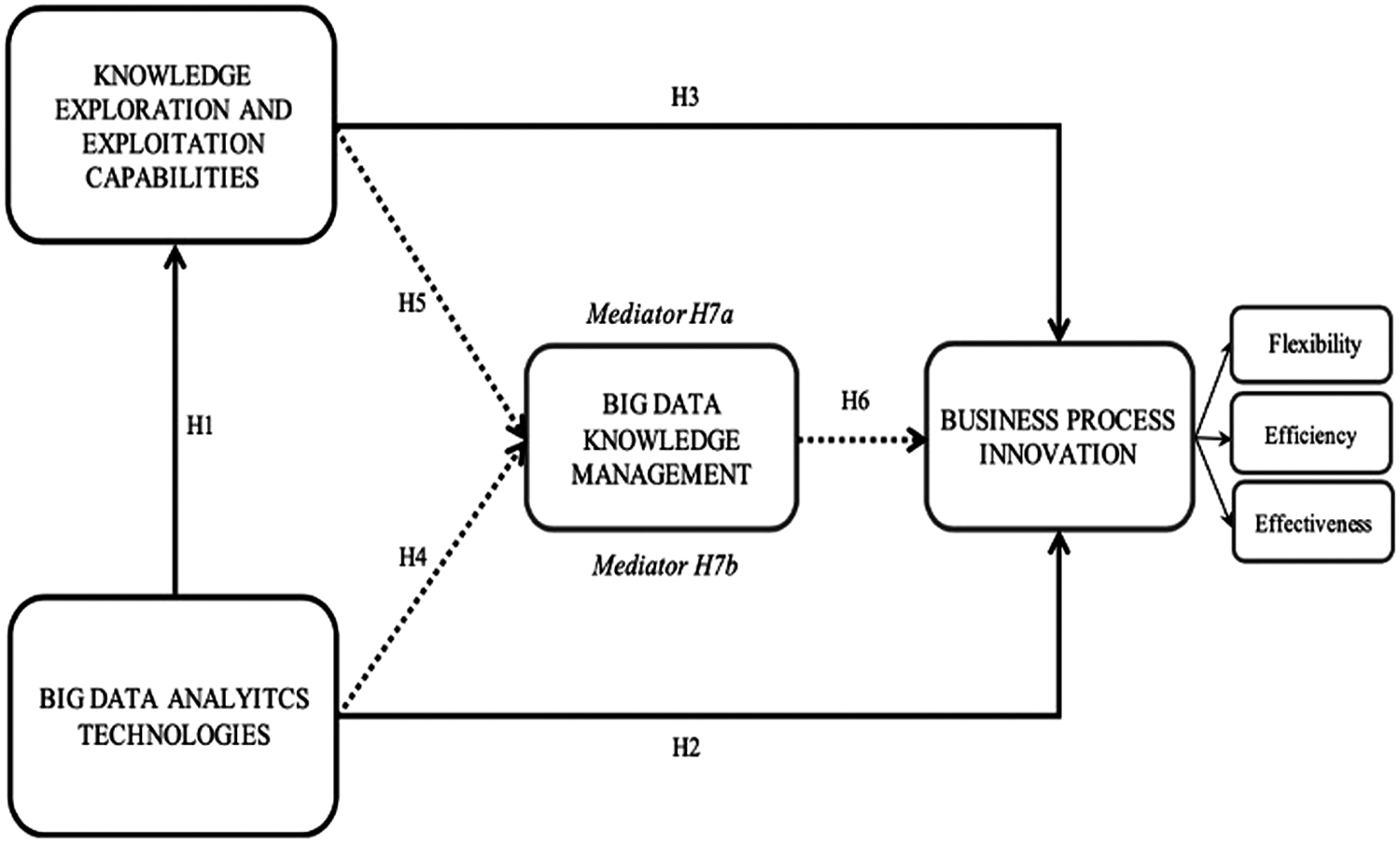
Theoretical model development.
Methodology Design
Items measurement development
This research combined and tested several constructs (see Appendix A1 for items measurements). First, BDAT composed of six items based on the study by Byrd and Turner, 55 and we extend to the two subfactors of BDAT, namely analytics oriented (AO) with three items and user-oriented (UO) with three items: AO1: All connectivity tools (remote, branch, and mobile) are connected to the central data of firm for analytics; AO2: Our firm utilizes open system network mechanisms to boost analytics connectivity; AO3: Software and applications can be easily transported and used across multiple analytics platforms; UO1: User interfaces provide transparent access to all platforms and applications; UO2: End users can utilize the object-oriented tools to create their analytics applications; UO3: The applications can be adapted to meet a variety of needs during analytics tasks by the operator or user.
Second, the two subfactors with four items each were used for the variable of KEEC 27 : LOR1: Business problem areas generating customer and partner dissatisfaction were discovered and solved through creative ways; LOR2: Another problem areas generating customer and business partner dissatisfaction were discovered and solved through creative ways; LOR3: New knowledge, methods, and technological ideas were introduced to achieve business process flexibility; LOR4: Many new novels and creative ideas of business process were produced by “thinking outside the box”; LOI1: Valuable existing knowledge elements were identified, combined, and reused to gain the effectivity of business process; LOI2: Existing knowledge and competences related to existing products/business services were used and adjusted; LOI3: New and existing ways of doing things were integrated without hindering efficiency; LOI4: Lessons learned in other business process areas of the firm were put in operation.
Third, BDKM was measured with seven items adapted from the studies of Chierici et al. 56 and Alegre et al. 57 : BDKM1: We use coding systems of BD that we have collected about knowledge acquisition and business process activities; BDKM2: We use internal mechanisms to promote an exchange of BD/knowledge on the business process; BDKM3: We use participatory techniques among our business partners (e.g., client meetings and interviews); BDKM4: We use tools to ensure BD about knowledge and information reach everyone in the company; BDKM5: Our company has information and knowledge processing systems to process BD about business; BDKM6: Our company uses control systems and reviews the firm's existing information and knowledge on business to be more efficient and effective; BDKM7: We use systems that allow the BD that were used in previous innovation tasks to be used in new flexibility innovation tasks.
Fourth, for the BPI, the measurement questions were divided into three main subfactors, namely process flexibility, process efficiency, and process effectiveness adopted based on the study by Karimi et al. 36 and modified to fit the context of this study. Process flexibility: FLY1: We have found ways to customize our business processes; FLY2: We have made our firm more agile by using BD technology and knowledge sharing activities; FLY3: We have made ourselves more adaptive to changing business environment; FLY4: We have improved the flexibility of our operations by using BDAT. Process efficiency: EFY1: We have improved the efficiency of our operations; EFY2: We have lowered the cost of our operations by using BDA technology; EFY3: We have reduced the amount of rework needed for data entry errors by using BD technology. Process effectiveness: EFS1: Data and knowledge provided by BD systems and KM add value to our operations; EFS2: We have improved timely access to corporate data by using BD systems; EFS3: We provide a high level of enterprise-wide data integration through BDAT; EFS4: The functionality of BDAT and KM adequately meets the requirements of jobs and successfully improved the quality of our operations. For the perspective view of this study, we adopt ambidexterity theory from the studies of March 26 and Revilla et al. 27
The items scores using a 5-point Likert scale with 5 presenting strongly agree and 1 presenting strongly disagree. 58 SmartPLS 3.2.8 tool was used for the research model and path analysis testing based on structural model criteria. 59 We used the SmartPLS because this statistical tools merit with the complex model 60 and it is suitable and premises sample with relatively small.61,62 To support our reasons, some scholars also used and found that the SmartPLS tool can be used for small size respondents even under 100 and very suitable, 63 and SmartPLS has merit to apply in KM studies. 64
Sampling and procedure
The respondent target of this research is the profit companies in Indonesia. Indonesia is the largest industry in the Southeast Asia continent, 65 and respondents from Indonesia companies could be generalized to other developing countries since they have similar cultural, behavior, and economic situations. 66 We prechecked the respondent candidate of each profit company to ensure that they were involved responsible for BD technology or IT-related features in their company. Those companies that did not meet checking standards were not involved. We did several ways to get the respondent feedback through mailed, conventional surveys, and an online survey (e-mail).
The respondent's feedback was collected from December 2019 to March 2020. The invitation and questionnaire survey were delivered to 550 companies. A total of 155 companies have participated with a 28.2% response rate. The respondent's company size varies from a micro, small, medium, and large companies based on Indonesia regulation. 67 The respondent's position was categorized into IT managers, business managers, hardware and software department, manufacturing firms, computer and IT services firms, mining, oil, gas firms, agriculture and farming industries, finance firms, food industries, entertainment industries, and others staff in IT- or BD-related area. Table 1 shows an executive summary of the company's respondents.
Respondents' demographics
IT, information technology.
We tested the nonresponse bias sample of the respondents. During the distribution of samples, for the first round, 40 valid samples were collected, while 20 valid samples for the second round. Thus, the T-test has verified the questionnaires for the first and second round. Additionally, the common method variance (CMV) technique will inappropriately expand the correlation among constructs. We adopted Harman's single factor test to determine whether there are CMV in research constructs. 68 This method is to analyze all items of each construct in the nonrotating factor, and the value should be more than 1.
Analysis and Executive Results
Reliability and validity scores
Scholars suggest that for the loading scores should be significant and exceed 0.7, composite reliability should exceed 0.7, and average variance extracted (AVE) should exceed 0.5. 69 The data quality test consists of testing validity and reliability. Validity checking uses correlation techniques such as a correlating score of each item with a total score.
Based on Table 2, Cronbach alpha scores of all constructs are reliable for this study. Besides, the CR scores shown are acceptable since all scores met the minimum standard cutoff of 0.7 that indicating a commonly acceptable level for confirmatory of the model. Thus, regarding the result of the value, all scores for convergent validity were met. Moreover, the scores of factor loadings of each measurement item are above 0.7, except LOI2, EFY2, and EFS1 were eliminated from further analysis. Regarding the validity and reliability values, it can be concluded that the data collected show a fairly good level of consistency and accuracy. Additionally, the testing of the path coefficient or hypothesis proposed in this study was carried out based on the critical ratio value of the causality correlation among constructs.
Convergent validity and reliability results
AO, analytics oriented; AVE, average variance extracted; BDAT, big data analytics technological; BDKM, big data knowledge management; BPI, business process innovations; CA, Cronbach alpha; CR, composite reliability; UO, user-oriented.
Furthermore, Table 3 “discriminant matrix” represents the square root of AVE for each variable and shows that the diagonal scores exceeded the interconstruct correlations. It is indicating that all variables in the conceptual model present adequate discriminant validity as additional technique examining the impact of potential CMV when the AVE scores for each variable over the square of the construct correlation. The degree level to which different variables are distinct from one to another variable such as a discriminant validity was tested by cross-loading scores among variables to the square root of the AVE for that variable. 70
Discriminant matrix results
KEEC, knowledge exploration–exploitation capabilities; SD, standard deviation.
Conceptual model results
Figure 2 and Table 4 show the executive summary of hypothesis/path coefficient results: KEEC, BDA technology, BDKM, and BPI.
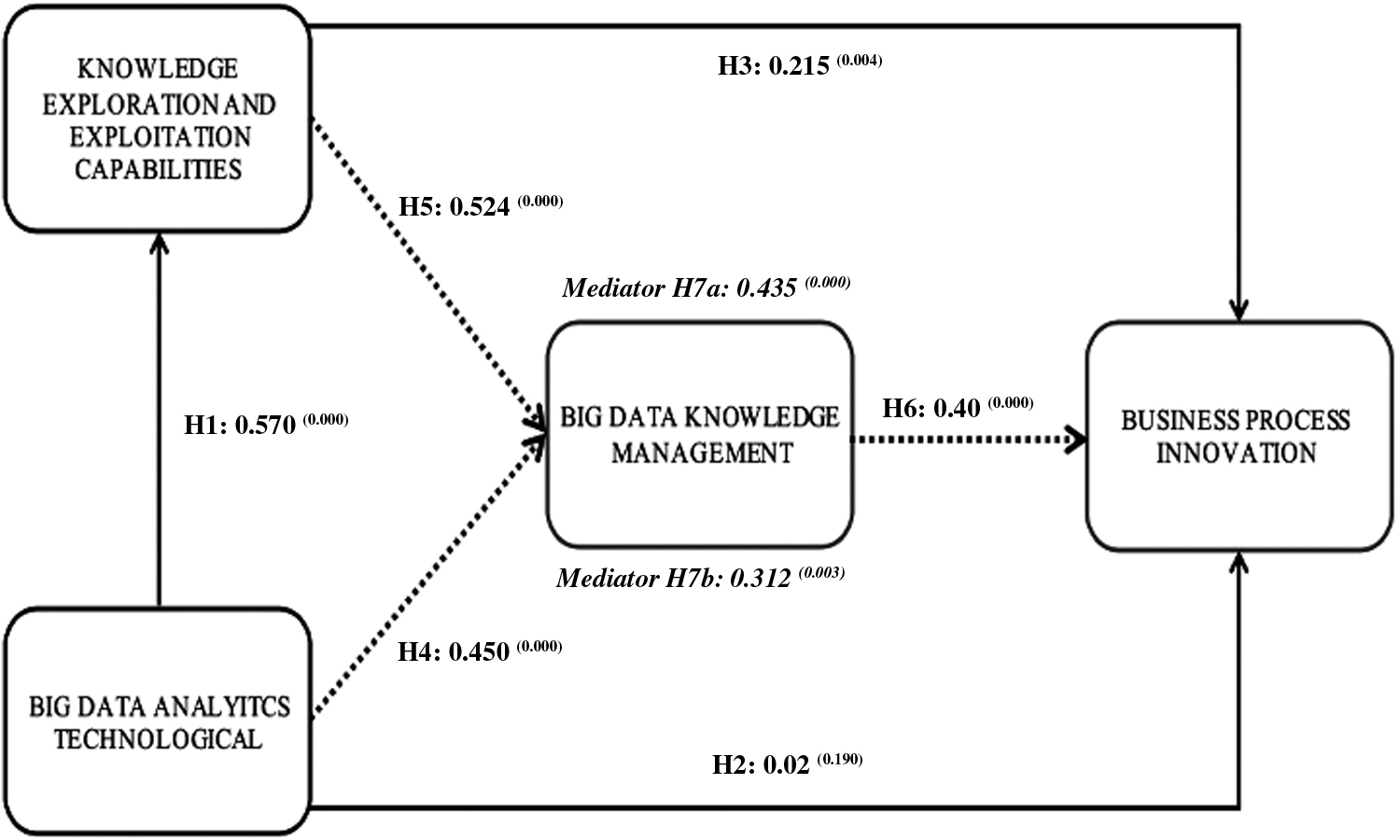
Research model results.
Executive summary of model results
SE, standard error.
The result of path coefficient 1 was observed, and the result was approved by a positive relationship between BDAT and KEEC (β = 0.570***). In contrast, the finding of path coefficient 2 showed that BDAT is nonsignificant for direct relationship on BPI (β = 0.02n.s). For path coefficient 3, there was a positive correlation between KEEC and BPI (β = 0.215**). Similarly, path coefficient 4 showed that the correlation between BDAT and BDKM was positive (β = 0.450***). Besides, a positive correlation was provided for path coefficient 5, which is KEEC on BDKM (β = 0.524***). As expected, for path coefficient 6, BDKM and BPI were positively correlated (β = 0.392***). The authors discussed an in-depth explanation of the correlation in the Discussion, Conclusion, and Contribution section.
Mediating role results
Besides the main hypothesis analysis, we also tested the mediating effect variable (Table 5). We checked whether BDKM mediates the correlation between KEEC and BPI with technique, namely an asymmetric bootstrap test of mediation or indirect effects.40,71
Executive summary of mediation results
CI, confidence interval.
Also, the correlation between BDAT and BPI through BDKM was checked. In addition, scholars argue that to establish the mediating role, a significant indirect effect is required. 71 The findings show that two mediators' values from BDAT were supported. BDKM has successfully mediated the relationship between KEEC and BPI (path coefficient 7a: β = 0.435***). Similarly, the result shows a significant correlation between BDAT and BPI through mediating variable BDKM (path coefficient 7b: β = 0.312**). Thus, both hypothesis 7a and hypothesis 7b received support.
Discussion, Conclusion, and Contribution
Discussion
Companies are increasingly looking BD and KM strategy to improve their business process goals.4,5 With the increasing popularity of BD adoption in profit companies, it is important to understand how BDAT works and how it is linked to knowledge exploration and exploitation capabilities (KEEC) and BDKM. Despite these remarkable topics that have attracted the interest of both practitioners, the impact of how BDAT enhances the KEEC practices that can contribute to KM strategy and BPI remains largely unexplored. Transforming knowledge–business related to meaningful capabilities through the development of KM practices has become a critical asset for firms to boost their innovation and to achieve greater business process performance.
This study explores the constructs underlying BDAT, KEEC, and BDKM to enhanced BPI. Our results show that BDAT has a significant influence on KEEC and BDKM. As previous study, this study also found that knowledge exploration–exploitation practices are a stronger driver of BPI.26,27 Also, KEEC construct influences BDKM by providing knowledge resources as sources for BD systems.
BDKM is key mediators of this research. The results show the significant results of indirect effect of mediating role through BDKM between BDAT and BPI, followed by a significant indirect effect between KEEC and BPI via BDKM. In our research results, however, BDAT is not directly significant associated with BPI. We speculate that BD tools required knowledge capacity of the users/team that operate BD systems in the context of business activities. Like our result of third hypothesis when the BDAT is mediated by BDKM, the relationship of them is supported. In other words, better the knowledge sharing practices, better the outcome of BDA capabilities to enhance business process routines.
Practical/managerial implications
In this study, we empirically found that to fully gain the benefits of BDAT in BPI, companies must possess BDAT and a certain level of BDKM orientation. Our study presents that BDAT, KEEC, and BDKM simultaneously are a clear antecedent approach to support business activities, which ultimately results in superior BPI. As the BPI is directly influenced by KEEC practices and BDKM, the management level ideally develops and increases such a knowledge creation/acquisition practices in an organization to gain more meaningful benefits from these two capabilities. Otherwise, their business process will not be getting peak innovations on the market.
The top management level should provide technological infrastructures that can increase the functionality of KM practices and BDA tools in the company. 4 Leaders should, therefore, invest in developing these capabilities, ultimately creating business flexibility, effectiveness, and effectivity. In this study, the effectiveness results refer to knowledge provided by BD systems and KM add value to business operations, can be accessed in real time, data integration, and meet the works requirements and successfully improve the quality. The effectivity outcomes are related to the operational cost-efficiency and reduced the errors of data entry process by using BD technology.
Specifically, this research shows that BPI can be direct and indirectly gained by focusing on several sides of interrelationships such as from knowledge capabilities, BD technologies, and BDKM. Leaders are recommended to invest more extraordinary systems such as open system networks, software, hardware, and other BD-related applications that can cover all levels of companies including external boundaries. These kinds of technology tools will help KEEC through collecting, storage, and sharing it throughout the company. In short, in this way, the firm can achieve the maximum business process initiative and become more autonomously.
Besides focusing on KM in the times of BDA technology, the management team of firms must pay more attention to the human side (e.g., ability, knowledge, know-how) of BD technology adoption. As the scholars found that whenever the company willing to adopt the technology, it always required the capacity of users or humans. 48 If the staff or internal users who operate the BD systems are not capable, they will fail to get a maximum of BD benefits and lose a lot of BD investment. In addition, if needed, the company may hire the experts or consultants of BD that provide the services of how to successfully operate the BD technological system. 72 The team in an organization that understands the problems needs to be brought together with the right data, information, knowledge, but also with the people who have problem-solving techniques that can effectively and efficiently enhance the business process. This may support better decision-making development locating knowledge resources and the business activities relevant decision. Hence, in the BD era, knowledge is created and transferred, and knowledge workers are often not where it used to be.
Theoretical/research implications
This research has several theoretical or research implications. First, this study contributes to the stream of KM literature, emphasizing another promising effect of developing KM capability through knowledge exploration-exploitation orientation. Additionally, the KEEC have the potential to amplify the positive effects of BDAT on BPI, maximizing knowledge resources with BDKM management. Second, this study empirically validates the effect of BDAT on BPI, confirming the emerging IT-related capabilities to the overall business process competitiveness of digital business era. 20
Third, this research extends the current design of KM practices by providing empirical impact for the mediating role of BDKM as a vital company resource in the relationships between BDAT and BPI and between knowledge exploration–exploitation practices and BPI. These interesting findings indicate that, in contrast to knowledge exploration–exploitation practices that influence BPI only directly, the other way to enhance BPI indirectly through the mediating role of BDKM. Similarly, compared with an insignificant direct effect of BDAT to BPI, the result is more meaningful via the mediating role of BDKM. Due to the negative risk of using resources strategy, this research promises that BDKM support firm's BPI in maximizing knowledge resources such as exploring new knowledge and exploiting existing knowledge through mediating role.
Fourth, in this view, our work extends the mediating construct adopted to explain the correlation between BDAT and knowledge exploration–exploitation, highlighting that BDKM is an important element for flexibility, effectiveness, and effectivity of BPI. Furthermore, since the different results of the direct and indirect relationship of BDAT on BPI through a mediator of BDKM, this research also suggests treating the BDAT as coexisting but separate variables.
Fifth, this research may subsidize the dynamic capability area of literature by addressing the role of three crucial capabilities and their association. Moreover, the research model result may be complemented with previous studies that argued about the connection between IT capability and business innovation with dynamic capabilities that mediates the correlation 73 to get better benefits of the sources of IT or BD-based competitive advantage. 20 This study shows the importance of strategic alignment of knowledge, and technical factors are acknowledged and regarded as having a significant positive direct effect upon BPI. Moreover, maximizing and increasing the knowledge exploration-exploitation through KM-related theory is one of the key required conditions of BPI and can be considered in future studies.
Conclusion and future work
Our research is inspired by recent discussion regarding how empirical research of BDKM approaches can help to shape the BPI field of inquiry. 4 The authors are not to claim that this research framework will be fully suitable in different types of organizations because this research focused on profit firms. The cases of this research are profit firms in a developing country such as Indonesia, and the company's types are manufacturing firms, computer and IT services firms, mining firms, agriculture and farming industries, finance firms, food industries, and entertainment industries sector. Hence, we remind the readers and researchers to be more critical thinking and recheck to apply or re-developed our research framework.
Therefore, the result provides future research opportunities for upcoming researchers in different settings such as different type of industries or more specifically companies type, economy level of countries (comparing the developed countries with the developing countries such as Indonesia), the business regulation, and other environmental dynamical. Further research agenda could also empirically check the mediating effect of KEEC between BD and business processes. Moreover, the specific style of leadership could be considered as a moderating variable for future studies to explore more whether the top management level will increase the adoption of BDKM in the context of business innovation.
Footnotes
Acknowledgments
S.S. is the corresponding author of this article (PhD candidate at Department of Information Management, National Taiwan University of Science and Technology; Lecturer at Department of Information System, Universitas Islam Negeri Sultan Syarif Kasim Riau, Indonesia; and PRO-Knowledge Research Group, Indonesia). We would like to thank the Committees and Reviewers for their critiques and revision recommendations.
Author Disclosure Statement
No competing financial interests exist.
Funding Information
The authors declare that no grants were involved in supporting this research/publication. This research was supported with Department of Information Management, National Taiwan University of Science and Technology.
Abbreviations Used
Appendix A1. Items Measurement
This research combined and tested several constructs, namely big data analytics technological (BDAT), knowledge exploration–exploitation capabilities (KEEC), big data knowledge management (BDKM), and business process innovations (BPI).