




Abstract
With the widespread application of intelligent systems in major industries, the traditional equipment manufacturing industry has gradually shifted to advanced equipment manufacturing. The innovation network of an industry directly affects the innovation capability of the industry, so the research of innovation network has always been the focus of attention. However, there are few researches on the innovation network of advanced equipment manufacturing industry, so this article has launched an in-depth study on it. First, it analyzes the basic geometric characteristics of the innovation network. Then, based on the small-world network model, an evolution model of the advanced equipment manufacturing innovation network was created, and simulation experiments were performed on the evolution model. The experimental results show that the clustering coefficient and the average distance showed different changes in different stages, but in the end they all gradually stabilized. The clustering coefficient was 0.484, the average distance was 1.854, and the degree of small cosmos was 0.497. This shows that the innovation network evolution model established in this study can reveal the evolution process of the innovation network of advanced equipment manufacturing through simulation experiments.
Introduction
Background significance
Advanced equipment manufacturing industry has many advantages, such as high technology content, strong industry driving ability, and high productivity increment rate, which provides technical support for national economic development and national defense construction. 1 Under the background of intelligent era, the concept of intelligent manufacturing also needs to be introduced into traditional equipment manufacturing industry to promote its transformation to advanced equipment manufacturing industry. Innovation network effect can enhance the innovation ability of industry, improve the efficiency of innovation, and comprehensively enhance the competitive advantage of industry and enterprise. 2 Therefore, revealing the evolution process and internal law of innovation network of advanced equipment manufacturing industry can provide assistance for the development of advanced equipment manufacturing industry.
Related study
The application of intelligent systems in the equipment manufacturing industry has aroused the attention of many researchers. Chavarria-Barrientos et al. proposed a method based on the principles of enterprise architecture to analyze the characteristics of sensing, smart, and sustainable manufacturing enterprises (S-3-ME). 3 Lu et al. proposed the displacement pressure drop framework of the double closed-loop control method. Based on Siumlink and the mechanical model, the control system model was established and simulated. 4 Their research is of great reference for the development of advanced equipment manufacturing, but the analysis methods used for the results obtained after experimental simulation are not accurate enough. Innovation network has always been an important part of enterprise development, and in-depth research has been carried out at home and abroad. Acemoglu et al. use 1.8 million U.S. patents and their citation attributes to illustrate the innovation network and its strength, and uses the cross-technology category citation model from 1975 to 1994 to calculate the past innovation network structure. 5 Xie et al. use Fuzzy Set Qualitative Comparative Analysis (fsQCA) to explore the relationship between collaborative innovation networks and knowledge transfer performance. 6 Although their research data are very large, the data are old and not representative.
Innovative points in this article
To reveal the evolution process and internal laws of the innovation network of the advanced equipment manufacturing industry, and provide assistance for the development of the advanced equipment manufacturing industry, this article has launched an in-depth study on it. The innovations of this article are as follows: (1) The basic geometric characteristics of the advanced equipment manufacturing innovation network are analyzed, including network, node, degree, degree distribution function, clustering coefficient, and average shortest distance. (2) Based on the small-world network model, starting from the regular network, randomized reconnections are carried out to establish the evolution model of the advanced equipment manufacturing innovation network. (3) Simulation experiments are carried out on the model, and the evolution process of innovation network is simulated with certain probability points and edges. It is concluded that the innovation network has three different stages: rapid growth stage, mature stage, recession, and renewal stage. (4) Finally, it is concluded that during the decline and renewal stage of the innovation network, nodes can alternate between the new and the old, and the result of the entire network has shown a relatively stable state. (5) This paper discusses the development of innovative networks, and creatively proposes a network computing environment generation algorithm based on the small-world network model.
Intelligent Advanced Equipment Manufacturing and Innovation Network
Intelligent manufacturing system
Big data and intelligent manufacturing
Big data can be seen as a way and means to look at and solve problems. Through the analysis of data, we can predict demand, manufacture, solve problems, or avoid problems that have not yet appeared, and integrate data into industrial chains and value chains. 7 The relationship between big data and intelligent manufacturing is complex. A large amount of data will appear in the manufacturing system. By mining and analyzing these data, one can grasp the cause, process, and impact of the problem in the manufacturing system.
The problems in the manufacturing system can be divided into two types: explicit and implicit. Common problems include poor quality, low accuracy, equipment failure, weak performance, and low efficiency. The data in the manufacturing system must be able to reflect the problem, be problem oriented, use the data to understand and solve the problems that appear, and avoid the problems that will appear in time. The core of the manufacturing system is the knowledge learned from problem solving, that is, the production process, production process, design, etc.
Big data can realize intelligent manufacturing from three aspects. Turn the problems in manufacturing into data and experience into sustainable value; turn the excavated data into knowledge, and use predictive analysis to make the invisible problems explicit; and convert the acquired knowledge into data to generate new knowledge. Big data is a platform that provides a large amount of data for analysis systems, and the speed of data utilization is very fast. The absolute advantage of big data is that it is predictable, and all possible problems can be found through analysis. 8
Business intelligence
Business intelligence system is not a product, nor a service, but a business idea. 9 On the basis of enterprise data, data mining technology is used to obtain the required business information to provide support for business decision making. The core of business intelligence is to dig out conclusive and factual information from the data generated by business operations. Through analysis and processing, information can be transformed into knowledge that can assist decision making. This knowledge can help managers and decision makers see business data more clearly.
Business intelligence solutions include three levels of applications 7 : data analysis, data reporting, and data mining. Enterprises can analyze and handle exceptions in real time through data analysis applications, understand the current situation of the enterprise through data reporting applications, and implement exception management. Through data mining applications, companies can predict future operations. In addition, you can also compare whether the company has deviated from its strategic goals and make corrections. These three applications complement each other to form a complete enterprise application system.
Business intelligence is driven by business and is a cyclical process of continuous optimization. In general, there are two ways to implement business intelligence, top–down and bottom–up. From top to bottom, data must be extracted from the business operation system, and the data will be merged and standardized after cleaning. The processed data are loaded into the data warehouse to form a unified data integration platform. Finally, distribute the data according to actual needs. Bottom–up is just the opposite. It is necessary to form a department-level data set according to actual needs and the principle of subdepartmental consideration and implementation, and finally form a complete data warehouse.
Composition of intelligent manufacturing system
Advanced planning and scheduling (APS) and manufacturing execution management system (MES) are important components of the intelligent manufacturing system. Together they constitute the core of the workshop information system. Their operation quality is the decisive factor of the degree of manufacturing intelligence. 10
APS gathers all the data, and the MES can control the production organization activities of the enterprise, generate material requirements to ensure production, and control the entire production process. In addition to the enterprise resource planning system, to accurately and quickly respond to the customer's order requirements, we maximize the use of limited resources. It is also necessary to quickly plan the operation schedule to meet the needs of customers, and strengthen the APS to optimize resource allocation.
The main content of the MES is to realize the digitization, intelligence, and networking of information. The application of MES involves the system architecture and data flow of intelligent manufacturing in the entire workshop, providing information transmission and integrated processing for workshop manufacturing. 11 The production planning process of MES is to make a production plan based on the safety stock and sales forecast data of the finished product warehouse. The real-time database of MES production inventory is relatively large, so plan managers can shorten the production cycle. Generally speaking, even a 10-day plan or a 1-day production plan can be made. In this way, the time for issuing the overall plan of the MES will be greatly shortened.
Advanced equipment manufacturing
Features of advanced equipment manufacturing industry
The advanced in the advanced equipment manufacturing industry refers to industries with advanced characteristics that have high added value and technical content, and are high end in the international production system; advanced technology, even the traditional equipment manufacturing industry, introduces advanced after technology, it can also be transformed into an advanced equipment manufacturing industry, integrating advanced management methods in the whole process of production, operation, and sales.12,13
The advanced equipment manufacturing industry has a relatively high technical content and a relatively large amount of investment capital, which has a relatively strong driving force and control. The advanced equipment manufacturing industry combines high-end technology, cutting-edge technology, and sophisticated technology, and the industry's knowledge and technology are very intensive. 14 Most of the investment capital is due to the high difficulty of research and development technology, the need for a large amount of research and development expenses, and the purchase of materials and equipment used in the production process. The advanced equipment manufacturing industry is highly innovative and the technology is also very advanced, which can drive the competitiveness and innovation of the industrial chain. The advanced equipment manufacturing industry is at the control node in the industrial chain and has the characteristics of monopoly, so it has strong control.
The development of advanced equipment manufacturing shows a trend of clustering, informatization, and service. The clustering trend of the global equipment manufacturing industry continues to develop, and enterprises after the cluster gain competitive advantages through innovation. Informatization is reflected in the integration of technology, high-tech products, and more integrated and networked system management. With the diversification of user needs, the center of the advanced equipment manufacturing industry has gradually shifted from production to service, with comprehensive engineering capabilities.
Problems in the advanced equipment manufacturing industry
The development of the industry is unbalanced and there is no complete industrial chain. The supply of basic parts cannot meet the demand, and there is a mismatch. Only a few large-scale equipment manufacturing enterprises have formed a complete industry chain from top to bottom. Most of them have small industrial scale, low economic benefits, and low competitiveness. 15 The habit of relying heavily on imports will lead to the loss of price advantage of advanced equipment manufacturing products and the loss of voice in international competition.
The advanced equipment manufacturing industry has technical shortcomings and lacks core competitiveness. The core engine technology of industrial parts assembly and mechanical equipment is weak, losing the opportunity of international competition and forming barriers to the international development of this type of enterprise. 16 Because domestic companies generally have a short-term interest tendency to focus on purchases rather than Research and Development (R&D), the design capabilities of domestic advanced equipment are weak, and core technologies lack competitiveness.
The training mechanism for relevant technical talents is not perfect, and there is a lack of reserve talents. The advanced equipment manufacturing industry has a huge demand for talents, but the number of domestic technical R&D personnel and high-tech blue-collar workers is far from enough, which directly leads to the development difficulties of the advanced equipment manufacturing industry. In particular, the cultivation of technical operators has not received the attention it deserves, resulting in a large number of professional talent gaps.
Strategies for developing advanced equipment manufacturing industry
The strategies are to optimize the industrial structure, implement effective support measures, increase financial support, and give play to the effect of industrial agglomeration. The government can set up an equipment manufacturing industry revitalization fund to subsidize the research and development of important technologies, establish major equipment development risks to encourage and promote the localization of major technical equipment, give full play to the role of various fiscal policies to support the optimization and upgrade of the industrial structure of key advanced equipment, provide financial support and tax incentives for advanced equipment manufacturing, and provide technical support for the transformation of traditional equipment manufacturing. 17 Giving play to the effect of industrial agglomeration and forming a highly competitive equipment manufacturing base can reduce production costs and promote technological and organizational innovation.
The operation of innovation network needs to strengthen the cultivation of enterprise innovation capabilities, build a manufacturing equipment innovation and optimization system, guide enterprises to realize the independence of major technical equipment, and promote the localization of equipment releasing on key projects. It must also use information technology to transform traditional equipment manufacturing to promote the integration of information technology and traditional industries, and improve the technology and management level of traditional equipment manufacturing. 18 To establish and improve the equipment enterprise technology research and development center, technology research and development must be combined with the formation of the enterprise's technological innovation system, with the innovation of the enterprise system, and with the adjustment of the enterprise structure. This can be done by strengthening the protection of intellectual property rights, establishing a patent development fund, which can support the development of patent work, and then resourcing private capital to invest in the equipment manufacturing industry.
In addition, promoting international competitiveness, cultivating equipment companies with strong international competitiveness, and paying attention to the adjustment of market mechanisms needs to be done to create a sustainable environment for the development of the industry. By opening up overseas markets, and enhancing international competitiveness, we can establish enterprise alliances, develop their core capabilities, and develop new technologies and products. The government can appoint relevant enterprise alliance planning for guidance and promote the optimization of the industrial structure of enterprise alliances.
Innovation network
Formation and types of innovation networks
The uncertainty of technology and market, the complexity of technology, and the additional benefits generated by the success of technical cooperation will all contribute to the formation of innovation network. The network can also help to obtain complementary resources and enhance the competitiveness of companies in the network by providing multidimensional performance.
Innovation networks can be divided into formal innovation networks and informal innovation networks according to whether they are based on contractual arrangements. 19 In informal innovation networks, restraint depends on mutual trust and ethics among people. Its advantages are manifested in the ability to share risks when facing ambiguous innovation problems, balance and share resources, and bring diversity. Innovation is not just a simple idea, but the result of the joint action of ideas, technology, and scientific knowledge. However, informal innovation networks will gradually transform into formal innovation networks as resources or trust relationships deteriorate.
Innovation networks can be divided into self-generating innovation networks and constructing innovation networks according to the generation method. 20 According to the network structure, it can be divided into internal, vertical, multiobjective, and random innovation networks. Combining regional innovation theory, regional innovation networks can be divided into four types: mean and closed, homogeneous and open, heterogeneous and closed, and heterogeneous and open. 21
Driving force for the evolution and development of the innovation network
Collective learning based on geographical proximity is one of the driving forces driving the evolution of innovation networks. The key resources within the network are closely related to knowledge transfer. The network can promote knowledge transfer within the network, and can also form and generate new knowledge. 22 Technological innovation has changed the demand for knowledge, which has promoted the generation of network connections, and finally generated network structure. Based on the proximity of geographic space, the various themes of innovation can establish relationships to achieve interactive learning and collective learning. This can accelerate the flow and diffusion of explicit and tacit knowledge within the network, and enhance the innovation function.
Cooperative machines based on technological proximity can also promote the evolution and development of innovation networks. The complexity of innovation is difficult to be controlled by delayed enterprises, so different innovation entities will begin to cooperate. The decisive factors of R&D cooperation and innovation cooperation include the types of partners, the attributes of enterprises, and the types of innovation activities. 23 The company's cooperation strategy includes two types of companies gradually building internal knowledge networks and providing new research directions.
Even if cooperation is a necessary condition for the existence of innovation networks, the basis of cooperation is trust. Therefore, another driving force to promote the evolution and development of innovation networks is trust based on the proximity of relationships. Trust is a system simplification mechanism that can reduce the complexity of the environment and the system. The trust and reciprocity within the network need to be accumulated gradually, and successful interactive learning can promote further cooperation. Networked organizations have better cooperation technology and more skilled organization management.
Operating mechanism of the innovation network
Input and output effects jointly promote the use of innovation networks, and various connection mechanisms also play a practical role in this process. The input and output perspective will complement the application process of the innovation network. This helps to quantify the actual cost of input factors and the output value of the innovation network. 24 Improving the organizational relevance of the trust mechanism, innovation mechanism, learning mechanism, and adjustment mechanism through the division of labor can further investigate the operational efficiency of network organizations to establish an executable theoretical basis. 25
Certain elements must be invested in the use of innovation networks. The input elements of the innovation network mainly include human resources, capital, information, and policies. Among them, those responsible for talent knowledge and technology have become the focus of competition among various subjects, and the introduction of talents has become the driving force behind innovation. Capital is an indispensable input element for operating an innovation network. Information is the accelerator of the high-tech industry of production and operation, showing great potential advantages. Policies include the government's policy system, infrastructure construction, and guarantee conditions, which are the external conditions for the use of innovation networks.
Taking the main body of the enterprise as an example, the results of the application of the innovation network are directly reflected in the growth of production profits of new products, sales, and total industrial output. The effective interaction between relevant personnel of various innovation networks, such as enterprises, universities, scientific research institutions, governments, and intermediary institutions, can produce collaborative innovation effects and promote the rapid transfer of technology, information, knowledge, and experience. With the popularization of knowledge and the realization of resource sharing, the cooperation foundation of the innovation network is further strengthened, and the mutual relationship between the subjects is also closer.
Computational metrics
Network computing is a science that divides engineering data that require a large amount of calculation into small blocks, and calculates them separately by multiple computers. After uploading the calculation results, the results are unified and merged to arrive at a data conclusion. Network computing connects a group of geographically distributed computers and processors through a network to build a corresponding computing environment to jointly complete computing tasks. From the hardware point of view, each computer is autonomous, and from the software point of view, the system is like a computer. Among them, sharing rare resources and balancing load is one of the core ideas of computer distributed computing.
Experiments on Evolutionary Simulation of Advanced Equipment Manufacturing Innovation Network
Evolution of the innovation network
The basic geometric characteristics of the innovation network
The network consists of a G-element nonempty set and a set of G-element unordered pairs. The network can be represented by
To study the properties of a node, we must know the degree of the node, that is, the number of nodes directly connected to other nodes. The average degree of all nodes in the network is the average degree of nodes in the network, and its calculation method is given in Equation (1):
where i represents the node, di represents the degree on the node, and M is the total number of nodes in the network. In this network, a node is randomly selected, and the probability that there are exactly d connected edges is expressed by the degree distribution function
where Md represents the number of nodes with degree d.
The clustering coefficient of node i represents the ratio of the number of existing edges to the maximum possible number of edges in the subnet formed by all nodes directly connected to node i, as given in Equation (3):
where Fi is the number of existing edges in the subnet.
Evolution model of innovation network
Completely regular networks and completely random networks cannot reflect some of the characteristics of true networks, because many networks are neither completely regular nor completely random. The small-world network model is between the regular network and the random network, and has a large aggregation coefficient and a small average path.
The construction process of the small-world network model is as follows: first, start with a regular network, a nearest neighbor ring network containing M nodes, each node is connected to adjacent K/2 nodes, K is an even number. Then randomize reconnection with a probability P. There is only one edge between any different nodes, and each node cannot be connected to itself. When
The degree of small globality of the network can be expressed by the square root of the product of the linear interpolation of the aggregation coefficient and the average distance to the ideal network. The expression is given in Equation (4):
where M is the aggregation coefficient of the network, L is the average distance of the network, 0 is the regular network, and r is the random network.
Evolutionary process simulation
In the initial state, there are M nodes in the innovation network, and each node is given its knowledge stock, that is,
In the rapid growth stage, n new nodes need to be added at each time point, and each node should be given initial knowledge endowment. The number of edges that can be connected is determined according to the initial endowment of the node. In the same time point, some nodes in the network are randomly selected to exchange knowledge with the connected nodes. Parameter E is set and the strategy of knowledge exchange is selected.
In the maturity stage, edges and points are added with a certain probability within each time point. Randomly select a node x and node y with probability P, and add an edge between x and y. Then with the probability of
In the decay and update phase, nodes are deleted and added with a certain probability within each time point. With probability S, select the node whose node knowledge stock is lower than one-third of the average level, and delete this node and all its edges. Add one node with the probability of
Discussion of Evolution Process and Simulation Results
Characteristics of the evolution stage
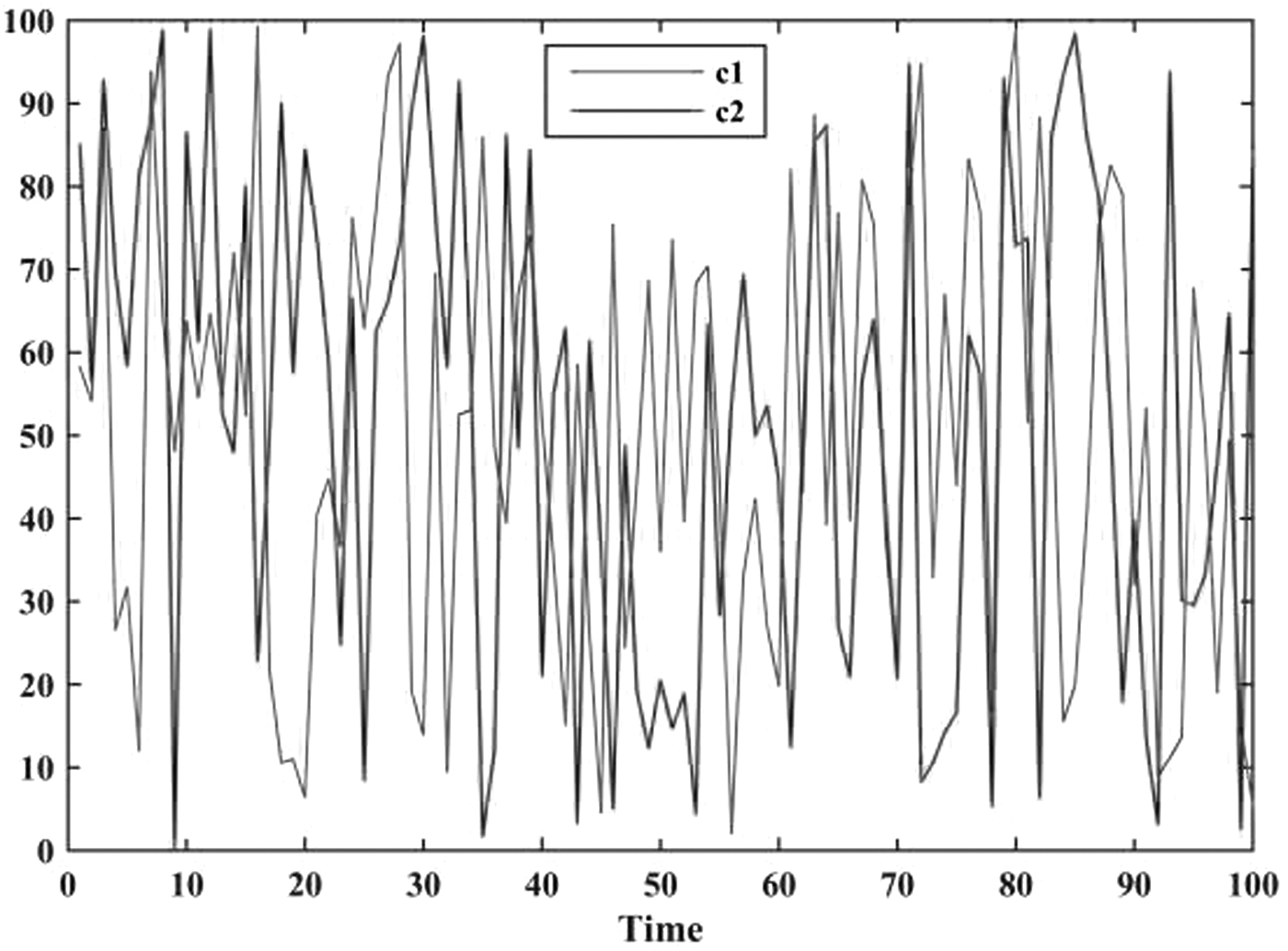
The simulation experiment dynamically shows the evolution process of the network, c2 represents the initial state of the network, and c1 represents the newly entered points and edges during the rapid growth of the network. The network diagram of the rapid growth stage of the innovation network is shown in Figure 1.
Schematic diagram of the rapid growth stage of the innovation network.
As shown in Figure 1, during the rapid growth stage, the scale of the innovation network has expanded significantly. In the network maturity stage, c2 represents the existing network evolution diagram at the beginning of the network maturity stage, and c1 represents the points and edges that have changed in the innovation network during this evolution stage. The network diagram of the mature stage of the innovation network is shown in Figure 2.

Schematic diagram of the mature stage of the innovation network.
As shown in Figure 2, after the rapid growth stage of evolution, the scale of the network has been large enough to gradually expand, and a small number of nodes and edges have been added to the existing network in the mature stage of the network. In the stage of network decline and renewal, the innovation network has realized the replacement of old and new nodes. Its network diagram is shown in Figure 3.

Schematic diagram of the decline and renewal stage of the innovation network.
As shown in Figure 3, at this stage, although the scale of the innovation network is a bit smaller than before, it has shown a relatively stable state overall.
Degree of small-world nature of the innovation network
Clustering coefficient
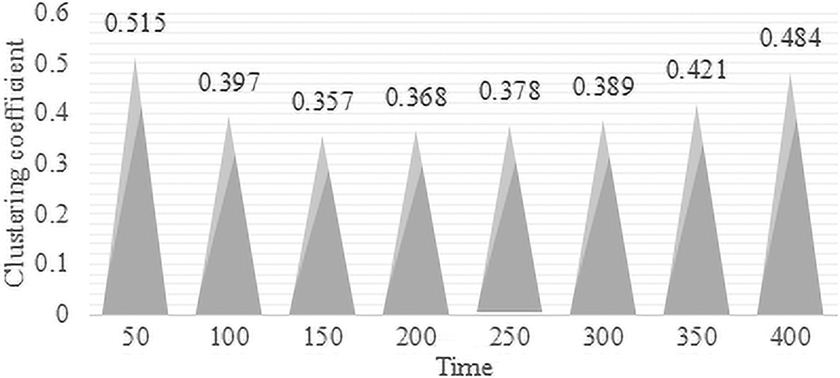
At different stages of the evolution of the innovation network, the structural characteristics of the network will also change. The aggregation coefficient reflects the tightness of the entire network. The larger the aggregation coefficient, the closer the connection, and the smaller the aggregation coefficient, the looser the connection. The changes in the aggregation coefficient of the innovation network in the three stages are shown in Figure 4.
Changes in the aggregation coefficient at different stages.
As shown in Figure 4, in the rapid growth stage, the aggregation coefficient decreased from 0.515 to 0.397. In the mature stage of the network, the aggregation coefficient still decreased to 0.357, but there was a rising trend, rising to 0.368. At the stage of network decline and renewal, the aggregation coefficient gradually rises and tends to be stable, and finally reaches 0.484. Because in the early stage of evolution, the aggregation coefficient is relatively large, and the network has just entered a stage of rapid growth, the number of nodes in the network has increased sharply, resulting in a decrease in the aggregation coefficient. In the maturity stage of the network, only a few nodes enter, and the reduction of the clustering coefficient is also slight. In the recession and renewal phase, the new and old nodes alternate, the network enters a stable state, and the aggregation coefficient becomes stable.
Average distance
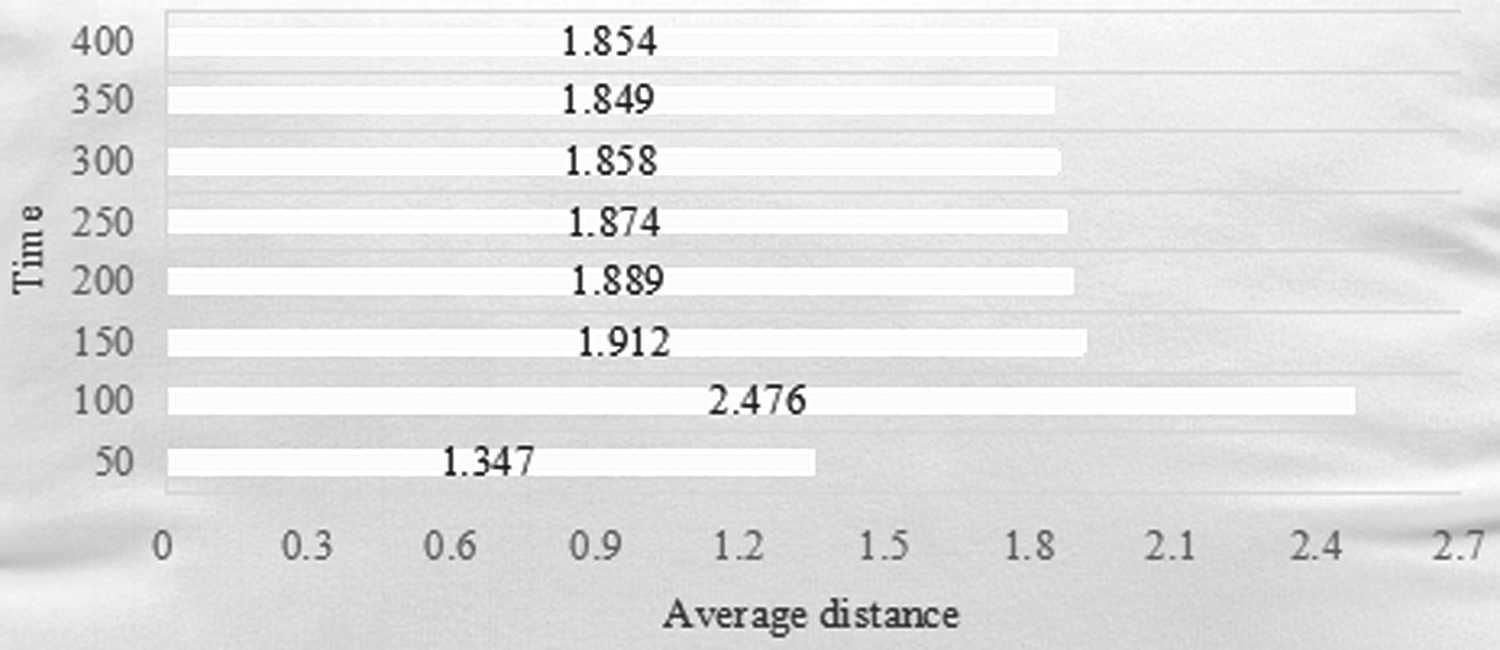
The average shortest distance will also change with the change of the network evolution stage. In the three stages of the innovation network evolution, the average distance changes are shown in Figure 5.
Changes in average distance at different stages.
In the rapid growth stage, the efficiency of network transmission decreases, and the average distance increases from 1.347 to 2.476. In the mature stage, the network structure is gradually stable, the transmission efficiency is enhanced, and the average distance is gradually reduced to 1.889. In the decline and renewal stage, the overall structure of the network only changes slightly, so the average distance is basically unchanged.
Degree of small world
According to the calculation, the characteristics of the established small-world network can be obtained. Considering that the probability of innovative connection is recovered to the influence of changes in the number of nodes in the network summary, it may happen that innovative nodes withdraw from the network organization. Therefore, it is necessary to know the degree of small world of the innovation network. The calculation results are given in Table 1.
Degree of small world of innovation network
As given in Table 1, the clustering coefficient of the innovation network established in this study is 0.484, the average distance is 1.854, and its degree of small world is 0.497.
Conclusions
The advanced equipment manufacturing industry has a relatively high technical content and a relatively large amount of investment capital, which has relatively strong driving force and control. Its development shows the trend of clustering, informatization, and service. However, the development of this industry is unbalanced, and a complete industrial chain has not been formed. There are technical shortcomings and lack of core competitiveness. Moreover, the training mechanism of relevant technical talents is not perfect, and there is a lack of reserve talents. Therefore, it is necessary to optimize the industrial structure, implement effective support measures, increase financial support, and give play to the effect of industrial agglomeration. Therefore, it is necessary to optimize the industrial structure, implement effective support measures, increase financial support, and give full play to the industrial agglomeration effect, so as to improve the innovation ability, guide the autonomy of major technical equipment, and enhance international competitiveness.
After the simulation experiment on the evolution process of innovation network in advanced equipment manufacturing industry, it is found that the innovation network has three different stages, namely, rapid growth stage, mature stage, decline and renewal stage. In different stages, the aggregation coefficient, average shortest distance, and small world degree of innovation network will be different. In the stage of decline and renewal, the nodes of innovation network change from old to new, and the structure reaches a stable state.
The evolution process of the innovation network of the advanced equipment manufacturing industry is actually very complicated. First, this article analyzes the network, node, degree, degree distribution function, clustering coefficient, and average shortest distance. Then the evolution time of the network rapid growth stage is set from 0 to 100, the evolution time of the mature stage is set from 100 to 200, and the evolution time of the network decay and update stage is set from 200 to 400. The experimental results show that the scale of the innovation network has been greatly expanded during the rapid growth stage. In the mature stage, a small number of nodes and edges will be added to the existing network. In the network fading and renewal stage, the innovative network has realized the replacement of new and old nodes, showing a relatively stable state as a whole. The following are calculated by experimental data: the clustering coefficient is 0.484, the average distance is 1.854, and the microcosmic degree is 0.497. This shows that the innovation network evolution model established in this study can reveal the evolution process of the advanced equipment manufacturing innovation network through simulation experiments. The simulation model in this article has been simplified to a certain extent. The use of a certain probability of points and edges to simulate the evolution process of the innovation network is somewhat different from the real situation and needs to be further improved in future research work.
Footnotes
Author Disclosure Statement
No competing financial interests exist.
Funding Information
This work was supported by Construction project of applied characteristic discipline in Hunan Province (Computer Science and Technology), the National Natural Science Foundation of China (71771083, 72024064), Provincial Natural Science Foundation of Hunan (2019JJ70044), Research Projects of Hunan Provincial Department of Education (20A298).