




Abstract
Demand for biospecimens in cancer research has increased but there are relatively few data on the trends in biospecimen usage. These data are needed to enable projection of future demand. We analyzed biospecimen usage in publications published at five-year intervals (2008, 2003, 1998, 1993, and 1988) in four cancer research journals (Cancer Research, Clinical Cancer Research, British Journal of Cancer and International Journal of Cancer). We categorized publications in three ways: 1) biospecimen utilization yes/no; 2) biospecimen cohort size; and 3) format of biospecimens used including frozen tissue, Formalin-Fixed Paraffin-Embedded (FFPE) tissue, fresh tissue, fluids, and hematological biospecimens. Biospecimens were used in 1292/3307 (39%) of publications analyzed and sufficient information was available to further classify biospecimen usage in 1228 publications. The proportion of publications in each journal using biospecimens ranged from 23% to 61% between journals, with no significant change within each journal over time. A more detailed review of tissue biospecimen use showed a significant increase in cohort sizes from 1988 to 2008 (mean 52 to 198, respectively; P < 0.0001). This reflected increased cohort sizes for both frozen and FFPE tissues from 1993 to 2008 (frozen, 59 to 119; FFPE, 66 to 194) but not fresh tissues. The relative proportion of studies using frozen or fresh tissues alone has decreased (71% to 24%) while those using FFPE alone or combined FFPE/frozen tissue cohorts has increased (24% to 72%) over this period. We conclude that the overall demand for biospecimens in cancer research has increased significantly (almost fourfold) over the past 20 years. We predict that average cohort sizes will increase by at least twofold for frozen and FFPE biospecimens over the next ten years, and that the majority of studies will be based on FFPE tissues or combined FFPE/Frozen tissue cohorts.
Introduction
“Biobanking” refers to the activity of creating collections of human biospecimens (tissues, blood, body fluids, and their derivatives) for diagnosis and/or research, and annotation of these samples with data such as composition, pathology and disease outcomes. Over the past decade, biobanking has developed significantly in complexity. Examples of this increased complexity include increased ethical oversight requirements and demand for higher-quality and more densely annotated biospecimens. 6 Due to the temporal gap between collection of the biospecimen and its subsequent annotation with treatment and outcomes data, these increased annotation requirements have resulted in increasing operational costs for biobanks. Therefore, biobank managers are now focusing on strategically planning and prioritizing their collection activities, including accrual targets and preservation format.
To help meet the increasing challenge of planning and prioritizing biobanks' collection activities, we have set out to analyze historical data on biospecimen usage, in conjunction with consideration of current research trends and emerging technologies. We analyzed four cancer research journals in order to determine the changes in biospecimen usage over the past 20 years and to project future demand. We hypothesized that biospecimen use has increased over the past 20 years and that the format of tissue biospecimens in highest demand has changed from predominantly frozen to formalin-fixed paraffin-embedded (FFPE) tissues.
Materials and Methods
Four cancer research journals were selected for review. The selection criteria for these journals were as follows: must be well-established; must be listed on PubMed, the leading biomedical citation database; must have an impact factor in the top 25% of oncology journals (>4.5 in 2008); and must have an editorial policy encouraging a wide variety of cancer research areas. In order to ensure that both North American and European research trends were incorporated, we selected four internationally recognized journals: Cancer Research (CR) and Clinical Cancer Research (CCR) to represent North American journals; and British Journal of Cancer (BJC) and International Journal of Cancer (IJC) to represent European journals.
Five publication years were selected to cover the past two decades: 1988, 1993, 1998, 2003, and 2008. It was possible to analyze CR and BJC at all five intervals, while IJC and CCR were analyzed over the last three intervals (due to limited access to earlier publication years or delayed date of first publication, respectively). For each interval we analyzed the first issue for every other month (January, March, May, July, September and November issues). For all journal issues analyzed, the following data were recorded: 1) total number of publications; and 2) total number of publications reporting studies based on use of human biospecimens. Of those publications that reported the use of human biospecimens, the following additional data were recorded: 3) type of biospecimen used (tissue and/or hematological); 4) biospecimen format (categorized as “frozen” tissue, “FFPE” tissue, “fresh” tissue, “fluids”, or “hematological” biospecimens (i.e., blood and its components or bone marrow); 5) whether documentation of subject consent for use of biospecimens was provided; and 6) whether documentation of Institutional Research Ethics Board (IRB/REB) approval for the use of biospecimens was provided (Table 1 provides the definitions used for these classifications). A database was developed in Microsoft Access (Microsoft Corporation, San Fransico, CA) to record these data and facilitate the data queries and analyses.
In total, 3,307 publications were reviewed and 1,292 publications reported the use of biospecimens (“biospecimen publications”). Of these, 1,228 biospecimen publications were included in the detailed analysis (see Table 2). This reduction was due to the need to exclude a small number of publications (n = 64) because of missing documentation within the publication that prevented accurate categorization of the number, type and/or format of biospecimens used.
total cases = number of human subjects from whom biospecimens were obtained.
Tissues (Frozen, FFPE, Fresh), Fluids, and Blood and Bone Marrow (BM) are numbers of biospecimens in each category.
Note that more than one biospecimen was obtained from some subjects.
Statistical analysis included descriptive statistics for means and standard deviations, and t-tests and one-way analysis of variance (ANOVA) coupled with post-test for linear trends. All statistical tests were performed using GraphPad Prism 5 (GraphPad Software, Inc., La Jolla, CA).
Results
Proportion of publications that used biospecimens
To determine the proportion of publications that used human cancer biospecimens (“biospecimen papers”), the total number of biospecimen papers was divided by the total number of all publications from the issues covered (six issues per journal, per year). The proportion of biospecimen papers varied between journals and the overall averages across all years varied: 26% (CR), 34% (BJC), 39% (IJC) and 61% (CCR). However, the proportions remained relatively constant within each journal over time (Fig. 1A). IJC was the only journal where the proportion of biospecimen papers varied significantly from one time period to the next, and this variation only occurred from 1998 to 2003 (P = 0.018). More detailed analysis of the proportion of biospecimen papers categorized by biospecimen format (tissue, hematological, and fluids) was then undertaken. Tissue biospecimen papers increased from 1988 to 1993 but showed little change thereafter in 3 of 4 journals, with an increase from 1998 to 2003 for IJC (Fig. 1B) Hematological biospecimen papers showed a trend towards a lower proportion of overall publications from 1998 to 2008 in three of four journals, but with no change seen in IJC (Fig. 1C). Fluid biospecimen papers showed no consistent trends (Fig. 1D).
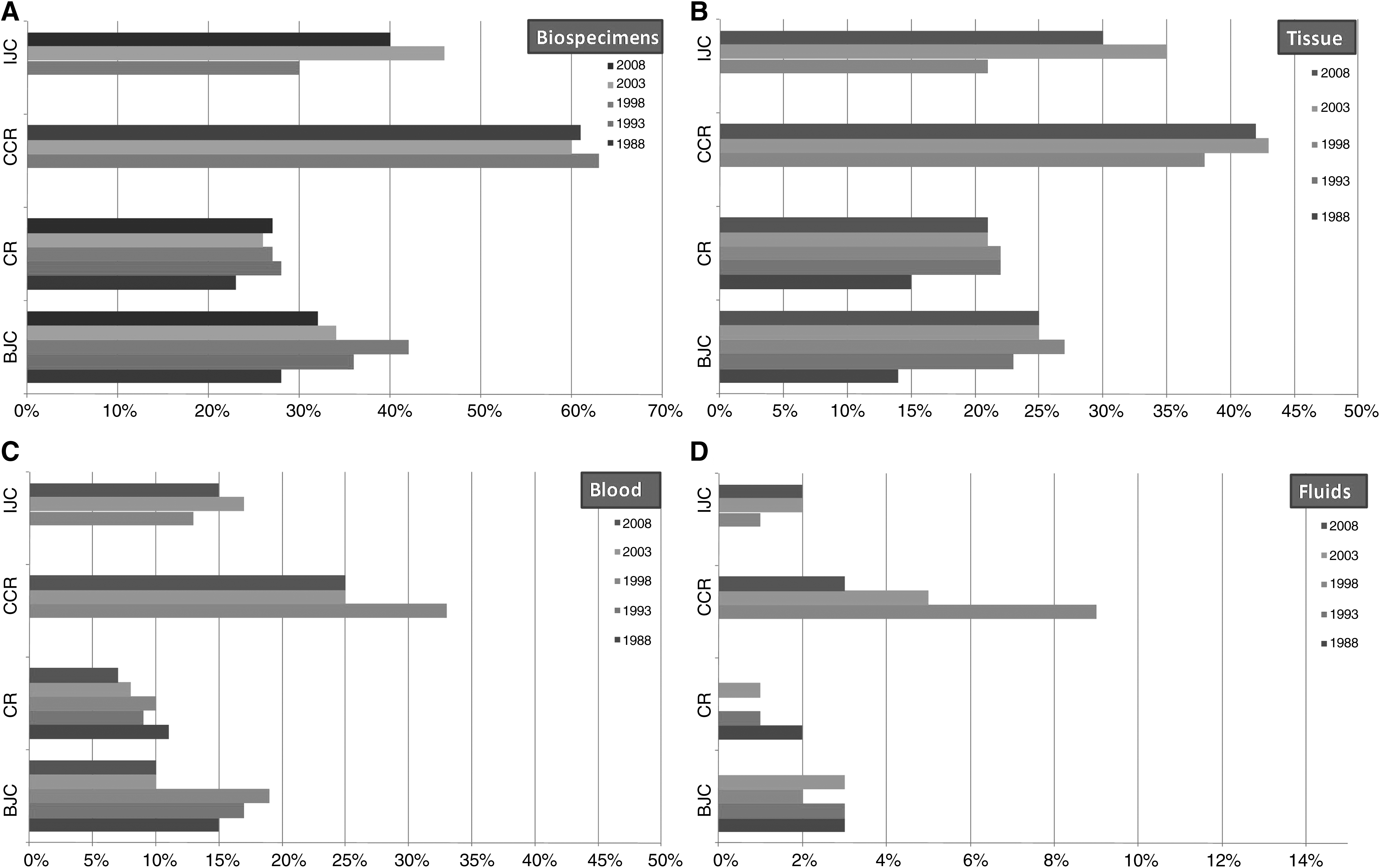
The proportion of publications that used
Number of Tissue Biospecimens Used Per Paper
Over the 20-year period studied, the overall proportion of publications that utilized tissue only, hematological only, or both tissue and hematological biospecimens remained around 59%, 26%, and 16%, respectively. Since these proportions remained constant, we focused our subsequent detailed analysis on tissue biospecimen papers, as tissue formats are most relevant to our tumor banks.7,8 We first assessed the number of tissue biospecimens utilized per publication over time, for each individual journal and in aggregate. We observed a consistent increase in the average number of biospecimens used per publication in all journals and the trend was statistically significant in 3 of 4 journals (Fig. 2A). For CR there was an increase from (47 to 173) biospecimens used over 20 years (P = 0.0071). For CCR the findings were similar with significant increases from an average of 111 to 245 over 10 years (P < 0.0001). Similarly, for BJC and IJC, the overall trends were significant with an increase from an average of 61 to 198 biospecimens used over a 20-year period (P = 0.0244) for BJC and from 75 to 133 over a ten-year period for IJC (P = 0.3365).
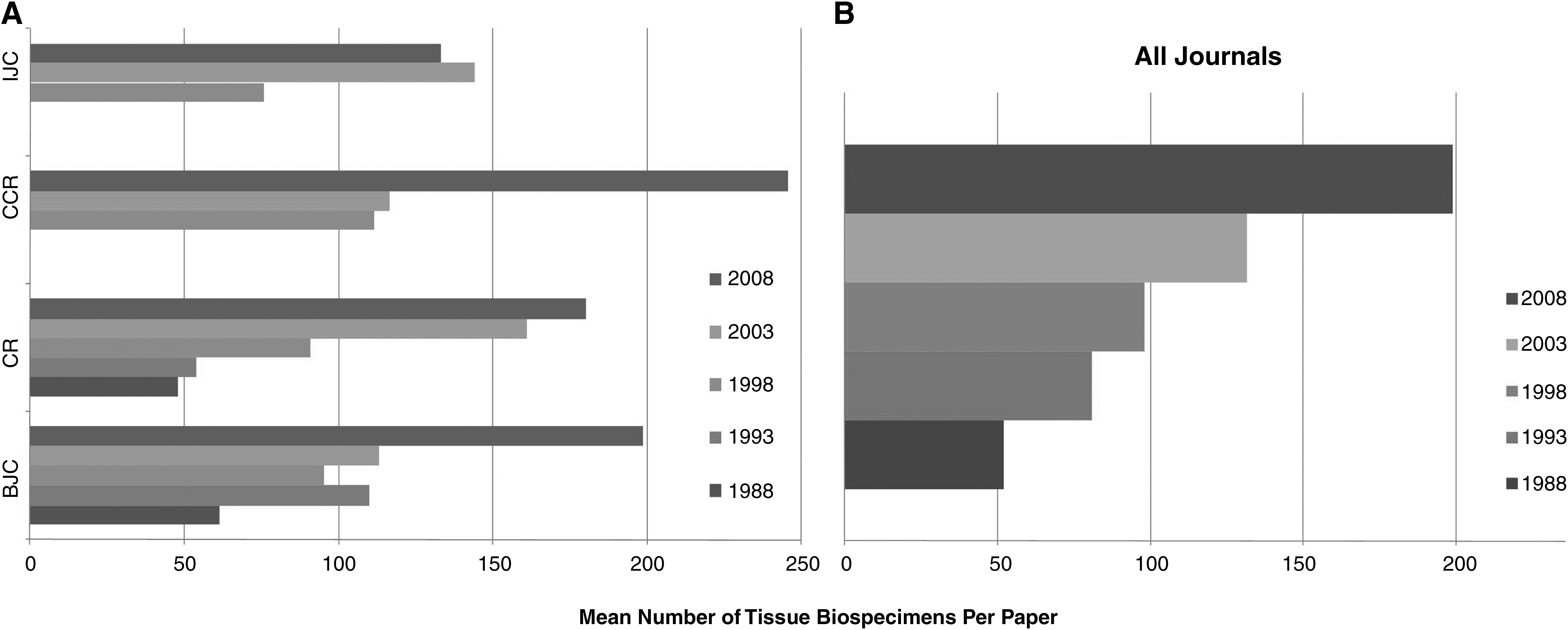
The mean numbers of tissue biospecimens used per publication shown
The total number of tissue biospecimens used across all journals in each year, adjusted for the total number of ‘tissue biospecimen publications’, was next assessed. We found that the overall number of tissue biospecimens used per publication increased significantly over 20 years (Fig. 2B). Across all journals, the mean increased from 52 to 198 tissue biospecimens per publication over the 20-year period (P < 0.0001). Similar results were observed when the North American journals (CR and CCR) and European journals (BJC and IJC) were analyzed independently.
Format of tissue biospecimens used in biospecimen papers
With the increase in tissue biospecimen use established, we next focused on determining which format of tissue biospecimens were in the highest demand. Among tissue biospecimens used in each publication, we determined the proportion that fell into of each major tissue format categories (Table 1). When publications were categorized according to usage of the four most dominant tissue format categories (frozen, FFPE, combined frozen and FFPE, fresh) we found significant changes in the predominant format utilized over time (Fig. 3). The proportion of publications using FFPE biospecimens alone increased over 20 years, from 18% in 1988 to 54% of all biospecimen publications in 2008. Similarly, the proportion using a combination of FFPE with frozen tissues increased from 6% to 18%. In contrast, the proportion utilizing frozen biospecimens alone has declined from 42% in 1988 to 22% in 2008. The use of fresh tissues has also decreased steadily (from 29% to 2%).
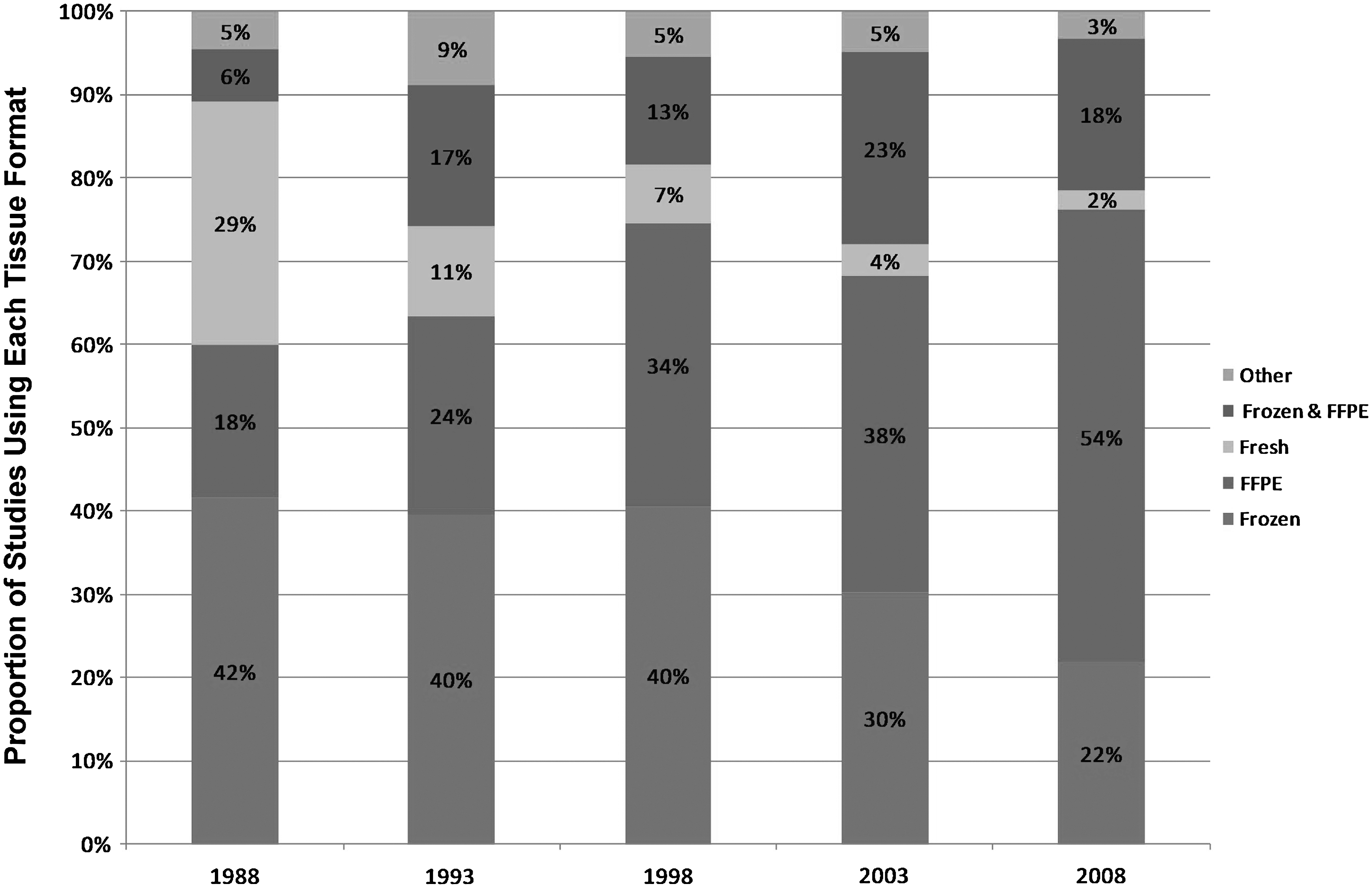
The relative proportions of different tissue formats in publications from 1988 to 2008. Formats and combinations included are either “Frozen,” “FFPE,” “Fresh,” “Frozen and FFPE”, or “Other” for all other combinations.
Cohort sizes within individual biospecimen formats
After observing that the relative predominance of different tissue formats has changed over time, we next examined whether there were trends in cohort sizes within each biospecimen format. The cohort size per tissue biospecimen format for all publications within a year and across all journals was analyzed (Fig. 4). The average cohort size for frozen tissue biospecimens was not significantly different between years but showed a significant increasing trend from 1988 to 2008 (from 43 to 119; P < 0.01). The average cohort size for FFPE was relatively static from 1988 to 1993, and then showed a significant increase (from 66 to 194; P < 0.01). Fresh tissue biospecimen cohort size showed no significant changes over time and average cohort size remained the same at around 70 since 1993.
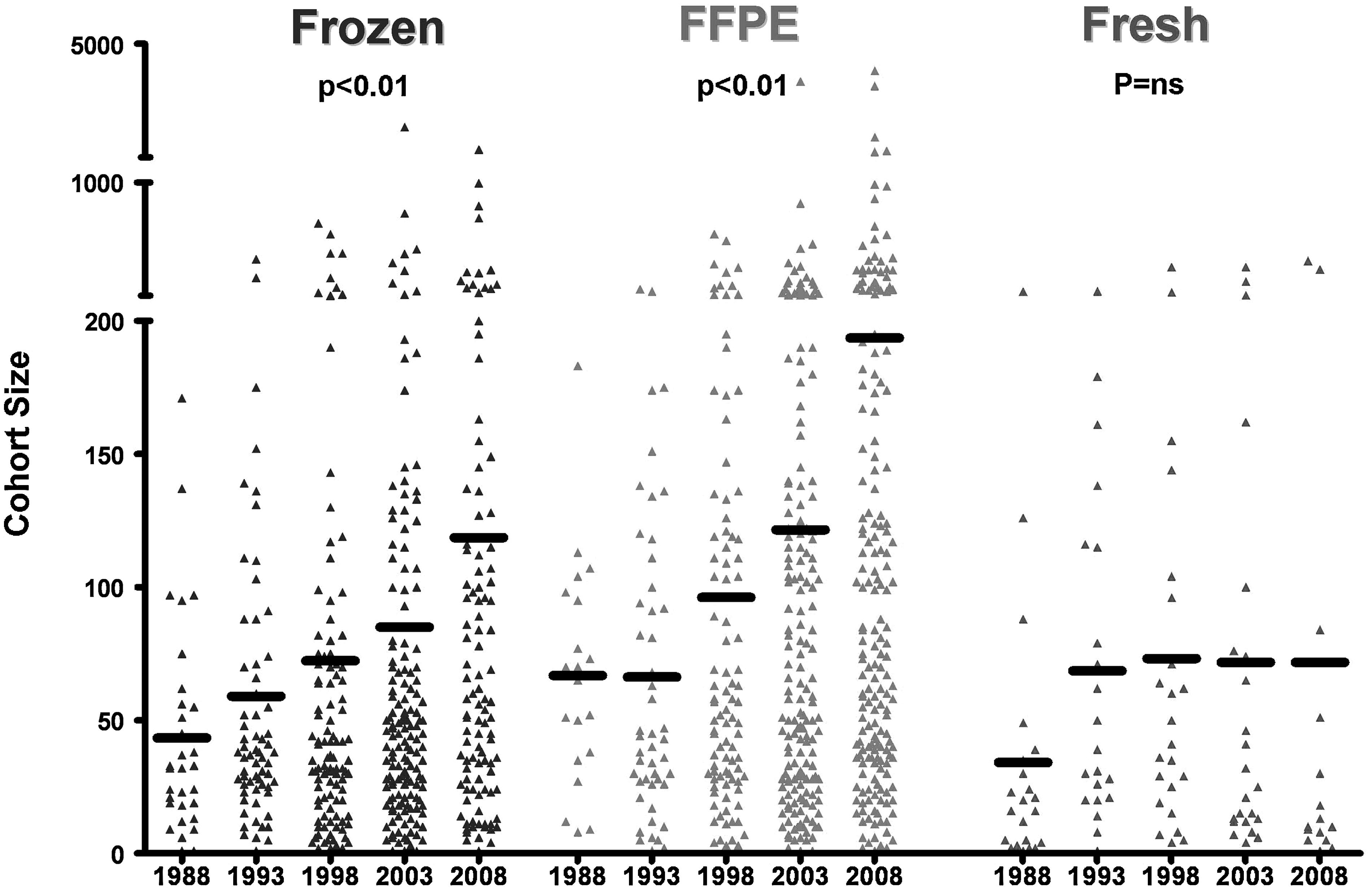
The cohort sizes for Frozen, FFPE, and Fresh formats of tissue biospecimens in publications from 1988 to 2008. Each data point corresponds to a publication and bars represent means.
Documentation of consent and research ethics board oversight
Finally, we assessed the rate of documentation of subject informed consent and documentation of IRB/REB approval for use of biospecimens. These parameters were assessed as a first step towards measuring quality and improvements in biobanking processes over the period studied. The proportion of publications that documented consent varied between journals, but all journals showed an increase from ∼10-25% in 1988, up to ∼35–55% in 2008 (Fig. 5A). Documentation of IRB/REB approval also increased from ∼10% to ∼70% over the same period (Fig. 5B). The most dramatic increase in documentation of these parameters occurred in the 1990's (consent in 1993; IRB/REB approval in 1998).

The proportion of biospecimen publications from 1988 to 2008 that reported documentation of either
Discussion
In this study we have confirmed and quantified the previously anecdotal trends in the usage of human biospecimens in cancer research. As demonstrated by our analysis of biospecimen cohorts used for reported studies, it is clear that demand for biospecimens is increasing, with a threefold increase in average cohort sizes for both FFPE and frozen tissue biospecimens over 20 years. We have also observed that the rate of this increase is highest for FFPE biospecimens, while demand for fresh tissue biospecimens has not changed.
Biobanking is a key component of cancer research. Biobanks were once widely regarded as a simple tool to support only the epidemiology and translational research sectors. However, advances in technologies have transformed the research landscape such that biobanks are now diverse and multifaceted tools supporting the breadth of cancer research. Furthermore, proponents in the field of tumor biobanking argue that we should expand our investment rapidly in the short term, in order to capture biospecimens during the current window of opportunity. This window is closing as earlier diagnosis, smaller surgical resections, and preoperative chemotherapy reduce availability of high quality cancer biospecimens. At the same time, biobanking proponents argue that we should also focus increased investment on better annotation quality. While these opinions are based on many expert observations, there has been a lack of unbiased data to support these views. This potential expansion in both scale and quality combined with increased complexity around biobanking, created by changes in public opinion and the legal and ethical landscape, 9 threatens research budgets with increasing and potentially unsustainable costs. The gradual emergence of the field of biospecimen science promises to generate important data to justify and to appropriately focus the costs of expanded quality to areas where better annotation and standardization are most important. Nevertheless, we are aware of no similar data to justify and appropriately focus the costs of increased capacity to areas where increased scale is most important.
When generating accrual projections for business plans for both individual biobanks7,8 and a provincial biospecimen accrual network 10 we have relied on anecdotal experience. For example, a typical cancer research program operating from 1993 to present day in the field of molecular pathology (PHW laboratory and collaborators), has utilized >6000 biospecimens and seen an approximately threefold increase in the average study cohort size in publications. Our current study now supports this anecdotal experience, both with respect to the overall increase in the average size of biospecimen cohorts over 20 years but also with respect to the shift in predominant biospecimen format used in studies. It is likely that several factors have influenced this increase. These include technology developments that have made it possible to study small human biospecimens and high throughput methodologies and bioinformatics and computing infrastructure that have made it possible to study large cohorts and associated datasets. The influence of technology on biospecimen use requires that biobanks maintain a watchful eye on technology developments and the adoption of new technologies by the biomedical research community, and that they respond to evolution of research methodologies. In doing so, biobanks will ensure that they have the right type of biospecimens available for research use.
The increasing use of biospecimens and shifts in formats that we have observed likely reflects changing research methodologies. For example, advances such as the development of microwave-based antigen retrieval from FFPE sections may have contributed to the increased FFPE cohort size after 1993. 11 The advent of Tissue Micro Array (TMA) technology in 1998 12 then further stimulated demand for FFPE biospecimens, as evidenced by the number of PubMed-indexed publications returned under the search term ‘cancer tissue microarray’ (1988 to 1993: 0 publications; 1998: 4 publications; 2003: 347 publications; and 2008: 800 publications). But the changes in demand may also reflect a more general wave of candidate biomarkers requiring validation in the most common clinical format. These biomarkers are now emerging from the impetus established a decade before by molecular biology-based cancer research. In general, the early molecular methodologies were developed and applied to models of cancer (e.g., cell lines and animal models). But as the sensitivity and spectrum of these methodologies advanced (e.g., with PCR and RT-PCR assays), coupled with new approaches for microdissection (e.g., laser capture microdissection 13 ), this enabled the cancer research enterprise to expand its focus to human biospecimens. With the wider availability of antibodies for use with FFPE tissues, and the ability to conduct high-throughput screening of samples using TMAs, it is not surprising that FFPE has become the dominant tissue format for research. In our experience, biobank users over the past ten years have increasingly used a research strategy that involves screening cohorts for gene expression in FFPE TMAs to identify smaller subsets of cases to investigate further using assays requiring frozen biospecimens.
In making projections for biospecimen demand in the future, it will be important to consider recent advances in methods and technologies that enable DNA and RNA applications in FFPE biospecimens14,15 and the emergence of more widely accessible high-throughput technologies (e.g., genomics, proteomics, metabolomics). It is likely that FFPE will remain the dominant format and that demand for increasing cohort size will continue. Demand for frozen biospecimens will also continue to rise, but at a more modest pace and mostly in the context of frozen biospecimens that are representative of specific pathologies and that are matched to readily-available FFPE biospecimens to facilitate discovery research.16,17 While demand for fresh biospecimens has remained static for 20 years, expansion of certain research areas (e.g., stem cell and immunological research) may also stimulate the need for live cell biobanking in the next decade. 18
Frozen and FFPE tissue formats have been commonly used because they preserve biospecimens for future use. A considerable body of work has been generated using biospecimens in these formats, and it has only recently been recognized that we lack sufficient data and indicators of biospecimen quality to fully interpret the effects of pre-analytical variables prior to preservation and long term storage. For example, we and others have shown that the manner in which biospecimens are collected and stored can influence gene expression. 19 Even when such processes are standardized within a biobank, variation between biobanks may be an important factor in interpretation of translational cancer research. Therefore, although looking back, there has been little change in demand for fresh biospecimens, it is likely that the emergence of live cell biobanking to support fields such as tumor immunology and stem cell research 18 will drive increasing demand in the future.
We recognize that our observations concerning the reporting of patient consent and ethical oversight have several limitations. These include the nature of the typical publications in each journal and the lack of biospecimen reporting guidelines. For example, it is not surprising that informed consent reporting is lower in CR than CCR, given the emphasis of the latter on clinical outcomes and of the former on cell biology (where anonymized biospecimens may be used with a waiver of consent under IRB/REB approval). Nevertheless, the adoption of the requirement for REB approval for any biospecimen-based research occurred in both North America and Europe around the year 2000 (e.g., dissemination of the Tri-Council Policy on Ethics in Research in Canada and other countries 20 ). So while it seems unlikely that REB approval has not been sought for all studies in 2008, this lack of documentation indicates a need for reporting guidelines that can assure journals and the public that appropriate oversight has occurred.
We conclude that the demand for both tissue and blood biospecimens in cancer research has increased almost fourfold over the past 20 years. If current trends continue unchanged, then the average frozen and FFPE cohort sizes are predicted to increase from ∼120 to ∼250 (frozen) and from ∼200 to ∼450 (FFPE) over the next decade (Fig. 6). However, based on observations from the current literature it is likely that the demand for FFPE biospecimens may increase at a higher rate. Although demand for fresh biospecimens has not changed for many years, we believe that this has changed recently and anticipate that this category will also show growth in the future.
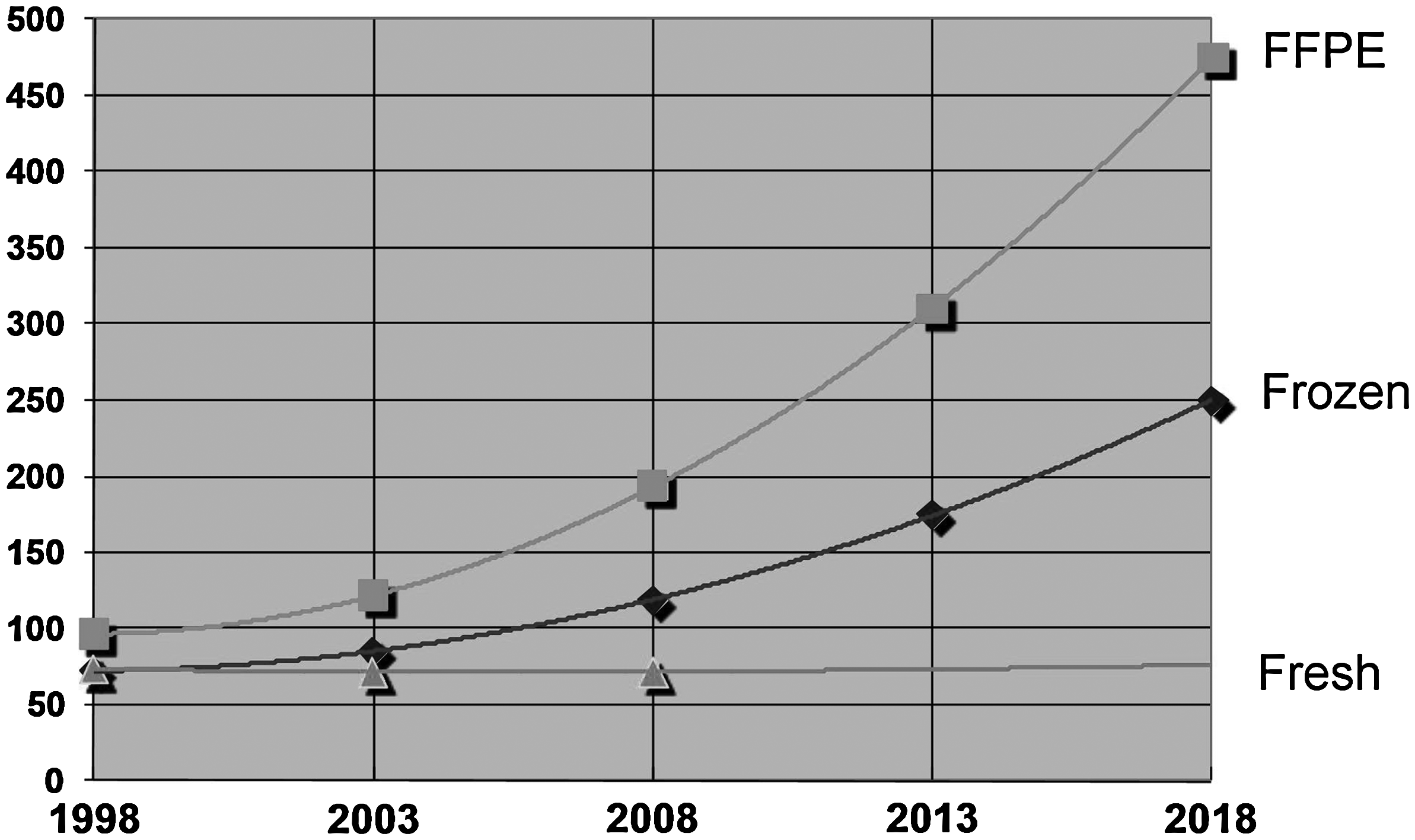
Projection of mean cohort sizes for the next decade. Data points for 1988, 1993, and 2008 are derived from the current study while those for 2013 and 2018 are superimposed on a trend line generated using Microsoft Excel.
Footnotes
Acknowledgments
This work was conducted as part of the Tumor Tissue Repository Program at the BC Cancer Agency (supported by the BC Cancer Foundation and a grant from the Michael Smith Foundation for Health Research) and the Canadian Tumor Repository Network (supported by a grant from the Institute of Cancer Research, Canadian Institutes of Health Research).
Author Disclosure Statement
The authors have no conflicts of interest or financial ties to disclose.