




Abstract
Two technologies for dry-state, ambient temperature transport of biospecimens were evaluated in this study. Umbilical cord blood (UCB) samples from 4 individuals were transported at ambient temperature using GenPlates, and the DNA recovered was compared with DNA purified directly from granulocytes of the same UCB samples. GenTegra™ DNA tubes were then used to transport the DNA from California to North Carolina and New Zealand, either immediately after drying or following 30 days of storage at 25°C and 76°C. The integrity of the recovered DNA was thoroughly tested using 2 human leukocyte antigens (HLA)-typing techniques (bead array and sequencing), as well as microarray-based whole-genome scanning. HLA-typing results were the same for all samples whether the DNA had been stored for 3 days during transport or 30 days at either 25°C or 76°C. There were no differences in the HLA-typing results of DNA recovered from UCB samples stored in GenPlates compared with DNA extracted directly from granulocytes. Moreover, the microarray analysis revealed call rates of >99.5% for every sample, regardless of storage method, with a statistical concordance of 99.99% between the UCB samples stored in GenPlates compared with DNA extracted directly from granulocytes. These results indicate that both GenPlates and GenTegra are viable methods of storing and transporting UCB (stem cell) biospecimens in a dry state. The quality and quantity of DNA recovered using both technologies are sufficient for complex genotyping using a number of different methods.
Introduction
Materials and Methods
Samples
UCB from 4 individuals (referred to as 21, 23, 24, and 32) was collected and processed at the Cell Therapy Facility, University of Utah. Whole UCB was applied to GenPlates (GenVault) and stored at room temperature (Fig. 1). Additionally, DNA was extracted from granulocytes of the same UCB samples (Gentra Puregene Blood Kit; Qiagen) and stored at −20°C. An aliquot of purified frozen DNA and 12 elements of GenPlate for each sample were sent to GenVault. DNA from the 4 UCB samples stored on GenPlates was recovered using GenSolve (GenVault), according to the manufacturer's instructions, and concentrated using a YM-100 microcon (Millipore). Aliquots (1 μg) of UCB DNA were applied to GenTegra DNA tubes (GenVault) and dried using a FastDryer (GenVault), according to the manufacturer's instructions (samples designated by suffix G). Following storage at −20°C, the DNA purified from granulocytes of UCB was also applied to GenTegra DNA tubes and dried (samples designated by suffix F). The samples stored in GenTegra DNA tubes were shipped by courier at ambient temperature from Carlsbad, California (CA), to Auckland, New Zealand (NZ), which took 2–3 days (Fig. 1). An identical set of samples was shipped from Carlsbad, CA to Raleigh-Durham, North Carolina, which took 2 days. DNA from the same UCB samples was also stored in GenTegra tubes for 30 days at 25°C and 76°C, to assess stability of the DNA, prior to shipping to NZ. Thirty days of storage of DNA at 76°C is equivalent to 2.6 years of storage at 25°C. 8

Biospecimen transport and recovery. Umbilical cord blood (UCB) was collected and processed at the Cell Therapy Facility, University of Utah (UT). Whole UCB was applied to GenPlates and stored at room temperature; samples were labeled “G.” DNA was extracted from granulocytes of the same UCB samples and stored at −20°C; samples were labeled “F.” Samples F and G were then sent to the DNA-processing laboratory at GenVault in Carlsbad, California (CA), for purification of GenPlate samples and application of purified DNA to GenTegra DNA tubes. Purified DNA was then shipped at ambient temperature in the dry state in GenTegra DNA tubes to the laboratories in North Carolina (NC) and Auckland, New Zealand (NZ), for analysis. Samples shipped to NZ were either transported directly after purification or stored in GenTegra tubes for 30 days at 25°C or 76°C prior to transport.
DNA recovery from GenTegra DNA tubes
DNA was recovered from GenTegra DNA tubes in 20 μL of molecular biology–grade water, incubated for 15 min at room temperature, and gently pipette-mixed prior to quantification with a NanoDrop Spectrophotometer (Thermo Scientific).
HLA typing of recovered DNA using Luminex technology
DNA samples were amplified by PCR using LABType (One Lambda) with locus-specific primers for HLA-A and -B (exons 2 and 3) and HLA-DRB1 (exon 2). Amplicons were checked by agarose gel electrophoresis. Labeled products were hybridized to complementary probes attached to fluorescently labeled LABType SSO microspheres (One Lambda). The products were analyzed using a Luminex xMAP platform (Luminex Corporation), which identifies the beads and the fluorescent intensity of each bead. HLA types were interpreted and assigned using HLA Visual software (One Lambda).
HLA typing of recovered DNA by DNA sequencing
High-resolution HLA typing of GenTegra-recovered DNA was carried out by DNA sequencing. Briefly, locus-specific amplification was carried out for HLA-A, -B, 9 and -DRB1. 10 PCRs were purified using Ampure beads (Beckman Coulter) and then sequenced in both directions using Big Dye Terminator chemistry (Applied Biosystems). The sequenced fragments were separated by capillary electrophoresis (ABI3130XL Genetic Analyzer; Applied Biosystems) and the sequences were compiled, analyzed, and HLA type assigned using SBTengine (Genome Diagnostics).
Genotyping of recovered DNA using the Illumina 1MDuo Platform
Recovery of the DNA from GenTegra DNA tubes (using the protocol described above) and genotyping were performed at the microarray laboratories of Expression Analysis (Durham, NC). Briefly, all samples were analyzed on the Illumina 1MDuo Genotyping platform and subjected to preliminary statistical analysis to generate an SNP call rate, which is a standard metric used to assess data quality. Each set of samples was further subjected to pairwise concordance analysis using standard methods.
Results
Biospecimen transport
Biospecimen types (UCB and purified DNA), transport methods, and recovery locations are outlined in Fig. 1.
Sample recovery
Samples 21F–32F and 21G–32G in GenTegra DNA tubes were rehydrated and quantified using the NanoDrop Spectrophotometer. As shown in Table 1, quantitative recovery was achieved for all samples, with a percent recovery of 100% ± 2% for samples 21F–32F (DNA extracted from UCB granulocytes and stored on GenTegra) and 96% ± 2% for samples 21G–32G (DNA extracted from whole UCB stored in GenPlates prior to GenTegra storage).
RT, room temperature; nd, not determined.
HLA typing of recovered DNA by Luminex LABType
The LABType PCR mixture (One Lambda) is usually in dark pink color, but in the presence of DNA recovered from GenTegra DNA tubes the color changed to a light pink/yellow. This is presumably attributed to a change in pH, but this did not affect the ability of the DNA to be amplified by PCR, as shown by the strong and clean band of each PCR amplification product in Fig. 2. These results are comparable with PCR products obtained from amplification of DNA extracted from the Roche MagNA Pure extraction robot routinely used in the New Zealand Blood Service Tissue Typing Laboratory (data not shown). For HLA-A and -B, exons 2 and 3 were amplified and each reaction yielded 2 PCR products shown as double bands in lanes B1–F1 and lanes B2–F2 (Fig. 2). Only exon 2 was amplified for HLA-DRB1, which yielded a single band in lanes A3–F3 (Fig. 2).
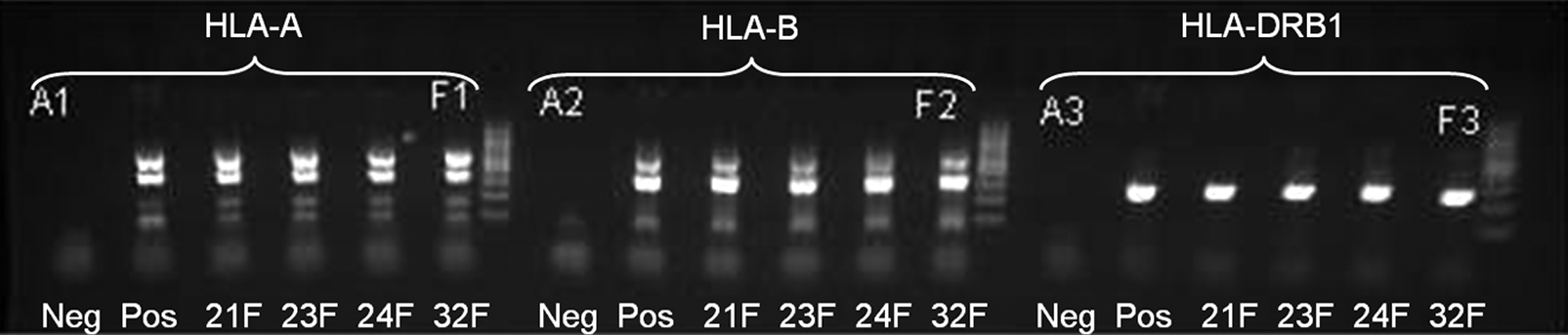
PCR amplification of samples 21F–32F using One Lambda LABType locus-specific primers for HLA-A, -B, and -DRB1. Lanes are designated A–F for each locus. A1–3: negative controls; B1–3: positive controls; C1–F1: HLA-A amplification; C2–F2: HLA-B amplification; C3–F3; HLA-DRB1. Positive controls are a previously HLA-typed sample. PCR, polymerase chain reaction; HLA, human leukocyte antigens.
HLA-typing results derived from the Luminex LABType analysis are shown in Table 2 for samples 21F–32F and are expressed as a 2 digit HLA type followed by a National Marrow Donor Program (NMDP) code. These results are typical of what would be seen in a tissue-typing laboratory for the vast majority of its HLA typing. NMDP codes translate into a string of possible HLA alleles present. For example, HLA-B*44ENCM represents HLA-B*4403/13/26/35/36/38/39/65 (HLA-B*4403 or 4413 or 4426 or 4435 or 4436 or 4438 or 4439 or 4465). Samples 21G–32G gave identical HLA types to samples 21F–32F using the LABType assay (data not shown). Translation of NMDP codes can be found at http://bioinformatics.nmdp.org/HLA/Allele_Codes/Allele_Code_Lists/Numerical_Order/index.html.
Asterisks indicate the following SBT ambiguities:
21F: cannot exclude A*0224,0317 and A*0226,0307 (genotype ambiguities), and A*02010102L (allele ambiguity); B*0707,1507, B*0709,1563, and B*0755,1565 (genotype ambiguities), and B*0744, B*0749N, B*0758, B*0759, B*0761, B*9502, B*9504, B*9540, and B*9546 (allele ambiguities).
32F: cannot exclude A*0104N, A*0122N, A*0132, A*03010102N, A*0320, A*0321N, A*0326, A*0337, and A*0345 (allele ambiguities); B*0823,1570 (genotype ambiguity), and B*0819N, B*9502, B*9504, B*9540, and B*9546 (allele ambiguities).
HLA, human leukocyte antigens; SBT, sequencing-based typing.
The same samples were also stored in GenTegra DNA tubes for 30 days at room temperature (25°C) or at 76°C (equivalent to 2.6 years at 25°C) prior to transport and recovery of DNA. Identical HLA-typing results were obtained for each sample whether the DNA was stored for 3 days, 30 days, or the simulated equivalent of 2.6 years.
High-resolution HLA typing of recovered DNA by DNA sequencing
Our sequencing strategy for class I genes (eg, HLA-A and -B) was to amplify the whole gene and sequence exons 2–4. Figure 3 shows a very strong amplification (1/10th of PCR) for the most polymorphic locus, HLA-B, amplified in DNA recovered after 33 days of storage in GenTegra. Sequencing of the amplified HLA alleles, exons 2, 3, and 4 for class I, and exon 2 for class II, identified the allelic type for samples 21F–32F for HLA-A, -B, and -DRB1 (Table 2). The same sequencing results were obtained for 21G–32G (data not shown). These high-resolution results are typically seen in a tissue-typing laboratory, for example, when sequencing a bone marrow patient and an unrelated donor to find a match. Table 2 also lists the rare genotype and allele ambiguities generated by sequencing, which were obtained with both sets of samples. These are typically seen when 2 common alleles are in combination together, for example, A*0201, 0301 or B*0801, 1501.
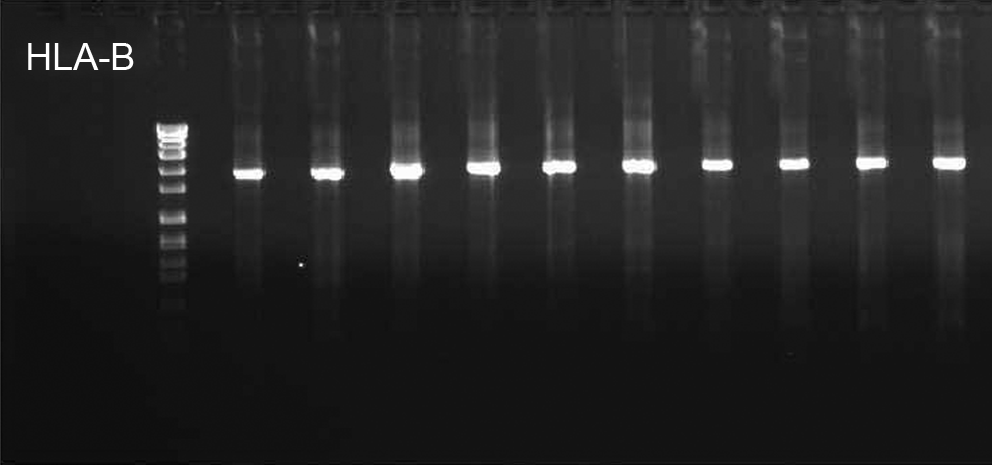
HLA-B amplification for sequencing. M: molecular weight marker VII (Roche Diagnostics). Arrow indicates position of the 2799 nucleotide marker. Lanes 1–6: whole-gene PCR of recovered DNA stored at 25°C [24G (1), 32G (2), 21F (3), 23F (4), 24F (5), and 32F (6)]; lanes 7–10: whole-gene PCR of recovered DNA stored at 76°C [21G (7), 23G (8), 24G (9), and 32G (10)].
HLA typing by Luminex and sequencing were also carried out on the same DNA samples that had been stored for 33 days on GenTegra at room temperature and 76°C. Identical results were obtained for each sample whether stored for 3 or 33 days.
Genotyping of recovered DNA using the Illumina 1MDuo platform
Samples 21F–32F and 21G–32G in GenTegra DNA tubes were rehydrated and used for microarray analysis on the Illumina 1MDuo microarray platform. The data quality generated from using these DNA samples is reflected in the SNP call rate. It has been established that the data quality from DNA samples with SNP call rates of >90% are satisfactory, those above 94% are thought to be high quality, and those in excess of 99% are considered to be extremely high quality. 11 Table 3 shows that all 8 DNA samples recovered from GenTegra DNA tubes gave SNP call rates >99%.
In addition, a pairwise comparison of microarray data from DNA recovered from whole UCB stored on GenPlates and the corresponding DNA extracted from granulocytes of the same UCB sample was performed using Illumina statistical software. 12 As shown in Table 4, among the ∼1 million SNP loci analyzed, concordance between measured data was above 99.99%, demonstrating that DNA recovered from whole UCB stored on GenPlates was of the same quality as DNA extracted from granulocytes of the same UCB sample.
Discussion
In this study, we evaluated the feasibility of GenTegra and GenPlates as novel methods of ambient temperature storage and transport of biospecimens, with special emphasis on storage and transport of DNA samples from biobanked UCB units for genetic analysis. GenTegra and GenPlates differ in that GenTegra is designed for storage of up to 25 μg of purified DNA, whereas GenPlates are used for storage of 10 μL aliquots of whole blood or other crude biosamples. Thus, the per-aliquot cost of GenPlates is lower than that of GenTegra, and the DNA yield recovered from a 10 μL aliquot of whole blood sample on GenPlates (an average of 130 ng, ranging from 50 to 350 ng depending on the white blood cell count of the sample) is also lower compared with the maximum storage capacity of GenTegra. We applied whole UCB from 4 individuals to GenPlates and compared the performance of the recovered DNA with that of DNA extracted from granulocytes of the same UCB samples. The integrity of recovered DNA was rigorously assessed by microarray-based whole-genome scanning and by a number of HLA-typing techniques, including Luminex™ bead arrays and sequencing-based typing.
The data presented here show that GenTegra DNA tubes are a feasible and cost-effective way of storing and transporting purified DNA at ambient temperature and a viable source of DNA for tissue typing and genotyping. Recovery of DNA from GenTegra was very efficient in all samples tested, with DNA yields approaching 100%. In addition, long-term stability of the purified DNA stored in GenTegra tubes was maintained, as evidenced by the identical HLA-typing results obtained for each sample whether the DNA was stored for 3 days, 30 days, or the simulated equivalent of 2.6 years. A limitation of this study was the relatively short-term storage and transport scenarios examined. A longer study period would have been ideal to demonstrate the ability of GenPlates and GenTegra to preserve DNA quality during long-term storage. However, validation studies by GenVault demonstrate the preservation of purified DNA for 6 months at 76°C, the simulated equivalent of 16 years (data not shown). Moreover, Whatman FTA technology (used in GenPlates) has been used to protect and store biosamples for nearly 20 years (source: Whatman Web site).
We have also shown that it is feasible to store and transport UCB samples at ambient temperature using GenPlates. Storage of UCB in GenPlates prior to DNA extraction has no effect on HLA-typing or genotyping results. Identical HLA-typing results were obtained between DNA extracted from whole UCB samples stored on GenPlates and the corresponding DNA extracted from granulocytes of the same UCB sample, regardless of the HLA-typing method used, indicating that comparable DNA quality could be recovered from UCB stored in GenPlates, even though the starting material is considerably less. Additional evidence for the high quality of DNA recovered from GenPlates is the exceptionally high concordance rate (99.99%) in the pairwise comparison of SNP call rates between corresponding DNA samples. Thus, GenPlates represent an ideal method for transporting crude biosamples, such as UCB, for later extraction of DNA. However, GenPlates cannot preserve other biomolecules present in crude samples, such as RNA and protein. In this case, DNA purified directly from UCB was stored in GenTegra, and any remaining UCB could be used for extraction of other biomolecules of interest.
In this study, we subjected the purified DNA samples stored in GenTegra to 76°C temperature for 30 days and showed that the integrity of the DNA was maintained. It should be noted that FedEx shipping guidelines state that packages can reach temperatures of up to 60°C. This suggests that the GenTegra matrix may provide protection against the potential damaging effects of high temperatures while the samples are in transit. With this in mind, its use in the ambient shipment of DNA samples should increase confidence in the reliability of the results obtained from core laboratories. At ∼$1.18 per tube for GenTegra and as little as $0.11 per aliquot for GenPlates, it is cost-effective to ship purified DNA and crude biosamples at ambient temperature. For example, a savings of ∼$150 can be achieved when shipping a package via FedEx International Priority® from Carlsbad, CA, to Auckland, NZ in a FedEx envelope at ambient temperature instead of using wet or dry ice (source: FedEx Web site). Cost and energy savings can also be achieved by storing biosamples at room temperature in GenPlates or GenTegra. One personal archive, used for storing GenPlates in a humidity-controlled environment, holds more aliquots of crude biosample than a single −80°C freezer, while using <10% of the energy, reducing energy consumption by ∼6500 kWh/year—an annual savings of roughly $950. 13 GenTegra does not require storage in a humidity-controlled environment, resulting in savings of 7000 kWh/year, the equivalent of $1000. 13
Wan et al. recently reported that there is no difference in the quality and integrity of DNA stored in GenTegra compared with controls stored at −80°C, supporting our findings. Equivalent performance in short-range PCR, long-range PCR, DNA sequencing, and Affymetrix 500K or 6.0 DNA Microarrays was also obtained between samples stored in GenTegra and controls stored at −80°C. 13 Our results showing equivalent performance of DNA in HLA typing and analysis on the Illumina 1MDuo microarray platform between samples stored in GenTegra and controls stored at −80° provide further confirmation of the compatibility of DNA GenTegra with a wide range of genetic analysis platforms.
In the study conducted by Wan et al., samples were stored in a laboratory environment at room temperature for 3–4 weeks. 13 Thus, no data were obtained from samples subjected to actual transport or from samples exposed to elevated temperatures to simulate shipping conditions. 13 Our findings provide the first data showing the thermal stability of DNA stored in GenTegra and demonstrate a key application of GenTegra and GenPlates for ambient temperature transport of biosamples.
In summary, we have demonstrated the feasibility of 2 technologies for dry-state storage and transport of biospecimens at ambient temperature. DNA samples recovered using both methods are of sufficient quality and quantity for use in microarray-based genotyping and all 3 HLA-typing techniques tested, with results typical of those routinely seen in microarray and tissue-typing laboratories. In future studies, we intend to investigate longer periods of DNA storage in conjunction with HLA typing of recovered DNA to determine the feasibility of long-term DNA storage at room temperature.
Footnotes
Acknowledgments
This work was supported by a Utah Center of Excellence Grant from the Utah Governor's Office of Economic Development (sponsor award number 081068) to the Cell Therapy Facility, University of Utah, and by the New Zealand Blood Labs and GenVault Corporation.
Author Disclosure Statement
Michael Hogan is the Chief Scientific Officer of GenVault Corporation, who have developed the technology that is tested in this pilot study.