




Abstract
In recent years, the focus of research on human disease has shifted to the molecular level to determine genetic and proteome expression variations among humans as well as during disease development and progression. This trend, along with the many technological advances in the biomedical field, requires the availability of high-quality human specimen and accompanying clinical data. Therefore, a well-planned, quality-controlled biorepository is a critical resource in furthering the advances of biomedical discoveries. This article describes the considerations and decisions needed to obtain and store high-quality specimen and accompanying clinical data in a biorepository.
Introduction

Biorepository development checklist.
The development of a biorepository is a complex undertaking. At our community hospital, more than 7 years passed between initial discussion and full implementation. Of primary consideration by both stakeholders and consultants were, first, the determination of an adequate supply of available specimen at our facility and, second, the establishment of the scope of the biorepository, including the type of biorepository to be developed and specimen to be collected. Additional items included funding, staffing, facility needs, and regulatory and legal issues. It was determined that an adequate supply of specimen was available, and the administration and its governing board moved forward in 2007 with a biorepository offering both preserved specimen and fresh specimen with corresponding clinical data.
Many families over multiple generations receive continuity of care at this hospital and the closely associated outpatient clinic, which was a decisive factor in offering preserved specimen (formalin fixed, paraffin embedded) linked to data. This type of longitudinal clinical information, and its associated specimen, has tremendous value for investigators searching for the pathogenesis as well as genetic factors associated with disease. The types of specimen to collect will initially be limited to specimens related to gastroenterology, neurology, cardiology, and breast oncology, as these are the 4 core areas of research at our institution. Research specimens are processed in the pathology laboratory at the same time as the clinical specimen. The ability to offer fresh and fresh-frozen specimen is also advantageous to the investigator. This type of specimen is more difficult to obtain, but because it can be used for broader research applications than preserved specimen, it is in high demand.
Another important consideration regarding specimen was choice of collection model. Many factors such as space, equipment, supplies, access to specimen, and knowledgeable staff were taken into account. 1 A 10-question anonymous survey was developed to obtain feedback from investigators in the surrounding community regarding current and future specimen needs. Because of its advantages for investigators, namely readily available specimen and its corresponding data, a retrospective biorepository was selected. Because this requires more storage than prospective “on-demand” facilities, availability of space and equipment became critical in the decision process. It is also important to note that data collection and mining is labor intensive and having knowledgeable staff is the key to successful implementation.
Initial staffing needs are relatively small. Our pathologist (90% clinical and 10% research time commitment) has overall supervision and provides technical support. The pathologist ensures that patient diagnoses are not compromised by the provision of specimen to the biorepository and that policies and procedures for quality control were developed and are maintained. The pathology report provides initial information on the specimen, such as type, site, stage, and grade. Before the specimen is accessioned into the biorepository, the pathologist reviews a quality control slide cut from each block. The pathologist will note the percentage of normal, diseased, and necrotic tissue for each specimen. All specimens will be reviewed again to confirm the above information before release to a researcher.
Placement of the facility within the pathology laboratory, or in close proximity, increased the efficiency of the biobanking process. In addition, 1 full-time, specially trained data management specialist is responsible for supporting daily operations such as handling inquiries, conducting intake for investigator requests, communications with pathology, storing specimen, maintaining all databases, preparing invoices, and budget maintenance. The director of research operations oversees the high-level functioning of the biorepository and serves as the honest broker (this concept is discussed in more detail later). This staffing was adequate to accomplish the background research and setup of this biorepository within 18 months.
Another key factor in developing our biorepository was funding. The initial funding for equipment came through 1 main donation and additional charitable gifts. Currently, our hospital covers the cost of employee salaries and benefits and absorbs the annual operating budget with the understanding that this will assist with meeting the institutional long-range goals for research. Over time it is expected that a portion of operational costs will be offset by processing fees.
There are many regulatory and/or certification standards that must be adhered to, such as the amount of time the pathology laboratory must wait after final diagnosis before discarding a specimen. It was critical to have early communications with pathology, including discussions about services and processes. A fee structure was developed and contract executed. Discussions were held with the laboratory manager and supervisor to develop procedures for obtaining specimen that would not impede the clinical workflow of the pathology laboratory. Consultation with both internal and external legal counsel was vital during the development of legal documents such as the data use agreement, material transfer agreement, and our consent form.
Biorepository Development Research
Conducting site visits to existing repositories was a crucial first step in researching biorepository development. Familiarity with guidelines and standards provided by reputable organizations prior to these visits was valuable (Table 1). The mentor relationship that developed with a specific repository was also beneficial. As the number of tissue banks has increased, so has the amount of guidance, standards, and regulatory documents available in the literature. A thorough review of literature and guidance and regulatory documents provided insight into lessons learned by others during their biorepository development. Organizations such as the International Society for Biological and Environmental Repositories, Public Responsibility in Medicine and Research, and the National Cancer Institute have best practices or work group recommendations that provide information to use as a starting point for developing a biorepository.3–5 The Office for Human Research Protections provides the regulatory and guidance information pertaining to human subject research and repositories. 6 We used all of these resources and the mentor biorepository in the development of detailed and high-standard policies and procedures—the key to a successful biorepository. Also of great benefit was creating a list of existing biorepositories, which included services provided, costs of services, cost recovery methods, and other information.
In regard to software choice, there are a handful of software companies with products for repositories, such as Freezerworks, Cryo Track, and GenConnect. The Cooperative Human Tissue Network has specimen tracking software, and the Canadian Tumour Repository Network released its tumor bank application, ATiM, under a free public use license. There is also the option of developing an internal database. Before deciding, we (the Research Institute and the internal IT department) had thorough discussions with potential vendors regarding their willingness to work with our specific needs, conduct demonstrations, customize the software program, and determine compatibility with the current infrastructure.
Regulatory Considerations
To comply with federal regulations, 6 a biorepository must seek Institutional Review Board (IRB) approval and have IRB oversight during the life of the biorepository. Our IRB process began in January 2008 with the initial submission of the standard operating procedures, donor consent, and other supporting documents. After working for 2 months with the IRB staff, the submission was reviewed at a full board meeting. The IRB had a number of questions about the biorepository as this was a new area of review for this IRB. They employed external legal counsel with regulatory expertise in tissue banking who worked diligently with the local IRB; approval was received in June 2008.
When an investigator defines a research study that will utilize specimen from the biorepository, the investigator will submit a request for specimen. Figure 2 depicts the workflow for a specimen request. It is important to point out if the investigator is requesting more data elements than is provided in the Limited Data Set, because the research study must be submitted to the IRB for review and approval of the additional data points.
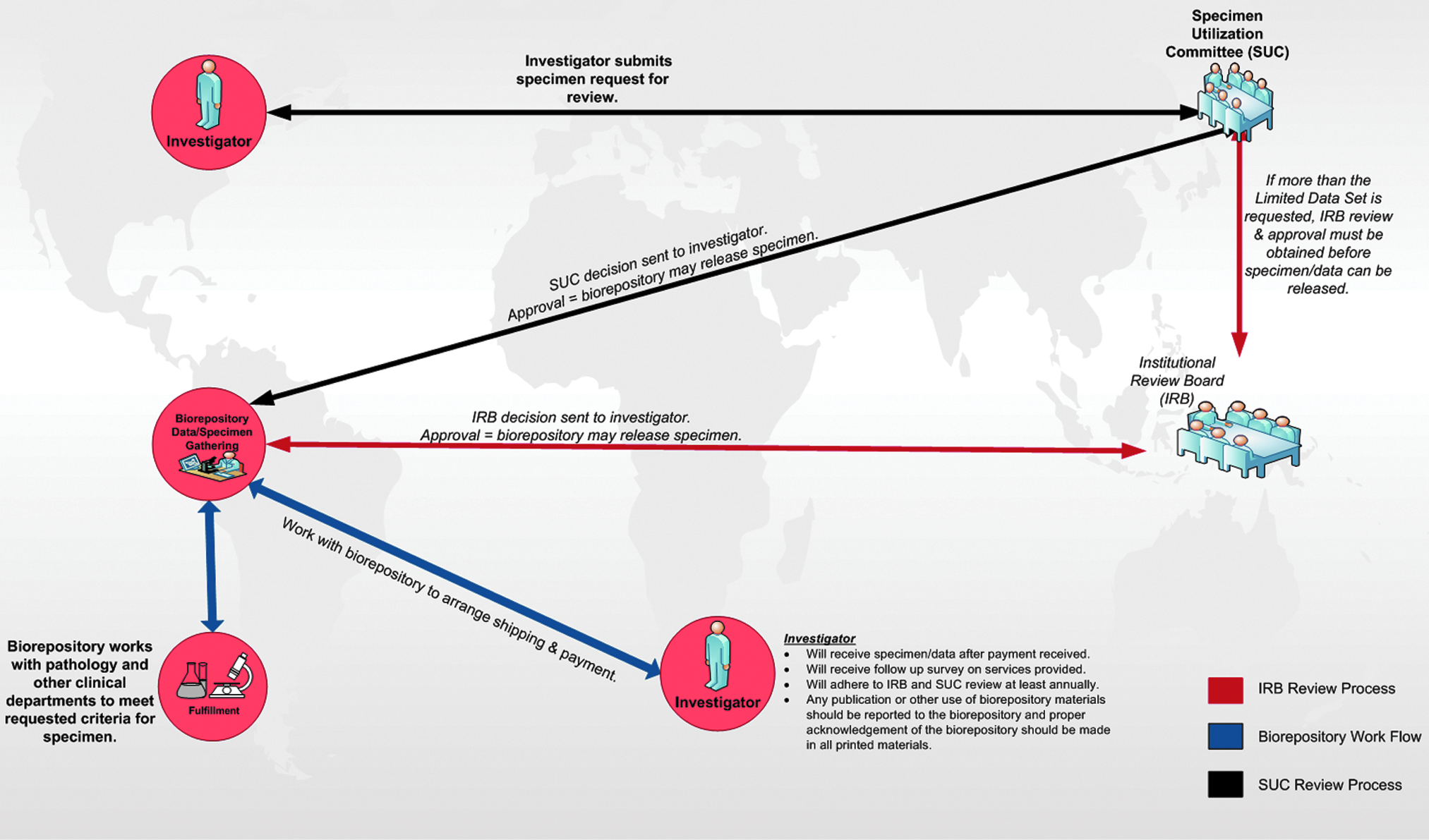
Flow of specimen request. A specimen request explains what services and specimen are being requested, provides justification of the sample size, explains how the information will be disseminated, outlines research procedures to be followed, and defines what data elements are requested. The request is submitted to a Specimen Utilization Committee (SUC) that decides if this research project has great scientific merit and if this is a priority research area for this community hospital. If the committee approves the request, it either goes to the biorepository for fulfillment or needs Institutional Review Board (IRB) approval if the request involves more information than in a Limited Data Set before it goes to the biorepository. The biorepository works with pathology and other clinical departments, as needed, to obtain the requested specimens if not already on file. See online article at www.liebertonline.com for color figure.
In addition to IRB oversight, a biorepository that is part of a covered entity must also comply with all Health Insurance Portability and Accountability Act regulations.7,8 Part of becoming Health Insurance Portability and Accountability Act compliant is ensuring that the protected health information from patients consenting to donate specimen is protected by developing IRB-approved forms such as material transfer agreements and data use agreements that will be executed for each project requesting specimen.
As with all human research, the informed consent process for the biorepository is of great importance and it is 2-fold: the physical informed consent form and the verbal communication between a trained consenter and the potential donor. Creating a donor informed consent is a critical step that warrants explicit interpretation of the code of Federal Regulations, 45 CFR 46.116, and all its subparts. We found it prudent to consult external legal counsel before seeking IRB approval.
The second part of the consent process is training and education about the biorepository and the consenting process. Several meetings took place with nurses and nurse managers who obtain informed consent from patients. The informed consent for specimen will be performed at the same time the surgical consent is obtained. A training packet was distributed at these meetings. The training consisted not only of how to fill out the informed consent form and timelines for regular reapproval of the form, but also the reason behind the biorepository and the benefit to the community. Careful consideration was expressed to avoid coercion and to always give ample time for donors to decide. 8 If the patient is unsure, or would like more information before consenting to donate, he/she is provided with an informative donation brochure with a contact number to call to obtain more information. Periodic contact to see how the consent process is working, or if there are any needs that staff may have in regards to the biorepository, is key.
Another crucial element of a biorepository is the honest broker concept, which allows a 1-way flow of information through the honest broker to the investigator (Fig. 3). We decided that because of the various data elements needed, it would be best for the biorepository to have an honest broker who extracts the data elements needed for each donor. We developed an honest broker database in which the linking code, patient medical record number, and donor name will be maintained. Only those designated as honest brokers for the biorepository have access to this database. These designees are not directly involved in research and have signed an employee confidentiality agreement stating that they will not reveal the identity of any donor. Additionally, to help protect the privacy and confidentiality of our donors, we obtained a Certificate of Confidentiality from the NIH. 9 This certificate allows the investigator and others who have access to research records to refuse to disclose identifying information in any civil, criminal, administrative, legislative, or other proceeding, whether at the federal, state, or local level.
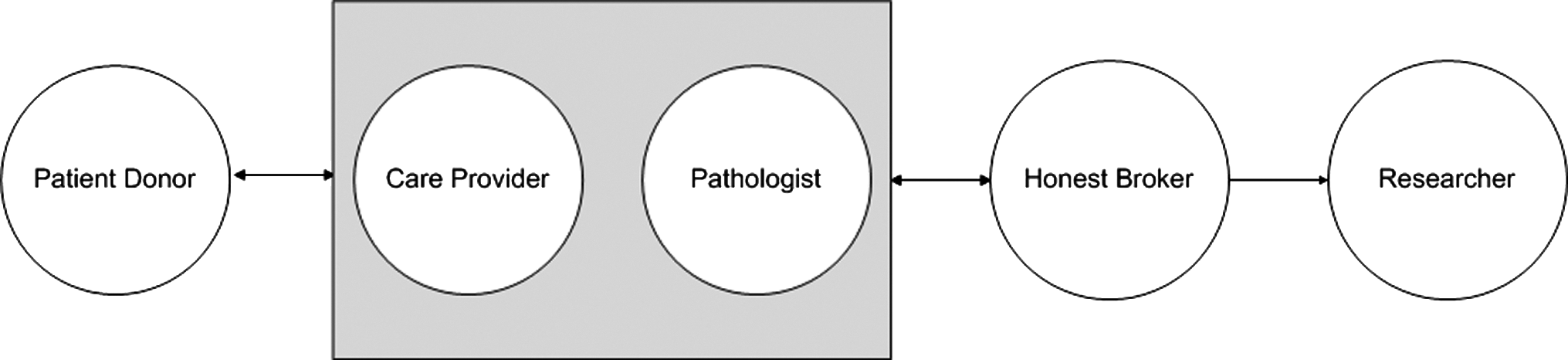
Flow of medical information using an honest broker. When a patient donor gives specimen to the biorepository the medical information is first received by the health care facility (care provider(s) and pathologist [gray box]) as part of their health care at that particular covered entity as defined by Health Insurance Portability And Accountability Act regulations. The medical information can be shared with the patient donor, within the covered entity for medical reasons, as well as with the honest broker of the biorepository. The honest broker is an individual, organization, or system acting for, or on behalf of, the covered entity to collect and provide the medical information to the research investigator. This is done in such a manner that it is not reasonably possible for the investigators or others to identify the donor, either directly or indirectly. The honest broker system is recommended by NIH, NCI, and PRIM&R to protect donor privacy when sharing data. Information provided to an investigator by the honest broker may be coded to permit further information collation and the code is retained by the honest broker. The honest broker allows a 1-way flow of medical information from the covered entity through the honest broker to the investigator.
Facilities
Providing a safe and efficient work environment was an important aspect to consider when deciding on a location for our biorepository. There was detailed discussion with the Engineering Department regarding facility needs and the possibility of either using an existing location that could be remodeled or the need for a new facility to be constructed. An existing location was chosen because it required minimal retrofitting and remodeling. The most important considerations were an available floor drain, correct electrical outlets for equipment, ability to control the temperature in the facility, telecommunication lines, IT ports, and having ample space for all functions. Access and monitoring have been a focal point for the biorepository. Admittance to the biorepository is restricted to individuals with the appropriate badge access and is also logged and monitored. An alarm system set with motion detectors is in place to monitor unauthorized entry.
The desire to preserve quality biological specimen requires the development of methods for long-term storage and best practice requirements to monitor and maintain the functionality of the equipment to ensure quality-controlled samples. 3 The formalin-fixed, paraffin-embedded specimen is stored in cabinets at room temperature, fresh specimen at room temperature or at 4°C, and fresh-frozen specimen in liquid nitrogen or first flash frozen in liquid nitrogen and then transferred to −80°C. Fresh samples are handled as required by the individual investigator's IRB-approved research protocol and often the fresh specimen is picked up in medium by the investigator as soon as the specimen is available from the operating room to ensure viable cells. Careful monitoring and recording of temperatures are paramount. We selected a monitor with unique features that enable the biorepository to monitor up to 8 temperature sensors; each is separately programmable for high and low temperatures and a defrost time delay. A temperature log records temperatures from all freezers. 3 The temperature displayed on the outside of every freezer is checked against the automatic log for verification of calibration. This allows us to proactively evaluate each unit's performance and determine maintenance needs. 3 For preventive maintenance, all equipment is checked at 3-month intervals, per our institution's requirement. We chose to have an audible alarm and logging on-site as well as off-site monitoring by our Engineering Department. Emergency contact numbers are posted in both the Security and Engineering Departments as well as at equipment locations.
Our backup power setup follows International Society for Biological and Environmental Repositories' best practices. 3 A natural gas-supplied, backup power generator was chosen. The natural gas is supplied by a pipeline, which is an optimal unlimited source of fuel when there is a need for the generator. 3 The generator is automatically tested weekly. In the event that the backup generator is not functioning at an optimal level, a notification system will alert the institution's power plant staff to assess the problem and then relay the alert to the biorepository staff.
Safety
Safety considerations are a part of every job, and knowing how to avoid risk to yourself and others is a critical standard. The laboratory follows all existing fire safety guidelines and emergency operation plans developed by our institutional Safety Department. To meet state, federal, and Occupational Safety and Health Administration (OSHA) requirements, Material Safety Data Sheets must be maintained in an online master file. All staff receives biological and safety training at orientation and completes an annual refresher as required by their job function and by federal regulations.1,10 Personal protective equipment should be worn when appropriate. Staff has been encouraged to conduct themselves as if every specimen is infectious, which means to always follow universal precautions when handling specimen. 11 Hand washing after specimen handling is also a requirement. 5
Informatics
Informatics represents a set of tools that support and enhance the scientific process. We purchased GenConnect Software to be used as our tracking database. Internal IT and biorepository staff worked with technical support at GenConnect to personalize the system. Once all data points were identified and included in the database in distinct locations, the software was installed on a local server. Training on use of the system was conducted via multiple webinars with GenConnect. Our internal IT staff was instrumental in developing templates for batch uploading to the new software database. An encryption procedure was implemented to enable electronic transmission of data to investigators. A homegrown database will be utilized for our honest broker system, which will store the link to the de-identified specimen. A large task for the biorepository staff was to determine the reporting capabilities of the electronic medical record. To limit the number of errors due to manual entry, a report of extractable fields from the electronic medical record was developed to allow for batch upload into the GenConnect database.
Marketing the Biorepository
Effective marketing can reach an intended audience with information that reflects your product or service. In getting the word out to the community and to investigators about the biorepository, our marketing department played an instrumental role in the development of our campaign. A display was created for use at community events and local conferences to educate attendees on translational research and how the biorepository fits into that bench-to-bedside model. Biorepository staff attends events to provide attendees with informational brochures about tissue donation, conduct Q&A, and assist the community in gaining a deeper knowledge of tissue donation. The biorepository has been featured in multiple printed publications. The articles provide an overview of what the biorepository represents and what it offers our medical community. From a community standpoint, the biorepository has been very well received, and during our first year of running the biorepository, over 700 donors have been consented.
Lessons Learned
Involve a clinical pathologist from the beginning. The pathologist is crucial to the overall functioning of a biorepository. Expertise in specimen-processing techniques will assist with developing consistent collection and processing procedures, which will result in more valuable specimen. If possible, these procedures should allow for simultaneous collection of research and clinical specimen.
Include site visits specific to software. It is imperative that the software has the capability to track a specimen accurately from the moment of collection, to arrival at the biorepository, and ending with receipt of the specimen by the investigator. Speak with current users of the software to hear the highlights and the pitfalls they may have encountered.
Include your institution's biomedical department staff with new equipment purchases. These are the individuals who service various types of equipment throughout the institution on a daily basis. No one is more familiar with the durability of equipment and reliability of a vendor than they are. They can also provide input on what equipment they are trained to service.
Have regular contact with each area that will be affected by the biorepository (IT, patient care, purchasing, IRB, etc.). Developing a biorepository involves an array of people. Involving all parties from the beginning for their professional input will ensure that protocols and procedures are feasible. Obtaining input and buy-in during the planning process will facilitate the implementation of workflow changes in the affected areas.
Conclusion
There are multiple factors to consider when developing a biorepository, but the overarching goal of providing high-quality human specimen to support medical research should remain paramount. Policies and procedures governing not only how specimen and associated data will be collected and stored, but also how these resources will be utilized, must be developed. Additional issues such as confidentiality of donors, selection of software systems, and cost recovery fees require careful consideration. Continued program oversight and refinement based on updated best practices and new regulatory guidelines are essential, as are listening to investigator needs and monitoring donor confidentiality.
Footnotes
Acknowledgments
Our biorepository was established with funding from the Opha Johnson donation. We are grateful to all the individual staff members who gave input during the development phase. We thank Patricia Stevens and Annette Fudge for assisting with the revising and editing of this manuscript. Our sincere appreciation to Dr Andre Balla, University of Illinois at Chicago, for serving as our mentor.
Author Disclosure Statement
No competing financial interests exist.