




Abstract
Biobanking is recognized as a critical area requiring development if progress is to be made in identifying clinically useful markers of disease and disease progression, discovering new drug targets, and understanding the mechanisms of disease in cancer. Researchers continue to report that they are unable to obtain sufficient high-quality, well-annotated samples of diseased and control tissue, blood, and other biological materials. At the same time, funders of research, and especially funders of biobanks, are looking to obtain the best value from their investments in sample and data collection. There is a need to increase the availability to researchers of large numbers of high-quality, well-annotated samples of diseased and control tissue, blood, and other biological materials and, in this way, accelerate cancer research. To do this, samples need to be collected, processed, and stored in standardized ways that give assurance to researchers that they are fit for purpose. Quality assurance is an essential part of good science and this article describes how quality assurance is applied in cancer biobanking and discusses the need for internationally acceptable standards.
Introduction
Researchers report 2 major problems: (1) the ability to get access to sufficient numbers of samples and (2) the fact that the available samples are not always suitable for their research. The Cancer Genome Atlas group in the United States, for example, reported at a meeting of the International Cancer Genomics Consortium that biobanks typically overestimated the quality of cancer tissue samples they hold. 3
Research by the European Commission's Joint Research Centre and Institute for Prospective Technological Studies 4 recognized the need for improved collaboration and networking among biobanks. Currently, networks of biobanks, such as the Confederation of Cancer Biobanks in the United Kingdom, CNIO Tumour Bank Network in Spain, the Danubian Biobank Consortium, Canadian Tumour Repository Network, and the Australasian Biospecimen Network, are working to develop harmonized methods and quality-assured procedures to address these issues. The ultimate aim of these networks is to increase the numbers of high-quality, well-annotated samples that are available to researchers and so accelerate cancer research.
The need for quality assurance (QA) is recognized as an essential part of any scientific endeavor5,6 and it is especially important when different organizations work together. 7 If donors, researchers, financial contributors, and the biobanks themselves are to be assured that samples and data are of high quality, “interoperable,” made available, and used in research, then there is a need to define sample and data quality, define best practices for biobanks, and set up a scheme to confirm that biobanks are following best practice guidelines and achieving high quality.
This article will discuss the components of a QA system in a biobank and the availability and usefulness of written standards and guidelines and will give some examples of work in this field. Although many of the examples used come from cancer biobanking, the principles of QA are applicable to all biobanks storing human tissue or data for research. This article will give an overview of current thinking on the need for and use of QA in biobanking of human tissue and data.
What is QA?
The simplest definition of quality is “fit for purpose.” The purpose of a biobank is to collect, store, and distribute high-quality samples and data and it may, in addition, process and test the samples. The way in which the biobank performs these tasks needs to be controlled, so that all of the operations of the biobank, including the ways in which the biobank is managed and in which legal and ethical requirements are met, are fit for purpose.
Organizations control the quality of their activities by implementing a quality management system (QMS). The QMS defines the organization's quality policy and objectives and ensures that these are achieved through QA and quality control (QC). QA focuses on the processes through which the product is obtained, whereas QC focuses on the product.
Most scientists are familiar with QC, which is “that part of QA that focuses on fulfilling quality requirements” and perform QC as a routine part of their day-to-day activities. QC consists of specific tests defined by the QA or QMS program to be performed to monitor procurement, processing, preservation and storage, specimen quality, and test accuracy. These tests may include but are not limited to performance evaluations, testing and controls used to determine the accuracy and reliability of the biobank's equipment, and operational procedures as well as monitoring of the supplies, reagents, equipment, and facilities.
The concept of QA is less familiar than QC and often meets some resistance from scientists who are proud of their scientific knowledge and achievements. So what is QA, why is it important, and what can a cancer biobank gain from implementing a QA program?
QA is defined as “that part of quality management that focuses on providing confidence that quality requirements will be fulfilled.” 8 QA requires the systematic monitoring and evaluation of all aspects of the biobank's processes; it covers the way in which the biobank is operated as well as the quality of the samples and data held.
The quality of any product or process can be demonstrated by comparison with a quality standard, and organizations who can show that they meet the requirements of the standard can gain certification or accreditation.* The international standard, ISO 9001:2008 9 (ISO 9001), sets out the internationally accepted requirements for a QMS that can be applied to any type of organization. It is based on Deming's Shewhart cycle of “plan, do, check, act” (Fig. 1) and covers management requirements as diverse as defining quality objectives, documenting procedures, controlling documents and records, contracting, purchasing, handling complaints, correcting and preventing problems, internal auditing, training, and committing to improvement. The organization is able to set its own quality objectives and decide for itself (and its stakeholders) what its product or service should look like. Compliance with ISO 9001 does not, by itself, ensure that scientifically valid methods are used and samples and data are fit for purpose, because this standard does not give any technical requirement for the quality of the samples or the scientific aspects of a biobank's work. It does not cover, for example, qualification of equipment, validation of methods, measurement traceability, use of control and reference materials, participation in proficiency testing schemes, and handling of samples and data. As well as having a management system that ensures that the biobank's core processes are fit for purpose, a biobank must ensure that the samples and data it provides are fit for purpose (Fig. 2).
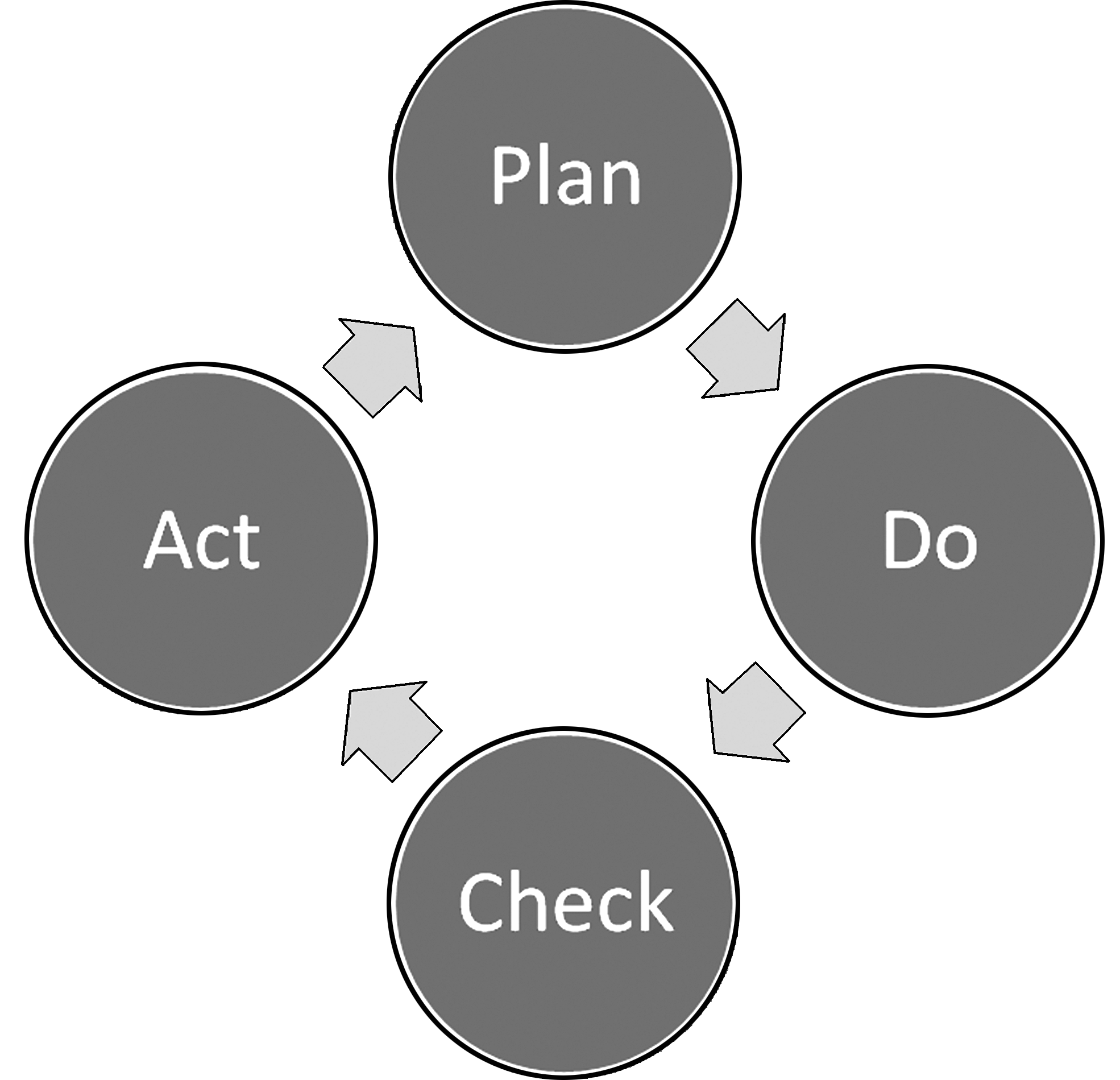
Deming's Shewhart cycle.
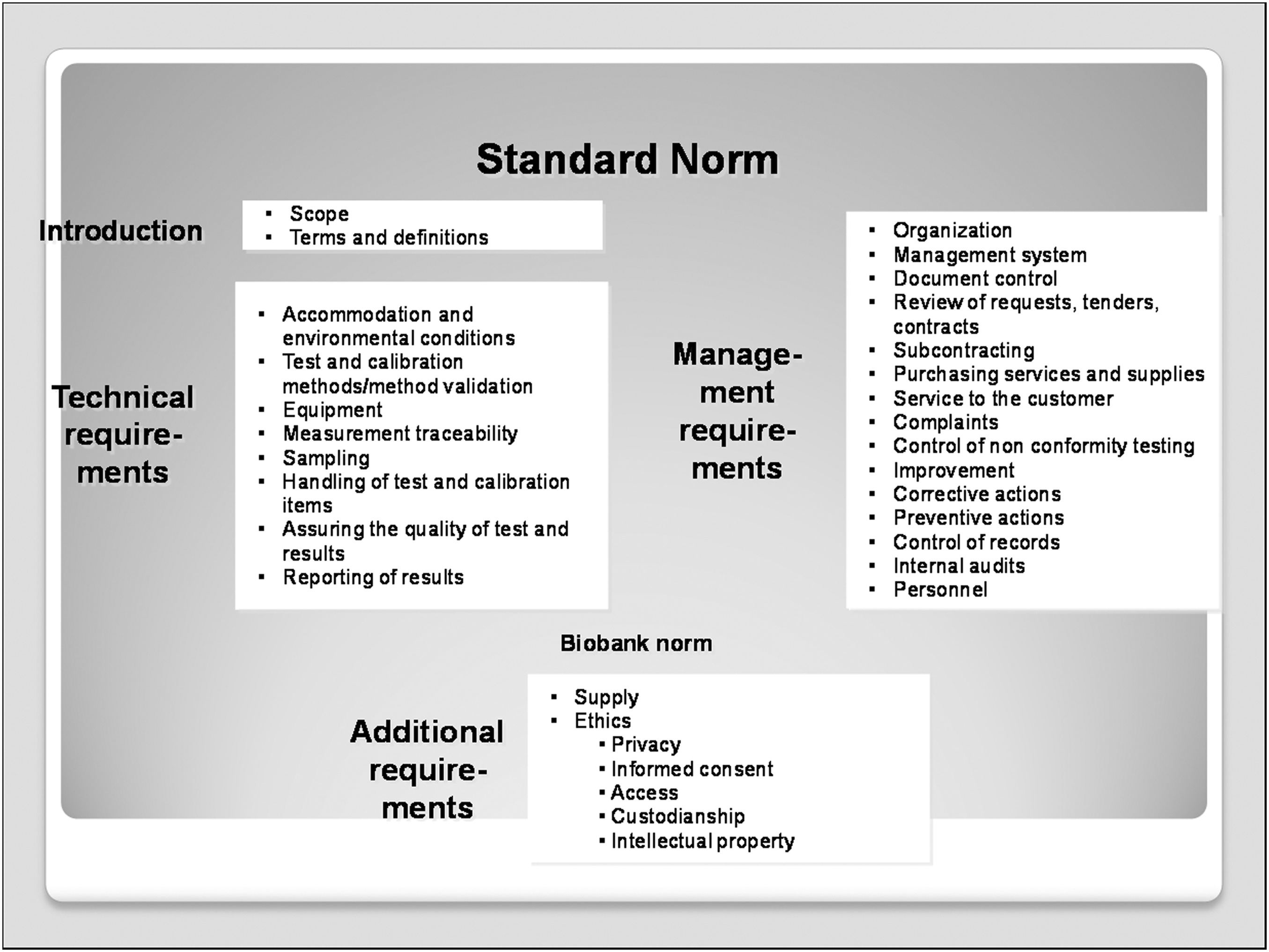
Requirements for a quality management system and technical requirements for quality assurance in a biobank.
Quality Standards
There is no international standard for technical quality in a biobank, so the Marble Arch Working Group on International Biobanking (MAWG) studied the requirements of the available ISO† standards containing technical requirements that could be applied to biobanks as well as available guidelines/best practice documents. The standards selected were ISO 17025:2005 (ISO 17025), the standard for testing and calibration laboratories, 10 and ISO guide 34, for reference material producers, 11 which contain the QMS requirements present in ISO 9001 and additional technical requirements relevant to the subject area. The MAWG looked also at biobanking “best practice” guidelines published by the OECD, 12 NCI, 13 and ISBER 14 to determine what additional technical requirements are needed for biobanking. ISO standards contain technical requirements but do not mandate how those requirements should be met, whereas best practice guidelines give detail on the best ways to achieve such requirements. Best practice guidelines are not compulsory for organizations seeking certification or accreditation if the organization can justify why they have taken an alternative approach.
None of the guidelines/best practice publications examined by the MAWG was found to be sufficient as an international standard for biobanking so the MAWG compiled elements from them into the format of an ISO standard specific for biobanks. 15 The document produced contains the requirements for an international standard for biobanking. However, a biobanking standard has not been adopted as a “work item” by an ISO Technical Committee yet.
The only existing national biobank-specific standard is the French standard, NF S 96-900 Quality of biological resource centres—Management system of a biological resource centre and quality of biological resources of human and microbial origin, published in July 2008. Its design was based on ISO 9001, and it includes some additional specific technical requirements. It is applicable to the wide activities of research tissue banks and is suitable as a certification, but not as an accreditation standard. Certification against either ISO 9001 or NF S 96-900 is requested of research tissue banks by the French research infrastructures funding organization and so far 47 organizations have been certified against NF S 96-900, of which a majority are research tissue banks. The French standard has not been used outside of France, but its application in France shows that a specific standard designed for research tissue banks is useful and applicable.
In the absence of a widely applicable biobank-specific standard, many biobanks have obtained certification of their QMSs against the requirements of ISO 9001 [for example, UK Biobank, UK DNA Banking Network, Spanish HIV Biobank, Invidumed (Hamburg), Norwegian Mother and Child Cohort Study biobank, Biobanque de Picardie, Biobank Graz (Austria), and Singapore Bio Bank]. Interestingly, the Karolinska Institute biobank and the National Reference Cell Culture Centre of Instituto Zooprofilattico Sperimentale della Lombardia dell'Emilia Romagna–Brescia have been accredited to ISO17025 and the ATCC has been accredited to both ISO17025 and ISO Guide 34. No such example exists for a cancer biobank yet. ISO 9001 is described in the Molecular Medicine Ireland's Guidelines for standardized biobanking 16 as “the recognized international quality standard that biorepositories are working to implement.” The Molecular Medicine Ireland guidelines have been accepted by BBMRI‡ as a first version of a BBMRI Laboratory Manual, thus giving increased authority to this publication.
The MAWG publication and the French biobanking standard provide an excellent starting point for the development of an ISO standard specifically for biobanks. ISO standards are aimed primarily at reducing barriers to international trade and cooperation, thus development and implementation of an ISO for biobanks will ensure that samples and data collected in any biobank that conforms to the ISO requirements are suitable for use in local, national, and international research projects.
Harmonization, Standardization, and Best Practice
Biological materials and their derivatives are fragile; they can change rapidly when removed from the living host, they need to be conserved ex vivo with as little modification as possible in relation to their in vivo state, and they need to correspond to the researchers' needs. Standardization of procedures is an essential part of QA; a biobank will determine and document its ways of working in standard operating procedures to ensure that samples and data are collected and handled consistently. If researchers are to be able to use samples and data from more than one biobank, however, samples and datasets held by different biobanks must be comparable. If they are not comparable, differences discovered during the research may be due to the ways in which the samples and data have been obtained and handled, rather than to physiologically relevant differences in vivo.
Harmonization is a process through which procedures and practices are aligned so that they are compatible with one another. This would allow researchers to have knowledge of the differences between samples and take these into account during their research. Standardization is the process of defining and agreeing upon technical standards, so that samples and data obtained from one biobank are equivalent to those from other biobanks using the standardized methods. Both rely upon biobanks having a common aim and willingness to work together and adapt preexisting practices.
The definition of a high-quality specimen or dataset can be a problem for a biobank. A researcher working on a specific project, using specific sample types and experimental techniques, can determine which factors will affect his work and ensure that samples and data are collected appropriately to suit his needs. A biobank, in contrast, is collecting samples and data for future, unspecified research and does not know what techniques will be used, what factors will affect the suitability of the samples, or what data will be needed. Samples that are suitable for one technique may not be suitable for a different technique—there is no single way of handling samples that will suit all users. The biobank must decide which factors are most important to control and it must select procedures that provide a balance between the predicted needs of any potential researchers and the available resources within the biobank. There is little scientific evidence supporting one protocol over another; thus, it is difficult to find justification for the methods chosen and equally difficult to persuade a biobank to change so that it is in line with others.
There is a need for biospecimen research to define evidence-based best practices. This need is recognized by the biobanking community, but funding for this type of research is hard to come by; much of the current research is funded in the United States by the National Cancer Institute through the Office of Biorepositories and Biospecimen Research, where it is a strategic priority, 17 and in the EU through an FP7 project, SPIDIA.§ Few institutions have an internal biospecimen research focus, as do the Integrated Biobank of Luxembourg and the Van Andel Research Institute. To achieve interoperable samples and data, practices must, as a minimum, be standardized inside each biobank and harmonized between biobanks. In the meantime, the best that can be done is to validate procedures and keep meticulous records so that any difference between samples can be attributed to the sample itself rather than the way in which it was collected, processed, and stored.
At present, many researchers validate the samples they receive from biobanks because they are not able to rely upon the suitability of samples that they have not collected themselves. The purpose of harmonization and standardization is to ensure that samples are collected, transported, processed, tested, and stored in ways that give consistently high-quality samples and consistently accurate data. This makes the samples and data acceptable to researchers without further testing.
Harmonization with respect to sample variability
The differences between samples are multifactorial. Preanalytical factors affecting the samples occur in vivo, because of differences between the donors (preacquisition variables), during sample collection such as those due to differences in anesthesia, time delays during surgery and surgical techniques (acquisition variables), and after the samples have been removed from the donors, during transport, stabilization, processing, and storage (postacquisition variables). Examples of preanalytical variables are shown in Table 1.
It is possible to control some acquisition variables and many postacquisition variables, but with tissue in particular, biobanks are often constrained by local pathology procedures, with differences limiting the intraoperability of samples. Preacquisition factors are almost all outside the control of the biobank. To allow such samples to be used by researchers, it is necessary to keep meticulous records and make them available to the researcher. A system for annotating samples with data about preanalytical factors has been developed by the ISBER Working Group on Biospecimen Science and published as a standard preanalytical coding for biospecimens (SPREC). 18 The criteria used to annotate solid tissue samples are shown in Fig. 3. This system allows samples to be annotated by a code that describes how they have been obtained and processed, allowing preanalytical factors to be compared by the researcher. The application of a preanalytical sample code can not only facilitate a more effective inter- and intralaboratory specimen utilization by scientists from different biobanks supplying samples for common research and validation exercises, but also allow more effective reporting of research results.
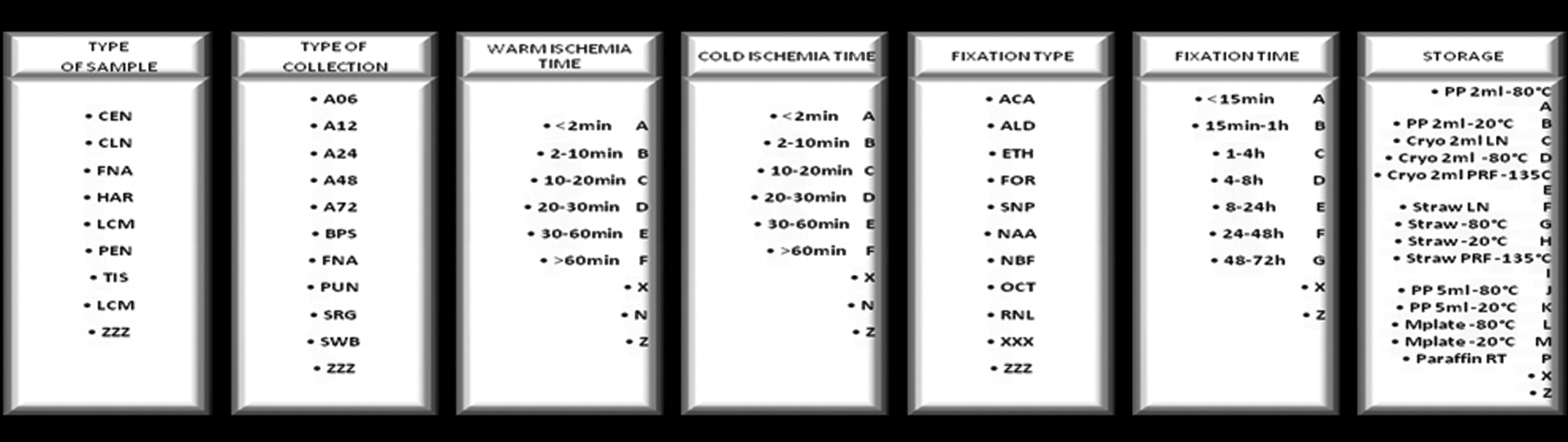
SPREC for solid tissue samples. Data originally published in the paper by Betsou et al. 18
Validation
Validation of biobank's methods, samples, and data
Validation can be defined as “establishing documented evidence which provides a high degree of assurance that a specific process will consistently produce a product meeting its predetermined specification and quality attributes.” 19 Validation of methods, samples, and data will enable biobanks, financial supporters, and researchers to have confidence in sample quality and so give added credence and reproducibility to the results of research.
Validation can be applied to the “raw” biological material or data, the processing methods used, and any QC testing performed. The objective of validation is to demonstrate that the samples, data, and methods are suitable for their intended purpose. Equipment also needs to be validated (validation of equipment is usually referred to as equipment qualification). Information and guidance about validation are available from IUPAC, 20 the International Committee on Harmonisation, 21 NIST, 22 ISO 5725, 23 and ISO 17025, covering validation of the methods of performing analyses, traceability of measurements, evaluating uncertainty of measurement, and defining the accuracy and precision of results. Elements to consider when validating testing methods are shown in Table 2.
Validation of processing methods looks at preanalytical variables that have the potential to affect the outcome of results but are not related to the inherent sample differences of interest to researchers. Validation aims to design methods that minimize and control these differences. The problem for biobanks is that while potential confounding factors can be postulated, their effect on research results is not known. This makes it essential to carry out biospecimen research to identify which processing steps are critical to sample quality and which sample attributes are important once these are known it is possible to develop appropriate QC assays. 24
Some of the elements of biospecimen research that can support QA in biobanking are already within the scope of biobanks and/or associated laboratories. Indeed, it is possible to evaluate the uncertainty of measurements that biobanks may be performing. It is also possible to evaluate the impact of several preanalytical variables on downstream analyses. 25 However, some of the elements that might be essential to the implementation of an integral QA program are still missing. One such element is the availability of Proficiency Testing/External QA programs, which would allow biobanks to assess their own performance in comparison with others. Proficiency Testing/External QA schemes also permit the evaluation of the accuracy and precision of the different types of measurements that biobanks often carry out for the characterization of their samples. Another missing element is the availability of reference materials, which are necessary for validation of a testing method. 11
Validation of data requires verification of all clinical and biological annotations, use of standard ontologies, checks on accuracy of transcription, eventually through double entries, and implementation of data security systems, for example, compliance with the EU Directive on the protection of personal data and the EU-US Safe Harbor principles.26,27
Indirect validation of biobank's impact
Although this section has concentrated on the quality of samples and data, this is only one aspect of the quality issues in biobanking. The financial supporters of biobanks seek to maximize the return on their investment. Ensuring the quality of the sample and its suitability for use by the researcher is one way that this investment can be maximized, but these supporters have further interest in the access policies and scientific review procedures that are used when biobanks grant access to samples and data to researchers. From the investors' perspective, numbers of samples used in research and numbers of publications from those samples are also markers of the quality of a biobank. Best practice guidelines are broad based and cover every aspect of running a biobank, considering, for example, legal and ethical issues, sustainability of funding, appropriate levels of anonymization, and methods of determining who has access to samples and data. These are often the areas where best practices devised in one country may not be applicable elsewhere, as legal and ethical requirements differ between countries, but their control is essential to give confidence to donors, financial supporters, and researchers.
Benchmarking of Biobanks
Once standards and best practices are defined, it is possible to benchmark biobanks. In 1999, the OECD suggested that national governments “should support the development of an accreditation system for biobanks based upon scientifically acceptable objective international criteria for quality, expertise and financial stability.” This is one way in which biobanks can be benchmarked but there are several options for benchmarking of biobanks, namely self-assessment, peer review, or through a formal certification or accreditation procedure.
Self-assessment is the simplest and least expensive route. A series of questions can be drawn up based on the required standards and the biobank can rate itself against the questionnaire. ISBER members, for example, have access to a web-based self-assessment tool designed to allow biobanks to assess their compliance with the ISBER best practice guidelines. The main drawback to self-assessment is the lack of consistency and transparency in assessments.
Peer review consists of inspection and assessment of compliance with the required standards by experts in the field, such as staff from another biobank or associated organization. This system is more expensive, requiring staff to be released from their normal work to visit the biobank that is seeking assessment. Its advantage over self-assessment is that the assessors can be trained so that assessments are consistent and the relative independence of the assessors gives greater assurance of the validity of the results of the assessment. The assessors, however, are not truly independent because they assess one another's banks; there is a natural “professional courtesy” between such assessors that is to the detriment of the perception of independence because the person whose bank you are assessing today may come to assess your bank next time. In addition, there are problems with ensuring confidentiality and protecting intellectual property if the assessors are your “competitors.” This is handled in most instances by requiring assessors to sign confidentiality agreements, but some commercial organizations are not willing to permit peers from competitor organizations on site. Great care is needed when using competitors as assessors.
Certification and accreditation are widely recognized as the “gold standard” ways to assess organizations. The terms certification and accreditation tend to be used interchangeably by “lay” people; however, they have different meanings. Certification is the proof of consistency in the procedures followed. Accreditation is the proof of the competence, the impartiality, and the independence of a certification body or laboratory in view of existing norms. Thus, an organization can be certified as having a QMS that conforms to the requirements of ISO 9001 and can seek accreditation against ISO 17025 to demonstrate its competence in carrying out specific testing or calibrations (as defined in its “Scope of Accreditation”). Organizations that gain accreditation against ISO 17025 are recognized as complying with the requirements of ISO 9001, because a QMS is an integral requirement of ISO 17025. Formal certification and accreditation are expensive to implement and maintain. They depend upon an international consensus to devise appropriate standards but grant international recognition to organizations that are certified or accredited.
There are several national and international initiatives looking at certification and accreditation schemes to assess biobanks, but as discussed earlier, only in France is there an official national standard. The need for a certification and accreditation working group was proposed and strongly supported at the ISBER 2010 meeting, held in Rotterdam in May 2010. The Canadian Tumour Research Network has launched a certification scheme for Canadian tumor biobanks at a meeting in Vancouver in January 2011. The National Centre for Tumor Diseases in Heidelberg has obtained accreditation against ISO 17020:2004 General criteria for the operation of various types of bodies performing inspection. ISO 17020 is not an obvious choice as a standard for a biobank; it was used to accredit the competence of pathologists to examine tissue but does not cover other biobank activities. 28 Its use is another sign of the need for a biobank-specific ISO standard. Work Package 3 of the BBMRI project aims “to provide support for the development of a European framework facilitating harmonization of standards through certification and accreditation procedures” (www.bbmri.eu/index.php/workpackages/wp-3). The American Association of Tissue Banks offers “accreditation” to research tissue banks based on its own criteria (www.aatb.org/accreditation). The College of American Pathologists is exploring the possibility of developing an accreditation scheme for American tumor banks. These schemes are not interchangeable; therefore, although biobanks within a scheme will have confidence in each others' samples and data, others outside the scheme or in a different scheme will not have the same assurance. The need for an international (ISO) standard for accreditation of research tissue banks is long overdue.
The breadth and depth of interest in biobanking at present make exciting times for cancer biobanks. Donors, financial supporters, researchers, and governments are showing that the need for high-quality, well-annotated samples of human tissue and its derivatives are widely recognized as a key to enhancing cancer research. QA is the key to providing confidence in the quality of samples and data, enabling collaboration between biobanks and furthering the research effort.
Footnotes
Acknowledgment
The authors express thanks to Dr. Sabine Lehmann, Quality Manager at IBBL, for critically reading and making helpful comments on the manuscript.
Author Disclosure Statement
The authors declare that they have no conflicts of interest.
*
Certification is the procedure by which a third party gives written assurance that a product, process, or service conforms to specific requirements. Accreditation is the procedure by which an authoritative body gives formal recognition that a body or person is competent to carry out specific tasks.
†
ISO is the Geneva-based International Organization for Standardization. This organization produces and publishes written standards according to the perceived needs of the international community. Standards are sponsored by a national standardization body (the British Standards Institute in the UK, for example) and agreed, by consensus, with representatives of the community to which they relate.
‡
BBMRI is the European Biobanking and BioMolecular Resources Research Infrastructure, currently in its preparatory phase. It is supported by the European Union Framework Program 7 and aims to lay the basis for unified biobanking across the EU. It brings together some 250 biobanks from European Union (EU) member and associated states (see  ).
).
§
SPIDIA is a 4-year project, funded by the European Union FP7, which aims to tackle the standardization and improvement of preanalytical procedures forin vitro diagnostics. The proposed research and standardization activities cover all steps from creation of evidence-based guidelines to creation of tools for the preanalytical phase to testing and optimization of these tools through the development of novel assays and biomarkers.