




Abstract
The validity of results from biomarker studies using archived specimens depends on the integrity of the specimens and the manner in which they are collected, processed, and stored. The management of a huge amount of biomaterial generated from research studies and clinical trials is becoming a very demanding task and many organizations are facing the choice between in-house storage and processing and outsourcing some activities. Storage and logistic functions are the prime targets for outsourcing, because to sustain these critical assets organizations must have the expertise, the dedicated qualified personnel, the proper quality control programs, and available resources to fulfill the mandatory requirements to maintain the integrity of the samples. External biobanks are dedicated and certified infrastructures (ISO, GMP, etc.) that apply efficient logistic and shipping activities, use validated standard operating procedures, install appropriate monitoring back-up systems, and, most of all, have room for expansion. Thus, the choice between in-house biobanking and outsourcing cannot be exclusively based on a financial decision; it must also consider (i) type of collection/project, (ii) logistic complexity (number and locations of collection sites), (iii) safety requirements, (iv) functional expertise, and (v) business priorities.
Introduction
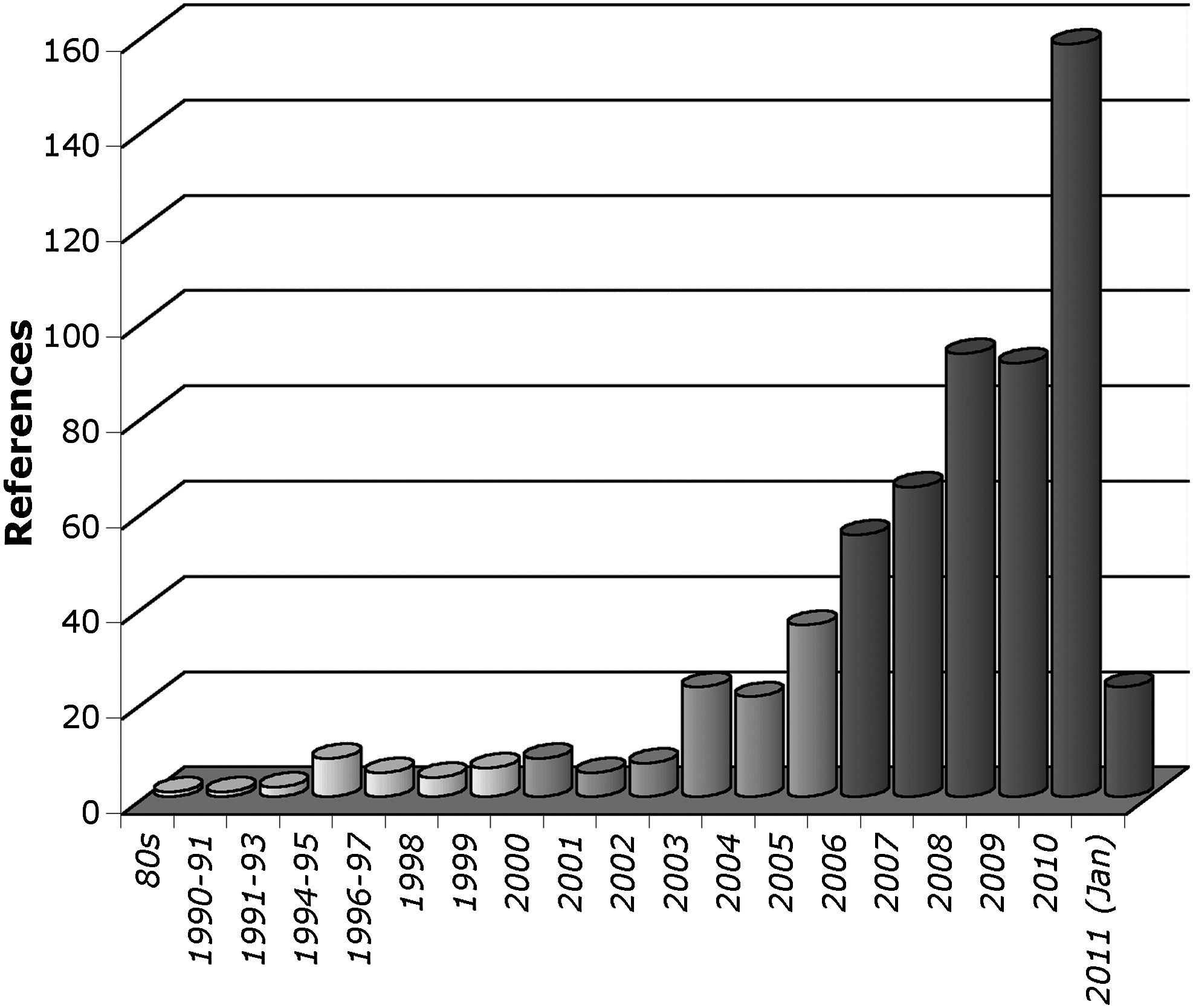
Number of PubMed references citing “biobanking” or use of “biobanks” in their title, abstract, or keywords for basic and translational research.
Pharmaceutical companies are shifting their efforts toward a more personalized medicine approach3,4 using molecular-based findings, which, on the other hand, require the collection, transportation, and storage of a huge number of high-quality and well-maintained biosamples. 5 The high-throughput molecular technology platforms available require large quantities of biomaterials to be used in research and clinical trials. Today, researchers can implement a wide range of analyses on archived biospecimens, which would not have been possible 1 or 2 decades ago. However, this type of workload cannot be handled by public and/or private hospital-based institutions despite the availability of sophisticated protocols and strict guidelines (Table 1) that regulate the handling and storage of biosamples. 6 This imposition is mainly due to financial constraints, limitations on capital budget expenses, and the ever-increasing demand to reduce costs.
In-House or Outsourcing Biosample Storage
Given the pivotal role that biomaterials play in pharmaceutical product development, private or public institutions are faced with on-site or off-site storage options. Depending on the strategy chosen, some institutions prefer 100% control of their own storage, and others instead prefer to allocate their biosamples to experienced biotech storage organizations based elsewhere. A potential compromise could be to maintain an in-house storage suite and in parallel retain, in a different but secure location, a duplicate set of samples.
However, when choosing on-site management of biomaterials, an institution or a company needs to thoroughly evaluate whether it is able to sustain several critical aspects (Table 2). Sample storing, validation processes, tracking, and invoicing are arduous tasks that require a great deal of time from experienced personnel. To manage such operational complexity, the storage facility needs to have a rigorous and structured organization based on the following: (i) standard operating procedures to be implemented in addition to training staff to ensure proper compliance with the way materials should be processed and stored; (ii) an international biobanking consent form that must be signed to allow the sample to be used in international research studies 7 ; (iii) good knowledge of the international biosafety rules and regulations for handling and shipping of biomaterials to avoid unwanted custom delays; (iv) sophisticated logistics and product-tracking systems such as enterprise resources planning software, document management systems, and bar-coding to provide a complete history of the handling, status, and transfer of biospecimens. 8
SOP, standard operating procedure.
In-sourcing the cold-chain storage and logistic functions may provisionally be a good investment, but it may become an overwhelming and expensive burden in the long run. For these reasons, many biotechnology and pharmaceutical companies are increasingly outsourcing the management of their samples to expert service providers (Table 3). It has been estimated that the costs to build a 50,000 sq ft facility ranges from $6,000,000 to $9,000,000 depending on the geographical location as well as the costs of material and labor. 9 In addition, the management costs to maintain high-quality standards and fulfill all the requirements for sample traceability need to be accurately considered; even if they are difficult to estimate, because of the great variability among different institutions, it is clear that centralizing these functions would help to optimize the resources and reduce the cost of each sample. It is imperative to consider that the number of biosamples or bioproducts obtained from and for clinical trials is continuously growing; therefore, the need to store and logistically manage this huge amount of samples is very challenging, requiring proper infrastructure, special expertise, technologies, and regulatory compliance. By outsourcing these functions to experts in the field, drug manufacturers and researchers can mitigate risks and expenses and focus their resources on their core competencies.
Cost Is Not the Only Factor
Compliant storage is just one of the many factors to take into consideration if the outsourcing strategy is selected.
Which then are the criteria when choosing an outsourcing partner?
(i) First of all, the right storage partner must convey to a researcher and to the respective institution's governance “confidence” in the efficiency and quality of services they offer.
(ii) The off-site partner must have state of the art ultra-low freezer storage facilities, a high-security environment, including access, control systems, motion smoke detectors, and continual closed-circuit television (CCTV) surveillance. Computer-controlled sensors that guarantee temperature integrity with constant monitoring, full emergency back-up including spare freezers, dedicated service teams on call 24/7, and proactive technicians to monitor equipment and provide preventive maintenance and repairs.
(iii) Bio-outsourcing relationship, unlike typical customer–supplier relationship (which can be short-lived and largely impersonal), is usually a long-term partnership that requires open communication, mutual respect, and trust.
(iv) An ideal biorepository partner should be a true industry innovator and should set quality and service standards.
Conclusion
The present biotechnology industry no longer resembles the industry of the past; its greatest challenge is to manufacture sufficient quantities of products (eg, vaccines) to meet market demand. Biomanufacturing is a complex, costly, labor-intensive process, and, coupled with labor shortage and high costs for building adequate facilities, it has prompted many companies to outsource some of their activities. To assure quality and consistency of such activities, biobanks need to follow rigorous norms and standards that have been developed for specific medical environments: ISO9001:2000 for activities involving research, ISO17025:2005 for diagnostic purpose, and GMP/FDA-compliant certification for therapy. In this way, a comprehensive center for the preservation of biological samples (vaccines, bone marrow, culture collections, DNA, microbial, and viral seed stocks) can manage resources and no-core functions, providing specialized outsourcing facilities that are recognized by an official organization. 10
Biobanking entails long-term financial resources, a strategic location, ongoing validation, expert management, qualified employees, investment technology, and a deep understanding of the worldwide industry regulations and continuously updated contingency plans. By outsourcing such complex and specialized functions, biopharmaceutical companies can allocate their resources and capital toward drug development, which is their primary mission.
Escalating and costly industry regulations regarding audit trails, reporting requirements and handling procedures will likely increase the frequency of outsourcing storage operations.
As a guide, at least 180 disease-biobanks exist in the United States and over 200 establishments are currently licensed to operate in Europe, most of which were established in the last 10 years. 11 These evidences indicate that specialized external facilities are a true alternative and not only a perspective.
Footnotes
Acknowledgments
The authors acknowledge the support of NeuroStemcell (European Community's Seventh Framework Programme grant agreement nr. HEALTH-2008-B-222943) and are grateful to Marble Arch Working Group on International Biobanking and the European Middle Eastern and African Society for Biopreservation and Biobanking who provided additional knowledge.
Author Disclosure Statement
No competing financial interests exist.