




Abstract
The Infectious Diseases BioBank (IDB) has consistently archived peripheral blood mononuclear cell (PBMNC) RNA for transcriptome analyses. RNA is particularly labile, and hence, these samples provide a sensitive indicator for assessing the IDB's quality-assurance measures. Independent analyses of 104 PBMNC RNA specimens from 26 volunteers revealed that the mean RNA integrity number (RIN) was high (9.02), although RIN ranged between scores of 7 and 10. This variation of RIN values was not associated with ischemic time, PBMNC quality, number of samples processed per day, self-medication after immunization, freezer location, donor characteristics, differential white blood cell counts, or daily variation in RNA extractions (all P>0.05). RIN values were related to the date of collection, with those processed during mid-summer having highest RIN scores (P=0.0001). Amongst specimens with the lowest RIN scores, no common feature could be identified. Thus, no technical explanation for the variation in RNA quality could be ascertained and these may represent normal physiological variations. These data provide strong evidence that current IDB protocols for the isolation and preservation PBMNC RNA are robust.
Introduction
High-quality RNA is essential for such studies because denatured samples can give misleading results. 5 Although RNA is relatively thermostable, it is extremely labile because of the ubiquitous nature of RNAses. Quality of a eukaryotic RNA preparation has been classically determined by calculating the 18S/28S ratio of ribosomal RNAs.6,7 However, such estimates are highly subjective and can give ambiguous results, for example, marked changes in the 18S/28S ratios occur during aging in mice. 8 Moreover, ribosomal RNA ratios are only an indirect estimate of the quality of the much rarer mRNA species required for transcriptome analyses. Improved techniques for assessing overall RNA quality include the Screen Tape Degradation Value and use of software to deduce RNA integrity number (RIN), both of which provide much more reliable estimates of RNA viability than 18S/28S ratios.9–11 The RIN method takes account of the complete microcapillary electrophoretic trace and assigns each sample a value between 1 (degraded) and 10 (high-quality RNA). 10 For successful transcriptome analyses, RIN values exceeding a score of 7 or 8 are recommended. 12
As part of the HIRD study, 104 PBMNC RNA preparations were analyzed to identify which genes were differentially transcribed after vaccination. As part of this analysis, RIN values were determined and all samples were of high quality (all exceeded 7) and suitable for microarray analysis. However, there was some variation (between scores of 7 and 10) and this investigation aimed to identify the source(s) of the observed differences so that future samples are maintained with consistently high integrity.
Materials and Methods
HIRD study and volunteers studied
The HIRD protocol was reviewed by Brent Research Ethics Committee, who provided a favorable opinion (reference 09/H0717/88). PVB samples were collected into tubes containing sodium–heparin from overnight-fasted, reclining volunteers at the NIHR cBRC Clinical Research Facility at St. Thomas' Hospital, London. All PVB samples were collected between 8 and 10 a.m. during March through to November 2010. Two prevaccination PVB samples were taken on days −7 (visit 1) and 0 (visit 2), the latter followed by intramuscular injection with Pandremix™ H1N1 vaccine according to the manufacturer's instructions (GlaxoSmithKline Biologicals Ltd.). On visit 1, all volunteers had additional PVB samples taken for routine clinical analyses; subsequent PVB donations were made on days +1 (visit 3), +7 (visit 4), and +14 (visit 5) and on day +65 (visit 6). PVB samples were kept at ambient temperature after phlebotomy and dispatched in batches of 4 donations to the IDB at Guy's Hospital via courier (∼1.5 miles distant). PVB samples were continuously tracked before arrival at the IDB, thus providing data on “ischemic time” (overall time between phlebotomy and arrival at the IDB) and its subcomponents (“clinic delay”: time between phlebotomy and pick-up by courier; and “transfer time”: courier time between St. Thomas' and the IDB). In the present study, RNA samples collected on visits 1 to 4 from each of 26 healthy volunteers (13 women) aged between 19 and 64 years [mean=35.9; standard deviation (SD)=14.8] were investigated.
RNA preparation and analyses
PVB PBMNCs were isolated aseptically on a step gradient of endotoxin-free Ficoll-Hypaque™, washed twice by centrifugation through Dulbecco's phosphate-buffered saline, and then adjusted to 1×10⁷ trypan-blue-excluding PBMNCs in 0.75 mL of Qiazol™/vial in DNAse/RNAase-free tubes. All procedures were conducted by the same 2 IDB workers and all PBMNCs were frozen to −80°C within 4.5 h of phlebotomy. PBMNCs were couriered overnight to Miltenyi Biotec Ltd. (Bergisch Gladbach) on dry ice (−78.5°C). As repeated sampling can reduce RNA integrity from tissues, 13 none had undergone a freeze–thaw cycle before receipt in Germany. The RNA extraction and analysis on an Agilent 2100 bioanalyzer were performed to determine RNA yield (as μg RNA/1×107 viable PBMNC) and RIN value for each sample (Fig. 1) over a period of 4 days by the same technician.

Examples of RNA quality data. Left: Representative electrophoresis of peripheral blood mononuclear cell RNA. Right: Corresponding fluorescent traces used to derive RIN values (of 7.5, 9.2, 9.5, 8.9, 9.3, and 9.4, respectively, for human immune response dynamics samples 001-1, 001-2, 001-3, 001-4, 005-1, and 005-2 illustrated left to right on the gel photograph). RIN, RNA integrity number.
Statistical analyses
Paired Student's t-test, 2-tailed chi-squared test, and linear and polynomial regression analyses were used to assist in the interpretation of data using commercial software (Graphpad Prism™).
Results
Mean RNA yield was 13.5 μg per 1×10⁷ viable PBMNCs (SD=5.5 μg) and RNA integrity was high (mean RIN=9.02; SD=0.58) with no significant differences between the mean RNA yields or RIN values for any of the 4 visits or between those collected before (“pre”) and after (“post”) immunization (all P>0.05; data not shown). Nevertheless, there was variation with RIN scores ranging between 7 and 10.
Ischemic times averaged around 2 h (mean=131 min; SD=59 min; range=34–180 min); however, there were no significant associations between RIN scores and these delays (P>0.05: Fig. 2) or their subcomponents (P>0.05; data not shown). Qualities of PBMNC preparations in terms of percentage viabilities were not recorded. As samples were adjusted to a fixed number of viable PBMNCs/vial, those specimens containing higher numbers of dead cells should contain more RNA and have lower yields of viable PBMNCs per mL of PVB. Neither of these proxy measures of PBMNC quality was associated with RIN scores (both P>0.05; data not shown). To determine whether RNA integrity was due to degradation during storage, RIN values were plotted against date of collection over the 8-month period. The line of best fit was a polynomial curve (R2=0.275, P=0.0001; Fig. 3).
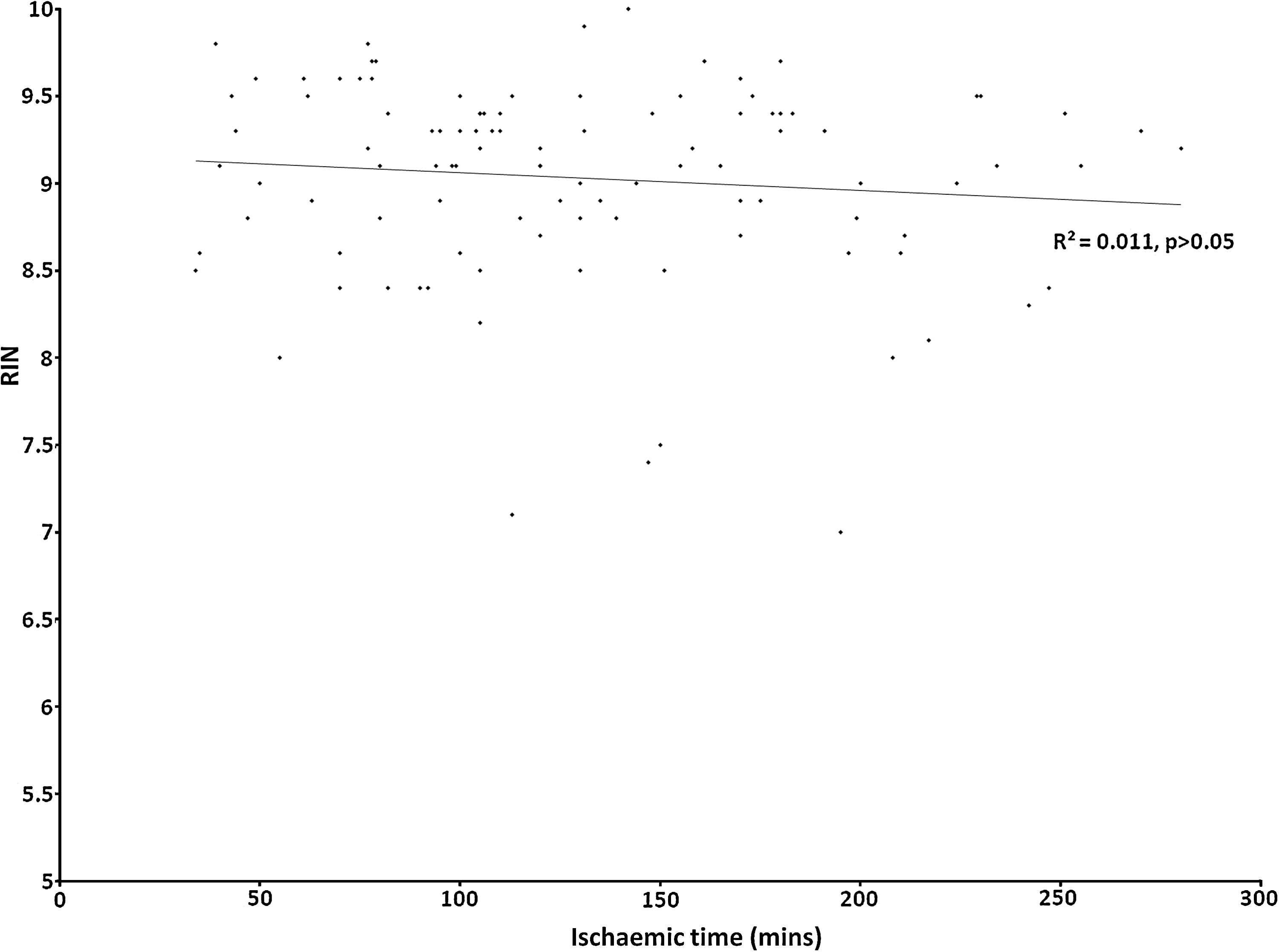
RNA quality versus ischemic time.
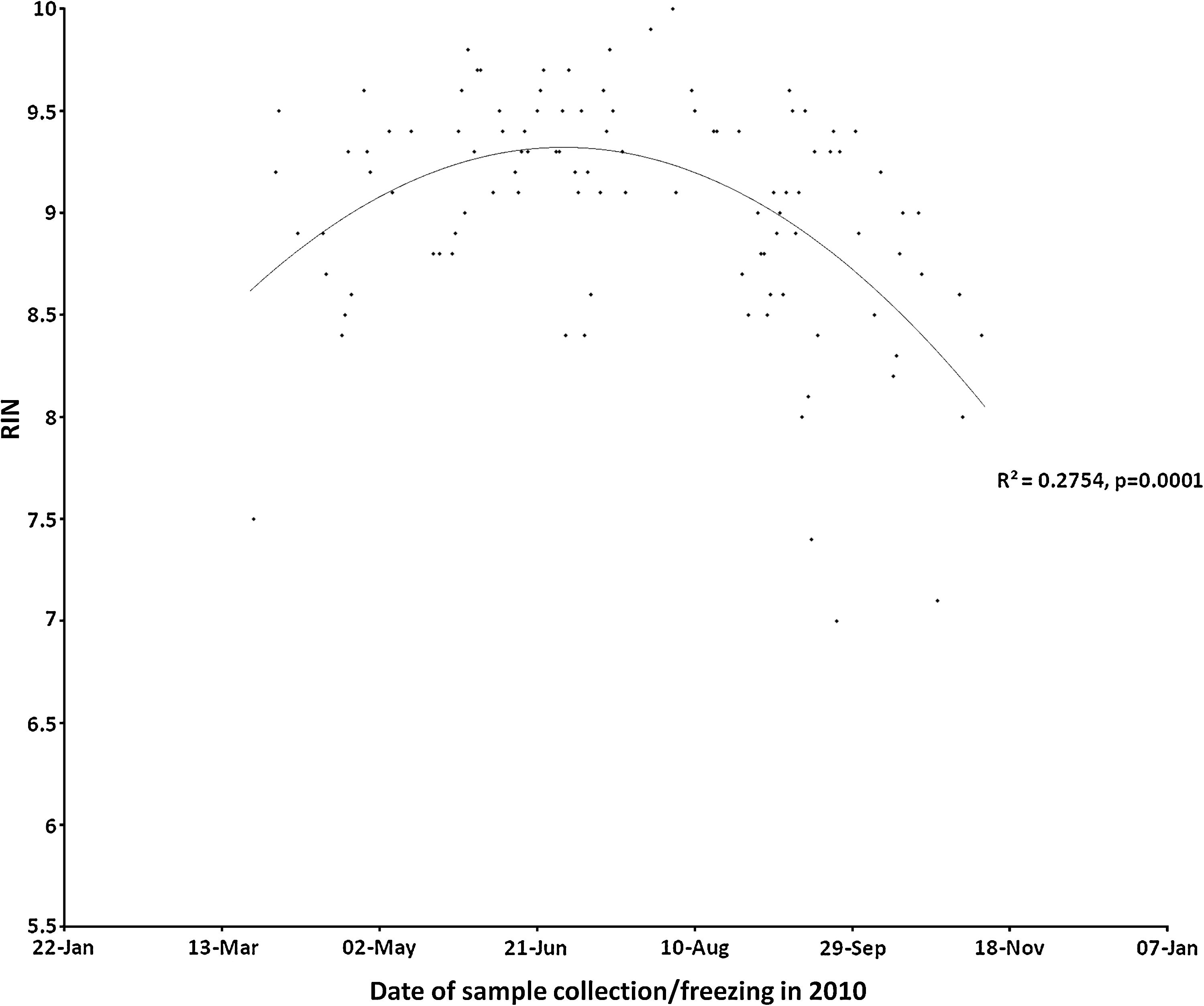
RNA quality as a function of collection date in 2010. RIN values were plotted against the date of processing/freezing, with data analyzed to determine the line of best fit.
Eighteen of the 104 samples (17.3%) had RIN scores of 8.5 or less (Table 1). All of these samples except 2 were processed by the IDB on different days, and for those with low RIN values, there was no factor (number of samples processed by the IDB per day; volunteer's age, gender, self-administered drug therapy after vaccination; or number of circulating lymphocytes, monocytes, or total white blood cell numbers detected at visit 1) that differentiated them from those who had RIN values of >8.5 on all 4 visits (all P>0.05; data not shown). Physical location of those samples with low RIN scores within the −80°C freezer was not clustered. Five were located at the back of the freezer in boxes A–D, 6 in E–H, 3 in J–M, and 4 in boxes N–R nearest the door. Samples were extracted over a 4-day period by 1 technician at Miltenyi Biotec Ltd. There were no significant differences between the mean RIN values of samples processed on different days (all P>0.05; data not shown), and the 18 samples with low RIN values were evenly distributed over the 4-day period of extraction.
Numbers in bold represent RIN values of 8.5 or below.
R, self-administered Neurofen (Neuro) or paracetemol (Para) after visit 2; M, male; F, female; Ly, lymphocytes; Mono, monocytes; WBC, total white blood cell counts; RIN,
Discussion
Biobanking represents a new and valuable way in which translational research can be performed. It is critical that biobanks conform to the highest standards and provide researchers with materials of consistently high quality. The IDB utilizes standardized operating procedures based upon EEC standards (ISO guideline 34, No. 17025: 2005), works within the UNE-EN-ISO 9001:2000 guidelines, and is a member of the International Society for Biological and Environmental Repositories to maintain high standards and to facilitate future interbiobank networking capabilities. Preanalytical variation is a major source of experimental error, 14 and an important consideration for clinical archives is ensuring that materials do not become degraded between collection and delivery to researchers. Thus, IDB PVB samples for the HIRD study were processed within a venepuncture-to-freezer time of <4.5 h for all samples. As part of ongoing reviews of IDB standards, we constantly monitor available quality-control data generated by studies using IDB samples.
Overall, the RNA integrity of the PBMNC preparations for the HIRD study was high, with all having RIN values well above the minimum recommended for microarray analyses. There were no significant differences between mean RIN values for PBMNCs collected at the 4 different visits or between those before and after H1N1 vaccination. Nevertheless, there was a range of RIN values observed and the potential source(s) of variation were therefore investigated.
Initially, we determined whether there was an association between ischemic times as this could affect the integrity of RNA as well as even the types of mRNA expressed. 15 However, there was no association between these variables (P>0.05) or between the individual subcomponents of this delay. Others have also noted that small delays in ischemic procurement times (up to 1 h) do not significantly decrease RNA quality from pancreatic cancers. 16 Similarly, in this report, delays of up to 3 h had no detectable influence on PBMNC RNA quality. The main contributor to ischemic time for the IDB samples was that they were dispatched from the clinic in batches of 4 donations and the delay was due to the time involved in consenting, questioning and bleeding subsequent donors.
The quality of PBMNC preparations was inferred from 2 proxy indicators, RNA and PBMNC yields; however, neither was associated with RIN values. Another possibility was that samples had become degraded in a time-dependent manner during storage. Had this been the case, those stored longest should have had lowest RIN scores, but this was not observed. There was no variation in procedures or reagent degradation. Additionally, there was no evidence of freezer malfunction during the study (these were alarmed to the mobile telephones of key workers and also monitored daily for temperature fluctuations, which are logged). The fact that the IDB was processing between 1.5 and 2.9 L of blood/week over this time means that there was a high turnover of all reagents and also makes the explanation of reagent degradation unlikely. The polynomial line of best fit indicated that RNA integrity was lower during spring and autumn, yet higher during the summer. Despite this analysis, the reason for this variation could not be explained by technical variations or intervolunteer characteristics. Similarly, the specimens were received frozen in Germany (and shipping had a negligible effect upon RNA yield or quality 17 ) and no differences in the different RNA preparations by Miltenyi Ltd. were detected.
There are some caveats with the present observations. First, the time of storage between collection and analyses was relatively short (8 months) and biobanks may need to store samples for many years, especially if medical information associated with disease outcomes is required. Second, although RIN values are a good measure of RNA quality, it would be useful in future studies to additionally compare RIN to polymerase chain reaction performance on a target gene to see whether this is comparable. Finally, it would also be interesting to determine whether different technicians have similar RIN scores.
There are physiological factors beyond the IDB's control that might explain the present observations. For example, no differences were observed between baseline differential blood counts for those volunteers with RIN values of 8.5 or less, but others have reported nadirs in PVB subsets of CD4+, CD8+, and NK cells, 18 as well as a zenith in vitamin D levels, 19 in the summer. Both of these factors may affect the overall quality of PBMNC RNA. However, to determine the true nature of this seasonal variation, dedicated studies need to be performed.
Many others have considered the viability of archived samples, although most studies have been restricted to the analyses of labile serum components such as enzymes 20 or recording the number of freeze–thaw cycles that individual samples have undergone. 21 The IDB has a policy of not reissuing plasmas or sera that have undergone a freeze–thaw process and has checked the virological viability of plasmas collected from other cohorts by successfully isolating and sequencing human immunodeficiency virus nucleic acids from around 33% of its archived stocks. Here, the IDB had a unique opportunity to directly assess the quality of stored RNA and, by inference, also that of the PBMNC preparations. The samples themselves had only been archived for a relatively short time period (maximum 8 months) and it is entirely possible that a greater range of (lower) RIN values would have been observed upon prolonged storage.
In conclusion, although the IDB was able to provide high-quality PBMNC RNA preparations sufficient for transcriptome analyses to researchers, there was some variation in RNA quality albeit minimal. The reason for these differences could not be ascertained from recorded technical variables other than the date of sample processing, which implied a seasonal variation rather than degradation.
Footnotes
Acknowledgments
The authors are grateful for funding for the IDB from Guy's and St. Thomas' Charity and from the NIHR cBRC and the latter for support for the HIRD study. In addition, the authors appreciate the involvement of the volunteers who made this study possible. The authors thank Dr. B. Gerstmayer of Miltenyi Biotec Ltd. for data on RNA extractions.