




Abstract
Biobanks have a primary responsibility to collect tissues that are a true reflection of their local population and thereby promote translational research, which is applicable to the community. The Infectious Diseases BioBank (IDB) at King's College London is located in the southeast of the city, an area that is ethnically diverse. Transplantation programs have frequently reported a low rate of donation among some ethnic minorities. To determine whether patients who volunteered peripheral venous blood samples to the IDB were representative of the local community, we compared local government demographic data to characteristics of patients who have donated to the IDB. There was a good match between these statistics, indicating that the IDB's volunteer population of human immunodeficiency virus patients was similar to local demographics.
Introduction
The IDB recruits volunteers from patients among the diverse population of Southeast London, UK. Organ donations can be low among ethnic minorities, and in the United States, this has stimulated education programs, which have partially redressed the situation. 3 Consequently, we had concerns that the IDB may not be representative of the local community. This is critical, because translational research will increasingly become dependent upon biobanks and a bias in the populations from the outset could lead to unrepresentative research findings. Over time this may preclude the development of appropriate diagnostics or therapies for all. There is also a strong argument against locating such clinical archives in ethnically homogeneous cities. Our local population is multiethnic, with the most commonly spoken languages after English being Yaruba (West African) and then Portuguese.4,5 The IDB was established in 2007 and is thus in its infancy compared with many long-established biobanks. In this analysis, we determine whether the patients who have volunteered to date are representative of the local community and, if not, devise new recruitment strategies to correct any disparities at an early stage.
Materials and Methods
The IDB has recruited 200 clinically interesting patients infected with HIV-1 clade B infections who were not initially receiving highly active antiretroviral drug therapy (HAART) in 3 main categories: (1) those who progress to disease very quickly (rapid progressors), (2) those who have a more delayed progression to disease (long-term nonprogressors), as well as (3) patients before and after initiation of HAART. These patients were recruited at a tissue collection center at the Harrisson Wing Clinics at St Thomas' Hospital London, and in September 2010, the IDB had collected samples from over 1000 patient visits of this cohort of patients. Demographic data were obtained from local government figures4,5 and a study of 679 HIV (all types and clades)-positive patients in the same area. 6 For the local government data and IDB statistics, individuals self-identified as “White,” “Black African,” or “Black-Caribbean.” In the case of the HIV study, 6 ethnicities were recorded as “White” or “Black-African.” Data were compared by 2-tailed Fisher's exact test.
Results
There was remarkable concordance between all 3 sets of demographic data, with the “White” predominating, followed by Black-African and then Black-Caribbean (Fig. 1). No significant differences were found between the 3 sets of data (all P>0.05).
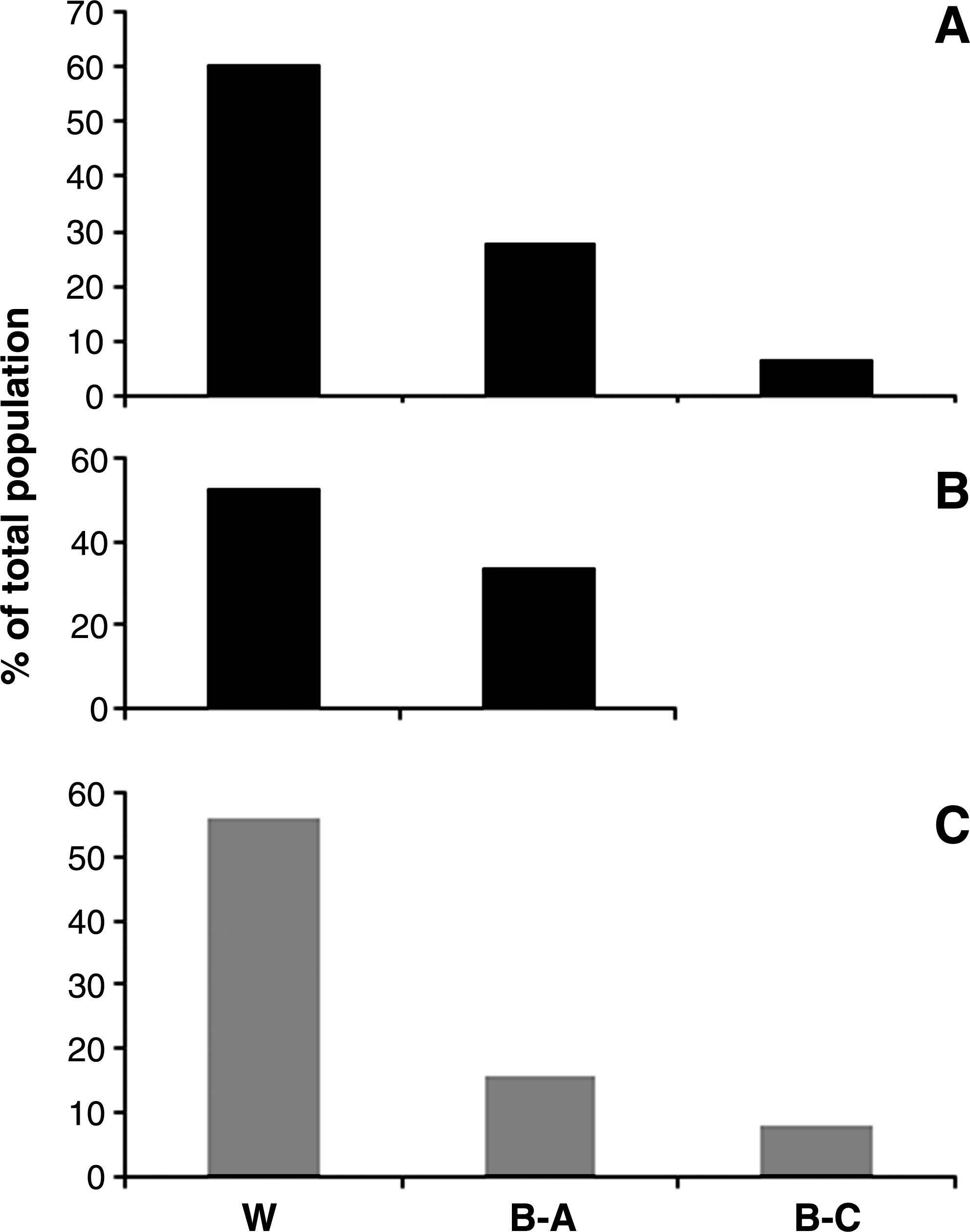
Ethnicity of Infectious Diseases BioBank (IDB) volunteers.
Discussion
The IDB is a relatively new biobank and we wanted to establish at a relatively early stage whether the samples being collected were representative of the multicultural nature of the local community. The major component of the IDB is a cohort of HIV patients that was initially restricted to those infected with HIV-1 clade B viruses. This clade of virus accounted for around 58% of HIV infections in our locality among samples collected in 2000. 6 The analysis of the ethnicity of the HIV-positive IDB volunteers indicated that there was a remarkable similarity to local government demographic figures for the boroughs of Southwark and Lambeth, which is the main catchment area for the Harrisson Wing Clinics. Data on demographics collected by both local governments by a previous study and by the IDB depend upon self-association by the individuals and patients, and slightly different categories are present in the 2 datasets. Nevertheless, for both the government figures and IDB data, “Whites” were most common, followed by “Black-African” and then “Black-Carribean.” Thus, unlike the experience of those recruiting organ donations, volunteers for the IDB match the local demographics acceptably. There is a multitude of cultural, religious, and scientific explanations for these differences between organ donors and biobank recruits. Additionally, for the latter, there may also be a strong linkage between willingness to donate and potential self-interest, as opposed to altruism.
Footnotes
Acknowledgments
The IDB acknowledges funding from the Guy's and St Thomas' Charity and the National Institute of Health Research Comprehensive BioMedical Research Centre at Guy's and St Thomas' NHS Trust.
Author Disclosure Statement
No competing financial interests exist.