




Abstract
The UK DNA Banking Network (UDBN) undertakes biobanking for genetic epidemiology research projects. A task assigned to it is the addition of scientific value to the resources under its management. This task is implemented by enabling appropriate access to the resources. We reasoned that access requires not only a fair access policy but also a quality policy implemented via a Quality Management System (QMS). UDBN decided to achieve consistency in sample management by identifying and implementing a suitable QMS with external certification. UDBN selected ISO9001 as a QMS. It was soon recognized that the QMS needed to encompass not only UDBN but also the academic department in which UDBN sits. An external certification body was selected and a post was dedicated to the role of QMS-Management Representative. Specialized software was acquired. A Quality Manual, individual training files and Standard Operating Procedures (SOPs) were prepared. QMS training was provided. These actions led to the approval of the ISO9001:2000 standard. This is the first report of an academic genetic epidemiology research laboratory receiving approval of the ISO9001 standard to validate the consistency of its operations. ISO9001 was selected because of its greater breadth of scope compared with other QMSs. We found that while laboratory protocols are transferable between labs, QMS SOPs are not transferable. This has consequences for efforts to ensure consistency across a biobank network: joint adoption of one multiparty QMS is probably required. We found that it was not possible to implement a QMS for biobanking in isolation: its host university department needed to be included. We have found that ISO9001 helps enable longitudinal accrual of data on the use of biobanking methods. Thus ISO9001 is not only a management tool to improve access to a biobanking research infrastructure but also a research tool for research infrastructure development.
Introduction
UDBN was assigned a range of biobanking tasks including the secure storage of native DNA and derived transformed cell lines and the addition of scientific value to the resources (samples and data). This latter aim is attained by enabling appropriate access to the resources for follow-up and secondary investigations.
After extensive discussion, we recognized that to enable access—as the funder required—it was essential not only to have a fair access policy but also to have consistently high standards for the resources under management to maximize the confidence of biobank users. UDBN's fair access policy has been previously described 2 . We reasoned that the prerequisites for achieving consistently high standards in sample management are:
1. Taking account of relevant best practices issued by the International Society for Biological and Environmental Repositories (ISBER), 3 National Cancer Institute US (NCI), 4 Organisation for Economic Cooperation and Development (OECD) 5 and World Health Organisation—International Agency for Research on Cancer (WHO-IARC). 6
2. Implementing a Quality Management System (QMS). This comprises the managing structure, responsibilities, procedures, processes, and management resources required to implement the principles and action lines needed to achieve the quality objectives of an organization. 7
3. Using the data generated by a QMS to drive management change aimed at increasing rigor in the use of Standard Operating Procedures (SOPs) and, in combination with data from the Laboratory Information Management Systems, to identify factors that cause unacceptable variations in outputs from biobanking processes. This then permits continual improvement in biobanking. These activities contribute to the maturation of the QMS.
4. Thereafter, specifications can be consensually established and collaboratively improved among a group—a community—of biobanks such as the emerging European network 8 along with their upstream and downstream users (eg, clinics for accrual and facilities for sequencing). If there is consistency across a biobank network and its users, then this enables or facilitates research that would otherwise be impossible or difficult and there are major opportunities to increase cost-effectiveness. UDBN, in collaboration with biobankers elsewhere in Europe and internationally, has already undertaken work toward consensus and collaborative improvement on the topics of DNA concentration estimation9,10 of sample handling 11 and of accrual protocols. 12
This article describes work to attain certification for a QMS. We found that a QMS provides a reliable foundation for improving consistency and provides a research tool for research infrastructure development.
Methods and Results
Investigation of available quality systems identified ISO9001:2000 as a suitable QMS. Coordinated from Switzerland, the International Organisation for Standardisation (ISO: www.iso.org) develops and publishes international standards. It comprises a network of the national standards institutes of 160 countries including the United Kingdom where the United Kingdom Accreditation Service (UKAS: www.ukas.com/) is the sole national accreditation body recognized by government. The ISO network enables a consensus to be reached on solutions that meet both the requirements of business and the broader needs of society.
Reasons are presented (see Discussion) for the decision to select ISO9001 from among available QMSs as the appropriate standard for this research biobank. The version of ISO9001, initially when this decision was made was ISO9001:2000 and the present version is ISO9001:2008. The ISO standard includes: control of documents and records, management review, human resources, product realization, user-related processes and purchasing.
ISO9001 provides a framework for UDBN to document its processes; to undertake continual improvement in those processes; to reassure owners of annotated samples of UDBN's competence to manage their resources; to assure recipients of those resources about UDBN's commitment to consistency and quality.
Work toward certification to ISO9001:2000 started in 2004. It was divided into 4 phases: first, to define and document all UDBN core and support processes (except R&D) (see Fig. 1); second to define and document other departmental activities; third to assess progress toward compliance to the ISO9001 standard; and fourth to achieve overall certification to the ISO9001 standard. This measured approach has proved appropriate because initial implementation of a QMS requires careful planning before certification can be achieved.

Core and support processes in the Centre for Integrated Genomic Medical Research Quality Management System. Core processes are indicated in the left hand box. Support processes are indicated in the right hand box. Connecting lines represent interactions between processes. The diagram is based on the Quality Manual.
Definition of processes
To define and document UDBN processes, 3 initial actions were necessary. First, CIGMR management had to allocate a dedicated position to achieve certification. In the absence of a management level position for this, a UDBN laboratory scientist position was assigned responsibility as QMS Management Representative (QMS-MR). Second, CIGMR management recognized that, for efficient implementation of the QMS, specialized QMS software was highly desirable. One of us (C.B.) had industrial experience of implementing ISO9001:2000 compliant QMS using Q-pulse compliance management software (Gael Quality, Glasgow, United Kingdom). This supports the management of document control, internal audit scheduling and reporting, issuing corrective and preventative actions, and responding to user comments. Third, a certification body had to be selected to provide an external audit of compliance with ISO9001:2000. UKAS has accredited 91 certification bodies for QMS. Lloyds Register Quality Assurance (LRQA) was selected from among these certification bodies because CIGMR management was satisfied with LRQA's quality of support and training.
Following these decisions, the Q-pulse software was studied, 13 installed, and supported and the QMS-MR was trained. LRQA's initial training course covered the interpretation and appreciation of ISO9001:2000 and internal QMS auditing. This was followed up with advice to staff members on their basic responsibilities for compliance with ISO9001:2000, on the concept of standardizing the way they worked within the laboratory and on staff responsibilities for the formalization of record-keeping.
Other departmental activities
This formalization work took 3 months. It was soon recognized that the QMS needed to encompass not only UDBN but also the rest of the department. This recognition rested on the realization that CIGMR senior management had a critical role in ISO9001 implementation and that it was reasonable to expect that certain university research projects could also benefit. The QMS-MR oversaw preparation of the Quality Manual and of individual training files. The manual overarches all of the QMS. It comprises a departmental quality policy (see Box 1); lists the core and support processes within the QMS (see Fig. 1); and describes the top line organization of the QMS (see Fig. 2).
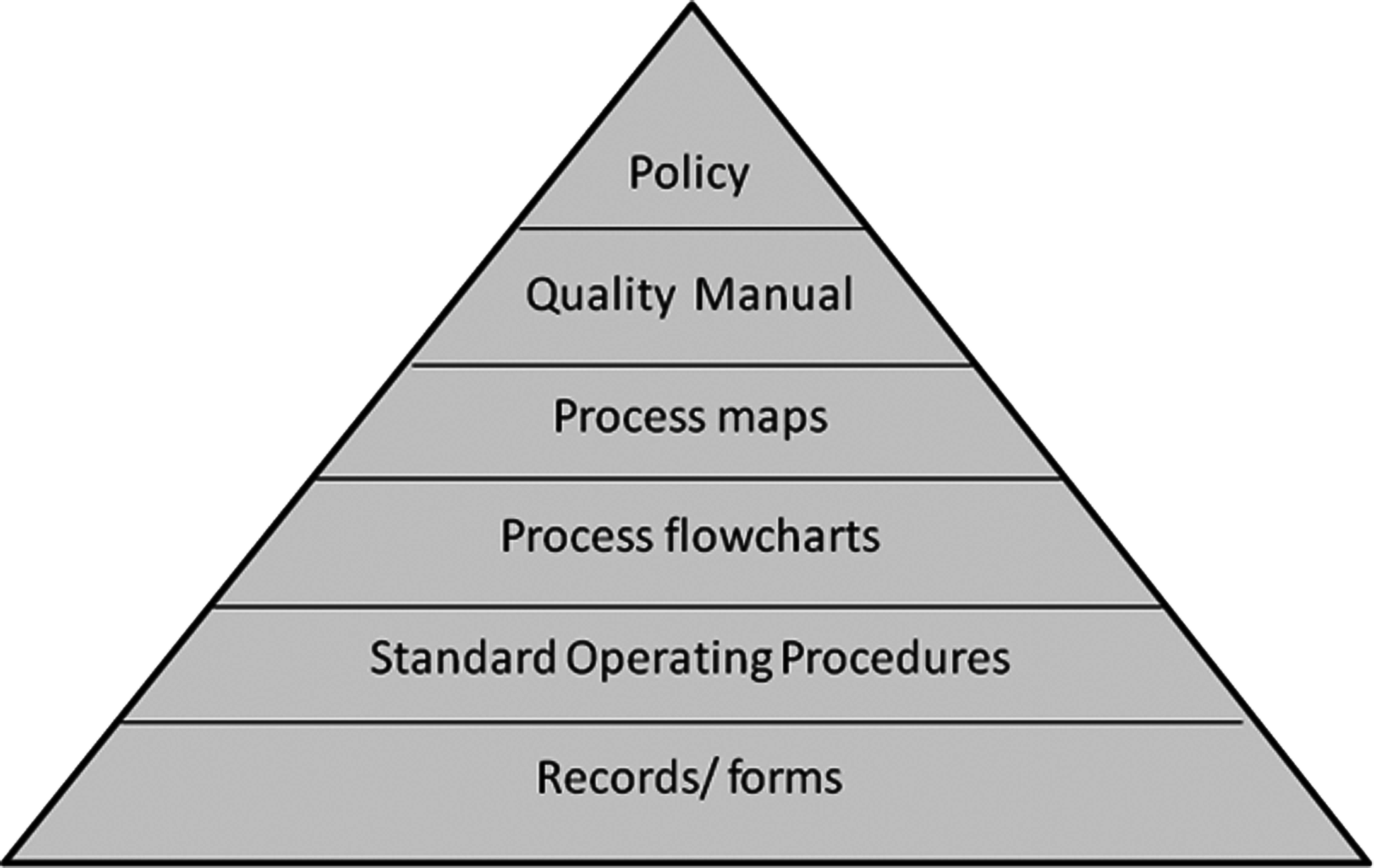
Document control from policy to records. The Quality Management System is documented in a hierarchical structure of controlled documents as indicated by the triangle. The diagram is based on the Quality Manual.
The Centre for Integrated Genomic Medical Research Quality Policy
The CIGMR provides an archiving facility for biological samples and DNA to support academic research into complex diseases. The Archiving Facility covers all biological samples and DNA that are stored and managed by core CIGMR groups, including the UK DNA Banking Network, and Arthritis Research UK studies that use our processes.
The purpose of the Archiving Facility is:
• to provide and facilitate the widest access and use of biological samples, and associated data, within CIGMR and by bonafide scientists for investigation into complex diseases
• to maintain and replenish samples stocks through the use of Whole Genome Amplification, Cell Line Expansion and investigation into new techniques
• to provide secure and monitored long-term sample storage, while ensuring full traceability of sample integrity and aliquot hierarchy through the use of a Laboratory Information Management System and freezer telemetry system
• to provide auditable sample processing and aggregation through the use of automated DNA extraction equipment and integrated robotic liquid handling platforms
• to ensure unique identification of aliquots through the use of aliquot Ids and 1D and 2D bar-coding systems
The Archiving Facility Quality Management System is designed to meet the requirements of ISO9001. CIGMR will endeavor to continuously improve all aspects of its business through the support and commitment of its entire staff.
CIGMR has established Quality Objectives that are communicated to all. These will be pursued by all employees and reviewed for continuing suitability during the Quality Action Group Meetings.
This policy statement is its current iteration (now under review).
CIGMR, Centre for Integrated Genomic Medical Research; ISO, International Standards Organisation.
In brief, the current CIGMR quality policy states that CIGMR “provides an archiving facility for biological samples and DNA to support academic research into complex diseases.” It describes the purposes of the archiving facility in providing and facilitating the widest access to and use of biological samples and in providing secure and monitored long-term sample storage with full traceability.
Standard training files contain a record for each staff member of the training and refresher training they have received to perform a given SOP. It includes training received prior to implementation of the QMS, induction training, and overseeing preparation of the Quality Manual, the QMS-MR oversaw the writing of SOPs. In ISO9001 these have a standardized structure with sections on: scope; purpose; process owner (a member of staff with responsibility for versioning the SOP); health and safety; materials and equipment; method; and document history. All sections should be completed, where applicable. An ISO9001-certified organization provided CIGMR with their SOPs as a starting point in the hope that this would expedite implementation of the QMS. However, it soon emerged that these external SOPs described methods that differed in significant ways from those employed by UDBN. It was therefore necessary to start afresh with SOPs specific to CIGMR-UDBN.
Compliance assessment
Having created initial versions of these documents and a matching document control system, CIGMR was able to undergo a compliance assessment against ISO9001:2000 by LRQA. The assessment schedule was delivered in 2 stages. Stage 1 involved a document review and planning visit to confirm that the system was sufficiently well-designed to allow an initial assessment to take place. Stage 2 considered implementation of the QMS and the request for approval to be certified to ISO9001:2000.
Preparations for Stage 1 assessment involved establishing the current documentation and processes used within CIGMR; preparation of system and procedural documentation; and implementation of the QMS. LRQA required that all of the documented processes be implemented for at least 3 months prior to the Stage 1 assessment. The QMS-MR also set a requirement that at least 75% of the QMS processes be audited; that the system be reviewed by CIGMR management; and that a program of continual improvement be initiated. Senior management commitment to QMS is essential for successful implementation. This commitment required regular management review meetings. Fulfilling these objectives would provide clear evidence of CIGMR's commitment to ISO9001:2000.
A further preparatory measure prior to Stage 1 assessment was staff induction. First the QMS-MR received LRQA training for such induction. This then enabled the roll out of the QMS to all UDBN and related staff via a 3-day induction meeting. Members of staff were issued with their individual training files.
Assessment and certification
LRQA then undertook its Stage 1 assessment. The purpose of this visit is to confirm the readiness of the organization for full assessment. The assessor: confirms that the quality manual conforms to the requirements of ISO 9001, confirms its implementation status, confirms the scope of certification, checks legislative compliance, produces a report that identifies any noncompliance or potential for noncompliance and agrees to a corrective action plan if required, and finally, produces an assessment plan and confirms a date for the Stage 2 assessment visit.
The Stage 1 assessment specified 5 corrective actions that CIGMR was required to implement so as to address 5 nonconformances. These nonconformances arose from lack of clarity in documented processes and a deficit of information in some SOPs.
The Stage 2 assessment was performed over 2 days. It considered all aspects of the ISO9001:2000 standard, including consideration of items stated in the standard that were not present in the CIGMR QMS. LRQA recommended that CIGMR be certified to ISO9001:2000. Some minor clarifications were made after LRQA had identified an observation for improvement. LRQA awarded CIGMR a certificate of compliance to ISO9001:2000 on October 21, 2005.
Discussion
This is the first report of an academic genetic epidemiology research laboratory acquiring approval to the ISO9001 standard to validate the consistency of its operations. However, we note with interest a report on a tissue transplantation biobank 14 that has also been approved to the ISO9001 standard. We have chronologically described the steps taken by an academic biobank—and then its university department—to select, prepare, and implement an externally certificated QMS. We have outlined the assessment process resulting in successful certification.
ISO9001 was chosen for 6 reasons:
1. ISO9001 has a requirement for certification by an external approved notified body. An independent external approval process provides confidence that a claim of consistency is valid. This confidence is critical to our role of managing research resources accrued by collaborators or other parties because it enables those parties to confidently relinquish responsibility for management of samples.
2. ISO9001 is generic. It is not specific to named processes in design, production, and distribution. The organization may choose to include or exclude any given process from the QMS. This generic character is essential in a research setting because it allows the flexibility that an academic biobank needs to introduce or remove a process and to tailor the QMS to the specific and changing needs of the biobank. Thus it was CIGMR that identified the core and support processes that it wished to include in the QMS (see Fig. 1) and it was CIGMR that specified the Quality Policy (see Box 1) that drives these processes.
3. ISO9001 allows and encourages quality system management at all levels of management. For example, changes to the Quality Policy can change the scope of the biobank and then this will cascade down through the QMS organization (see Fig. 2). Alternatively, a need may be identified for greater detail in an SOP and the QMS allows this detail to be readily introduced.
4. ISO9001 requires actions to continually improve the QMS. These actions arise from corrective actions and nonconformances (ie, recorded deviations from an SOP) that underlie inconsistency from data analyses that indicate unacceptable variation and from feedback by users.
5. ISO9001 requires promotion of the standard upstream and downstream. For research biobanking processes this means building a “chain of quality” from the initiation of accrual of the annotated sample to the return of newly-acquired experimental data. Such a chain is critical to the development of biobank networks integrated with clinics and analytical platforms.
6. ISO9001 is harmonized with other international standards (eg, ISO27001 QMS for data management) thus simplifying administration of the quality environment.
Other QMS systems are less broad in their scope and Table 1 indicates some of the standards available with their areas of application. One of these standards is Good Laboratory Practice (GLP)—a quality system of management controls for laboratories and organizations designed specifically to evaluate the integrity of clinical studies. Since UDBN was constructed as the first step toward the construction of a network to underpin research in a range of disciplines, GLP was not considered sufficiently broad in scope. However, as a single biobanking research infrastructure that is extending its capabilities, capacities, and range of users, GLP may become an appropriate additional standard to implement.
PAS 99 (Integrated Management PAS 99 is a Publicly Available Specification of common requirements for management systems that can be used as a framework for an integrated management system); GLP refers to a quality system of management controls for research laboratories and organizations to try to ensure the uniformity, consistency, reliability, reproducibility, quality, and integrity of chemical (including pharmaceuticals) preclinical safety tests.
ISO, International Standards Organisation; GLP, Good Laboratory Practice.
Some important consequences were found to flow from the fact that all SOPs were required to have a consistent structure: scope, purpose, process owner, health and safety, materials and equipment, method, and document history. This list implies a dependency. For example, the method is dependent on the precise type of equipment and materials in our organization. A second organization may have an SOP with the same scope and purpose but is unlikely to have the same materials and equipment. We therefore avoided the temptation to take short cuts by using SOPs from elsewhere. In brief, laboratory protocols are transferable, but QMS SOPs are not.
This has a consequence for ensuring consistency across a biobank network. Such networks have been emerging in the European Union and elsewhere.2,4,15 Increasing numbers of biobanks have individually adopted a QMS (See eg, references16,17). However, these individual QMSs may have the undesirable consequence that biobanks are consistently different for the same output. Work has also been initiated to try to reach a consensus on sample protocols at both the national level and the European level11,12,18 Our experience indicates that while such consensus on protocols is a useful first step, it cannot ensure consistency between biobanks. This probably requires joint adoption of one multiparty QMS.
We have also provided evidence that, in the context of an active academic research department, it is not possible to implement a QMS for biobanking in isolation. Thus the support processes include activities that are undertaken by a range of staff with responsibilities that lie outside of biobanking. We did not appreciate this fully from the start: the task of developing the QMS was assigned to a UDBN lab scientist and discussions of the QMS were initially restricted just to members of the biobanking team. As a consequence, the QMS was generally seen as only belonging to that lab scientist. Further, other staff felt, to a greater or lesser degree, that the QMS gave them work that was on top of already full workloads. Thus, we observed that the introduction of a QMS can be associated with tokenism, as has been described. 19 Ending this tokenism required staff to learn to flip-flop between 2 cultures—the independence that research work fosters and the team-work that a QMS fosters. Achieving this cultural flexibility required: support from senior management both for the QMS in addition to support for research work, a detailed explanation of the value of the QMS, and the emergence of data 20 supporting the view that QMS favors quality improvement.
How has certification improved access to the biobank? UDBN started as a biobank that networked with MRC-funded consortia undertaking genetic epidemiology to develop some common policies and to manage their 25,000 samples. Since then, UDBN has enabled access to its biobanking solutions by consortia responsible for 97 collections requiring storage of over 500,000 tubes. In the first years of its life, UDBN retrieved no samples from its freezers other than for internal purposes (eg, quality assurance). Since then, UDBN has enabled access for aliquots from over 100,000 samples by academic and industry experimental investigators. These facts provide evidence that both upstream and downstream users of UDBN have confidence in the research infrastructure and its QMS processes. It is reasonable to infer that ISO9001 certification has contributed to this confidence and has thus acted as a tool to improve access to UDBN. This conclusion is strengthened by users' mainly positive comments to UDBN by anecdotal evidence of the confidence that certification has inspired and by continued support for QMS from the funder. Obtaining direct evidence of the extent to which UDBN's success has resulted from approval to the ISO9001 standard will be possible through carefully constructed user surveys to the extent that users know and understand the standard.
ISO9001 certification has been successfully maintained by CIGMR-UDBN for 6 years. Throughout this period, staff members have demonstrated a deepening appreciation of the special value of the requirement in ISO9001 for continual quality improvement. Initially, this focused on the clarification and simplification of SOPs. Thereafter, since ISO9001 implementation involved the recording of information on the use of equipment within the biobank and since samples and related information are tracked within a Laboratory Information Management System (LIMS), we have now found that ISO9001 plus LIMS enables longitudinal accrual of data on the real-world use of biobanking methods. Analysis of this data is proving valuable to improvements in the application of current methods. 20 This analysis will also allow us to improve the methods themselves and to provide evidence of needs for new methods and platforms. Thus ISO9001 is not only a management tool to improve access to a research infrastructure but also a research tool for infrastructure research and development.
Footnotes
Author Disclosure Statement
No competing financial interests exist.