




Abstract
It is important to have a resource of environmental specimens in order to investigate changes in contaminant exposure and accumulation over time. At the National Institute for Environmental Studies in Japan, red stingray livers have been archived and the banking activity has expanded successfully since 2003. The developed standard operating procedure helps to maintain quality of the archived homogenized liver samples, and the risk management plan has helped to prevent thawing them from any incidents, including the catastrophic 2011 Tohoku earthquake. The cryogenically homogenized powdered livers will be stored in a cryogenic environment in liquid nitrogen vapor containers at −160 °C and will be analyzed when new pollutants are identified in the future.
Introduction
Development of an environmental specimen banking (ESB) system and standard operating procedures are important for such future analysis. 2 For at least 50 years, the ESB archives various types of environmental monitoring samples under cryogenic conditions and has been recognized as an important complement to environmental research and monitoring. There are currently more than 10 environmental specimen banks in the world, including Germany, the United States, Japan, and several other countries. Some countries also plan to establish their banking system.
The ESB system at the National Institute for Environmental Studies (NIES) Japan originally started in 1980, 3 and the ESB became integrated into the Environmental Specimen Time Capsule (ESTC) program in 2003. It maintains the previously archived samples and has additionally deposited mussels, fish, atmospheric particulates, benthic sediments, and human breast milk. Those environmental samples are used to monitor contaminant levels to assess various impacts on human and wildlife health. The ESTC was also established to cryogenically preserve cells and tissues of endangered birds, mammals, and fish in Japan as an ex situ conservation method. The specimen banking activity at NIES began with a total capacity of approximately 470 m3 of −20°C freezer rooms in 1980. 3 The NIES ESB facility has added 34 liquid nitrogen (LN) vapor containers (−160°C) with a total capacity of about 20.3 m3, two freezer rooms (−60°C) with a total capacity of 360 m3, and 14 deep-freezers (−80°C) with a total capacity of about 6 m3 since 2003. The LN containers were primarily used to store homogenized mussels and red stingray livers, and cells of the endangered wild animals. The freezer rooms were used to store relatively large-sized specimens including fish, quartz filters collecting atmospheric particulates, and sediments, whereas the breast milk is stored in the deep-freezers. Most of the deep-freezers, however, are primarily used for temporal storages for subsequent sample processing.
Many ESB systems in the world have archived the same kind of specimens such as mussels, and each ESB system stores its unique samples. In the ESTC, the unique specimens are the red stingray (Dasyatis akajei) livers that were incorporated in 2003. In this report, standard operating procedures (SOP) and the status of red stingray livers banking between 2003 and 2010 are described. Also, the NIES ESB experienced the catastrophic Tohoku earthquake in March 11th, 2011 and the necessity of a risk management plan for ESB is discussed, based upon our experience with the earthquake.
Selection of Red Stingray Livers as Environmental Specimen
Red stingray livers were selected as environmental specimens that are banked for at least 50 years for five reasons, based upon the general recommendations of Wise and Koster. 4 First, red stingrays live widely throughout coastlines of the western Pacific Ocean. They can be used to monitor contaminants systematically throughout the region. Second, they are generally demersal and inhabit the sediment in relatively shallow bays and harbors so that potential contaminants accumulated following removal from the water column can be determined. Third, they have slower reproduction rates relative to other organisms in the marine ecosystem. It is likely that they can accumulate contaminants at even ultra-trace levels in seawater. Fourth, the liver samples can be large enough (more than 1.0 kg) for multiple analyses and representative of an area to be monitored. Finally, stingray livers and tissues have been previously used for several environmental monitoring studies.5–7 The red stingray livers are, thus, appropriate to be archived as environmental specimens.
Standard Operating Procedures (SOP) of Red Stingray Livers Banking
It is important to develop standard operating procedures (SOP) regarding red stingray livers collection, cryogenic homogenization, and preservation. The SOP plays an important role in maintaining quality of the archived samples. The SOP should also include information about how to avoid cross contamination among samples, equipment for cryogenic homogenization, laboratory environment, and laboratory wares used for preservation. For example, if a specific chemical compound of interest being analyzed is contained in lab coats and gloves worn during cryogenic homogenization, the samples will be contaminated. This situation could happen to any technician when new lab coats, gloves, and plastic lab supplies are bought, which are revealed by chemical analyses prior to use. Therefore, all the equipment and laboratory wares used for sample processing and preservation must be cleaned and chemically analyzed if possible prior to use.
The sample processing procedure for red stingray liver banking is as follows. Red stingrays are treated in our laboratory on the same day of capture. They are transported in a cooler with ice, so samples captured in nearby bays are collected. Sampling date and location in terms of longitude and latitude, biometry, and weight are recorded for each red stingray. Red stingray liver is located above its cloacal opening and on top of the urinogenital system. Acetone-sterilized stainless steel scissors are inserted through the cloacal opening and a shallow incision toward the gill slits is made. Skins are folded by the acetone-sterilized stainless steel forceps and then the livers can be exposed. The ducts around the livers are cut, and they can be detached. Each of the extracted livers with blood is placed into a vacuum sealed bag and stored in a −80°C deep-freezer until cryogenic homogenization. Clean lab coats, polyethylene lab gloves, and dustproof masks are worn the entire time during treatment.
After the livers are completely frozen, cryogenic homogenization in LN for each liver is performed in a clean environment on different dates. Clean lab coats, polyethylene lab gloves, and dustproof masks must be worn during the homogenization. All the metal and ceramic equipment is rinsed by acetone and well cooled by LN prior to every use. After about 30 min of thawing a liver at room temperature, approximately 20 cm long ceramic-bladed knives are used for chopping the liver, producing approximately 1 cm small pieces. The small pieces generated from the liver are kept in a stainless bowl, filled with liquid nitrogen, until the following process of ball milling. Custom-made titanium ball mills are then used for powdering without any thawing. Each ball mill can process approximately 40 g of the chopped frozen liver pieces with four 2.0 cm, eight 1.5 cm, and 16 1.0 cm titanium balls. All the balls are custom made and well cooled by LN prior to use. Every ball milling runs 170 rpm for 15 min. The size of the produced liver powders is then checked by a particle size analyzer which has shown approximately 20 μm of mean grain size over years. After the frozen powdered livers are placed in the pre-cleaned and -cooled 50 mL glass containers, they are stored in LN vapor containers at −160°C. Each glass bottle contains approximately 25 g of the homogenized livers and is labeled with its identification number and bar code. Each LN vapor containers can store 900 glass bottles.
Status of Red Stingray Livers Banking during 2003–2010
Red stingray livers banking in the ESTC at NIES was able to expand successfully from 2003 and 2010. The total numbers of collected male and female red stingray livers are 220 and 204, respectively. The number of collected livers ranges between 16 in 2004 and 85 in 2008 (Fig. 1). The cumulative number of the archived glass containers has gradually increased every year and resulted in more than 1000 bottles at the end of 2010. This is equivalent to more than 25 kg of the homogenized banked livers. The preserved livers will be stored under cryogenic conditions in LN vapor containers at −160°C for at least 50 years and be analyzed when new pollutants will be identified in the future.
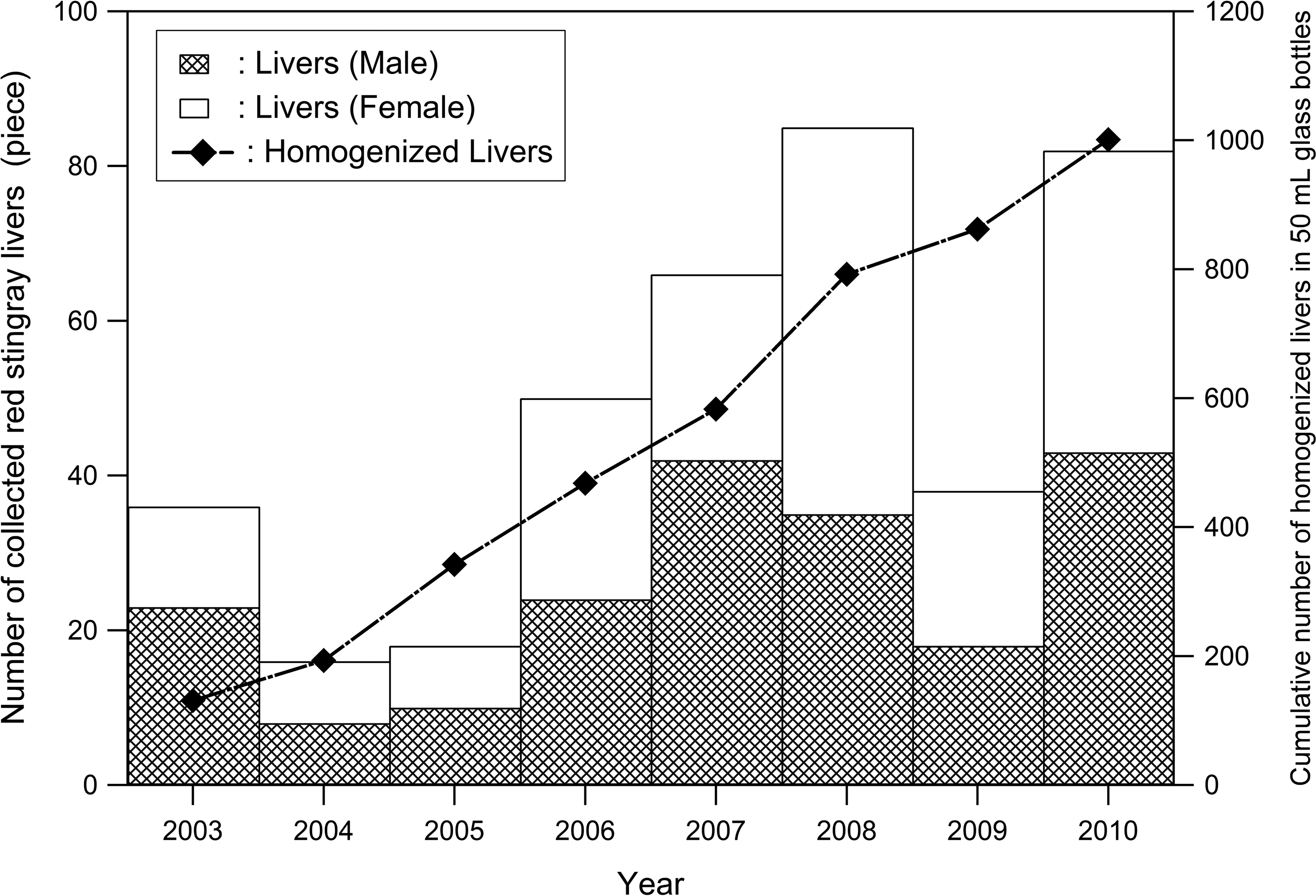
Number of red stingray livers collected and cumulative number of the archived homogenized livers in the ESTC.
Necessity of Risk Management Plan for Each Banking System
Along with SOP, each banking system must identify, assess, and prioritize risks in order to maintain the facility for a long time. Some risks happen unexpectedly. In March 11th, 2011, a massive earthquake (magnitude 9.0) hit the eastern part of Japan. The ESB at NIES trembled with an intensity of 6 on the Japanese 7-stage seismic scale for a few minutes even though the facility is located at approximately 350 km away from the epicenter. A number of laboratory equipment and books tumbled off the shelves and fell out to the floor. Some chemicals spilled over the floor. There were many visible damages in all the lab rooms. After the first earthquake, a number of strong aftershocks (approximately magnitude 5 to 7) hit the region for the next few days. The ESB building at NIES fortunately had no damages, and no one was injured. The ESB, however, had lost its electrical power for about 3 days after the earthquake. There is no emergency power supply for the NIES ESB system. The 12 operating liquid nitrogen vapor containers (−160°C), 14 deep-freezers (−80°C), and all of the freezer rooms (−60°C and −25°C) had lost their power.
Although there were a number of damages and troubles at the ESB system at NIES, we prepared our own risk management plan which helped to prevent thawing of the archived samples. It had been confirmed before the earthquake happened about how long each of the storage units can keep and hold its cold internal temperature. The LN vapor containers can keep their internal temperature below freezing for 3 weeks without supplying any LN, and the freezer rooms can maintain their internal temperatures below freezing for 6 days without any electrical power. Both storages were, therefore, just visibly checked to make sure that there were no apparent damages and they were securely closed to keep cold air inside. All of their monitoring and controlling systems were rebooted successfully when the electrical power came back 3 days later. The system indicated approximately −160°C for the inside temperatures of LN vapor containers and about −40°C and −15°C, respectively, for the internal temperatures of the freezer rooms. It was very likely that the archived samples stored in both storages were never thawed between Mar. 11th and 14th. Subsequently, sample containers, glass bottles, and vials in both storages were visibly checked to make sure that there were no leaks, spills, or any physical damage.
On the other hand, immediate action was necessary for the deep-freezers. It had been confirmed that the deep-freezers can increase their internal temperature from −80°C to room temperature within 24 hours without any electrical power. Any vacant spaces inside for each deep-freezer must be filled with dry ice to keep its inside cold according to our risk management plan. It was determined that approximately 30 kg of dry ice were required to maintain their internal temperature below −20°C for 15 hours. The large amount of dry ice was purchased and put into each deep-freezer soon after the earthquake occurred. It was, however, difficult to accomplish the mission simply because the catastrophic earthquake and tsunami disrupted everything in Japan, and a number of large aftershocks hindered staff from going out to purchase dry ice.
It was about 20 hours after the electrical power was lost when the vacant space inside a deep-freezer was filled with the first dry ice. The six deep-freezers (0.7 m3 each) that were used to archive the human breast milk and for temporal sample storage prior to processing have priority over the other freezers that kept solutions for analysis, analytical standards, and unrelated samples to the ESCT program. As a result of the order of priority, those freezers that were used for archiving and temporal storages did not leak any water on the floor in front of the freezers. It was likely that the inside temperatures had been maintained below freezing. Their thermometers indicated from −10°C and −15°C when the electrical power was recovered. The other deep-freezers, however, did leak some water before putting in the first dry ice. Although their thermometers showed between −5°C and −10 °C when the electrical power was recovered, it was likely that the inside temperatures had reached above freezing once before dry ice was put in. Most of the chemicals and analytical standards were spoiled, but they could be purchased and prepared again.
As a result of the catastrophic earthquake on Mar. 11th, the NIES ESB system faced an extreme challenge to maintain its cold storage. The most valuable information in our own risk management plan was how long each type of storage could keep and hold its internal temperature below freezing to identify the order of priority. This information depends upon the type of freezer, maker's industrial standard, and how much the inside space was occupied by frozen samples. It was observed that a deep-freezer that was filled with the samples without much vacant space could maintain its inside temperature below freezing longer than the one with more vacant space.
It was also recognized that our risk management plan needed to be improved. For example, we were unable to tackle the problems soon after the earthquake because the disaster disrupted the entire society, including economical activities, for a few days. At least an overnight was necessary to help get settled. We were aware of a large dry ice sales company nearby prior to the earthquake. It was, however, impossible to purchase dry ice, transfer them from the company, and put them into each freezer soon after the earthquake. An emergency power supply may be a solution in order to prevent thawing samples in a deep-freezer even though it usually runs for a day continuously without refueling. It can provide enough time for us to get settled and make steady progress toward recovery according to our risk management plan.
Conclusion
Environmental specimen banking has been recognized as an important complement to environmental research and monitoring. At NIES in Japan, cryogenically homogenized red stingray livers have been archived since 2003. The homogenized powdered livers are placed in pre-cleaned 50-mL glass bottles, and more than 1000 bottles are stored in liquid nitrogen vapor containers at −160°C. The developed and modified SOP regarding the liver collection, cryogenic homogenization, and preservation helps to maintain quality of the archived samples and avoid contamination. In addition, the developed risk management plan helped to prevent thawing from the catastrophic 2011 Tohoku earthquake. The risk management plan, however, needs to be modified and improved. There are more than 10 environmental specimen banks in the world, and some countries plan to establish their banking system. It is strongly recommended that each banking system must develop its own risk management plan along with SOP.
Footnotes
Disclosure Statement
No competing financial interests exist.