




Abstract
Ethnic differences in disease susceptibility and drug response necessitate the participation of the community in biomedical research. Public involvement includes the donation of biospecimens for basic and translational research with a focus on understanding the molecular make-up of individuals. A growing strategy that fosters public involvement is establishing biobanks that serve as a focal point for sample collection, storage, and dissemination. A biobank's success is dependent on the availability of high-quality biospecimens, as well as accessibility of personal and medical data. Diverse public participation in biobanks is also as critical. Due to lack of data related to public knowledge and attitude towards biospecimen-based research and their willingness to participate in biobanking, a structured questionnaire was conducted at the national level. Data were collected from 3196 individuals aged 18 and above, constituting a representative sample of the Jordanian population. Demographic data included age, gender, and education level. Although there was lack of knowledge of the term “biological samples,” 80% of respondents approved the use of biospecimens in research. In addition, almost two-thirds of respondents agreed to donate both biospecimens and relevant information for biobanking. Approval of biospecimen-based research and willingness to participate in biobanking significantly correlated with younger age and increasing education, but not gender. Our results provide an insight into the perception of biobanking among the Jordanian population and strengthen the importance of educating the public about research and the value of biobanking. The data should enable researchers in Jordan and surrounding countries of similar culture to lay the foundation for a successful biobank and research program.
Introduction
The success of biobanks, however, depends on the participation of individuals via donation of both biospecimens and data. Wide participation of diverse groups, with respect to gender, age, and ethnicity, is critical in molecular profiling studies, drug-based research, or even molecular evolutionary investigations. It is also important to address the behavioral and social differences among potential participants in biomedical research in order to offer respect for their opinions and wishes. 2 The effort of a national biobank in the UK was initiated via surveying the public in regards to its knowledge and perception of biobanking. 4 Previous studies found positive attitudes towards biomedical research and high rates of intention to participate in biobanking in different regions of the world.5–8 Yet, social variability is also reported, emphasizing the need to elucidate those aspects.
Jordan is a good example of Middle Eastern countries having a strong regard towards traditional and religious values. Family connection is highly regarded, and consanguineous marriages are common, resulting in appearance of rather rare diseases.9–11 It is a country with an advancing health care system and a developing biomedical research capacity. In Jordan, there are plans to establish a biobank by the King Hussein Institute for Biotechnology and Cancer (KHIBC). This project will facilitate molecular research. However, the knowledge and attitude of the Jordanian population toward biomedical research and, specifically, the idea of biobanking has yet to be clarified.
Considering the significance of public support for the success of the biobank, we investigated the knowledge concerning biospecimens, attitude towards biospecimen-based research, and willingness to participate in biobanking among the Jordanian public. The questionnaire was part of the national survey “Knowledge, Attitudes, and Practices towards Cancer Prevention and Care in Jordan” (KAP Survey). The KAP survey was implemented by King Hussein Institute for Biotechnology and Cancer (KHIBC) in collaboration with the University of Jordan and the Department of Statistics (DOS). The biobanking questionnaire is the first study of its kind conducted in the Middle East at the national level. Due to the similar cultural background between Jordan and surrounding countries, the data generated herein may be reflected elsewhere in the region.
Methods
Study design
The questions regarding biobanking were part of a larger, cross-sectional survey entitled “Knowledge, Attitudes, Practices towards Cancer Prevention and Care in Jordan.” The questionnaire consisted of twelve sections of various topics. Arabic was the main language of the questionnaire, with an English translation at hand. Within a section entitled “New Fields in Cancer Research and Care in Jordan,” public knowledge and attitudes towards biobanking were surveyed.
Study population
The Survey sample was designed using the 2004 Population and Housing Census as the sampling frame. In order to ensure that the final sample reflected the socioeconomic and geographic content of Jordan, the sampling frame was stratified by governorate, major cities (each city with a population of more than 100,000 was considered a stratum—6 cities), and other urban and rural areas. The survey was conducted nationwide in the three regions of Jordan (North, Central, and South) via live interviews from 3196 individuals aged 18 and above during the period of January–March 2011.
Face-to-face interviews were conducted in interviewees' households by trained individuals. Data collection and data processing activities proceeded almost simultaneously.
Techniques
Knowledge of biospecimens
Participants were queried about their knowledge of the term “biospecimens” by asking them whether they ever heard of or read about the term.
Perception of biobanking
A paragraph defining biospecimens and the concept of biobanking was read to participants who were then asked if they approved of utilizing biospecimens for biobanking purposes. The latter was measured on a 4-point Likert scale, with scores ranging from strongly agree to strongly disagree.
Attitude towards biobanking
Thirteen statements regarding the potential operation of the biobank were read to participants. The statements included: absence of direct health benefit, lack of payment to or cost for participation, access of health information, re-contact, freedom to withdraw, availability of consent, availability of general research results, but not individualized data, participation of non-Jordanian researchers, indefinite storage of samples, imprecise research studies, and religious approval of research. Participants were then asked about their willingness to donate biological samples, as well as personal information and information related to their health and family. Those attitudes were measured on a 5-point Likert scale with scores ranging from “very likely” to “very unlikely” in addition to a category of “don't know.” The latter category was excluded from analysis due to small size (0.34%), yielding a sample size of 3185.
Statistical analyses
Data were analyzed using the SPSS software program. Descriptive statistics were used to report sample characteristics, in addition to frequencies and percentages. Data were correlated with age, gender, and education level. Pearson correlation coefficient was used to assess the relationship of those demographics and the attitudinal statements.
Results
Sample characteristics
A total of 3196 respondents were included in the analysis for this report. As can be seen from Table 1, males constituted 51.5% of respondents. This figure matches the 51.5% male estimate for 2011. 12 The majority of respondents fell in the 18–29 and 30–39 age groups, accounting for approximately 60% of respondents. The Jordanian population is considered young with continuously decreasing proportion at increasing age. 12
The status of education was variable among respondents. The highest percentage of participants had attained an educational level of preparatory to high school (51.3%), followed by those having a higher level of education, including diploma level, baccalaureate, Master's, and doctoral degrees (29.5%). The rest of respondents (19.2%) had an elementary level of education or less. The survey presented in this study had a similar proportion as the population according to 2011 estimates. 13 For example, the national estimate of those having an elementary degree or less has been estimated to be 19.9%, which is very close to the 19.2% in our survey. Specifically, the national estimate of illiterate individuals was 7.1% and our survey included 7.3% respondents of this category. This study, however, had a higher proportion of those having higher education and a lower proportion of those with intermediate level than the national estimate (22.9% and 57.2%, respectively). Nevertheless, the sample used in this study reflects the population of Jordan highlighting the appropriateness of the survey.
Interestingly, there is a significant correlation between younger age group and higher education (r=−0.245, p<0.001), which is in accordance with the educational policies mandated in Jordan in the past few decades. In addition, although the correlation was weak, there was a significant association between level of education and gender (r=0.08, p<0.001) with males tending to hold a higher level of education.
Knowledge and attitude towards biospecimen-based research
Participants were asked whether they ever heard of or read about the term “biospecimens”. Only 25% of respondents had some knowledge of the term. Further analysis showed that there was a significant correlation between knowledge of the term and increasing educational level (r=0.132, p<0.001). No association between knowledge and either gender or age was found.
Although our intention was to inquire about public perception towards biobanking, we did not question about familiarity of the term “biobank” as this latter would be even more foreign than “biospecimens.” In addition, the question was a transition for the following paragraph that was read to all participants. In this paragraph, the concepts of biospecimens and biobanking were introduced; the survey participants were asked whether they approve of using biological samples for the biobanking initiative. Approximately 80% of respondents approved of the concept, with strong agreement from almost one-third of all respondents (Fig. 1). This was in comparison to almost 20% of respondents who either disagreed (11.9%) or strongly disagreed (8.9%) with the use biospecimens in research. Interestingly, there was a significant correlation between those who responded positively and both increasing education (r=0.1, p<0.001) and younger age independently (r=0.1, p<0.001). In addition, there was an association between increased knowledge of the term “biospecimens” and approval of their use in research (r=0.1, p<0.001). In contrast, there was no significant association between approval of using biospecimens and gender (p=0.058).
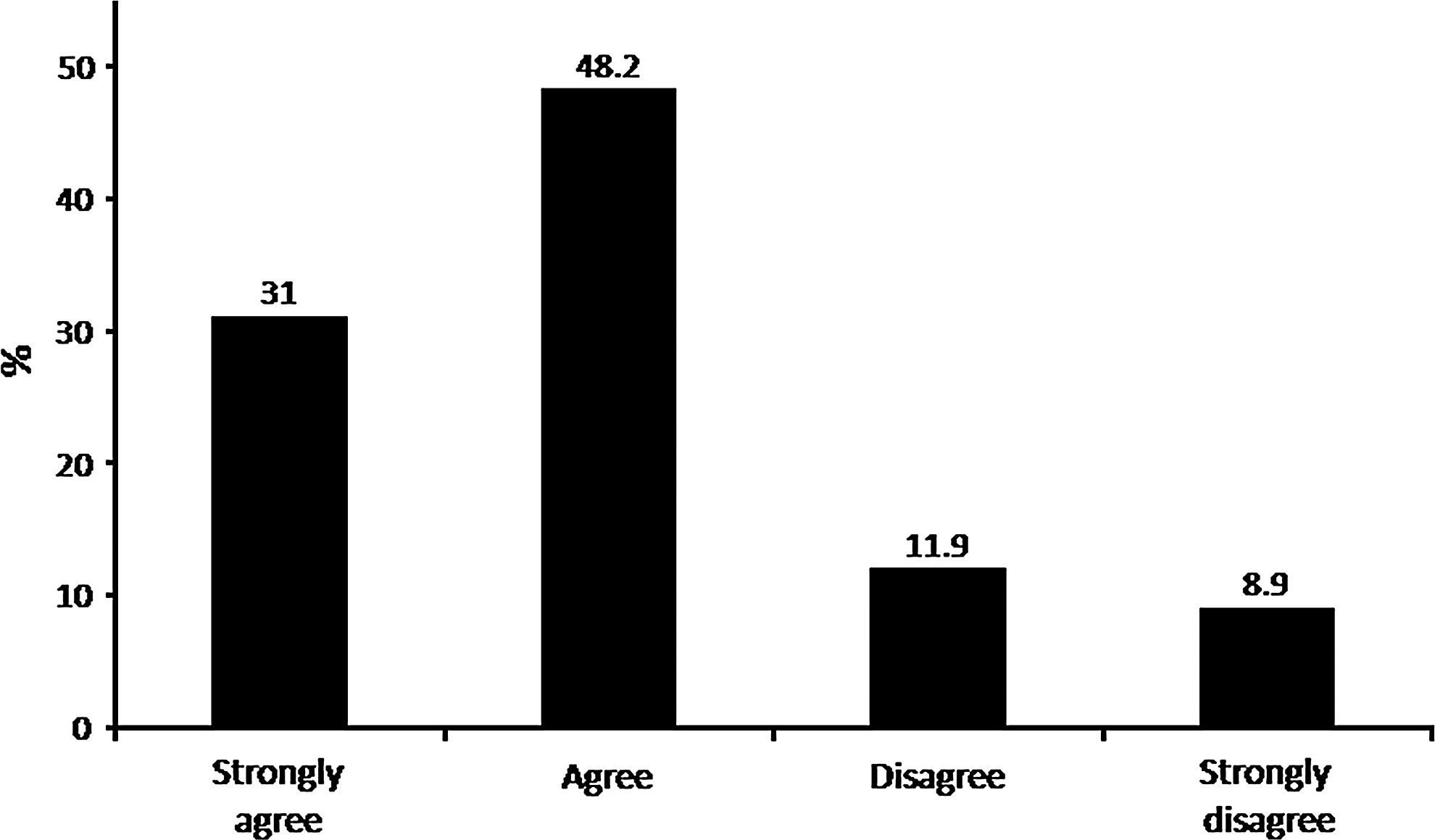
Public approval of biospecimen use in research (n=3196).
Willingness to donate biospecimens
A number of statements relating to the potential operating procedures of the biobank were read to survey participants (see Materials and Methods) who were then asked about their willingness to donate biospecimen
Using Peason correlation coefficient, positive responses correlated significantly with younger age and increasing education (p<0.001), but not gender.
These responses were removed from the analysis due to their small size (final sample size: 3185).
Willingness to donate biospecimens, personal and family health information were correlated to participants' gender, education level, and age. Responses demonstrated a significant correlation between intention to participate with both younger age (r=0.12, p<0.001) and increasing education (r=0.08, p<0.001) independently. On the other hand, there was no association between willingness to donate and gender (p=0.536). Willingness to participate in biobanking via donation of biospecimens and information correlated to both knowledge of the term “biospecimens” (r=0.09, p<0.001) and strongly to approval of the utilization of biospecimens in research (r=0.486, p<0.001).
Discussion
This study provides an insight for the perception of the Jordanian population towards biobanking. This is reflected by their levels of knowledge, approval of biospecimen-based research, and willingness to participate in biobanking. Since the Jordanian population is culturally close to other populations in the Middle Eastern region, the study also provides an opportunity for understanding and accessing the public in the region. The presented data provide an excellent starting point for deeper and more focused studies. Overall, it can be concluded that the Jordanian population appears to be willing to take part in biobanking-based research, although more effort is needed to increase awareness and promote wider participation.
When it comes to the level of knowledge of the term “biospecimens,” the Jordanian population is not very knowledgeable of the term, since only one-fourth of them have heard of it. There was a correlation between knowledge and both approval of the use of biospecimens in research and willingness to donate biospecimens for research purposes. However, the familiarity of the term itself is not a major concern since this did not influence approval of using biospecimens in research where, after explaining the meaning of the term, 80% of the Jordanian population approved of utilizing biospecimens for research purposes, and almost two-thirds were willing to participate in biobanking. A similar phenomenon was reported in the United Kingdom where both the public and those in medical profession, general practitioners, and nurses, were not familiar with the term, yet approval of the concept and willingness to participate in biobanking activities was high. 4 In addition, Kaufmann et al. 14 reported a similar rating of approval where 84% of US survey respondents supported the idea of large cohort studies. It is interesting to note that willingness to participate in biobanking was extremely high among Jordanians visiting a cancer center (M. Al-Hussaini, personal communication). The approval rating among the Jordanian public is higher than what was recently reported in Saudi Arabia, a neighboring conservative Islamic country, where only 70% of escorts of hospital visitors had favorable attitudes towards tissue donation for research purposes. 15
After reading a few statements related to the potential biobank procedures in Jordan, almost two-thirds of the Jordanian population agreed or strongly agreed to participate in biobanking. On the other hand, a considerable one-third of people were not willing to participate in biobanking activities. These data are in contrast to results obtained in different studies where higher rates of approval were variably reported. For example, according to two Scandinavian studies, as high as 95% of those participating in questionnaires are willing to donate samples for research.7,8 Other studies reported similar high positive attitude in the US and UK.5,16 However, our data are comparable to the 70% likelihood to participate in biobanking in Saudi Arabia 16 and the 60% recently reported in US 15 and UK. 17
Some of the aforementioned studies, as well as ours, revealed that enthusiasm to participate in biobanking differed within sociodemographic backgrounds. A UK study showed that increasing age was associated with lower desire of storing blood samples and using them in research, 17 whereas middle-aged Swedes were more likely to donate blood for research. 7 In Saudi Arabia, 70% are willing to participate in biobanking. 15 In the latter study, being a female and having an educational level higher than secondary grade (equivalent to high school) were predictors for favorable attitudes towards biobanking. In our study, we found a correlation between willingness to donate for biobanking and younger age, increasing education, but not gender, familiarity of the term “biospecimens.” Similar to our findings, the influence of increased education, but not gender, was also observed earlier in a study conducted in Ireland. 6 Therefore, it can be surmised that education has a critical role in promoting public participation in biobanking.
It is satisfying to note that a similar percentage of people were willing to provide personal, health-related information, and family-related information as those willing to donate samples. Providing information associated with samples is a concern for biobanking participants, in general.4,7,14 In Egypt, although not considered a major issue, some participants expressed concern of sharing information with others. 18 A difference in concern was frequently reported according to who would access information, with academic researchers being favored over government agencies and pharmaceutical companies.4,15,19 Linking data to samples seemed to be a concern among the Irish public at a relatively higher rate than what was reported in Sweden.6,7
In the Irish study, providing more information about biobanking provided assurances and shifted the views in favor of the linked system. 6 These results suggest that increasing awareness among potential donors can reduce concerns and increase the level of participation. In support of this claim, we found a significant correlation between increased educational level with increased familiarity of the term “biospecimens,” approval of using biospecimens in research, and willingness to participate in biobanking. In fact, this case can also be illustrated in the observation that 13% of those who initially disapproved the use of biospecimens in research shifted their opinion in favor of donating after reading a few statements regarding potential procedures of biobanking (data not shown). It also worth noting that 22% changed their views to the opposite direction where they were approving of using biospecimens in research, yet expressed unwillingness to donate. It is of great interest to examine the factors that led to this change.
Although the majority of people in Jordan are willing to donate biospecimens and data for biobanking activities, the proportion is relatively less than seen in other studies. This low enthusiasm towards biobanking can be surmounted by increasing awareness and establishing trust with the public, both of which play important roles in public view of biobanking.20–25 It is important, therefore, to engage the public in scientific awareness programs to increase their knowledge about research and to provide them with assurances of the safety of their data and, hence, increase trust in research institutions and researchers. In addition, deeper interaction of the public with researchers can also enormously ease doubts and concerns. Understanding the factors that may make individuals hesitate from donating samples can be overcome with education and awareness.
Footnotes
Acknowledgment
The KAP Survey was implemented by King Hussein Institute for Biotechnology and Cancer (KHIBC) under The National Life Science Research and Biotechnology Promotion (LSR/BTP) Initiative in Jordan with the support of the Arab Fund for Economic and Social Development (AFESD). The authors offer their gratitude to Professor Moayyad Ahmad for his valuable input.
Members of the Advisory Committee of the KAP survey include the following institutions and individuals: King Hussein Institute for Biotechnology and Cancer (Mamoun Ahram, Manal Shahrouri, Natasha Shawarib), Ministry of Health (Mohammad Tarawneh), Department of Statistics (Zeinab Dabbagh), University of Jordan (Muayyad Ahmad, Mamoun Ahram, Ekhlas Algamal, Madi Jaghbir, Inaam Khalaf, Areej Othman), Jordan University for Science and Technology (Muntaha Gharaibeh), and King Hussein Cancer Center (Nour Obeidat); University of Minnesota (Cari Clark).
Author Disclosure Statement
No competing financial interests exist.