




Abstract
Two core aspects of the discipline of biobanking are biospecimen quality and good governance. Meeting the demands of both sample quality and governance can be challenging, especially in a resource limited environment. Frequently, differences between biobank processes reduce the ability for cooperative action and specimen sharing with researchers. In the Canadian context, we have made an attempt to identify these gaps and have provided a framework to support excellence, initially for tumor biobanks. The Canadian Tumour Repository Network (CTRNet) was established with funding from the Canadian Institute of Health Sciences (CIHR) Institute of Cancer Research (ICR) to foster translational research through improved access to high quality tumour biospecimens. Consistent with this mandate, CTRNet has focused on the establishment and deployment of common standards to harmonize biospecimen quality and approaches to governance. More recently, CTRNet has implemented a certification program to communicate these standards in conjunction with simultaneous exposure to education focusing on the rationale and foundations underlying these standards.
The CTRNet certification program comprises registration and certification steps as two linked phases. In the registration phase, launched in November 2011, biobanks are registered into the system and individuals complete an introductory educational module. In the subsequent certification phase, the type of biobank is classified and assigned relevant educational modules and adoption of relevant standards of practice is confirmed through review of documentation including policies and protocols that address the CTRNet Required Operational Practices (ROPs). An important feature of the program is that it is intended for all types of tumor biobanks, so the scope and extent of assessment is scaled to the type of biobank. This program will provide an easily adoptable and flexible mechanism to communicate common standards through education and address both quality assurance and governance across the broad spectrum of biobanks.
Introduction
It is useful to consider these issues from the perspective of some of the key stakeholders (e.g., participants, funders, researchers, research ethics boards). Participants donate biospecimens out of a sense of altruism and a desire to advance science. However, they have concerns about the implications of participation with respect to their individual privacy, and also about ethical practice, and they wish to ensure that their participation impacts positively on the future of our society. Any erosion of public trust can jeopardize access to biospecimens, public funding, and feasibility of the clinical research agenda. The importance of public confidence is illustrated at a national level by events such as the Alder Hey organ scandal, leading to the Redfern Report 3 and its implications, and at the level of individual projects by evidence of a direct relationship between detrimental media coverage and declines in consent rates. 4 Controversy surrounding one bank and its practices can lead to a negative effect on unrelated research groups and their biobanks, and this can have significant costs for institutions and progress. A challenge for biobanks is to maintain public trust through proactive strategies that respect the values of stakeholders; for example, the public values the role of research ethics committees to oversee health research. Research users access biospecimens from biobanks with the anticipation that the major variables among them are clinical, biological, and molecular differences attributable to disease states. However, there is increasing recognition that the effects of pre-analytical variables such as collection time and temperature and preservation methods have contributed to unanticipated bias within and between cohorts that hinder our ability to either replicate or validate findings. 5 Funders also support this activity with the expectation that banks will enable research that not only generates basic knowledge (e.g., in the form of publications) but information that can be translated in further research studies into improvements in clinical practice. This requires the ability to expand and conduct validation research at a sufficient scope and scale to be applicable to larger populations.
Currently, Canadian biobanks benefit from oversight from Research Ethics Boards (REBs). The REB encompasses expertise to review the ethical aspects of biobanks, but in many cases REBs feel that assessment of technical, operational, and biospecimen quality aspects of biobanks is beyond their scope. Many research entities (e.g., research laboratories, research group core resources, clinical studies and trials with associated biospecimens) working with biospecimens and annotating data do not necessarily recognize that they are conducting ‘biobanking’. Even those entities that designate themselves as biobanks and wish to adopt common national standards or seek educational materials for improving their operational standards could access few resources until recently. However, the past few years have seen significant contributions to establishing standards including guidelines [International Society for Biological and Environmental Repositories (ISBER) Best Practices, National Cancer Institute (NCI) Best Practices, and open access Standard Operating Protocols (CTRNet)]. Nevertheless development of mechanisms to communicate these standards and to support their adoption has been lacking.
The Institute for Cancer Research (ICR) of the Canadian Institutes for Health Research (CIHR), the national agency responsible for funding health research in Canada, supports CTRNet to foster improved standards for tumor biobanking. Furthermore in the context of the strategic plan for cancer research developed by the Canadian Cancer Research Alliance, CTRNet was tasked with defining biobank standards. This article describes the development and launch of the CTRNet Certification Program to address these important issues in biobanking.
Program Planning
CTRNet has a mission to improve capacity and quality of cancer biospecimens through standardization and improvement of biobanking processes and frameworks. Consistent with this aim, CTRNet began to develop a plan for a tumor biobank certification program with supporting online education modules and linkage to a biobank resource center in January 2010, leading to the public launch of the program in November 2011. 6 The program design involved a national and international landscape assessment, national consultation, advice from leaders spanning ethics and research communities, and input from working groups drawn from leaders and staff of leading Canadian biobanks to develop supporting education.
A landscape survey was initially conducted by CTRNet through literature and online sources, and discussion was stimulated through abstracts and presentations made at international meetings (e.g., workshop at ISBER annual meeting May 2010, 7 presentation at the Marble Arch Working Group meeting, Jerusalem, November 2010 8 ). These forums indicated that there was debate in the biobanking community about the optimal mechanisms to ensure biobanks were aware of and/or in compliance with best practices. There was also discussion around the different merits of accreditation and certification (Table 1). On the other hand, there was agreement on the need to provide better access to education tools. Several of these important tools, such as self-assessment questionnaires, training for staff, and biospecimen proficiency testing, have since been developed through the efforts and under the auspices of ISBER working groups. 9 Table 1 summarizes the similarities and differences between accreditation and certification programs.
Considering the current status and diversity of Canadian tumor biobanking, CTRNet concluded that developing a ‘certification program’
7
would serve as the optimal mechanism for addressing the system issues in biobanking outlined above, at least in Canada, and for achieving uptake and adoption from the widest spectrum of biobanks. There are several features that appear to distinguish the CTRNet certification program from the approaches that some national and international organizations have taken. These can be summarized as follows;
• It was conceived and created by Canadian biobankers with input from REB, researchers, and international experts to meet the needs in the Canadian research community. • It has been further tailored in its development through a broad grass roots effort across stakeholders in Canada and created in both English and French languages. • It is focused on and designed to be applicable to the full broad spectrum of biobanks—from individual research projects engaged in limited biospecimen collection through to institutional biobanks and large prospective studies and clinical trials. • It is based on principles encapsulated in a set of Required Operational Practices (developed from international best practice guidelines to summarize the principles behind biobank operational polices and SOPs). • It is a program that combines both external assurance with self-assessment and education to achieve the goals of improved oversight as well as assurance combined with improved standardization for higher quality of biospecimens.
A summary of bodies that have made progress in developing other relevant programs and education tools is provided in Table 2.
Record provided: R=Register; C=Certification; A=Accreditation; L=Licence Features; interpretation from websites and personal communications.
Program Refinement
The CTRNet certification plan was initially presented at an international workshop led by CTRNet (at the ISBER May 2010 annual meeting), as one step beyond self-assessment, but one step before accreditation. It would be inclusive of all levels/types of biobanks, fill in the gaps in ethics review with operational oversight, and would meet CTRNet's strategic goal of communicating national standards for biobanks. In a survey conducted at this workshop, 75% of the workshop attendees (n=40) agreed that the biobanking community needed a straightforward and relatively simple mechanism to assess whether biobanks were adhering to the key best practices. This input stimulated a close examination of relevant accreditation and certification programs applicable to Canadian health and research organizations. In particular, the Accreditation Canada's Qmentum program 10 for accreditation of health care institutions was examined from both the user and accreditor perspectives, and provided many important lessons for molding the final CTRNet program.
The next step for CTRNet was to consult with a representative cross section of stakeholders in biobanking in Canada. This was necessary to confirm that comparable initiatives had not been launched by other organizations and to confirm that the perception of the importance and need to address the issues as identified by CTRNet was shared by the broader biobanking and research communities. A national meeting of Canadian biobank stakeholders was held in Vancouver, BC, Canada, January 2011. Attendees (74) were selected to represent a cross-section of Canadian regions, biobanks, REBs, researchers, as well as public representatives and international biobanking and public engagement experts. Stakeholders relevant to tumor biobanks were the principal focus but stakeholders in non-tumor biobanks were also well represented. The full workshop report is available on the CTRNet website (www.ctrnet.ca). In brief, the 2-day workshop was structured to devote equivalent discussion to airing the issues, presenting a draft certification plan to focus discussion on the optimal design and implementation, and presenting a draft version of an initial education module to provide an overview of the field.
No significant reservations were expressed during the meeting, and attendees were also later surveyed about the need for a process like certification and fundamental questions raised by the workshop—to which 26 responded with written feedback. One hundred percent (26/26) of respondents thought there was a need for educational materials and resources, while 96% of respondents (25/26) indicated that certification should be a requirement for biobanks in Canada. The majority of responses indicated the importance of engaging all the stakeholder groups in developing a certification program, and that the goal should be to evaluate the operating standards within Canadian banks in a nonpunitive way, via education and support. Seventy-seven percent (20/26) of respondents and attendees indicated that if such a certification program were available, they would access it. Taken together, these responses confirmed that development of the education and certification programs was greatly needed and that the Canadian community was committed to its adoption once developed. This enthusiasm became a cornerstone in moving these projects forward.
Program Design
The CTRNet Program is comprised of two linked phases: Registration and Certification (Fig. 1).
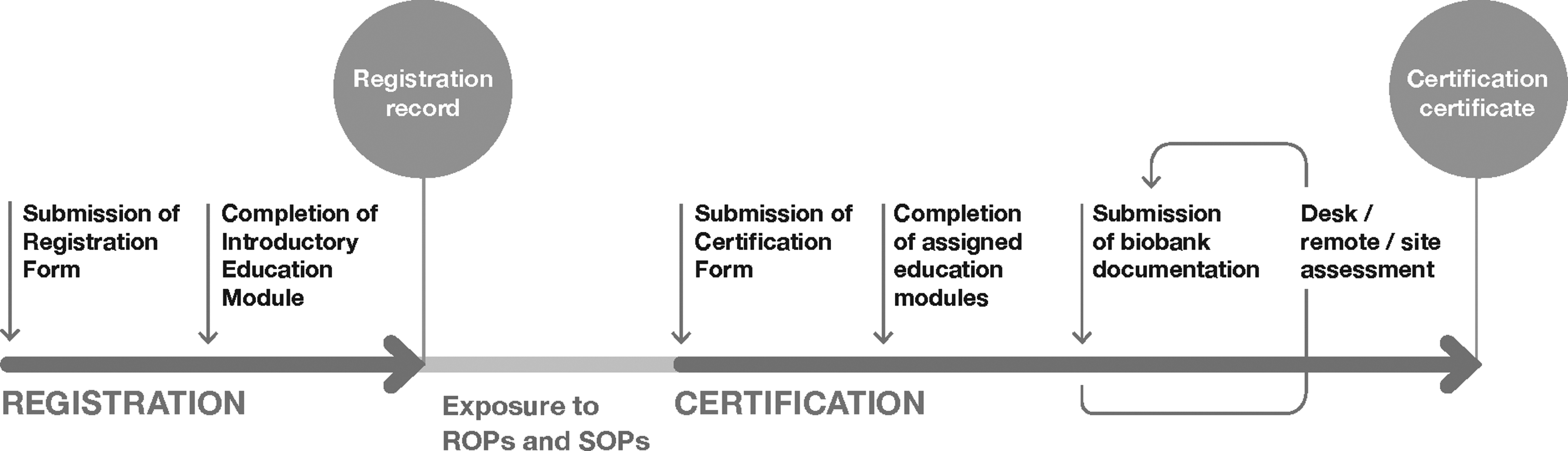
CTRNet Biobank Registration and Certification Program.
The Registration phase of the CTRNet Program was launched on November 30, 2011. Canadian researchers involved in tumor biobanking can enroll in the program by completing an online registration form and an introductory educational module, available in both official languages (English and French). The registration form accessible through the CTRNet website (www.ctrnet.ca) serves to collect baseline data and allow for classification of the biobank. The introductory module is broadly applicable to all biobank types and follows a web-based, interactive format. Once both parts are completed, which takes approximately 60–90 minutes, registrants are issued a record of Registration. Once registered, participants have one year to apply for Certification. As of May 2012, 20 tumor biobanks across Canada have completed registration, and another 5 are in progress.
The Certification phase of the program will be launched after December 2012. Canadian researchers involved in tumor biobanking who have registered in the first phase will be invited to complete an extended registration form. The CTRNet Certification office will use the information provided to classify the type of biobank 11 and will determine the extent and nature of the requirements for certification in the program according to the results of the classification. Based on the profile of the biobank, applicants will then be assigned up to eight additional educational modules to complete. Applicants will be required to familiarize themselves with the CTRNet Required Organizational Practices (ROPs, see below) which outline the high level standards and policies of accepted best practices in biobanking and to compile their own specialized SOPs or to adapt or adopt CTRNet SOPs (see below) in order to provide evidence that the operation of the biobank conforms to CTRNet's ROPs. Depending on the classification of the biobank, the level of final assessment (desk, phone interview, site visit) is then planned.
This assessment will result in either a decision that an application is incomplete or that it meets CTRNet's requirements for certification. If the application is deficient or the documentation does not sufficiently well address the CTRNet ROPs, applicants will be offered assistance through the biobank resource center (see below) to address the issues. Certification will be valid for the biobank project's duration, to a maximum of 5 years. However, this will expire immediately if REB approval from the applicable REB(s) is not maintained. There will be an annual process involving submission of a brief updated self-assessment by the biobank to identify any substantive changes that impact adherence to ROPs. If substantive changes have been made, the CTRNet Certification Office will re-review the application and re-issue the certificate.
Program Supporting Tools
Biobank classification
In order to aid in identifying the certification needs of a bank, the registration form was designed to allow the classification of a full range of biobank types. The classification elements were developed in the context of a previously published classification schema. 11 Questions in the registration form enable categorization of the biobank through four functional elements: the type of donor/participant (e.g., the patient group), the key aspects of the design (e.g., retrospective or prospective accrual, size and scope), the characteristics of the biospecimens (e.g., the predominant type of biospecimen preservation, such as fixed or frozen), and the nature of the brand (e.g., the major sponsor and the range of end users). Once a biobank is classified in this way, it enables the application of stratified certification requirements including customized education components.
Required Operational Practices
The certification program is founded on a set of 13 Required Operational Practices (ROPs) that define the key principles of operations to which a bank should adhere in order to meet the current best practice standards: ROPs are different from SOPs (Standard Operating Procedures). The latter are meant to provide the details for a given procedure such that personnel can complete and then repeat a process correctly each time with no operator variability. SOPs are therefore a mechanism to achieve a predetermined standard, not the standard or the principle underlying it. To convey these standards and principles, ROPs were developed by careful analysis of relevant international best practice guidelines,12,13 in order to summarize and adapt the key principles to fit the Canadian context, in documents of 1–2 pages in length. The ROPs therefore provide a relatively digestible framework for all biobanks to determine if their operation conforms to the standards, and then if not to revise their own SOPs or adopt CTRNet SOPs in order to address these principles. The draft ROPs were subjected to independent external review from 3 international experts for consistency with the original guidelines and internal expert review and approval from the CTRNet management committee, comprising leaders of Canadian provincial tumour biobanks.
Education modules
To support the program a set of nine online education modules was created. These include an introductory ‘basics of biobanking’ overview module in support of the registration phase and eight additional modules, each dealing with key aspects in greater detail to support the certification phase (Table 3). All modules are uploaded into an online learning management system (LMS) (eFront, Epignosis Ltd).
The introductory module is already available as it is necessary for registration, and other modules will be available at the time of initiating the Certification phase. The initial steps in creation of the content of the introductory module involved approximately 6 months, and then the remaining modules were developed over a further 8 months. The process included surveying and defining personnel learning needs in the context of available Best Practice guidelines, an open invitation and nominations for biobank staff to participate from across CTRNet member biobanks and selected nontumor biobanks, operation and capture of the working group input to learning content, finalization of IT requirements, and selection of learning management software. All material created was referenced to either best practice guidelines or scientific sources. After completion of content, the full suite of modules was subjected sequentially to second round review and approval from the CTRNet management committee. An instructional designer, copy editor, and graphics designer were also engaged to refine and complete the on-line educational material.
Program impact assessment
Two knowledge survey tools will be completed by the applicants as part of the certification process. This will involve completion of a standard set of general biobank knowledge questions before and then again at an interval after completing the assigned education modules. The difference in performance between the pre- and post- tests will enable assessment of uptake of the information presented and refinement of the education course.
A set of biospecimens from each bank will also be requested from each biobank applying for certification. These samples will undergo QC testing for common and assessable product categories as appropriate to the collection (e.g., semi-quantitative scoring from morphological assessment of paraffin sections or preservation assessment of extracted DNA and RNA from frozen biospecimens). These data will also serve as a baseline for measuring long-term success of the program.
Resource Center
A biobank resource center has been established to provide live and online advice and support. This center and its services are intended to offer an avenue for advice to biobanks under planning, as well as newly established and already existing biobanks seeking to certify, that is distinct from the certification office. Recognizing the common needs of tumor and nontumor biobanks, CTRNet has partnered with the University of British Columbia Office of Biobank Education and Research (OBER) to offer this support in the context of a joint Canadian Biobank Resource Centre (CBRC, accessible through a common web portal (http://www.biobanking.ca).
Discussion
CTRNet is a national tumor biobanking network that is representative of a spectrum of tumor banks in 5 Canadian provinces. CTRNet was initiated and is driven by biobankers with many years of experience conducting and supporting translational cancer research across tumor disease sites, and is tasked by the national Institute of Cancer Research–Canadian Institute of Health Research (ICR-CIHR) to develop tools and frameworks to facilitate biobanking in support of research in Canada. CTRNet is a cohesive productive network managed by individuals with a range of clinical and research backgrounds. The collective expertise and experience in biospecimen-based research makes the organization a reasonable choice to create and lead a national certification model for tumour biobanks.
Several challenges and barriers were overcome during the creation of this program. The landscape survey identified a desire for a simple, voluntary, inclusive, education-focused program based on self-assessment. However, no existing accreditation or certification model met these criteria; nor did a comprehensive educational program exist. Following on from the success of the initial planning, tight timelines were imposed on CTRNet staff, leaders, and volunteers from other Canadian banks to complete the design phase in order to be able to launch the program in conjunction with the first Canadian national cancer conference in fall 2011. Nevertheless, it was recognized early on that the larger challenge for this type of initiative is the future uptake of the program after it has been launched. This naturally depends on the perspectives and perceptions of value, and the cost and effort required to undertake certification. The latter includes the actual work involved and the perceptions that may differ across groups external to CTRNet—including funders and researchers. The pressures to institute short timelines in the planning phase were therefore balanced with the need for stakeholder engagement, and integration of input from specific relevant groups such as REBs.
The CTRNet certification program is different from other certification/accreditation programs in a number of significant ways, including the breadth of the target group, its focus on a set of practice principles, the grass roots process taken to define these principles and education content to support their implementation, and the integrated strategy taken to foster subsequent adoption.
The target group for the CTRNet Certification program is the full range of biobank types, from individual research projects engaged in creating small and large biospecimen collections, through to institutional biobanks and clinical studies and trials. This differs from some accreditation approaches which are more focused on entities that already define themselves as biobanks and are intended to assure and/or raise their level of quality. Some of these approaches may also only be feasible for the larger biobanks, due to resource and cost requirements inherent to engaging an external organization to conduct the assessment.
The fundamental principles underlying the program have been developed through a structured grass roots process involving our biobank community and external experts using accepted Best Practices as the starting template. These CTRNet ROPs delineate a set of principles within nine practice areas that provide the rationale behind more detailed operational protocols (SOPs) that need to be considered by a biobank. This differs from the approach of adapting biobank operations to a pre-existing ISO norm, such as ISO 9001 14 or ISO 17025. 15 These two ISO norms, which are the most applicable ISO norms to biobanking, are only a partial fit for this discipline: ISO 9001 is a norm for quality management systems; ISO 17025 is a norm for assays and calibration. Both of these norms are to some extent generic, by design, and therefore fall short of addressing the specific aspects and considerations for biobanking. Furthermore, these norms do not address many other key activities involved in biobanking.
The self-assessment and education modules that support the program have also been developed through a grassroots process. The educational material is divided into modules that can be selected and completed as applicable depending on the type and focus of different biobanks seeking certification. An important aspect of the CTRNet program is that anonymized measurement and assessment of biospecimen quality is undertaken only as a tool to assess the future impact of the entire program, but not as a factor to be used in determining certification of individual biobanks. This is because the intent is to encourage future adoption of standards that will lead to common higher quality (harmonization), not to exclude biobanks that do not meet standards which can be difficult to define. It is also recognized that research users already currently assess and determine quality using a range of approaches in relation to the intended purpose.
CTRNet chose an integrated strategy for adoption: this has involved working closely with all stakeholders throughout the development phase to ensure that the program is both ‘owned’ by all and feasible for all. A key stakeholder group has been the REBs, and the CTRNet program design ensures that the information gathered in the enrollment forms is structured so as to facilitate assessment by both REBs and CTRNet of the oversight, governance, and operational design of the biobank. This also creates an effective avenue for adoption of the program. REBs may value some of the information gathered for the process of ethical review and recommend certification by biobanks. Another key stakeholder group is researchers and their staff (who are conducting biobanking activities in the context of or as a part of the protocol for a designated research project). This group may value the access to information and education that improves the impact of their research and at the same time the ability to readily address oversight concerns by demonstrating knowledge of biobanking.
In the future, through collaboration with the University of British Columbia OBER (www.OBER.pathology.ubc.ca), an adaptation of the registration phase of the certification program for international biobanks and for Canadian nontumor biobanks is also being developed and will also be launched late 2012. This is being developed from the existing CTRNet platform with input from other Canadian, US, and Australian experts to modify and augment the education curriculum to include international examples, standards, policies, and additional nontumor focused case studies.
Conclusion
The Canadian biobank and research community identified a need for a simple and achievable mechanism to ensure biobanks were aware of and/or in compliance with best practices. CTRNet has developed a unique program that is designed to meet this need. The benefits of the CTRNet program are that it is a grassroots program developed by and for biobankers, is applicable to both governance and quality aspects of all types of biobanks, and is based on self-evaluation and exposure to education to provide the rationale and encourage adoption of higher standards that can enhance research quality. The next steps are to extend the program to Canadian nontumor and international biobanks.
Footnotes
Acknowledgments
The authors would like to thank Dr. William Grizzle, Ms. Marianna Bledsoe, Dr. Robert Hewitt, Ms. Alison van Nie, and Dr. Kieran O'Doherty, for their careful and thoughtful review of the CTRNet ROPs and other commentary given to this program. Additionally, we would like to thank all members of the Working Groups that provided invaluable input into the creation of the educational modules. We would like to thank all participants that gave their time and expertise to the January 2011 CTRNet Certification Workshop and lastly, to Dr. William Grizzle, Ms. Kathy Sexton, Dr. Nik Zeps, and Ms. Jane Carpenter for their contributions to the International Certification phase development.
We would also like thank Jeff Miller (Senior Manager, Distance & Blended Learning at the University of British Columbia); Carolyn Levy (instructional designer); Gabriel Lascu and Anne-Rae Vasquez (graphic designers); as well as Johanna Ward (copy editor) for their outstanding expertise and the depth they provided to the educational content of this program. Finally, we would like to thank Simon Dee for his outstanding contributions to all parts of this program.
Author Disclosure Statement
The authors have no conflicts of interest or financial ties to disclose.
Funding was provided by the Institute for Cancer Research (ICR) of the Canadian Institutes for Health Research (CIHR) to support CTRNet. Additional support for the education development was provided by the Michael Smith Foundation for Health Research to the BC BioLibrary and the University of British Columbia, Department of Pathology and Laboratory Medicine to support the Office of Biobank Education and Research.