




Abstract
The average cohort size for tissue biospecimens used in cancer research studies has increased significantly over the last 20 years. To understand some of the factors behind changes in biospecimen use, we examined cancer research publications to characterize the relationship between specific assay techniques and biospecimen formats and products. We assessed a representative cross section of 378 publications in the journal Cancer Research that used tissue biospecimens, selected from 6 intervals between 1988 and 2010. Publications were categorized by biospecimen utilization, format type (Frozen, Formalin-Fixed Paraffin-Embedded, and Fresh), product type (RNA, DNA, Protein, Cells, and Metabolites), and types of research techniques performed. There was an increase in average biospecimen cohort size (p=0.001); relative use of Formalin-Fixed Paraffin-Embedded biospecimens (24%–68%, p<0.0001); and the proportion of techniques assaying RNA products from biospecimens (Frozen and Fresh formats, p<0.05), from 1988 to 2008. However, these trends have not continued and there has been no further increase from 2008 to 2010. While specific techniques such as ‘tissue microarray’ analysis appear to have driven some changes in format requirements, there is an overall trend towards techniques requiring RNA products across all formats of biospecimens in basic cancer research. Since pre-analytical variables influence gene expression (RNA levels) more than gene structure (DNA sequence), recognition of these research trends is important for biobanks when deciding priorities for the optimal preservation format and annotation of biospecimens.
Introduction
In order to plan a biobank, projections are required about how and in what type of research a biospecimen will be used, and with what type and detail of data annotation, both at time of collection and over time. A biobank also needs to be able to predict and plan for the type of biospecimen format that will be required and the kinds of techniques that will be used in research that is often conducted many years after initial biospecimen collection. Therefore, we believe that historical data on biospecimen use may inform biobank planning and future projections. The objective of this study was to examine historical data concerning published articles utilizing biospecimens and to relate this to the requirements, types, and scope of techniques performed in cancer research. By analyzing the historical relationships between techniques and biospecimen use, we sought to identify future trends in demands for biospecimens.
Materials and Methods
Journal selection
We analyzed a cohort of representative articles for tissue biospecimen usage and techniques, published in the journal Cancer Research (American Association for Cancer Research Inc.) from 1988 to present. Tissue biospecimens were defined as any human biospecimen or biological material comprised of whole solid tissues, cells isolated from solid tissues, or fluids other than blood. Cancer Research was selected for the study for several reasons—it is well-established; all articles over the period studied are listed on PubMed; it has an editorial policy encouraging a wide variety of cancer research areas; and we have previously shown that articles published in this journal have a similar trend of tissue biospecimen use compared to other international cancer journals. 1 Six publication years were selected to cover intervals over the past 2 decades: 1988, 1993, 1998, 2003, 2008, and 2010.
Publication analysis
For each year, we analyzed the complete first issue for every other month (Jan, Mar, May, July, Sept, and Nov), assessing each article for tissue biospecimen use and recording 1) Cohort size; 2) Biospecimen format: Frozen, Formalin-Fixed Paraffin-Embedded (FFPE), or Fresh tissue, as previously defined; 1 3) the category of cellular subproducts generated for the study: DNA, RNA, Protein, Cells, or Metabolites; and 4) the technique performed on the isolated cellular subproducts (Tables 1 and 2). These data were recorded in a database developed in Microsoft Access (Microsoft Corporation, Redmond, WA) to facilitate data query and analysis.
Assay types and Product types are defined in Table 2.
In total, 1607 articles were assessed; of these, 387 from the 6 selected publication years that used tissue biospecimens were reviewed in detail. A final set of 343/387 (89%) articles were analyzed (mean/standard deviation=57/14 per year) after removal of some publications (n=44/387, 11%). Articles were excluded if there was insufficient documentation about the original biospecimens and/or assays used to enable accurate categorization (e.g., studies that utilized digital data sets or where it was difficult to determine biospecimen format or cohort size).
Technique classification
Only those research techniques applied to tissue biospecimens were assessed and classified into a list of 24 common techniques, “Technique subcategory” (Table 1). All Technique subcategories were further sorted into one of three “Assay type” or one of four “Product type” supercategories defined in Table 2. If a primary cell line or cell culture was generated from a tissue biospecimen, this technique was classified into the Technique subcategory “Development of primary cell line/cell culture” and any further techniques performed on the cell line or culture were not considered in our reporting, as our goal was to analyze techniques specifically related to tissue biospecimens.
Statistical analysis
Statistical analysis was performed by the principal investigator (PW) and first author (AC) and included descriptive statistics in terms of means and standard deviations, T-tests, Fisher's contingency, Chi squared and ANOVA tests, as appropriate. All statistical tests were performed using GraphPad Prism 5 (GraphPad Software Inc., La Jolla, CA).
Results
Trends in tissue biospecimen cohort size and format
Tissue biospecimen use over a 22-year period was assessed in order to validate our previous observations, 1 and to extend the time period up to the present. The number of tissue biospecimens utilized in publications was analyzed for each selected publication year. We confirmed that there has been a consistent increase in the average number of biospecimens used per publication from 1988 to 2008 (Table 3, p=0.001, ANOVA), with an almost 4-fold increase in cohort size. However, interestingly, we found that no additional increase occurred in the last time frame (from 2008 to 2010). We also analyzed the mean number of biospecimens used per study, excluding the use of Tissue Microarray (TMA), a technique widely implemented after the year 2000 that allows for hundreds of samples to be studied on a single slide. It alone could potentially account for the increasing number of biospecimens used. In 2003, we found that TMA was responsible for the increase in the mean number of biospecimens used (161 vs. 89) specifically due to one article that used TMAs with a combined total of 3675 tissue cores. However, in 2008 and 2010, the increase in number of biospecimens used per article remained, even with TMA excluded.
TMA, tissue microarray.
Sum of the percentages of articles utilizing Frozen, FFPE, and Fresh formats does not equal 100% as some articles utilized more than one format.
The use of different formats of biospecimens was also assessed over the same period. The number of articles utilizing a specific tissue format in a given year was divided by the number of articles analyzed in that year (Table 3). Significant changes in the predominant formats used were observed from 1988 to 2008 (Table 3), with the most notable and consistent change being an increase in the use of FFPE tissues (from 24% to 68%, p<0.0001, Chi squared test for trend). By contrast, the proportions of publications using both Frozen and Fresh tissue formats from 1988 to 2008 were less consistent but exhibited downward trends. Use of the Frozen tissue format declined overall, at least from 1993 to 2008 (69% to 41%, p=0.01 Chi squared test for trend) and the Fresh format steadily decreased from 1988 to 2008 (40% to 7%, p<0.0001, Chi squared test for trend).
Trends in number of techniques performed per publication
The number of techniques performed per publication was analyzed for each time period (Fig. 1). We observed a significant increase in the mean number of techniques per publication from 1988 to 1998 (1.31 to 2.25, p=0.001, ANOVA test). However, there has been no significant change since 1998 and there has even been a nonsignificant trend to use of fewer techniques per article in the past decade.

Variations in numbers of techniques performed per publication over two decades. Bars represent means (with standard deviation error bars) and statistically significant differences tested by ANOVA (* and ** p<0.05). A color version of this figure is available in the online article at www.liebertonline.com/bio.
Trends in overall techniques and product types with frozen tissue biospecimens
We examined those publications that used frozen tissue biospecimens and assessed the overall proportion of techniques related to each assay type and product type for each specified time period. We observed that techniques which required processing for extraction made up the greatest proportion of techniques which utilized frozen tissue biospecimens (Fig. 2A). This was consistent over the entire time period analyzed. By contrast, there was a significant increase in techniques utilizing ‘RNA’ as the product type from 6% in 1988 to 56% in 2010 (Fig. 2B, p<0.0001). The proportion of publications which used techniques studying ‘Protein’ product type decreased significantly from 41% in 1988 to 13% in 1993 (p=0.001), and then remained unchanged.
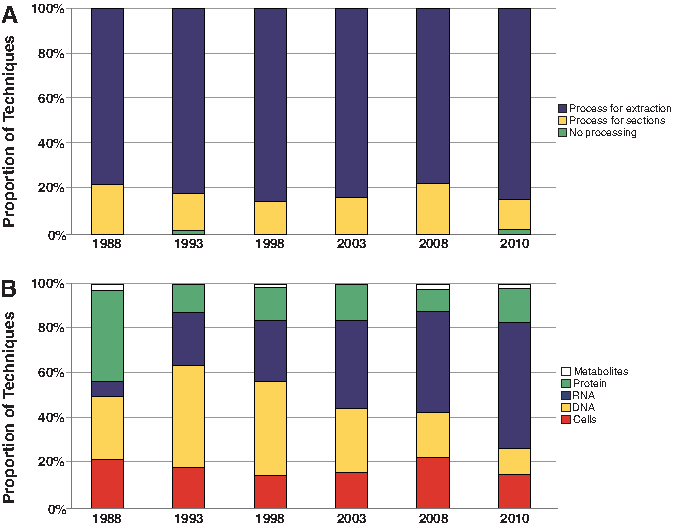
Changes in relative proportions of techniques using Frozen format tissue over two decades, grouped by assay type
Trends in overall techniques and product types with FFPE tissue biospecimens
We then sought to determine any trends in assay types and products relative to techniques that utilize FFPE tissues. Prior to 1993, only techniques requiring processing for sections and that then studied ‘Cells' as the product type used FFPE biospecimens. Since then, processing of FFPE biospecimens for extraction accounted for an average of 27% of applications, albeit with a steady significant trend to reduced extraction rates since 1993 (p=0.04, Chi squared test for trend, Fig. 3A and 3B). Also from 1993, the main extracts have been ‘DNA’ and ‘RNA’ rather than ‘Protein’, with a 25-fold increase in the RNA: DNA ratio (from 0.12 to 3.0, p=0.015).

Changes in relative proportions of techniques using FFPE format tissue over two decades, grouped by assay type
Trends in overall techniques and product types with fresh tissue biospecimens
The absolute numbers of articles and size of cohorts using fresh biospecimens were much smaller than for the other two formats (Table 3), making it difficult to arrive at firm conclusions. However, overall “no processing” has persisted as the predominant assay type and ‘Cells' have persisted as the predominant product type required by the techniques performed using fresh biospecimens. While no significant trends emerged, it appears that after a period where techniques requiring processing for extraction or for sections were most frequent (1993–2008), there may have been a recent return to the 1988 pattern (Fig. 4).
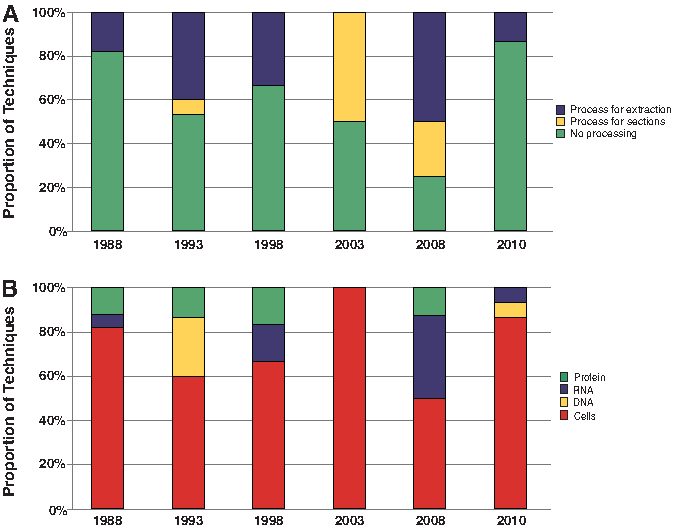
Changes in relative proportions of techniques using Fresh format tissue over two decades, grouped by assay type
Trends in specific technique subcategories
We selectively analyzed the four major technique subcategories: IHC/ICC, TMA, PCR, and RT-PCR because their use largely dictated the trends observed in the Frozen and FFPE biospecimen formats. In frozen tissues, the use of RT-PCR steadily increased from 0% in 1988 to 27.5% in 2010 (Fig. 5A), whereas the use of PCR has shown a decreasing trend from 1993 to 2010 in both frozen and FFPE tissues. For FFPE formats, IHC/ICC once accounted for 90% of the techniques used, but has decreased to 37.5% in recent years, mostly due to the gain in use of TMA (Fig. 5B).
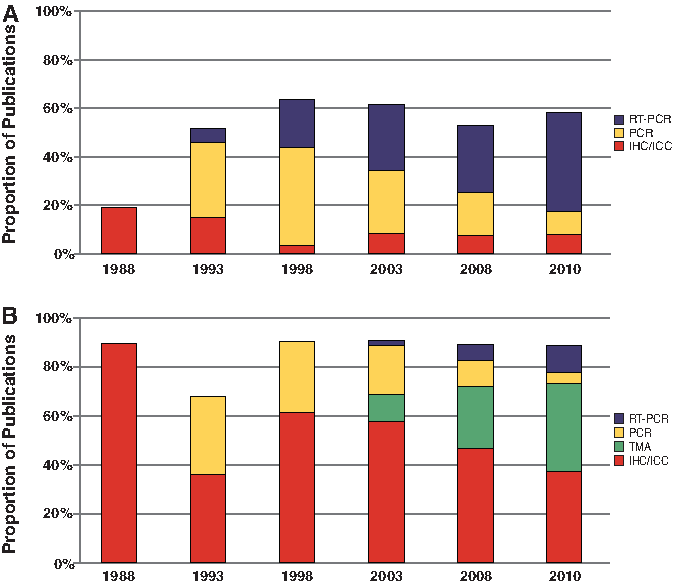
Trends in application of major technique subcategories with Frozen
Discussion
We assessed tissue biospecimen use as reported in publications in the journal Cancer Research for relationships between the format and use of human biospecimens and research techniques. There has been an increase in the average biospecimen cohort size since 1988. Analysis of the relative proportions of articles using the three major formats for tissue biospecimens showed that this is mostly due to the more frequent use of FFPE format biospecimens, with prominent increases occurring over two periods (1993–1998 and 2003–2008). This increase in FFPE format use corresponded to reductions in use of Frozen format in both periods. However, in the most recent time period analyzed (2008–2010), average cohort size and the relative use of different formats did not change significantly, but requirements in terms of processing and product types continued to evolve for all biospecimen format categories.
Although a range of techniques has been applied to tissue biospecimens, the major technique subcategories used from 1988 to present were IHC/ICC, TMA, PCR, and RT-PCR, and development of primary cell line/culture. Some of these subcategories are strongly associated with, and mostly applicable to, particular formats (TMA with FFPE; RT-PCR with Frozen format; primary cell culture with Fresh format), while others (IHC/ICC and PCR) are associated with different tissue formats over time. Analysis of the types of assays and products associated with the different biospecimen formats shows that FFPE biospecimens are predominantly and increasingly used to assess cell products directly using section-based assays, while frozen biospecimens remain predominantly and increasingly used by researchers for RNA extraction, and use of fresh biospecimens has fluctuated.
Although there was no direct relationship between cohort size and change in number of techniques used per article, examination of patterns of assay and product type reveal that increasing use of techniques requiring FFPE format was associated with different ‘drivers' in each period of most significant change (1993–1998 and 2003–2008). For example, there was no change in the relative requirement for processing or product in the first period, but there was an increase in frequency of IHC techniques, suggesting that research capacity may have been the major driver, but the latter period of increase was associated more with a change in technique requirements. By contrast, the relative use of frozen tissue has mostly shown a steady decline since 1993 which does not appear to be related to changing needs for processing. However, this has been associated with a significant relative increase in extraction for RNA product relative to DNA, also seen, but to a lesser extent, with extraction from FFPE format which correlates with increasing proportional use of RT-PCR. This apparent change towards higher proportion of techniques requiring RNA relative to DNA is intriguing. We speculate that this trend is a temporary phenomenon attributable to the emergence of biological interest in microRNAs and the beginning of a new wave of ‘disruptive’ nucleic acid analysis technologies and their rapidly decreasing costs. These new technologies include expression analysis platforms (e.g., microarray 2 and ‘nanostring’ high throughput RNA analytical assays) and a variety of next generation DNA and RNA sequencing technologies (e.g., whole genome DNA sequencing and RNA-seq 3 ). Rapid deployment of these technologies is occurring just as assay costs fall precipitously and the relative popularity of techniques that use DNA or RNA substrates is changing rapidly.
A significant increase in the average number of distinct biospecimen-related techniques performed per article occurred over the first part of the period studied from 1988 to 1998, followed by a nonsignificant reduction and apparent normalization since that time. This period was preceded by landmark cancer research articles using tissue biospecimens, such as the first description of the occurrence and association between oncogene alterations and prognosis in common solid tumors in 1987. 4 The early part of this period was also the time when the prototype techniques of the molecular biology era (e.g., Southern, Northern, and Western blot) first began to be augmented and/or replaced with techniques that allowed interrogation of smaller human tissue samples (e.g., PCR, RT-PCR, immunohistochemistry). In particular, PCR-based techniques, which first became widely deployed around 1990 in academic research centers, rapidly evolved into a variety of modified techniques which may have spurred the increase in techniques per article.
There is a natural lag period between initial reports of technical advances and widespread ability, capacity, and interest in adoption of technologies and instruments that lead to widespread use of a technique and demand for specific formats of biospecimens and/or product types (Fig. 6). The development of RT-PCR and later RNA expression microarray coupled to automated extraction technologies has had a significant impact on research capability, although their typical application to tissues still requires substantial effort in extraction of products and/or assay cost, limiting demand for cohort sizes in comparison with immunohistochemistry. Nevertheless, the steady increase in the relative proportion of techniques that demand RNA products when either FFPE or frozen biospecimens are used for extraction indicates that attention to pre-analytical variables and QC/QA efforts that affect gene expression (RNA) more than gene structure (DNA) are increasingly important for biobanks.
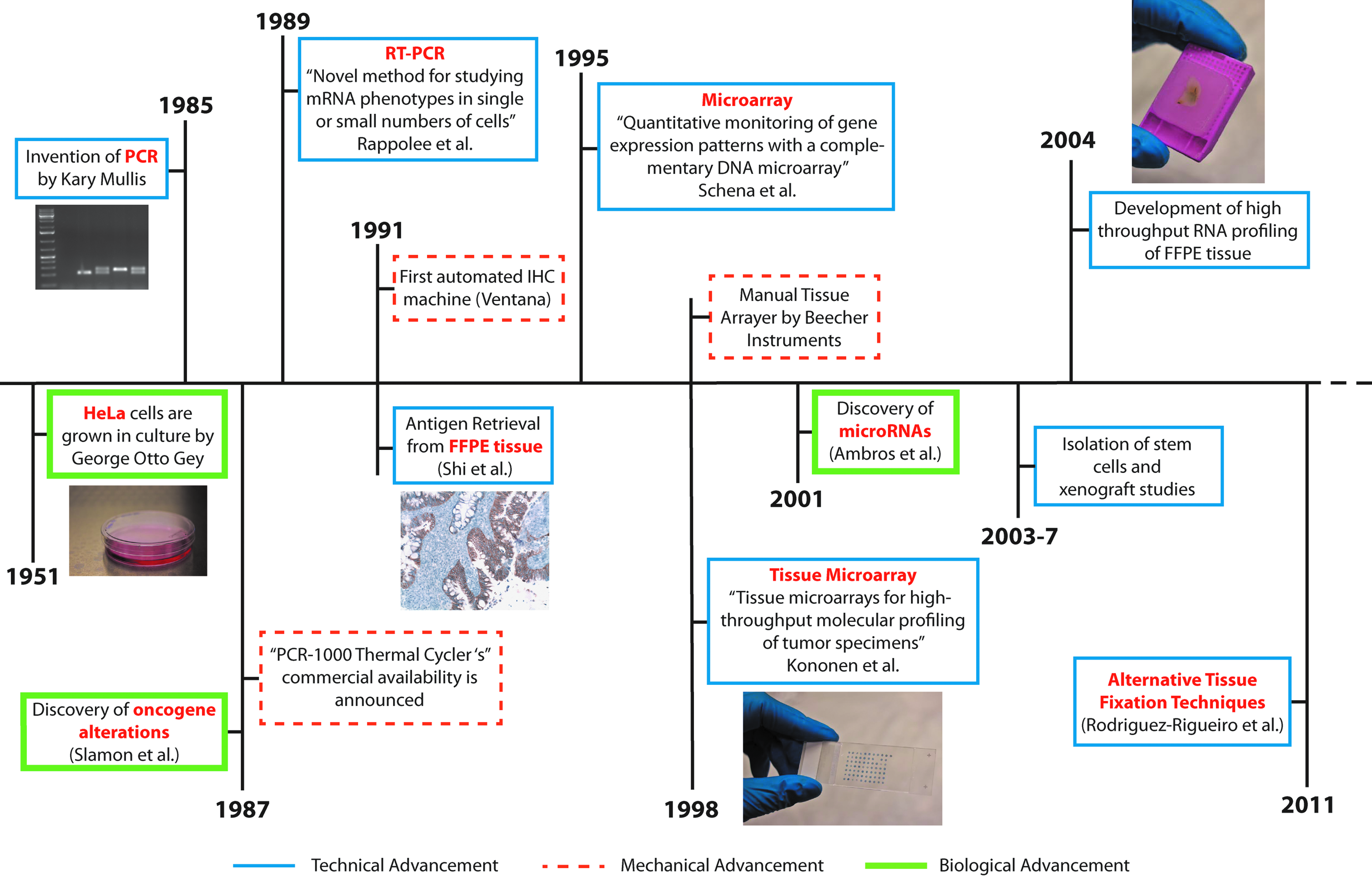
Timeline of sentinel articles and landmark technical, mechanical, and biological advancements affecting tissue biospecimens. A color version of this figure is available in the online article at www.liebertonline.com/bio.
Perhaps the most instructive techniques to consider are the development of tissue section antigen retrieval approaches in 1991 5 (created the potential to measure protein expression in archival FFPE pathology materials using antibodies with immunohistochemistry), and tissue microarray approaches in 1998 6 (that perhaps more than autostainer development created the potential to conduct high throughput immunohistochemistry). Both of these developments apply predominantly to the FFPE format; the influence of the first is likely initially detected in the change in demand for sections and cell products after 1998, and the influence of the second is likely reflected in the continued increase in demand from 2003 onwards. This interpretation would suggest that key technical advances may drive format preferences within 5–7 years of initial discovery. Since this is also the time period used for evaluation of many cancer treatments, it implies that biobanks need to be very responsive to new key technical advances in order to make early decisions about initial preservation format that will enable them to provide researchers with tissues preserved in the optimal format associated with 5 year outcome data.
By scanning recent publications for new techniques relevant to biospecimens, we predict no further change in the popularity of biospecimens in Frozen format but an increase in demand for FFPE and Fresh formats in the future. Extraction of high quality protein products has now been shown to be obtainable from FFPE tissues, a format once thought to be far inferior to frozen tissue for protein extraction. 7 Furthering the prediction of increased demand for fixed tissues versus frozen, a recent study used a new fixation technique to provide comparable RNA, DNA, and protein integrity on extraction compared to that of frozen cancer specimens. 8 With regard to predicting the demand for biospecimens in the Fresh format, a simple PubMed search using the keywords “stem cell xenografts” returns a set of papers that indicates an exponential growth in stem cell research and xenograft studies from the 1970's to 2011 that is likely to continue to further drive new demands for this format.9–11
Footnotes
Acknowledgments
This work was supported by the Tumour Tissue Repository Program at the BC Cancer Agency (a part of the Canadian Tumour Repository Network supported by a grant from the Institute of Cancer Research, Canadian Institutes of Health Research) and the Office of Biobank Education and Research, University of British Columbia, and the BC BioLibrary supported by a grant from the Michael Smith Foundation for Health Research. We would like to thank Rebecca Barnes for initial input and help with this study.
Author Disclosure Statement
The authors have no conflicts of interest of financial ties to disclose.