




Abstract
Buffy coat isolation from whole blood has typically been a long, manual process. We tested and evaluated the feasibility, efficiency, and reproducibility of extracting buffy coat by an automated process with the Tecan pipetting robot Freedom Evo200.
Introduction
Compared to manual BC extraction, automation guarantees high sample throughput, electronically controlled speed and volume of BC aspiration, no operator-due variability, tracking of sample identifications, and recording of all instrument-specific parameters of BC extraction.
Methodology and Feasibility
Essential platform components for the automation of the BC extraction are the software, the pipetting arm, and the Tube Inspection Unit (TIU), which detects differently colored layers of centrifuged blood by laser. For platform specifications, please refer to Figure 1.
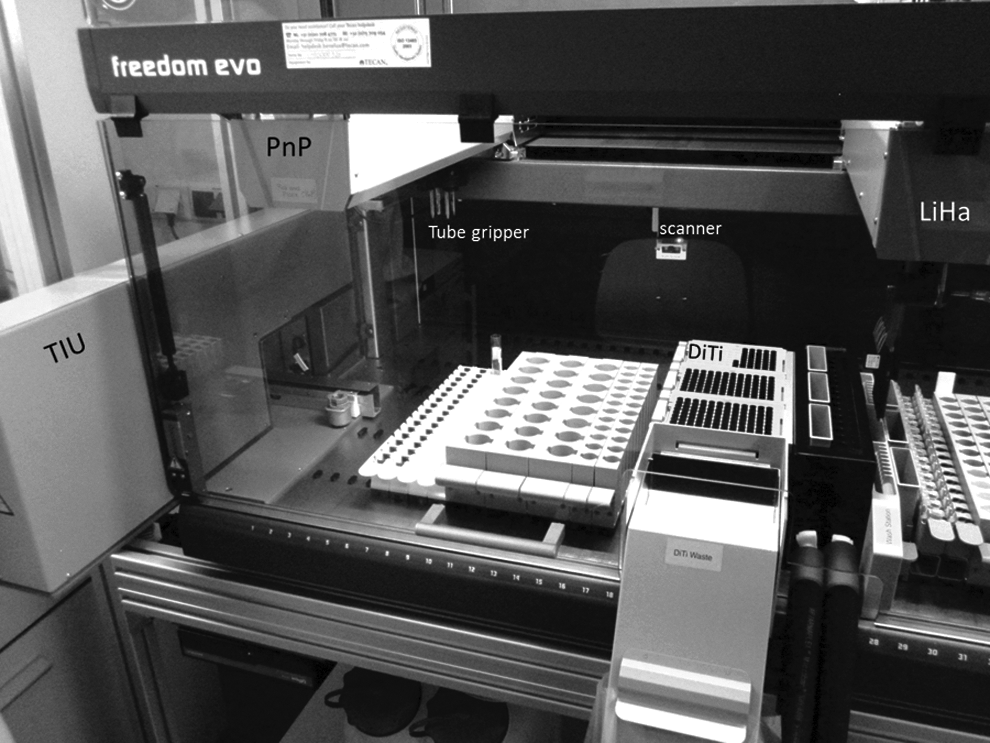
Illustration of the Tecan Freedom Evo200 platform at IBBL. The platform is composed of a pick and place arm (PnP), a liquid handling arm (LiHa) with eight adapters for disposable tips (DiTi), and a robotic arm with centric gripper. A Tecan Tube Inspection Unit (TIU) is installed to detect blood separation levels. Tube barcodes are identified by a Datalogic Matrix200 scanner (scanner). 2D barcodes of individual destination tubes are identified by a FluidX flatbed barcode scanner. FluidX decappers (XSD-96Pro and XSD-48Pro for 96, respectively, 48 individual tubes in racks), a laminar flow hood, and a reagent-cooling unit complete the instruments of the platform. The system is operated by the software EVOware Standard V2.4.
K2-EDTA, 10 mL blood collection tubes were centrifuged at 2000 g for 10 min at room temperature so that the blood separated into plasma, red blood cells, and the intermediate thin, white colored layer: the buffy coat (Fig. 2).

Typical appearance of a centrifuged blood collection tube after plasma withdrawal. The buffy coat (arrow) is located between the plasma and the dark erythrocytes.
The pipetting robot Freedom Evo200 used a customized human BC script where the blood tubes are first barcode-identified, then the software converts the location of the BC location into X, Y, Z vectors, which guide the tips of the pipetting arm to dip precisely into the BC layer and to aspirate the BC slowly. Finally, the extracted BC (approximately 1 mL) is ejected into a separate tube. One BC extraction run for 1–8 samples takes 5 min 20 sec; our configuration of the platform allows processing of 24 samples in one run.
Leukocyte content of automatically extracted BCs: Verification
The leukocyte subpopulation content of automatically extracted buffy coats from three adult donors was analyzed by flow cytometry (Table 1). Compared to reference ranges of leukocyte subpopulations in blood of healthy adults,1,2 normal values for leukocyte subpopulations (lymphocytes (B-cells and T-cells), monocytes, and granulocytes) were detected when BCs were extracted on the Freedom Evo200 platform (natural killer cells were not investigated).
Flow cytometry experiments were performed on a BD Influx cytometer using the following antibodies: anti-human CD3 APC-conjugated antibody (Immunotools, ref 21620036) for Pan T cells detection, anti-human CD4 PE-conjugated antibody (Immunotools, ref 21270044) for T cell subset detection, anti-human CD19 PE-conjugated antibody (Immunotools, ref. 21270194) for B cell detection, anti-human CD14 FITC-conjugated antibody (Immunotools, ref. 21279143) for monocyte detection, anti-human CD15 PE-conjugated antibody (Immunotools, ref. 21270154) for granulocyte detection, anti-human CD45 FITC-conjugated antibody (Immunotools, ref. 21270453) for total leukocyte detection. Isotype controls for IgG1, IgG2a, and IgG2b were performed.
Optimization and efficiency
BC is often used for DNA extraction. Quantification of the extracted DNA, from either automatically or manually prepared BCs, permits an efficiency assessment of the BC automation process. Data presented in Table 2 were obtained from 364 healthy volunteer donors over a 6-month timespan during which the BC automation was optimized. The same DNA extraction and quantification protocols were used for all specimens.
DNA extractions were performed with an automated process based on magnetic bead extraction (Chemagic DNA Blood 4 mL kit special) on a MSM I instrument (Chemagen). DNA eluates were quantified using spectrophotometry on a Synergy Mx monochromator instrument.
BCs were prepared from 8 mL blood either automatically or manually, and half of the BC volume was used for DNA extraction, corresponding to an initial 4 mL blood volume. The automated BC extraction resulted in a significantly lower DNA yield (47.8 μg) compared to manual BC preparation (61.3 μg). When the whole BC prepared by the Freedom Evo200 was used for DNA extraction, corresponding to 8 mL of whole blood, a median DNA yield of 147.9 μg was obtained. Manual BC extraction from 8 mL blood resulted in a similar median DNA yield (145.2 μg). Optimization of the BC script for automation resulted in a significantly higher DNA yield (199 μg) when compared to the yields obtained with the previous script. The optimization took into account some specific mechanical parameters of the used tube type. Additionally, the settings were optimized to allow a complete aspiration of the BC. As a result, the efficiency of optimized automated BC preparation in terms of DNA yield is higher than in manually prepared BCs.
Validation
To compare the physical content of extracted BCs to whole blood, cell counting was performed on blood before BC extraction and on automatically (optimized script) and manually extracted BCs from the same three donors (Table 3). The automatically extracted BCs contained significantly more leukocytes and platelets than the manually prepared BCs. Compared to whole blood, 95% of the blood leukocytes could be recovered in the automatically prepared BCs, whereas in the manually extracted BCs the leukocyte recovery percentage was 56%. Confirmation of these data came from a visual inspection of the collection tubes 30 min after the buffy coat extraction, where less buffy coat left over in the automated tubes was clearly observed (Fig. 3).

Six blood collection tubes from 3 donors after withdrawal of equivalent volume of buffy coat by manual process (Man, donors 1–3) or automated process (Aut, donors 1–3).
HGB, hemoglobin; PLT, platelets; RBC, red blood cells; WBC, white blood cells. Blood cell counting was performed on a Horiba ABX Micros CRP 200 instrument. Statistical t-test analysis on mean values of the three donors for WBC, RBC, HGB, and PLT (NS=nonsignificant).
Red blood cell (RBC) contamination in manually or automatically prepared BCs was not significantly different; however, in two of the three examined cases, RBC contamination was higher in the manually extracted buffy coats. Hemoglobin values were low in both manually and automatically prepared BCs, showing that in general no RBC lysis happened during the BC extraction. The median hemoglobin value was lower in the automatically extracted BCs (in two of the three cases).
In conclusion, the automatically extracted BCs were of high quality, presenting high leukocyte and platelets numbers and low red blood cell contamination compared to manually prepared BCs.
In a second part of this experiment the DNA content of the automatically or manually prepared BCs was analyzed from the same 3 donors (Table 4). The mean DNA yield of 204 μg obtained from BC from 8 mL blood (very similar to yields shown in Table 2), was 1.5 times higher in the automatically extracted BCs compared to the manually extracted BCs: however, the difference was not significantly different due to low numbers of donors. The ratios A260/A280 were high and very stable for both manually and automatically extracted BCs, thus indicating highly pure DNA samples.
DNA
Statistical analysis t-test, NS=nonsignificant.
Discussion
We demonstrate the feasibility of the BC extraction automation on a Tecan Freedom Evo200 platform. Optimization of the script and validation of the method were based on BC cell content analysis (blood cell counting and FACS) and on DNA extraction yields. Median DNA yield obtained with the optimized BC script (199 μg DNA from 8 mL blood) is significantly higher than the one obtained with the first BC script, highlighting that script optimization was a critical factor for best DNA yield outcomes. The optimized script generated DNA extraction yields that were even significantly higher than the ones from manually prepared BCs (Tables 2 and 4). In conclusion, automation of buffy coat extraction permits the isolation of all leukocyte subpopulations and extraction of high DNA quantities. It eliminates inter-operator variability and is time-saving, since up to 24 samples can be processed at the same time. Besides the Tecan system, Hamilton platforms have also been reported by the manufacturer as being capable of offering automation of buffy coat extraction. In our system, the automated BC extraction can be combined, on one hand, with upstream automated plasma aliquoting in the same run, and downstream automated DNA extraction from BCs on the other hand.
Footnotes
Acknowledgments
We are grateful to Hans-Peter Sattler and Matthias Greuter from Tecan for continuous assistance with the platform and Katy Beaumont, Estelle Henry, and Audur Thorlaksdottir for excellent technical help.
Author Disclosure Statement
No competing financial interests exist.