




Abstract
Background:
Preservation and optimization of biosample integrity to foster relevant research results and outcomes is a guiding principle of sample management. Tracking pre-analytical biospecimen lifecycle variables and bioprocessing chain of custody data enables documentation of adherence to best, regulatory and quality biobanking practices. Knowledge of individual sample and sample set temperature variability is believed to enhance delineation of artifacts during downstream analysis. Analysis of temperature responses may elucidate understanding of temperature trends which can aid downstream interpretation and provide an empirical foundation for “fit for purpose” sample management protocols and evidence-based biobanking practices. Bluechiip and the American Type Culture Collection (ATCC) conducted a pilot to test the bluechiip technology® performance and validate key proofs of concept for tracking temperature of biological samples.
Methods:
One hundred six (106) Corning® cryovials with bluechiip® buttons and one hundred six (106) standard Corning® cryovials labeled with 1-dimensional (1D) barcoded labels were evaluated. Identifiers were tracked and temperature data recorded in corresponding environments ranging from −192°C to +57°.
Results:
Nine of ten proof of concepts, defined in collaboration with ATCC successfully demonstrated functional capabilities of the bluechiip® technology. Bar-code label read performance was compared, producing evidence demonstrating a high rate of failure on the bar-code arm.
Conclusion:
Temperature data collected heightened observations of sample temperature variability. Prevalence of bar-code label read failure and issues affecting reliability of barcode performance may be under-reported and unrecognized in sample management practice, particularly when the temperatures are lower than −60°C. It appears the bluechiip® tracking technology may offer increased reliability over one-dimensional (1D) bar-coding technology; however while promising these findings require validation in future trials, including two-dimensional (2D) bar-coding technologies.
Introduction
Until recent technological developments, specifically the bluechiip® technology (a passive wireless technology based on MEMS (micro electromechanical systems)) it was not possible to obtain sample level temperature or assess the degree of individual sample and sample set temperature variability. Piloting of emerging technologies is considered a best practice. 3 Furthermore, one can intimate that products with user centered design are likely to have higher rates of utility and reliability. 4 Therefore, Bluechiip and the American Tissue Culture Collection (ATCC) conducted a pilot to test and validate the bluechiip® technology's performance. Ten proofs of concept (Table 1) were defined. Pilot objectives are noted in Table 2.
Materials and Methods
Background
Proof of concept pilot tests were conducted over four days including length of storage readings taken at 16, 104 (∼3 months) and 284 days (∼9.5 months). Products tested were the bluechiip® button ID device embedded into a Corning® 1.2 ml cryovial (Fig. 1) and the bluechiip® Matchbox™ reader (see Fig. 3). The pilot evaluated the bluechiip® technology's performance vs. bar-code scanning across thirteen trials (Table 3) relevant to repository and laboratory sample management processes. Sample sizes of each trial are listed in Table 3. ID and temperature sensing capability was evaluated for samples exposed to temperatures of +37°C to −196°C (Table 4). Structural integrity of the vials was evaluated after exposure to temperatures between +121°C to −196°C. Cryovial identifiers (ID) and temperature were ascertained by removing the sample briefly from its corresponding environment and placing the cryovial directly on the Matchbox™ reader. Chain of custody and biospecimen lifecycle interval temperatures (Table 5) were measured for the bluechiip® arm. ID was tracked for the barcode arm. Sample temperature history was acquired by the Matchbox™ reader when the cryovial was read by the reader. Corresponding date and time were recorded in the STREAM™ database. All tests were conducted on-site at the ATCC biological resource facility in Manassas, Virginia.

Bluechiip tagged Corning cryovial.
Trial set-up
On-site at Bluechiip Headquarters in Melbourne, Australia, bluechiip® tags were inserted into the base of cryovials using an overmoulded plastic insert or “button”. “Buttons” were constructed so that cryovial functionality (de-capping lock and height) was not affected. (The tag was not in contact with the sample, but was in contact with the inside surface of the cryovial.) Immediately following, bluechiip® embedded Corning® 1.2 ml cryovials were irradiated with 25kGy. Pre-trial, the temperature behavior of a number of tags was measured against a platinum thermocouple. From this data an algorithm was determined to calculate the temperature from a measure change in received signal. The tags were then calibrated on-site at ATCC.
Unique bluechiip® tag identifiers (ID) and/or 9 character 1-dimensional (1D) barcode identifiers were assigned to each cryovial prior to the trial, enabling comparison between the two technologies. Corning® 1.2 ml cryovials were used for the barcode arm printed on standard thermal labels. Total sample size on each arm was 106. The number of cryovials used for the primary trials was 96. During the trials, sub-sets from the 96 cryovials were split for workflow and field trials. Ten additional cryovials were sequestered for microwave and drop testing trials.
Prior to commencement of testing, Bluechiip® cryovials were read to confirm baseline ID and temperature. Prospectively for all trials, Bluechiip® cryovials were scanned to confirm ID, track chain-of-custody and ascertain sample level temperature; barcode cryovials were scanned to confirm ID (Table 5).
Conditions for “failure” were established and tracked. A “failed” read on the bluechiip arm was defined as a cryovial that could not be read when placed in the reader. A “failed” read on the barcode arm was “the need to wipe surface area” to induce a successful read. If a Bluechiip® tag completely failed, as in the drop test it could not be read again. (The temperature sensing and identification function of the tags are integrated and not separate, hence ID and temperature could be not be measured and vice and versa.) However, if a bar-code cryovial “failed” e.g. due to frosting it could be read again. Failed cryovials were not removed from the sample set, to maintain sample size. Partially failed tags were carried through and as a result additional instances of failure were recorded.
Data, logs and monitoring
Trial read duration was obtained for both arms throughout all processes. To support validation of temperature readings, environmental temperature measurements were obtained and recorded at key intervals, including pre-trial and post-trial. Instrumentation thermostat and probe vial readings were recorded when available.
Gamma radiation trial
bluechiip® cryovials were tested for ability to survive and function following gamma irradiation. This was determined by successful read upon removal from the study kit.
Cell culture cryopreservation trial
Labeled cryovials were filled with 1.0 ml of ATCC standard media at room temperature. Cryovials were scanned, attached to individually identified canes and placed in a Thermo® controlled rate freezer (CRF) for preservation time of ninety minutes. CRF temperature was tracked and correlated to the internal monitor and probe cryovial. Upon completion, the canes were transferred to a cryo-bin containing liquid nitrogen (LN2). Environmental temperatures were recorded and the bluechiip® cryopreserved samples were scanned. Bar-code cryovials were not read at this time. Canes were distributed evenly in two tiers of a MVE® 1800 Series cryo-tank in ATCC's biorepository.
Freeze/thaw trial
Cryovials were removed from cryo-tank, placed into a cryo-bin, scanned and transferred to the laboratory. Cane read time was documented and the samples were thawed in a +37°C water bath for seven minutes before scanning.
Centrifugation trials
Thawed samples were spun at 280 g for eleven minutes, at +4°C, repeating with four runs of progressively increasing samples sizes. Cryovials were scanned pre and post centrifugation.
Autoclave trial
Ten samples (five per arm), were placed in the autoclave for fifty-nine minutes. The log, documenting gravity, PSI and sterilization temperature, was obtained on completion. Samples were scanned pre and post autoclaving.
Snap freeze trial
Cryovials were scanned, placed on canes and submersed in LN2 in a covered cryo-bin. Samples were snap-frozen for forty-two minutes, pulled from submersion and read immediately. The majority of the cryovials remained on canes during the submersion; a minority were displaced and remained immersed throughout scanning.
Drop test
Twelve emptied cryovials (six per arm) were scanned and dropped from a height of two meters onto a concrete floor. Two runs were performed. Cryovials were scanned after each drop.
Microwave test
Twelve emptied cryovials (six per arm) were scanned and placed in a domestic microwave for five minutes. Cryovials were removed, inspected for structural damage and scanned.
Frost trial
Frozen, filled cryovials were scanned and placed in the vapor phase in a cryo-bin until an adequate level of frost was created. Cryovials remained in the cryo-bin (Fig. 2) while post-frost scans were performed.
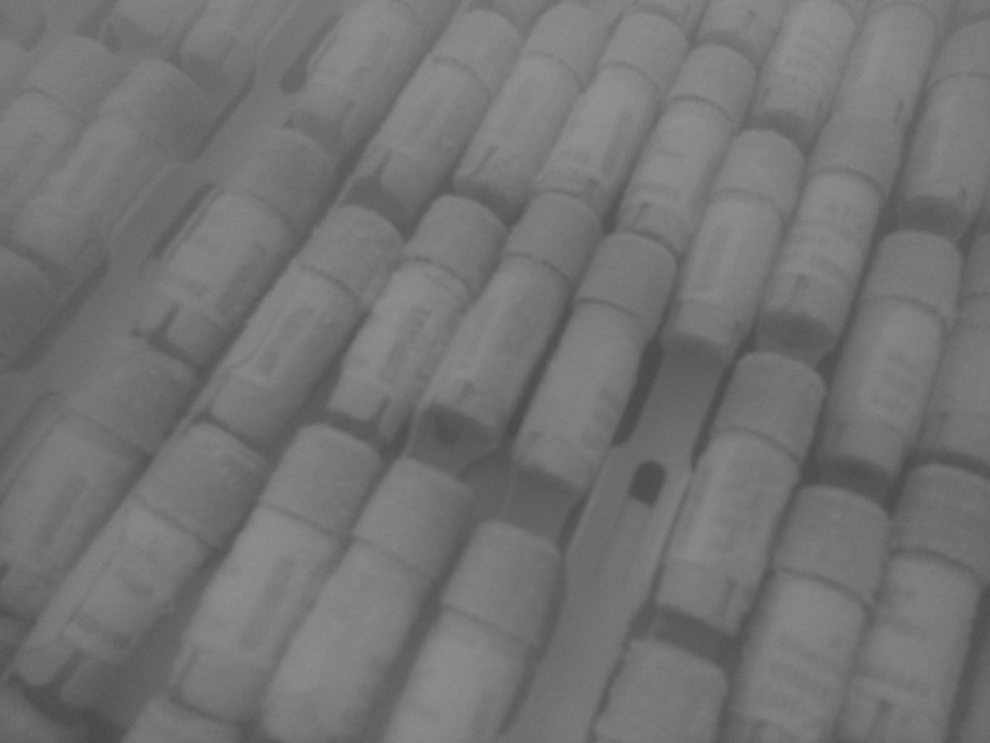
Cryovials in cryo-bin during frost trial.
Length of storage (LOS) studies
Cryovial ID, temperature measurements and bluechiip® technology cryogenic survival were assessed at Days two, sixteen and after approximately three and nine and a half months (104 and 284 days). Cryovials were removed from the two tiers of the LN2 tank and scanned to evaluate survival. After reading, all samples were returned to previous storage locations.
Trial analysis
Post pilot database logs underwent quality review of data. Individual sample temperatures and identifiers were confirmed for the bluechiip® arm for each trial. Sample and sample set temperature variability were examined across trials for the bluechiip® arm using reference tables and histograms to observe temperature trends over time and distribution of temperature across sample sets. Post pilot engineering analyzed the temperatures obtained against the algorithm defined. It was not possible to confirm accuracy of the bar-code ID measurements. Utility factors i.e. read rate duration and prevalence of failure were calculated for both arms.
Results
Proofs of concept
Nine of ten proofs of concept (Table I) across 13 tests (Table III) were successful. Confirmation of unique identifiers was not demonstrated in real time.
•
•
•
•
•
•
•
•
•
•
•
•

Frosted tagged cryovial on Matchbox™ reader.
11/106 vials failed in total throughout the trial. Failed vials were not removed from sample set.
Temperature observations
Pre-analytical temperature variation at the individual sample level was positively observed across all sample sets during bioprocessing, sample handling and exposure to differing conditions. Throughout the pilot, differences in stability of sample temperature in lower and higher cryogenic environments were observed. Large ranges in temperature variability were observed during cryogenic processing and when samples were immersed into or removed from cryogenic environments.
Duration of reads
The average successive read rate was five seconds. Bluechiip® arm read-rate durations were longer than the barcode arm. However, in instances when barcode read function was failing, barcode read-rate durations did increase. Bluechiip® arm read functionality was consistent across all time points and temperatures.
Reliability and incidence of failures
Operative reliability was not 100% for either arm of the trial (Table 6). Eleven total bluechiip® cryovials failed throughout the trial with a total failure rate ranging from 4.7% (5/106) (excluding drop test) to 10.4% (11/106) (including drop-test). It was not possible to track the total number of bar-code cyrovials that failed. It is possible, that Bluechiip® tag failure prevalence was due to the decision to include pre-production tags out of specification due to manufacturing related time constraints, however, the authors cannot speculate further at this time. The bluechiip® button cryovial concept has been re-designed to withstand drops and shocks. Per trial, reliability appeared to be more of an issue on the barcode arm, where barcode failures were significantly prevalent. Prevalence of failures was significantly greater in frequency across the barcode arm for four of the eight tests conducted. While prevalence of barcode failure was 0% for three of the tests (centrifuge, autoclaving and microwaving), reliability ranged between 16.2–87% for the other tests (Day 2 LOS (31.8%), Day 16 LOS (16.2%), Day 104 LOS (41.9%), Day 284 LOS (73.6%), post-thaw (45.7%), snap-freezing (48.8%) and frost (87%)). Greater incidence of failure was observed on the barcode arm than on the bluechiip® arm in every trial except for the centrifuge and drop test.
Discussion
The bluechiip® technology performed reasonably well across the process chain for extended periods of time in cryogenic and non-cryogenic environments as demonstrated by cell culture workflow and field trials (+56°C to −173°C). Pilot testing enabled comparison to bar-code read performance, which demonstrated high rate of failure. The high incidence of barcode arm failure (up to 87%) compared to the bluechiip® arm up to 13.6% (excluding the drop test), while generally expected was surprising to observe specific to distinct temperatures and lifecycle time points. It can be hypothesized that bar-code failure prevalence rate and issues affecting reliability of barcode performance may be under-reported and unrecognized in sample management practice. Barcode technology was observed failing when exposed to temperatures outside the cryogenic space, as low as −60°C. Incidence of barcode read failure increased significantly when temperatures exceeded −80°C. Failure rates varied amongst sample processes, with increased prevalence at: snap-freeze, frost and when transferred in and out of cryogenic temperatures.
While post pilot analysis confirmed that the variation in responses from different tags appears to support the accuracy of the temperature measurements obtained, it is premature to comment further. Regardless, the ability to collect individual temperature data heightened observations of sample temperature variability. Temperature tracking data may enhance understanding of sample temperature response behavior, temperature trends over time and factors that affect sample temperature variability.
Empirical data collected during the trial appeared to support the following conclusions:
1. Distinct fluctuations in sample temperature occur across the specimen lifecycle.
2. Prevalent and consistent temperature variation appears to exist in individual samples and sample sets during sample management, despite standardized processing and environmental exposure.
3. Remarkable variation exists with samples in close proximity to one another (e.g. different temperatures were recorded for neighboring cryovials stored on canes).
4. Variability of sample temperature may be affected and impacted differently based on type of bioprocessing, environmental conditions, and degree of sample handling, mode, format and duration of biostorage.
5. Samples stored at the same temperature do not appear to maintain the same temperature as their corresponding sample set in during transport, short or long term biostorage.
6. Stability of temperature may be directly linked to length of storage and range of cryogenic temperature. Samples stored for durations longer than 2 weeks in temperatures colder than −150°C appeared to be more stable when exposed to room air and lower cryogenic conditions than samples stored for 2 days in the same conditions.
One could intimate that 1-D barcode labeling may be a less reliable method of tracking ID for samples managed in cold chain (−60 to −80°C) and cryogenic temperatures (below −80°C) than bluechiip® technology due to poor performance observed during the trial. However while the results obtained are promising, this conclusion may be premature based on the fact that these findings require validation in future trials and acceptable parameters for reliability need to be confirmed with end-users. Demonstration of real time confirmation of unique identifiers is also required to support best practice. Furthermore, additional studies testing expanded sample sizes, and comparing performance against advanced technologies (i.e. 2-dimensional barcodes) in concurrence with operational trials are recommended. Such studies would serve to confirm the aforementioned hypothesis regarding reliability of performance and increase statistical significance of results obtained. Ongoing testing should aim to demonstrate product functionality and length of storage survival beyond 9.5 months.
Footnotes
Acknowledgments
The authors wish to thank Corning Life Sciences (Dawn Jackson and Mark Rothenberg) for their collaboration, contributions to sponsorship of the pilot and time; ATCC Management and Staff (Stewart Davis, Ken Jones, Susan Carlson, Doug Daley, Sherill Smallwood and Jody Terry)for their collaboration and assistance in conducting the pilot; and Bluechiip Engineering and Informatics team members (David Beard, Rick Zheng, and Shane Harper) for their product development contributions and time preparing the technology for the pilot.
Author Disclosure
Lisa B Miranda/Biobusiness Consulting, Incorporated discloses that the majority of work on this project was performed as a compensated consultant/contractor of Bluechiip Limited. Any remaining work not funded was performed in collaboration with Bluechiip and ATCC.