




Abstract
Spray drying has the potential to enable storage of erythrocytes at room temperature in the dry state. The spray drying process involves atomization of a liquid into small droplets and drying of the droplets in a gas stream. In this short report, we focus on the atomization process. To decouple atomization from drying, erythrocyte suspensions were sprayed with a two-fluid atomizer nozzle using humid nitrogen as the atomizing gas. The median droplet size was less than 100 μm for all of the spray conditions investigated, indicating that the suspensions were successfully atomized. Hemolysis was significantly affected by the hematocrit of the erythrocyte suspension, the suspension flow rate, and the atomizing gas flow rate (p<0.01 in all cases). Under appropriate conditions, it was possible to achieve less than 2% hemolysis, suggesting that spray drying may be a feasible option for erythrocyte biopreservation.
Introduction
Spray drying is an alternative process for achieving the dry state, which involves atomization of a liquid and drying of the resulting droplets in a gas stream. The small droplets generated during atomization create a high surface-area-to-volume ratio, thus enabling extremely rapid drying. Spray drying has been used to preserve blood proteins for use as animal feed, 7 but to our knowledge, there are no published reports of spray drying for preservation of viable erythrocytes.
In the present study, we have investigated the effect of atomization on erythrocyte viability as a first step toward the development of spray drying methods for erythrocyte biopreservation.
Materials and Methods
We examined the effects of hematocrit, liquid feed rate, and atomizing gas flow rate on hemolysis and droplet size after passage through an external-mixing two-fluid atomizer nozzle (1/4J SS nozzle body, 1650 fluid cap, 1153–64 air cap, Spray Systems Co., Wheaton, Illinois). Nitrogen was humidified to approximately 70% relative humidity at 20°C by sparging the gas through sterile water. Humidified nitrogen was then used to atomize erythrocyte solutions. To prepare erythrocyte suspensions, whole human blood (purchased from Bioreclamation, NY) was centrifuged at 600 g for 10 min, and the resulting packed cells were rinsed once with phosphate buffered saline (PBS). Suspensions of 1% and 3% hematocrit were then prepared by diluting 0.56 and 1.67 mL packed cells, respectively, to 50 mL with PBS. The sprayed erythrocyte suspensions were collected and assayed for hemolysis using Harboe's direct spectrophotometric method. 8 A phase Doppler particle analyzer (FSA4000, TSI, Inc., Shoreview, MN, USA) with a Model 5500A class IV laser (Ion Laser Technology, Murray, UT, USA) was used to measure droplet size distributions of spray plumes in a custom-fabricated nozzle testing chamber. 9 Droplet size measurements were conducted 0.5 inches below the nozzle orifice and full spray plumes were analyzed in 1.0 millimeter increments.
Results
Hemolysis is plotted against droplet size in Figure 1. Droplet sizes are presented as the diameter corresponding with the 50th percentile droplet in the volume distribution (i.e., the volume median diameter), with horizontal range bars showing the diameters of the 10th and 90th percentile droplets. For all of the spray conditions we investigated, volume median diameters were less than 100 μm. Statistical analysis of the hemolysis data showed that gas flow rate, liquid flow rate, and hematocrit had significant effects on the incidence of hemolysis (p<0.01 in all cases). When the liquid and gas flow rates were 10 mL/min and 10 L/min, respectively, volume median droplet diameters were 85–92 μm and hemolysis was less than 2%. Increasing the gas flow rate and decreasing the liquid flow rate decreased the droplet size, but had adverse effects on hemolysis. Nonetheless, a gas flow rate of 20 L/min and a liquid flow rate of 10 mL/min resulted in a volume median droplet diameter of 47 μm and 6.3% hemolysis, suggesting that the degree of atomization can be balanced between erythrocyte protection and optimizing droplet drying kinetics.
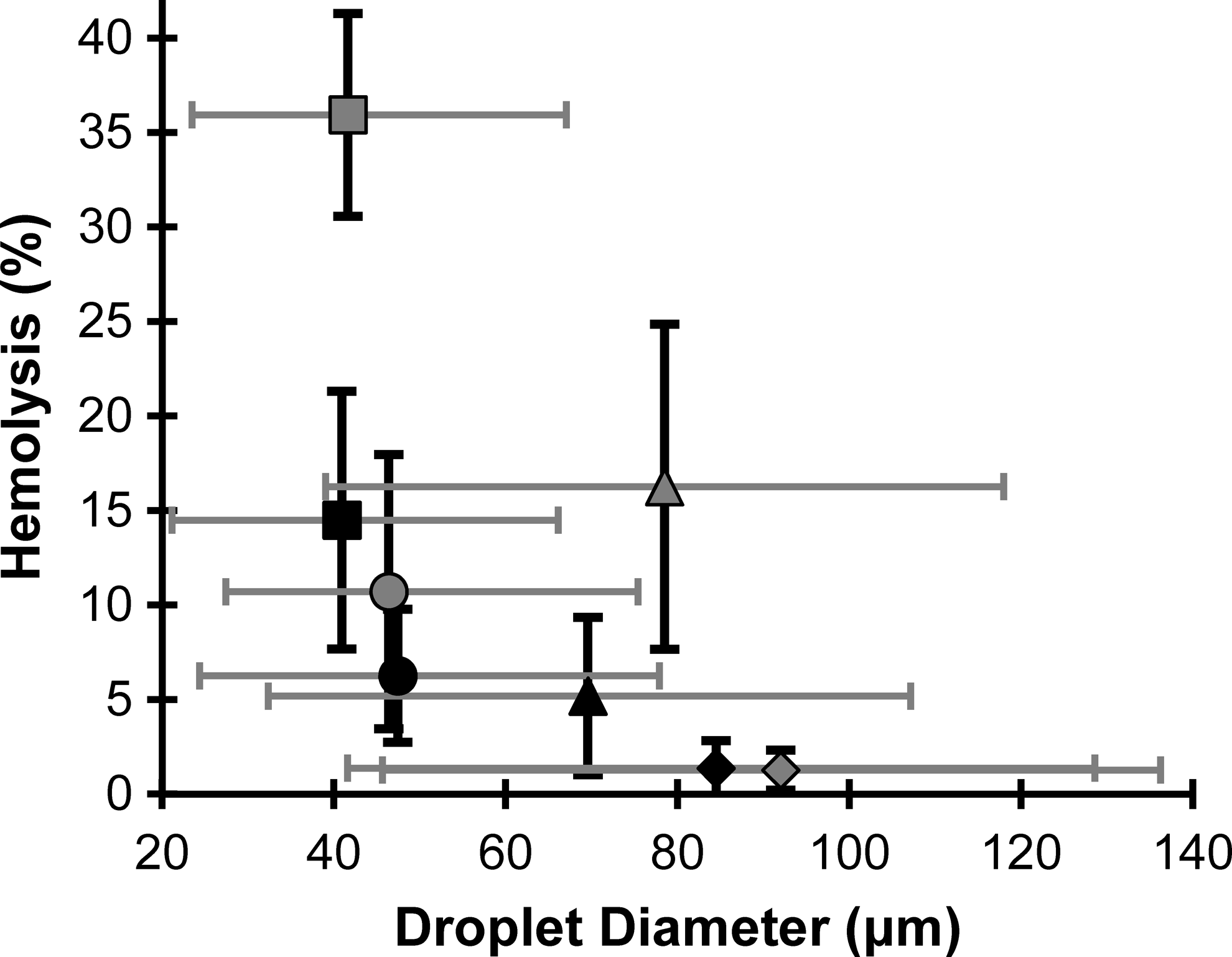
Hemolysis and volume median droplet size after atomization of erythrocyte suspensions with hematocrits of 1% (gray symbols) and 3% (black symbols). Combinations of gas flow rate (in L/min) and liquid flow rate (in mL/min) are represented by squares, circles, triangles, and diamonds for gas/liquid flow rates of 20/1, 20/10, 10/1, and 10/10, respectively. Vertical error bars show the standard deviation from three replicate experiments, each representing a different batch of blood. Horizontal range bars indicate the volume droplet diameters of the 10th and 90th percentile droplets.
Discussion
In this study, we decoupled the atomization process from the drying process by using humidified nitrogen gas in the atomizer nozzle. Our results show that atomization of erythrocyte suspensions is not damaging when appropriate spray conditions are used. One of the advantages of spray drying is that the atomization process creates small droplets with a high surface-area-to-volume ratio. These small droplets can be dried rapidly, in a fraction of a second in many cases.9,10 All of the spray conditions investigated in this study produced droplets that were small enough for rapid drying. Although this preliminary study demonstrates the feasibility of atomizing a suspension of erythrocytes, further research will be necessary to fully optimize the atomization process, including investigation of other nozzle types and a wider range of flow rates and hematocrits.
While atomization is an important part of the spray drying process, it is equally important to retain erythrocyte viability when the droplets are dried. Future studies will need to examine the factors affecting the recovery of dried erythrocytes, including the effects of excipients such as trehalose. 2 In addition, it will be necessary to optimize the conditions within the drying chamber, including the temperature and flow rate of the drying gas. 9
Footnotes
Acknowledgments
We would like to acknowledge Ravi Reddy and Bend Research for assistance with droplet size measurements. We would also like to acknowledge Meehe Kim, Jesus Montiel, John Simeles, Phil Harding, and Ratih Lusianti for their advice and assistance.
Disclosure Statement
No competing financial interests exist.